.png)
.png)

Daniel Saks
Chief Executive Officer


Your prospects are researching solutions right now, but most B2B teams have no idea who those buyers are or what they want. The B2B buyer intent data tools market has grown to $4.49 billion in 2026 — a useful proxy for the broader buyer signal tracking category — and for good reason: industry analyses estimate that a large share (often cited around ~70%) of B2B research happens outside traditional attribution and CRM visibility, making intent data tools essential for identifying in-market accounts. Yet only a minority of teams report exceptional ROI from those investments.
The gap between buying signal data and actual revenue comes down to one problem: most tools tell you who is researching but leave you to figure out what to do about it. When 92% of B2B buyers already have a vendor in mind before they enter a formal evaluation (Forrester Buyers' Journey Survey 2024), speed and execution matter as much as signal detection.
We compared the best tools for buyer signal tracking across signal coverage, data accuracy, execution capabilities, ease of use, and real-world outcomes. Whether you need a full-stack agentic AI platform, standalone buyer intent signal tools, or website visitor identification, this guide breaks down the 10 best buyer signal platforms and B2B signal tracking software options worth evaluating in 2026.
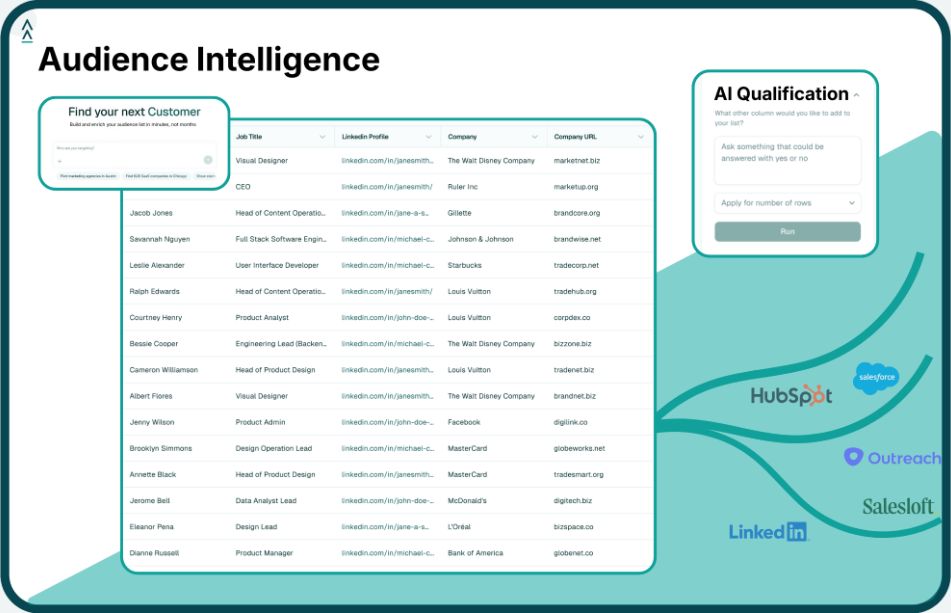
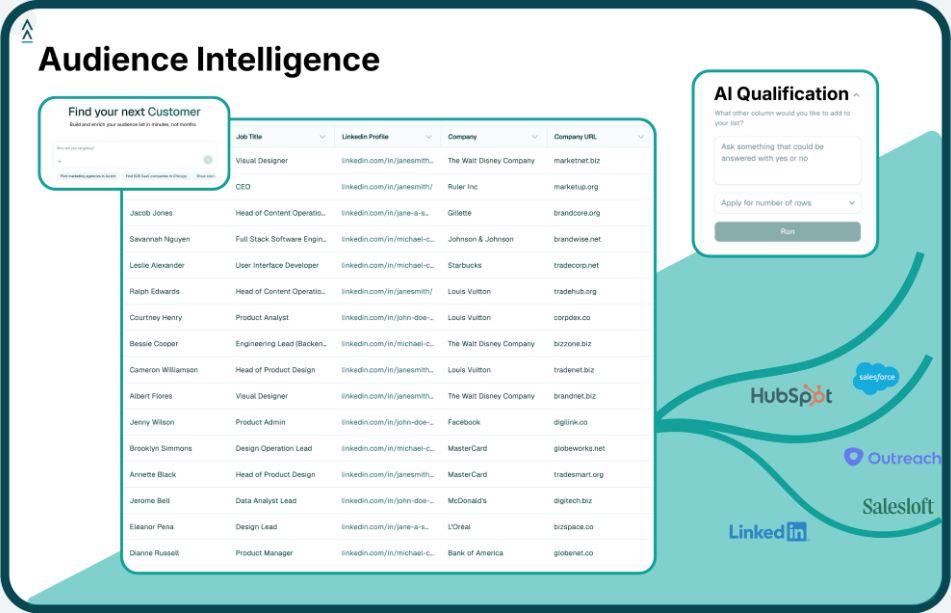
Landbase is the first agentic AI platform purpose-built for go-to-market that unifies buyer signal tracking, contact data, and autonomous outreach execution in a single system. Rather than just alerting you that an account is "surging," Landbase's AI agents detect signals, qualify the prospect, enrich the contact record, and launch personalized multi-channel outreach without manual intervention.
The platform tracks 30,000+ custom signals across intent, firmographic, technographic, hiring, funding, and behavioral categories. Its proprietary GTM-2 Omni model — trained on 50M+ B2B campaigns and 175M+ sales conversations — scores and prioritizes signals with context that generic intent data tools miss. Where most buyer intent signal tools stop at "Company X is researching your category," Landbase tells you which specific people to reach, what message to send, and then executes the outreach autonomously across email, LinkedIn, and phone.
What sets Landbase apart from other buyer signal platforms is the elimination of the signal-to-action gap. B2B teams using standalone signal tools often see intent signals decay within 7–14 days, and by the time a rep manually processes the data, the buying window has closed. Landbase's agentic AI architecture compresses that cycle by automatically routing signal-qualified leads into personalized sequences within minutes of detection. For teams evaluating how signals differ from raw intent data, Landbase's breakdown of signals vs. intent data clarifies why signal-qualified outreach consistently outperforms campaigns built on intent scores alone.
Best for: B2B sales and marketing teams that want to detect buyer signals and act on them automatically with AI agents, eliminating manual workflows between signal detection and pipeline generation.
Bombora operates the largest B2B intent data co-operative network, aggregating content consumption signals from over 5,000 premium B2B publisher websites. Its Company Surge methodology identifies accounts consuming content on specific topics at rates above their historical baseline, generating account-level intent scores that feed into existing sales and marketing tech stacks.
The platform tracks 14,000+ intent topics and provides Curated Ecosystem Audiences — pre-built segments organized by technology ecosystem. Bombora's data is designed to be a standalone signal layer that integrates with CRMs, marketing automation platforms, and ABM tools rather than a full-stack execution platform. Recent partnerships include Proximic by Comscore for predictive B2B audiences and availability on Reddit's ad platform for targeting.
Pricing: Starts at $30,000+/year for data access.
Best for: Enterprise marketing and ABM teams that need the largest third-party intent data co-op as a standalone signal source to feed into an existing tech stack.
6sense is an AI-powered ABM platform that combines predictive analytics with multi-source intent data to identify in-market accounts and predict their buying stage. The platform uses AI to score accounts and classify them across buying stages from awareness through decision, giving revenue teams visibility into which accounts are most likely to convert.
The platform aggregates first-party and third-party intent signals. Its RevvyAI AI-powered GTM command center, announced November 12, 2025, provides a unified dashboard for monitoring account engagement. 6sense also introduced AI Email Agents in August 2025 for personalized pipeline creation. Implementation typically requires dedicated RevOps resources, and most teams pay $25,000–$60,000/year with annual contracts.
Pricing: Range $15,000–$100,000+ depending on tier and modules. Implementation fees $5,000–$50,000 additional.
Best for: Enterprise companies running full-funnel ABM programs with dedicated RevOps teams and $50K+ annual budgets.
ZoomInfo combines one of the largest B2B contact databases with built-in intent signal tracking capabilities. The platform offers hundreds of millions of contact profiles enriched with firmographic, technographic, and intent data, tracking 12,000+ intent topics from 5,000+ B2B sites and capturing 58M intent signals weekly. Its Copilot Workspace, launched October 6, 2025, provides an AI-powered interface for querying intent signals using natural language.
ZoomInfo's WebSights feature uses IP-based tracking to identify anonymous website visitors at the company level. The platform also includes built-in sales engagement tools for email, phone, and social outreach, making it a combined data and execution platform. As a public company (NASDAQ: GTM), ZoomInfo has made 9 acquisitions including Comparably and Chorus.ai.
Key features:
Pricing: Professional plan starts at $14,995/year; most teams pay $25,000–$60,000/year. 3-seat minimum with annual contracts.
Best for: Mid-market to enterprise sales teams that need a large B2B contact database combined with intent signals and built-in engagement tools in one platform.
Demandbase One is an enterprise ABM platform that blends first-party website engagement data with third-party intent signals to score and prioritize target accounts. Its Pipeline Predict AI model estimates conversion likelihood based on signal patterns, and the platform orchestrates multi-channel campaigns across advertising, email, and web personalization.
Demandbase launched Agentbase on March 4, 2025 — a system of connected AI agents designed to automate account intelligence workflows. The platform has been named a Gartner Magic Quadrant Leader for five consecutive years and led 38 G2 Winter 2025 category reports. A recent partnership with NetLine Corporation (announced March 31, 2026) expands its first-party content engagement signal coverage.
Pricing: Minimum $18,000/year; median $65,000/year. Enterprise deals exceed $100,000.
Best for: Enterprise companies with $50K+ ABM budgets running multi-channel account-based programs with dedicated ABM teams and long sales cycles.
Common Room aggregates buyer signals from community platforms, product usage data, and social channels into unified account profiles. The platform monitors activity across Slack, Discord, GitHub, Stack Overflow, and other developer-focused communities, then correlates those signals with website visits, G2 review activity, and CRM data to build multi-source engagement scores.
For product-led growth (PLG) companies, Common Room's ability to track community engagement and product usage signals fills a gap that traditional intent data providers miss entirely. The platform hit $15M in revenue in 2024 and is backed by over $50M in total funding. Its lead scoring system weights signals from multiple sources so teams can prioritize accounts showing genuine engagement rather than passive content consumption.
Pricing: Starts at $1,000/month ($12,000/year minimum on annual billing); Enterprise $5,000–$8,000+/month.
Best for: PLG and community-led companies (especially DevTools, open source, and developer-focused products) that need to track and act on community engagement signals across multiple platforms.
UserGems built its reputation on job change tracking and has expanded into a broader signal intelligence platform covering 21+ contact- and account-level signal types. The platform alerts teams when past customers, champions, or closed-lost contacts change companies, creating warm re-engagement opportunities. Beyond job changes, UserGems now tracks funding announcements, M&A activity, tech stack shifts, and hiring trends.
UserGems provides contact-level intent data rather than just account-level signals, addressing a key frustration among B2B teams that want to know who specifically is researching, not just which company. The platform includes AI-driven scoring and prioritization to rank signals by conversion likelihood and integrates with Salesforce, HubSpot, Outreach, and Salesloft for execution.
Key features:
Pricing: Core Plan: $2,750/month ($33,000/year); Advanced: $5,750/month ($69,000/year); Elite: $10,000/month ($120,000/year).
Best for: B2B sales teams with established customer bases that want to capitalize on champion relationships when contacts change jobs, combined with broader signal intelligence.
Warmly focuses on real-time website visitor identification and instant engagement. The platform de-anonymizes 65% of visiting companies and 15% of individual visitors, then deploys AI-powered chatbots and automated outreach triggers to engage high-intent visitors while they are still on the site. This real-time approach targets the moment of peak buyer intent rather than working from historical signal data.
The platform earned high marks on G2 for Ease of Setup and Quality of Support, making it one of the fastest buyer signal platforms to deploy. Warmly raised a $6M Series A extension in February 2025 led by RTP Global, bringing total funding to $17M. The company reached 300 customers and $3M ARR and is targeting 3x ARR growth.
Pricing: Free plan (500 de-anonymized visitors/month); paid plans start at $10,000/year (AI Data Agent) and scale to $22,000+/year for full outbound automation.
Best for: SMB to mid-market B2B companies that want to identify and immediately engage anonymous website visitors with AI-powered chatbots and automated outreach.
G2 Buyer Intent provides bottom-of-funnel signals derived from the activity of 100M+ verified software buyers on the G2 review platform. When prospects view your G2 profile, compare you against competitors, visit pricing pages, or explore your category, G2 captures those signals and routes them to your CRM or ABM platform. G2 delivers exclusive, verified signals with high intent precision from its marketplace of 100M+ software buyers.
G2 launched Competitive Pulse, a sales intelligence dashboard that combines CRM data with G2 buyer activity to provide real-time competitive intelligence. In 2026, G2 buyer intent data also became available through Claude via MCP integration, expanding how teams can query and analyze signal data. Native integrations with LinkedIn, Salesforce, Marketo, HubSpot, and Demandbase make it straightforward to route signals into existing workflows.
Pricing: Core: $10,000/year; Review Growth: $18,000/year; Enterprise deals range $17,000–$95,000+ depending on add-ons.
Best for: B2B software companies that want high-precision, bottom-of-funnel intent signals from buyers actively comparing and evaluating solutions on G2.
Cognism combines phone-verified contact data with Bombora-powered intent signals, positioning itself as the go-to B2B signal tracking software for teams running phone-heavy outbound campaigns, particularly in European markets. Its Diamond Data program provides phone-verified mobile numbers with 98% accuracy and 3x higher connect rates compared to standard database numbers, and the platform maintains strong GDPR compliance for selling into EU markets.
Cognism tracks intent signals through its Bombora partnership, offering 12 topics on the standard Elevate tier and access to 14,000+ topics at higher tiers. Beyond intent, the platform monitors job change signals, funding data, M&A activity, and technographic shifts across 12 tracked technologies. Its AI segmentation and Sales Companion AI help teams prioritize signal-qualified contacts for outreach.
Pricing: Grow (Platinum): ~$15,000/year platform + $1,500/user/year; Elevate (Diamond): ~$25,000/year platform + $2,500/user/year.
Best for: B2B sales teams, especially in Europe and the UK, that need GDPR-compliant, phone-verified contact data combined with intent signals for phone-heavy outbound motions.
Not all buyer signals carry equal weight. The best tools for buyer signal tracking organize signals into categories that help teams prioritize response speed and outreach approach.
B2B buying signals fall into five primary categories:
The most effective buyer intent signal tools combine multiple signal categories and weight them using composite scoring models rather than relying on a single data source.
Signal stacking is the practice of layering multiple buyer signals to build a composite intent score. A single signal — such as one blog visit — might mean nothing. But when the same account also downloads a whitepaper, posts a relevant job opening, and receives new funding within the same 14-day window, the stacked signals create a high-confidence indicator of purchase readiness.
Teams using signal stacking typically see 33–41% win rates on proactive opportunities compared to 18–25% for reactive, buyer-led deals. The best B2B signal tracking software platforms automate this stacking process so that reps see a single prioritized score rather than raw data from multiple sources.
The right buyer signal platform depends on what you plan to do with the signals once you have them:
Speed is the most underrated factor when evaluating buyer signal platforms. Chili Piper reports that responding within 5 minutes can make you ~21x more likely to qualify a lead versus waiting 30+ minutes. Some sales research and industry summaries suggest first responders win a disproportionate share of B2B deals. Intent signals decay within 7–14 days, and most teams take days or weeks to manually process signal data.
The most effective approach is to choose a platform that automates the path from signal detection to outreach. Buyer signal platforms with built-in execution capabilities — such as AI-generated messaging and automated sequence enrollment — compress the response window from days to minutes.
Consider signal freshness as a deciding factor. Intent signals decay within 7–14 days, so platforms that automate the path from signal to outreach compress the window where signals are actionable.
The B2B buyer intent data tools market is projected to reach $9.68 billion by 2030, growing at a 16.6% CAGR. That growth reflects a fundamental shift: B2B buyers complete most of their research anonymously before engaging vendors, and teams that detect and act on signals first win disproportionate pipeline. Choosing the best tools for buyer signal tracking is no longer optional for revenue teams that want to compete.
The most significant trend in 2026 is the move from signal detection to signal execution. Buyer intent signal tools that only identify intent leave teams with spreadsheets of surging accounts and no clear path to revenue. Agentic AI platforms that combine buyer signal tracking with autonomous qualification and outreach represent the next generation of this category, closing the gap between knowing a buyer is interested and actually starting a conversation.
Landbase was built for this shift. With 30,000+ custom signals, 300M+ verified contacts, and AI agents that autonomously find, qualify, and engage your ideal customers, it delivers the full pipeline from signal to meeting. Whether you are supplementing an existing tech stack or replacing multiple buyer signal platforms, Landbase gives your team the speed and depth to act on buyer signals before they decay. Book a demo to see how you can act on signals in minutes, not days.
Buyer signals are data points indicating that a company or individual is actively researching, evaluating, or preparing to purchase a product or service. These include content consumption patterns (intent data), website visits, job changes, funding events, technology adoption shifts, G2 profile views, and community engagement. The most actionable signals combine multiple data types to confirm genuine buying intent rather than relying on a single source.
Traditional lead scoring assigns points based on demographic fit (job title, company size, industry) and basic engagement actions (email opens, form fills). Buyer signal tracking monitors external behavioral data, such as what topics a company is researching across the web, who at that company changed jobs, or whether they visited a competitor comparison page on G2. Signal tracking detects intent before a prospect engages directly with your brand, giving you a head start.
Most mature B2B signal programs combine three to five signal sources: third-party intent data, first-party website behavior, job change and relationship signals, technographic shifts, and firmographic triggers like funding or hiring. Tracking too few sources creates blind spots, but tracking too many without a system to prioritize and act on them leads to signal overload. The key is having a platform that fuses multiple signal types and scores them automatically.
Signal decay refers to the declining relevance of an intent signal over time. Research shows that buyer intent signals are most actionable within 7–14 days of detection. By 46+ days, signals are considered expired. Teams that manually process signal data often lose the buying window before a rep can act. Platforms with automated workflows or AI agents that act on signals immediately minimize the impact of decay.
Yes, but options vary widely by budget. Website visitor identification tools like Warmly offer free tiers, and Dealfront provides a free plan for basic IP-based tracking. Mid-range options like Common Room start at $1,000/month. Enterprise platforms like 6sense and Demandbase typically require $35,000–$100,000+ annual commitments. The best approach for smaller teams is to choose a platform that combines signal detection with execution so you are not buying separate tools for data, enrichment, and outreach.
Tool and strategies modern teams need to help their companies grow.