.png)
.png)

Daniel Saks
Chief Executive Officer


AI sales automation platforms can combine prospect data, outreach, follow-up, inbox management, and CRM activity within one environment. B2B Rocket operates in this category through AI BDR agents and related prospecting and sales workflow tools.
The platform combines lead generation, AI-guided outreach, email warm-up and validation, CRM functions, and multichannel outreach across email, LinkedIn, WhatsApp, and phone-related workflows. Its broader feature set also covers campaign management, unified communications, analytics, lead qualification, and meeting scheduling. B2B Rocket therefore spans several parts of the outbound workflow rather than operating solely as a contact database or email sequencer.
B2B Rocket combines capabilities that are often distributed across prospect-data, sales-engagement, and CRM systems.
Lead search supplies company and contact records for prospecting. Enrichment adds information to records, while email validation and warm-up support outbound preparation. The platform's AI BDR functions include lead generation, qualification, personalized outreach, follow-up scheduling, prospect prioritization, multichannel campaign execution, and outreach analytics.
The platform also includes a unified inbox and CRM functions for managing conversations, leads, deals, and appointments.
This structure keeps prospect identification, outreach, response management, and basic pipeline activity within the same sales-automation environment.
AI agents are used to automate parts of sales development.
A campaign can combine a selected audience with messaging instructions, channel settings, and follow-up activity. Automated response functions can continue parts of a prospect conversation before the interaction moves to another stage of the sales process.
Human involvement can still apply to audience decisions, campaign configuration, message review, account management, and sales conversations.
The exact division between automated and human activity depends on how the organization configures its outbound process.
B2B Rocket includes lead-search functionality for identifying companies and contacts based on campaign criteria.
Search criteria can include industry, job function, company characteristics, and other attributes associated with an intended audience. Contact information can then move into outreach workflows within the same platform.
Database coverage is only one part of audience construction. Geographic coverage, role information, company attributes, employment freshness, and contactability all affect whether a record is usable for a particular sales motion.
Teams comparing traditional filters with natural-language targeting may also consider how audience criteria are created, refined, and reused across later workflows.
Enrichment adds information to company or contact records that already exist.
Additional fields can provide job information, company attributes, contact details, and other context used for segmentation or personalization. Existing CRM records and uploaded lists can therefore become inputs to later outreach rather than requiring every campaign to begin with newly sourced prospects.
The quality of data enrichment workflows depends on factors such as record matching, source coverage, field completeness, refresh processes, and verification.
Enrichment and qualification remain separate tasks. Enrichment adds information to a record, while qualification applies business rules to determine whether the record belongs in the intended audience.
Static account characteristics describe whether a company fits basic targeting criteria, while business events can add information about timing.
Funding activity, hiring changes, leadership events, technology changes, and engagement data are examples of signals that may contribute to audience prioritization.
A structured buying signal workflow can keep account fit and recent activity as separate components of audience definition.
The relevance of any individual signal depends on the product, market, and sales motion involved.
Email remains a central part of B2B Rocket's outbound environment.
The platform supports campaign creation, automated sequences, follow-up, personalization, email validation, mailbox functions, and performance reporting. Email warm-up is also included as part of its outbound infrastructure.
Mailbox configuration remains separate from message generation. Sending volume, domain reputation, bounce rates, account health, and provider rules can all affect how an outbound program operates.
Generated messaging also depends on the audience data and instructions supplied during campaign configuration.
B2B Rocket extends outreach beyond email.
Current software profiles describe workflows involving LinkedIn, WhatsApp, SMS, and phone alongside email activity. This allows different channels to participate in the same broader prospecting process.
Each channel has separate operating requirements, including account connections, message formats, sending restrictions, and follow-up logic.
Multichannel support therefore involves both campaign strategy and technical configuration rather than simply adding more communication options.
B2B Rocket includes a unified inbox for handling responses generated by outbound campaigns.
Its CRM functions can track leads, deals, appointments, and related sales activity within the same environment. This can reduce the need to move every prospect interaction between separate applications.
Organizations that already maintain another CRM still need to consider how records and activities move between systems.
Field mapping, account ownership, duplicate handling, lifecycle stages, and synchronization behavior can all affect how outbound activity fits into an existing revenue process.
B2B Rocket supports connections with external sales and automation systems.
Current software profiles reference Salesforce, HubSpot, Zoho, Pipedrive, Zapier, and other integrations. The usefulness of an integration depends on the specific records, fields, triggers, and actions required by the organization.
A basic integration may only need to transfer newly generated leads. A more developed RevOps workflow can involve account ownership, custom fields, historical activity, lifecycle stages, opportunity information, and rules that prevent duplicate outreach.
Integration depth therefore matters separately from whether a platform lists a particular CRM.
Technical GTM teams may also require access outside a web application.
APIs and automation connectors can allow data and campaign events to interact with external systems. Other workflows may require a dedicated command-line interface for scripts, batch operations, AI coding environments, or multi-step processes.
The appropriate access model depends on how much of the GTM process is operated manually and how much is incorporated into internal technical infrastructure.
Authentication, schemas, output formats, permissions, and supported operations become relevant when a platform participates in custom workflows.
As of September 15, 2026, B2B Rocket has a 4.8 out of 5 rating across 297 G2 reviews. The current review page displays 268 five-star reviews, 26 four-star reviews, and three one-star reviews.
Recent reviewers discuss bringing lead generation, enrichment, outreach automation, and AI functions into one platform. Other reviewers mention ease of use, campaign organization, and having multiple prospecting functions available within the same environment.
The lower-rated reviews add a different set of experiences. One April 2026 reviewer reported limitations with a Zapier-based CRM workflow, campaign execution, and account administration. Another April 2026 reviewer described recurring LinkedIn disconnections, issues with lead credits, platform reliability, campaign setup, and support.
These reports describe individual deployments rather than expected outcomes for every customer.
B2B Rocket currently has a 4.8 out of 5 rating across 308 Capterra reviews. The rating distribution includes five-, four-, three-, two-, and one-star feedback.
Reviewers frequently discuss outreach automation, customer support, ease of use, campaign organization, lead generation, and meeting workflows.
Other reviews identify issues with email validation, advanced-feature configuration, high-volume data imports, reporting flexibility, performance during larger workloads, and occasional outdated or inaccurate contact records.
One January 2026 reviewer reported that high-volume imports could slow performance and that some reporting options were less flexible for complex workflows. Another reviewer noted that occasional inaccurate contact information still required manual verification.
Product Hunt currently shows a 4.8 out of 5 rating across 69 community reviews.
Several reviewers describe ease of use, AI-assisted outreach, lead targeting, productivity, and customer support.
Other individual experiences differ substantially. One reviewer reported running 12 campaigns across seven companies and sending thousands of emails with very few responses, while still describing support as responsive. Another reviewer said expectations established during the sales process did not match the later campaign experience and reported receiving no meetings.
The variation across review platforms reinforces the importance of separating aggregate ratings from the operational details described by individual customers.
Sales automation still depends on the data entering the workflow.
Contact records change as employees move companies, change roles, update contact details, or leave positions. Company attributes also change over time as organizations grow, restructure, adopt technology, or enter new markets.
Data coverage should therefore be considered alongside freshness, verification, field completeness, and match quality.
Manual checking may still be necessary when a record is incomplete, ambiguous, or especially important to a campaign.
A prospect can have complete contact data without matching the organization's ICP.
Qualification applies business criteria after relevant information has been collected. Those criteria can include company size, industry, geography, role, technology usage, business model, and selected signals.
Keeping qualification separate from enrichment makes it clearer why a particular company or contact was included in an audience.
It also allows the same enriched dataset to be evaluated against different qualification requirements for different sales motions.
Landbase provides web and command-line access to the same underlying platform.
Its web and CLI interfaces share the same data, agent, account, lists, and datasets. A list created through the CLI can appear in the web application, while work developed visually can later move into repeatable programmatic workflows.
The web application supports visual search, filtering, dataset review, and agent interaction. The CLI supports repeatable commands, batch work, scripts, and connected technical processes.
This allows different workflows to operate against shared GTM data rather than requiring separate datasets for different interfaces.
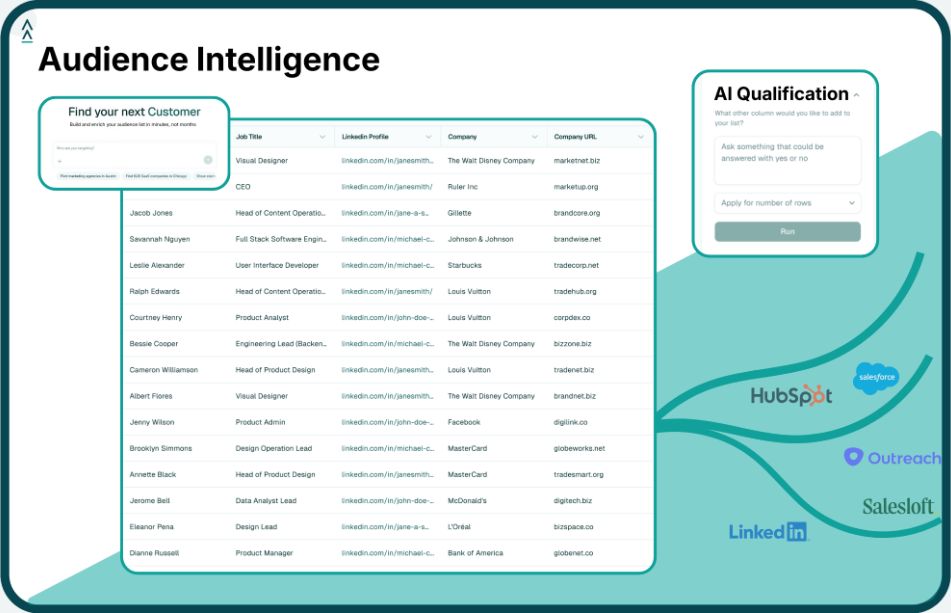
Landbase supports audience creation from plain-language requirements.
A user can describe the companies or contacts required and return structured results. More specific requirements involving precise logic, calculations, ratios, aggregations, or custom output fields can use the Advanced Dataset Creator.
The resulting audiences remain datasets that can be refined, enriched, qualified, or used in later operations.
This separates the definition of an audience from any single campaign that may eventually use it.
Landbase can also begin with company and contact records that already exist.
The match and enrich records workflow connects supplied records with Landbase data before adding selected fields. It can be applied to individual records or uploaded datasets such as spreadsheets and CRM exports.
Matching identifies the corresponding company or person. Enrichment then adds the required fields to the resulting dataset.
This allows existing first-party data and newly created audiences to participate in the same GTM data process.
Landbase supports applying explicit business criteria after records have been identified or enriched.
Its AI qualification workflow can use natural-language requirements involving firmographic, technographic, and intent information.
Qualification therefore remains distinct from data collection. Records can be enriched first and evaluated against an ICP or another set of business requirements afterward.
This also creates a clearer distinction between what is known about an account and why that account meets a particular targeting rule.
Landbase's current data infrastructure lists coverage of more than 800 million contacts and more than 40 million companies across more than 1,500 fields.
The same page describes contact enrichment using more than 20 data providers with verification for available work emails, direct dials, and mobile numbers.
These records can support audience creation, research, enrichment, qualification, CRM preparation, and other dataset workflows.
The data layer remains accessible through both the web application and CLI.
The CLI installation guide documents terminal use as well as AI-assisted environments including Claude Code and Codex.
This gives GTM engineers, RevOps operators, and AI agents programmatic access to Landbase data and workflows.
The CLI workflow guide also documents multi-step processes where the agent can search for accounts, add information, interact with connected tools, and pass structured results into subsequent operations.
Read and write permissions can remain separate when workflows interact with external systems.
B2B Rocket is an AI sales automation platform that combines lead search, data enrichment, email workflows, AI BDR functions, automated replies, multichannel outreach, inbox management, CRM functions, and analytics. Current software profiles describe outreach across email, LinkedIn, WhatsApp, SMS, and phone-related workflows.
B2B Rocket currently has a 4.8 out of 5 rating on G2, Capterra, and Product Hunt, although the review counts and rating distributions differ. Reviewers discuss automation, usability, customer support, prospecting, campaign organization, targeting, customization, data accuracy, integrations, platform reliability, and results from individual campaigns.
Yes. Current software profiles reference integrations with systems including Salesforce, HubSpot, Zoho, Pipedrive, and Zapier. The available synchronization behavior, fields, and workflow depth depend on the specific connection and configuration.
B2B Rocket centers its product on lead generation and outbound sales automation. Landbase provides GTM data and workflow access through web and CLI interfaces, with documented capabilities covering natural-language audience creation, matching, enrichment, qualification, buying signals, dataset management, CRM-related workflows, and terminal use with Claude Code and Codex.
Relevant areas include contact-data coverage, freshness, audience criteria, enrichment, qualification, personalization controls, mailbox management, multichannel support, CRM synchronization, reporting, approval processes, integration depth, and the level of programmatic access required by the organization.
Tool and strategies modern teams need to help their companies grow.