.png)
.png)

Daniel Saks
Chief Executive Officer


Most MedTech companies recognize that lead generation in healthcare operates under entirely different rules than standard B2B markets. With sales cycles averaging 12-24 months and purchase decisions involving 6-10 stakeholders, consistent pipeline development requires specialized strategies that account for regulatory complexity, extended nurturing workflows, and heightened trust barriers.
The challenge differs dramatically between established MedTech companies managing complex enterprise sales and startups needing to prove product-market fit while navigating strict compliance requirements. Success demands moving beyond simple contact collection toward strategic audience building based on real-time buying signals, clinical validation needs, and multi-stakeholder engagement patterns.
Today's most effective B2B lead generation for MedTech leverages AI-powered qualification and strategic targeting rather than volume-based approaches. AI-powered audience discovery platforms are transforming how companies identify prospects who are not just demographically aligned with their ideal customer profile, but actively showing buying intent through hiring signals, funding events, and technology stack changes specific to healthcare organizations.
The science behind successful MedTech lead generation has evolved significantly. Companies implementing thought leadership strategies with clinical evidence tend to see higher engagement compared to traditional product-focused messaging. For MedTech companies navigating highly regulated markets with skeptical buyers, understanding these modern frameworks can mean the difference between predictable revenue growth and constant pipeline uncertainty.
B2B lead generation for MedTech companies operates within a unique framework defined by strict regulatory requirements, extended sales cycles, and multiple stakeholder involvement. Unlike standard B2B markets, healthcare organizations approach vendors with justified skepticism because poor technology decisions directly impact patient care and carry significant compliance risks.
The modern MedTech buyer's journey involves complex evaluation processes with decision committees routinely including clinical staff (CMO, CNO), IT leadership (CIO, CMIO), procurement officers, CFOs, and compliance officers—each with different evaluation criteria and veto power. Many healthcare organizations experience buying cycles extending well beyond a year, making patience and persistence essential qualities for successful lead generation.
Healthcare professionals demand peer-reviewed studies, extensive reference calls, and detailed security audits before committing to new solutions. This creates a fundamental difference from standard B2B markets where feature demonstrations and ROI calculations often suffice.
The solution lies in quality over quantity—focusing on precise targeting and thorough qualification rather than volume metrics. Because healthcare leads are typically more expensive to acquire than general B2B leads, precision targeting plays a critical role in maximizing return on investment. Companies must build compliance-first strategies that establish credibility through thought leadership and clinical validation rather than traditional sales messaging.
Creating an effective Ideal Customer Profile (ICP) for MedTech requires going beyond basic firmographic data to understand the complex buying dynamics of healthcare organizations. Your ICP must account for multiple stakeholder personas, regulatory constraints, clinical workflows, and technology infrastructure requirements that vary significantly across healthcare settings.
Unlike standard B2B markets where a single decision-maker might control purchasing, MedTech ICPs must map the entire decision committee and understand how each role evaluates solutions. Clinical staff focus on patient outcomes and workflow integration, IT leadership prioritizes security and interoperability, procurement officers evaluate total cost of ownership, and compliance officers ensure regulatory adherence.
The Landbase Platform uses GTM-2 Omni to perform ICP recognition and evaluates audience fit and timing using 1,500+ signals, making it particularly valuable for MedTech companies needing to identify organizations with specific clinical, technical, and regulatory characteristics.
Successful MedTech ICP development requires deep domain expertise and ongoing refinement based on actual conversion data. Companies should track which account characteristics correlate with successful implementations and use this intelligence to continuously improve targeting precision.
The traditional approach of purchasing healthcare contact databases or running broad campaigns has given way to sophisticated, AI-powered platforms that combine vast data sets with intelligent qualification specific to medical device sales. Modern lead generation tools must integrate multiple healthcare-specific data sources, including firmographic, technographic, intent, and behavioral signals, to identify prospects with genuine purchase intent.
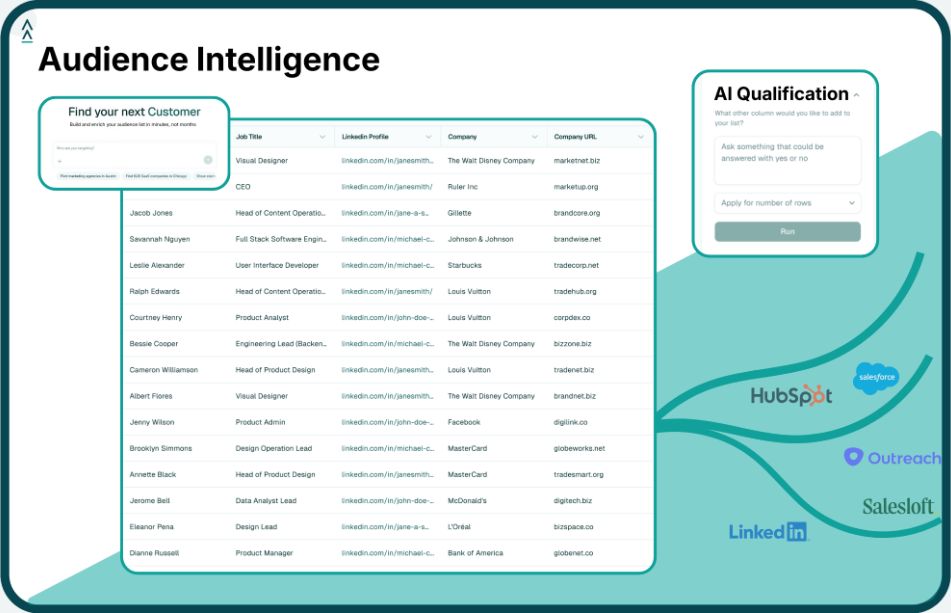
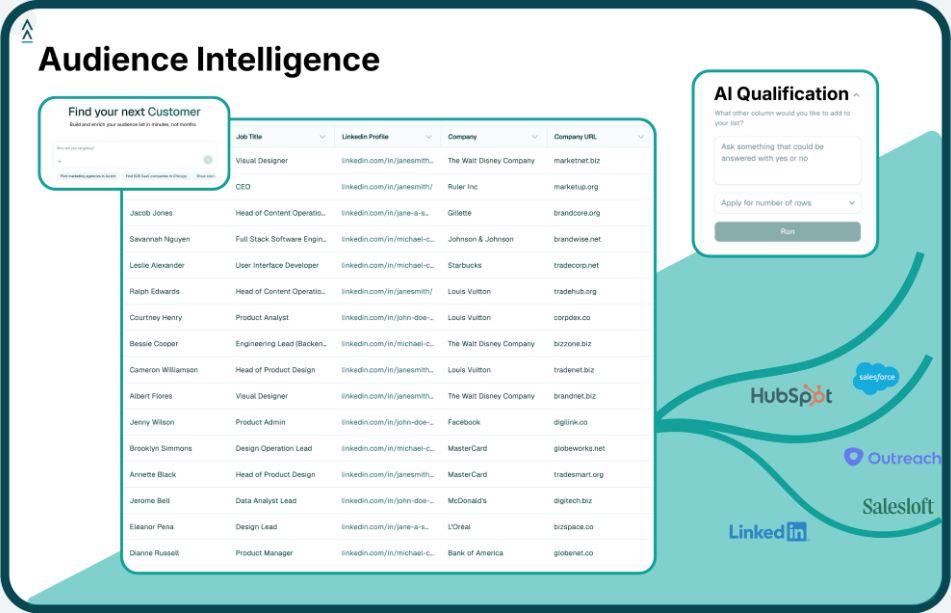
AI-powered audience discovery addresses the unique challenges of medical device sales by enabling precise targeting based on real-time buying signals. Instead of relying on static demographic data, these systems can interpret natural-language prompts like "Medical Directors at hospital systems with 500+ beds actively hiring IT compliance staff" and instantly generate AI-qualified prospect lists ready for outreach.
Natural language targeting eliminates the technical barriers and time investment required for traditional filter-based audience building in specialized healthcare markets. Instead of spending hours constructing complex Boolean queries or navigating multiple filter menus, users can simply describe their target audience in plain English and instantly receive AI-qualified results.
This approach is particularly valuable for medical device companies that need to target specific clinical specialties, procedure volumes, or healthcare settings. For example, targeting "Cardiology Department Heads at teaching hospitals performing 1,000+ cardiac procedures annually" becomes as simple as typing the description rather than building complex filter combinations.
Real-time data enrichment ensures that MedTech targeting remains current and relevant despite the dynamic nature of healthcare organizations. Hospitals regularly change leadership, expand services, upgrade technology infrastructure, and adjust budgets based on regulatory changes and market conditions.
Landbase offers real-time data enrichment with continuous updates across its 300M+ contact database, ensuring that exported contacts reflect current organizational structures and buying capacity. This real-time intelligence is critical for medical device sales where timing can be as important as fit—identifying organizations actively investing in new equipment or expanding clinical services creates immediate buying opportunities.
Healthcare startups and biotech companies face unique qualification challenges due to their innovative nature and the conservative buying behavior of healthcare organizations. These companies often introduce category-creating solutions that require extensive education and validation before prospects even recognize they have a problem worth solving.
Lead qualification for healthcare startups must focus on identifying early adopters—organizations with innovation budgets, progressive leadership, and willingness to pilot new technologies. Biotech companies similarly need to identify research institutions, specialized clinics, and healthcare systems with specific disease state focus and clinical trial capabilities.
High-intent signals in healthcare differ significantly from standard B2B markets. While general B2B intent might include website visits or content downloads, healthcare intent signals are more nuanced and often involve organizational changes that indicate readiness for new solutions.
Critical healthcare intent signals include:
The Landbase Platform provides real-time intent tracking and automated market event monitoring to identify these high-intent prospects for healthcare startups and biotech companies, ensuring outreach is perfectly timed to organizational readiness.
Nurturing qualified leads in healthcare requires sophisticated multi-channel workflows that maintain engagement over extended periods without appearing pushy. Healthcare professionals are notoriously busy and receive constant vendor outreach, so nurturing must provide genuine value through educational content, clinical insights, and peer validation.
Effective nurturing strategies include:
The nurturing timeline must accommodate healthcare's extended sales cycles, with content strategically mapped to different stages of the evaluation process and different stakeholder personas within the decision committee.
Building an effective sales funnel for MedTech requires accommodating the extended 12-24 month buying cycle and multiple stakeholder involvement that characterizes healthcare purchasing decisions. Unlike standard B2B funnels that might compress the journey into several months, MedTech funnels must maintain consistent engagement across year-long evaluation periods while addressing the diverse needs of clinical, technical, financial, and compliance stakeholders.
The MedTech sales funnel typically includes extended awareness and consideration phases where prospects consume educational content, evaluate clinical evidence, and consult with peers before entering the decision phase. This requires content strategies that provide value at each stage without appearing sales-focused too early in the process.
Content mapping for MedTech must prioritize educational value and clinical credibility over promotional messaging. Healthcare professionals respond to peer-reviewed studies, clinical outcome data, and evidence-based content rather than traditional sales messaging.
Conversion rate optimization in MedTech requires understanding that healthcare MQL-to-SQL conversion rates typically range 15-25%, compared to 30-40% in standard B2B. However, qualified healthcare leads convert significantly higher than unqualified leads, making precise qualification more important than volume metrics.
Optimization strategies include:
Effective targeting of MedTech decision-makers requires access to specialized data points and signals that go beyond standard B2B firmographic information. Healthcare organizations have unique characteristics, roles, and buying triggers that demand specialized data sources and filtering capabilities.
The most critical data points for MedTech targeting include healthcare-specific firmographic data (bed counts, patient volumes, specialty focus), technographic data (EMR systems, medical device inventory, IT infrastructure maturity), and behavioral signals (hiring patterns, funding events, conference attendance, research activity).
MedTech decision-making involves a complex web of stakeholders with different evaluation criteria and influence levels. Successful targeting requires identifying not just the economic buyer but also clinical champions, technical evaluators, and compliance gatekeepers.
Key decision-maker roles include:
Landbase offers 300M+ contacts with 1,500+ unique signals and filters, including firmographic, technographic, intent, hiring, and funding signals, to pinpoint these MedTech decision-makers with precision.
In-market signals for MedTech prospects include organizational changes and activities that indicate readiness for new solutions. These signals are often more reliable than demographic targeting alone because they reflect actual buying intent rather than just potential fit.
Critical in-market signals include:
AI-powered platforms can monitor these signals in real-time and alert sales teams to optimal outreach timing, ensuring engagement coincides with actual buying readiness rather than arbitrary sales cycles.
Multi-channel outreach is essential for MedTech sales success, with healthcare lead conversion typically requiring multiple touchpoints over 12-24 months across multiple channels. Single-channel approaches consistently fail in healthcare due to busy decision-makers, complex evaluation processes, and the need for consistent messaging across multiple stakeholders.
Effective multi-channel campaigns for MedTech combine email nurturing, LinkedIn engagement, phone verification, webinars, and content distribution with coordinated messaging that addresses different stakeholder concerns while maintaining consistent positioning across all touchpoints.
Messaging for MedTech professionals must prioritize clinical evidence and educational value over traditional sales pitches. Healthcare professionals respond to peer-reviewed studies, clinical outcome data, and evidence-based content that demonstrates real patient impact rather than feature lists or generic ROI claims.
Effective messaging strategies include:
AI integration enables sophisticated campaign optimization by analyzing response patterns, engagement metrics, and conversion data across multiple channels to identify the most effective messaging, timing, and channel combinations for different stakeholder personas.
Landbase Outbound & Nurture helps identify and qualify prospects, providing targeted audiences for sales teams to build effective multi-channel campaigns with AI-driven insights into optimal outreach strategies and timing.
AI-powered personalization ensures that each stakeholder receives messaging tailored to their specific evaluation criteria while maintaining consistent overall positioning. This multi-threaded approach is essential for navigating the complex 6-10 person decision committees typical in healthcare purchasing.
Measuring ROI in MedTech lead generation requires specialized metrics that account for extended sales cycles, higher lead costs, and complex multi-stakeholder decision processes. Traditional B2B metrics like MQL volume and short-term conversion rates often fail to capture the true value of healthcare lead generation efforts.
As healthcare lead acquisition can be costly, ROI measurement should emphasize lead quality and long-term pipeline value rather than short-term activity metrics.The extended 12-24 month sales cycle requires patience and sophisticated attribution models that track influence across multiple touchpoints and stakeholders.
Continuous optimization requires regular feedback loops between sales and marketing teams, with shared definitions of lead quality and unified metrics that track performance across the entire 12-24 month customer journey.
A/B testing becomes crucial for optimizing messaging, targeting criteria, and outreach channels in the healthcare context. Companies should systematically test different approaches—clinical evidence vs. ROI focus, educational vs. promotional content, multi-channel vs. single-channel—and scale what works while eliminating underperforming tactics based on actual conversion data.
Landbase stands out in the crowded B2B lead generation landscape by combining agentic AI with instant, natural-language audience discovery specifically designed for MedTech companies. The platform addresses the unique challenges faced by both established MedTech organizations and healthcare startups through its frictionless approach to finding qualified prospects while maintaining strict compliance standards.
The core innovation lies in GTM-2 Omni, Landbase's agentic AI model trained on billions of GTM data from 50M+ B2B campaigns. This allows users to simply type plain-English prompts like "CIOs at hospital systems with 500+ beds that recently hired cybersecurity staff" and instantly receive AI-qualified exports of up to 10,000 contacts ready for activation in existing tools.
Established MedTech companies benefit from Landbase's precision targeting capabilities, enabling account-based strategies that focus on high-value healthcare accounts showing real-time buying signals. Healthcare startups appreciate the speed and cost-effectiveness, with founder-led sales teams able to generate a consistent pipeline without building complex in-house systems or navigating lengthy procurement processes for expensive data licenses.
The platform's integration with existing tools like Gmail, Outlook, and LinkedIn ensures seamless workflow adoption, while the continuous learning from user feedback improves AI performance over time. For MedTech companies navigating highly regulated markets with complex buyer journeys and extended sales cycles, Landbase provides the precision, speed, and intelligence needed to find and qualify the right customers at the right time.
AI improves B2B lead generation for MedTech by enabling precise targeting based on real-time buying signals rather than just demographic data. AI-powered platforms interpret natural-language prompts describing complex healthcare criteria and instantly generate qualified prospect lists. These systems analyze 1,500+ unique signals including healthcare hiring patterns, technology infrastructure changes, funding events, and clinical activity to identify organizations showing genuine purchase intent. AI also enables sophisticated multi-channel orchestration that maintains consistent engagement across the 12-20+ touchpoints required for healthcare conversion while personalizing messaging for different stakeholder personas.
The most crucial data points for targeting MedTech prospects include healthcare-specific firmographic data (bed counts, patient volumes, specialty focus, teaching status), clinical role identification (Medical Directors, Department Heads, Chief Medical Officers), technology infrastructure mapping (EMR systems, medical device inventory, IT stack maturity), and real-time behavioral signals (hiring activity in relevant departments, funding announcements, conference attendance, research publications). Unlike standard B2B targeting that focuses on company size and industry, MedTech requires specialized healthcare data that reflects clinical workflows, regulatory requirements, and organizational complexity unique to healthcare settings.
Yes, small MedTech startups can effectively implement advanced AI lead generation without a large team by leveraging platforms that offer free, no-login access and natural-language targeting. These solutions eliminate the technical barriers and time investment required for traditional filter-based audience building, allowing founders to immediately test different targeting hypotheses and generate qualified prospect lists instantly. Since healthcare lead acquisition can be costly, startups benefit from precision targeting that focuses their outreach on genuinely qualified prospects. The key is choosing platforms that provide immediate access without lengthy procurement processes or significant upfront financial commitment.
The typical MedTech sales funnel includes extended awareness and consideration phases that can last 6-18 months before prospects enter the decision phase. The awareness stage focuses on educational content about clinical challenges and industry trends rather than product features, while the consideration stage involves clinical validation through peer references, case studies, and security documentation. The decision stage includes detailed ROI analysis, implementation planning, and stakeholder-specific messaging for the 6-10 person decision committee. Throughout this 12-24 month process, consistent multi-channel nurturing maintains engagement across multiple touchpoints while addressing the diverse evaluation criteria of clinical, technical, financial, and compliance stakeholders.
Landbase differentiates itself through its agentic AI model (GTM-2 Omni) trained on billions of GTM data points from 50M+ B2B campaigns, natural-language targeting that eliminates complex filter building for healthcare-specific criteria, and free no-login access that allows immediate testing of targeting hypotheses. Unlike traditional data providers that offer static contact databases requiring technical expertise to filter effectively, Landbase enables users to describe their ideal MedTech audience in plain English and instantly receive AI-qualified exports. The platform's 1,500+ unique signals include healthcare-specific indicators like clinical roles, technology infrastructure changes, and regulatory compliance markers that are essential for precise MedTech targeting.
Tool and strategies modern teams need to help their companies grow.