.png)
.png)

Daniel Saks
Chief Executive Officer


Most biotech companies understand that lead generation isn't just about collecting contacts—it's about finding scientifically literate prospects who are ready to engage with precision solutions. With sales cycles in healthcare technology averaging 12 months and involving up to nine stakeholders, consistent pipeline development requires a fundamentally different approach than general B2B. The challenge differs dramatically between established biopharma companies with complex regulatory requirements and startups needing to prove scientific validity quickly.
Today's most effective B2B lead generation in biotech leverages advanced data signals, AI-powered qualification, and trigger-based prospecting rather than volume-based approaches. AI-powered audience discovery platforms are transforming how companies identify prospects who are not just demographically aligned with their ideal customer profile, but actively showing buying intent through grant approvals, clinical trial phases, hiring signals, and funding events.
The science behind successful biotech lead generation has evolved significantly. Companies implementing trigger-based prospecting are seeing 15-25% response rates compared to just 1-2% for generic cold outreach. For biotech companies navigating specialized markets with skeptical, data-driven buyers, understanding these modern frameworks can mean the difference between breakthrough engagement and being dismissed as another generic vendor.
B2B lead generation for biotech companies operates within a unique framework defined by scientific rigor, regulatory compliance, and exceptionally long sales cycles. Unlike general B2B sales, biotech buyers—scientists, researchers, medical science liaisons, and procurement specialists—demand evidence-based validation and technical accuracy above all else. They are highly skeptical of marketing claims and respond only to content that demonstrates deep understanding of their specific scientific challenges.
The modern biotech buyer's journey involves multiple stakeholders with different priorities: researchers focus on technical specifications and scientific validity, procurement teams evaluate cost and compliance, while C-suite executives assess strategic fit and ROI. This multi-threaded buying process demands coordinated outreach strategies that address diverse perspectives within target accounts while maintaining scientific credibility throughout.
Over 90% of healthcare and life science buyers actively seek out trusted educational content before engaging with vendors, highlighting the critical role of scientific authority in the biotech sales process. The solution lies in moving beyond simple contact collection toward strategic audience building based on real-time scientific and business signals.
For established biotech companies, the focus should be on precision targeting of high-value accounts showing clear buying intent. Startups, meanwhile, need speed and flexibility to test hypotheses quickly while conserving limited resources. Both require tools that can adapt to their specific go-to-market motions and scale with their growth.
The traditional approach of purchasing generic contact databases or running broad LinkedIn campaigns has given way to sophisticated, AI-powered platforms that combine vast data sets with intelligent qualifications specifically designed for scientific markets. Modern lead generation tools must integrate multiple data sources, including firmographic, technographic, intent, and biotech-specific signals like grant funding, clinical trial phases, and research publications, to identify prospects with genuine purchase intent.
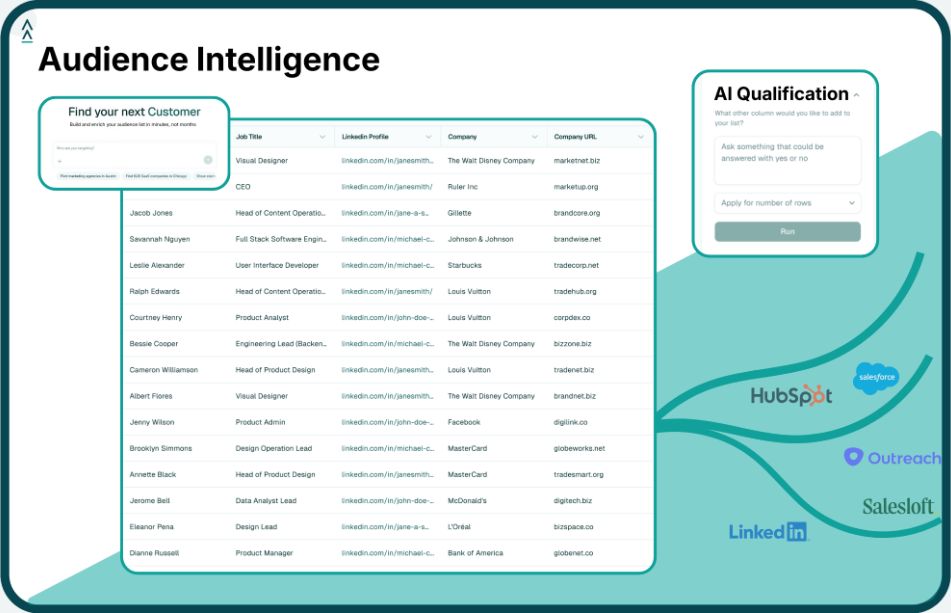
Agentic AI represents the cutting edge of this evolution, moving beyond simple data aggregation to autonomous audience discovery and qualification. These systems can interpret natural-language prompts like "CROs conducting Phase III oncology trials with 500+ patients" and instantly generate AI-qualified prospect lists ready for outreach.
The shift toward AI-driven platforms addresses a critical market need, with many companies preferring specialized expertise over building in-house capabilities. However, the most successful companies maintain control over their targeting strategy while leveraging external platforms for execution efficiency.
Free access to advanced lead generation capabilities has become increasingly important, especially for startups and growth-stage companies. Platforms offering no-login, instant audience generation allow teams to test targeting hypotheses quickly without lengthy procurement processes or significant upfront investment.
Biotech startups operate under different constraints than established companies, with limited resources, urgent need to prove scientific validity, and pressure to generate initial partnerships or revenue quickly. Their lead generation strategies must emphasize speed, cost-effectiveness, and rapid iteration based on real-world feedback.
Founder-led sales often characterize the early stages of biotech startups, where the founding team personally handles outreach and relationship building. This approach allows for deep customer understanding and rapid product iteration based on direct feedback. However, founders need tools that enable efficient prospect identification without consuming excessive time on manual research.
The ability to generate qualified prospect lists instantly using natural-language prompts is particularly valuable for startups. Instead of spending weeks building complex filter combinations or purchasing expensive data licenses, founders can immediately test different targeting hypotheses and adjust based on response rates.
Free lead generation capabilities become crucial for startups operating with minimal budgets. Platforms offering no-login access and instant contact exports enable startups to maintain consistent pipeline development without significant financial commitment.
Rapid experimentation is the hallmark of successful startup lead generation. Teams should test different messaging, targeting criteria, and outreach channels quickly, measuring results and doubling down on what works while abandoning approaches that don't generate engagement.
B2B marketing in biotech differs fundamentally from B2C approaches due to the technical nature of the products, the complexity of the buying process, and the scientific literacy of the buyers. While B2C marketing often appeals to emotions and lifestyle benefits, biotech B2B marketing must focus on rational, evidence-based arguments that demonstrate technical superiority and scientific validity.
Biotech buyers make purchasing decisions based on data, peer-reviewed research, and technical specifications rather than brand messaging or emotional appeals. They require detailed information about mechanisms of action, clinical outcomes, regulatory compliance, and integration capabilities before making purchasing decisions that can impact patient outcomes or research validity.
The emphasis on relationships in biotech B2B is particularly important. As one expert notes, "When you're selling the invisible, you're really selling trust." This trust is built through consistent scientific authority, transparent communication, and demonstrated expertise in specific research areas or therapeutic domains.
Multi-channel outreach becomes essential in biotech B2B, but the channels themselves differ from B2C. Scientific conferences, peer-reviewed publications, specialized industry events, and targeted digital campaigns on platforms like LinkedIn are more effective than mass media or social media advertising.
Creating effective prospect lists in biotech requires a methodical approach that combines scientific understanding with business intelligence. The process begins with defining a precise ideal customer profile (ICP) that includes both scientific criteria (research focus, therapeutic area, technology platform) and business criteria (company size, funding stage, geographic location).
The traditional approach of using basic firmographic filters is insufficient for biotech markets. Effective prospect lists must incorporate real-time signals that indicate actual buying intent, such as recent grant approvals from NIH or other funding bodies, new clinical trial registrations, hiring spikes in relevant departments, or technology platform changes.
The integration of these signals into AI-powered qualification systems enables unprecedented precision in audience targeting. Platforms with access to 1,500+ unique signals can evaluate both scientific fit (does this prospect match our research expertise?) and business timing (are they actively showing buying intent?).
Look-alike modeling further enhances targeting precision by identifying companies that share characteristics with existing successful customers. This approach leverages historical conversion data to find new prospects with similar scientific and business profiles, increasing the likelihood of successful engagement.
AI-qualified audiences become particularly valuable for biotech companies, as they ensure that exported contacts are not just accurate but actively showing purchase intent through real-time signals like grant approvals or clinical trial announcements.
The most effective biotech lead generation strategies leverage multiple channels to engage prospects over extended sales cycles. Campaigns using a mix of channels (LinkedIn, email, phone, content) see up to 287% better results than single-channel efforts. The phone can act as the "catalyst" for conversations, even in a digital-first world, when armed with scientific context and intent data.
Biotech prospects require consistent, multi-touch engagement that builds scientific credibility over time. Generic mass outreach achieves less response rates, while personalized approaches leveraging behavioral and contextual signals see significantly higher response rates. The key is maintaining scientific precision while scaling outreach across multiple channels.
Content serves as the foundation for omni-channel engagement in biotech. Technical whitepapers, case studies, peer-reviewed articles, and scientific webinars establish credibility and provide valuable touchpoints throughout the extended sales cycle. This content must be data-backed, technically accurate, and address specific scientific pain points rather than generic business challenges.
Measurement becomes critical in omni-channel biotech marketing. Companies should track engagement across all touchpoints to understand which channels and content types drive the highest quality conversations and eventual conversions. This data enables continuous optimization of the engagement strategy over time.
Effective biotech lead generation requires clear metrics and continuous optimization based on performance data. The shift from simple contact collection toward trigger-based prospecting demands equally sophisticated measurement approaches that track performance across the entire customer journey.
Key Performance Indicators (KPIs) should align with business objectives and revenue outcomes rather than just activity metrics. While contact volume might indicate marketing activity, conversion rates, customer acquisition cost, and scientific engagement metrics provide more meaningful insights into lead generation effectiveness.
The complexity of modern biotech buyer journeys—with prospects engaging across multiple scientific and business touchpoints before purchase—makes attribution challenging but essential. Multi-touch attribution models that distribute credit across all interactions provide more accurate ROI measurement than last-touch models that only credit the final interaction.
Continuous optimization requires regular feedback loops between sales and marketing teams. Shared definitions of lead quality, unified metrics, and regular performance reviews ensure alignment and enable rapid course correction when strategies underperform.
A/B testing becomes crucial for optimizing messaging, targeting criteria, and outreach channels. Companies should systematically test different scientific angles, trigger types, and content formats and scale what works while eliminating underperforming tactics. This data-driven approach to optimization ensures that lead generation efforts continuously improve over time.
Landbase stands out in the specialized B2B lead generation landscape by combining agentic AI with instant, natural-language audience discovery specifically designed for biotech companies. The platform addresses the unique challenges faced by both established biotech firms and startups through its frictionless approach to finding scientifically qualified prospects.
The core innovation lies in GTM-2 Omni, Landbase's agentic AI model trained on 50M+ B2B campaigns and sales interactions. This allows users to simply type plain-English prompts like "CROs conducting Phase III oncology trials that received NIH funding in the last 6 months" and instantly receive AI-qualified contact exports ready for activation in existing tools.
Established biotech companies benefit from Landbase's precision targeting capabilities, enabling account-based strategies that focus on high-value prospects showing real-time buying signals. Startups appreciate the speed and cost-effectiveness, with founder-led sales teams able to generate consistent pipeline without building complex in-house systems.
The platform's integration with existing tools like Gmail, Outlook, and LinkedIn ensures seamless workflow adoption, while the continuous learning from user feedback improves AI performance over time. For biotech companies navigating specialized markets with skeptical, data-driven buyers, Landbase provides the precision, speed, and scientific intelligence needed to find and qualify the right customers at the right time.
AI-powered platforms like Landbase can help biotech startups identify early-stage research institutions or clinical partners by monitoring real-time signals like NIH grant approvals, clinical trial registrations, and research publications. By using natural-language prompts such as "universities with active CRISPR research grants" or "hospitals conducting Phase I gene therapy trials," startups can instantly generate qualified prospect lists that align with their scientific focus areas. This trigger-based approach ensures outreach is timed with actual research activity rather than generic institutional targeting. The AI qualification process evaluates both scientific fit and business timing to maximize engagement potential.
The most effective channels for biotech lead generation combine digital precision with scientific authority, with multi-channel campaigns that integrate LinkedIn outreach, targeted email with scientific content, strategic phone calls, and scientific conference participation yielding 287% better results than single-channel approaches. Content marketing through technical whitepapers, case studies, and scientific webinars serves as the foundation for building credibility, while digital channels enable precise targeting of specific research areas and therapeutic domains. The phone can act as a catalyst for conversations when armed with scientific context and intent data. Scientific conferences and peer-reviewed publications provide valuable face-to-face opportunities that complement digital engagement.
Measuring ROI in biotech requires tracking metrics beyond simple lead volume, focusing on lead-to-opportunity conversion rates by scientific segment, sales cycle length by prospect type, and scientific engagement rates with technical content. Since biotech sales cycles can extend 6-18 months or longer, implement multi-touch attribution models that track engagement across multiple touchpoints over extended periods rather than last-touch models that only credit final interactions. Track appointment show rates for qualified meetings, as these often exceed 75-85% when prospects are properly qualified, providing immediate ROI validation. Monitor customer acquisition cost (CAC) by channel and campaign to optimize resource allocation continuously.
The most relevant data signals for biotech targeting include grant funding approvals (particularly from NIH and other major funding bodies), clinical trial phases and patient enrollment numbers, hiring spikes in research and development departments, technology platform changes, and research publication activity. These trigger-based signals indicate actual buying intent and scientific activity, making them far more valuable than basic firmographic data. Companies using these signals achieve 15-25% response rates compared to just 1-2% for generic outreach. Platforms with access to 1,500+ unique signals can evaluate both scientific fit and business timing to maximize targeting precision and engagement likelihood.
Yes, Landbase is particularly well-suited for small biotech startups with limited marketing budgets through its free, no-login access with instant audience generation and contact exports ready for immediate activation. This allows founders to test different targeting hypotheses immediately without procurement delays or financial commitment. The natural-language targeting eliminates the need for technical expertise in building complex filter combinations, while the AI qualification ensures that even limited outreach efforts are focused on prospects showing genuine buying intent. Startups can maintain consistent pipeline development and rapidly iterate based on response rates without significant upfront investment.
Landbase maintains SOC II and GDPR compliance across its entire platform, ensuring that contact data is ethically sourced and regularly validated. The platform combines premium data sources with proprietary enrichment while implementing continuous validation processes that monitor and automatically update information across its 300M+ contact database. This compliance framework is particularly important for biotech companies that must adhere to strict regulatory standards when handling contact information from healthcare providers, researchers, and other sensitive roles. The platform's security measures protect data integrity while enabling biotech companies to conduct outreach with confidence in regulatory adherence.
Tool and strategies modern teams need to help their companies grow.