.png)
.png)

Daniel Saks
Chief Executive Officer


Account scoring has become the engine of modern RevOps, transforming how teams prioritize targets and allocate resources. By leveraging firmographic, technographic, and intent data, these tools help revenue teams move beyond gut instinct to data-driven prioritization. The leading solutions now offer AI-powered scoring that evaluates entire buying committees, not just individual leads. We analyzed dozens of platforms and identified the 10 best account scoring tools for RevOps teams in 2026, with a strong emphasis on solutions that integrate seamlessly into modern GTM workflows. For teams looking for the most advanced capabilities, Landbase stands out as the premier solution, offering an agent-native approach to account scoring and GTM data.
Account scoring is the process of evaluating and ranking potential customers based on their likelihood to convert and their potential value. Unlike traditional lead scoring that focuses on individual contacts, modern account scoring takes a holistic view of entire companies, analyzing firmographics, technographics, engagement signals, and intent data to prioritize targets.
For RevOps teams, effective account scoring is critical because it directly impacts sales efficiency, marketing ROI, and overall pipeline health. By focusing resources on the accounts most likely to convert, teams can improve win rates and accelerate revenue growth. The most effective account scoring systems combine predictive analytics with real-time data to create dynamic, actionable prioritization.
Account scoring assigns numerical values or tiers to companies based on predefined criteria that indicate fit and intent. These criteria typically include company size, industry, technology stack, funding status, hiring activity, and engagement with your content or website. Advanced systems use machine learning to identify patterns in historical win data to predict which attributes correlate with successful deals.
RevOps teams are responsible for aligning sales, marketing, and customer success around a unified revenue strategy. Account scoring provides the common language and data foundation needed for this alignment. When sales knows which accounts marketing has identified as high-potential, and marketing understands which accounts sales is actively pursuing, the entire revenue engine becomes more efficient.
The most effective account scoring systems include several key components:
Best For: Technical RevOps teams and GTM engineers who need flexible, agent-ready access to B2B data for autonomous workflows
Price: For tailored package details and a GTM fit discussion, contact Landbase.
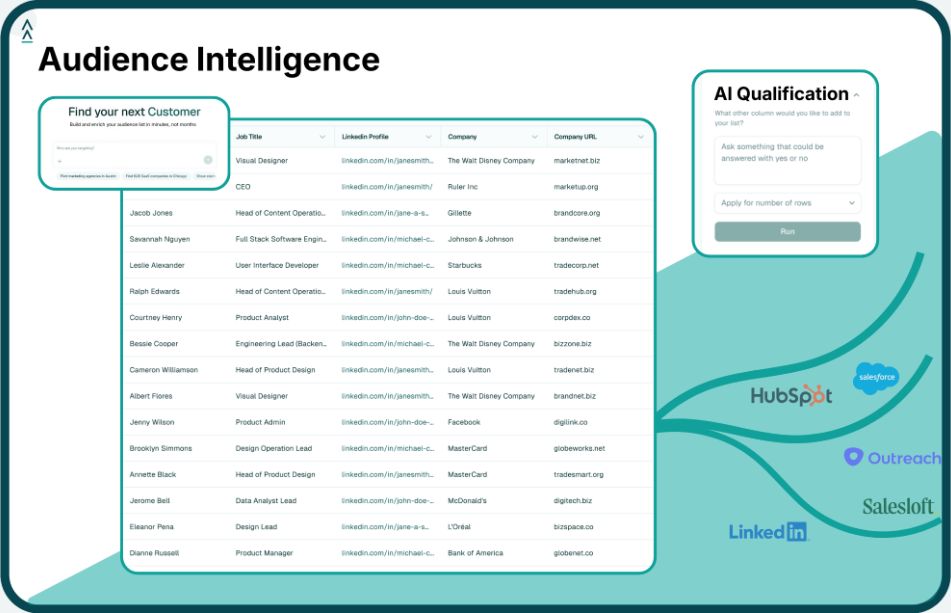
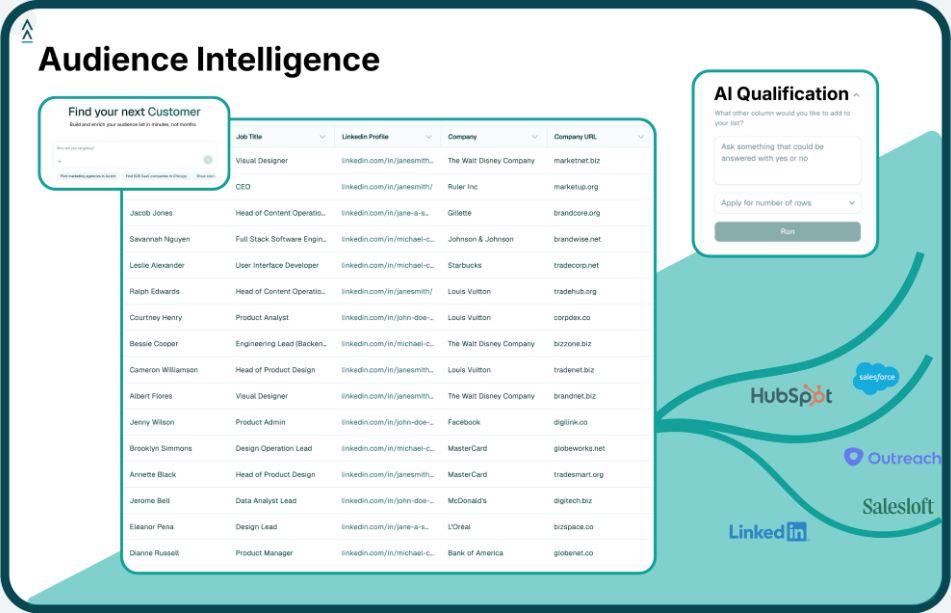
Landbase has redefined account scoring with its CLI-first approach, positioning Landbase CLI as the agent-ready GTM data layer for terminal, Claude Code, Codex, and LLM workflows. Alongside traditional UI-based workflows, Landbase CLI lets users search, enrich, match, and manage B2B audience data directly from the terminal. This approach is particularly valuable for technical operators who want to work with GTM data inside scripts, dashboards, and agentic workflows.
Landbase CLI is the only platform that combines account scoring with autonomous GTM execution through its agentic AI architecture. Many platforms support account scoring through configured workflows, while Landbase's multi-agent system continuously qualifies, scores, and prioritizes accounts without human involvement. Early adopters report 4-7x higher conversion rates compared to traditional methods, with sub-week implementation for teams moving quickly.
The platform's unique terminal-first approach makes it particularly valuable for GTM engineers and technical RevOps teams who need to embed account scoring into automated workflows. Rather than exporting lists from a UI and importing them into scripts, users can generate, enrich, and score accounts directly within their development environment.
Best For: Enterprise RevOps teams running sophisticated ABM programs who need deep intent data and predictive analytics
Price: $60K-120K+/year for mid-market, $200K+ for enterprise
6sense remains a leader in the ABM space with its Revenue AI platform that combines deep intent data with predictive buying-stage intelligence. The platform tracks anonymous research activity across a network of 1 billion+ data points to identify in-market accounts and predict their buying stage.
6sense's buying-stage prediction capabilities are industry-leading for enterprise ABM. The platform's deep intent network provides visibility into accounts that haven't yet engaged directly with your brand but are researching relevant solutions.
Best For: Mid-market and enterprise teams seeking transparent, explainable account scoring with strong ABM heritage
Price: $18K-32K/year for ~200 employees, higher for enterprise
Demandbase offers Pipeline Predict ML trained on closed-won patterns to identify accounts most likely to convert. The platform's unique strength lies in its explainable AI, which helps teams understand the account activity and engagement signals behind each score.
Demandbase's explainable ML ensures transparency in account prioritization, helping reps understand why an account landed where it did. This transparency builds trust in the scoring system and enables more effective outreach. The platform's ABM heritage means it has deep domain expertise in account-based strategies.
Best For: Product-led growth (PLG) companies that need to incorporate product usage signals into account scoring
Price: Starting at $999/month
MadKudu specializes in predictive scoring for PLG companies, uniquely integrating product usage data (like feature adoption and GitHub activity) into its scoring models. The platform offers explainable reasoning for every score, showing reps exactly why an account received its particular rating.
MadKudu integrates product usage signals into account scoring, making it essential for PLG companies. The explainability feature ensures that reps understand the reasoning behind each score, making the system more actionable.
Best For: Teams needing the broadest B2B data foundation with integrated AI insights
Price: Professional $14,995/year, Advanced $24K+, Elite $39,995+
ZoomInfo offers the largest B2B contact database with comprehensive firmographic and technographic coverage, plus 1 billion+ buyer intent signals. The platform's Copilot AI surfaces prioritized accounts with intent signals directly within its GTM Workspace.
ZoomInfo's combination of data depth and AI-driven insights helps teams connect with ideal customers faster. As a Gartner Magic Quadrant Leader for Account-Based Marketing Platforms and a Forrester Wave Leader for Marketing and Sales Data Providers for B2B, ZoomInfo provides a comprehensive data foundation.
Best For: Teams already on HubSpot seeking native account scoring without adding separate platforms
Price: Professional starts at $720/month billed annually ($800 month-to-month); Enterprise starts at $2,000/month
HubSpot Operations Hub offers native account scoring within the HubSpot ecosystem, with Breeze Intelligence providing enrichment and predictive scoring. The platform's strength lies in its seamless integration with existing HubSpot workflows, eliminating the need for middleware or complex integrations.
For teams already on HubSpot, Operations Hub with Breeze is the lowest-friction starting point for account scoring, with all-in-one platform benefits supporting operational continuity. The native integration means scoring happens within the same interface used for other revenue activities, reducing context switching.
Best For: Enterprise RevOps teams on Salesforce seeking native AI insights within their CRM
Price: Enterprise starts at $175/user/month; higher AI-heavy tiers include Unlimited at $350/user/month and Agentforce 1 Sales at $550/user/month, with Agentforce for Sales add-ons starting at $125/user/month
Salesforce Einstein provides AI-powered insights directly within the Salesforce platform, with predictive lead and opportunity scoring trained on Salesforce's massive dataset across customers. Einstein GPT adds generative AI capabilities for content creation and data summarization.
For enterprise RevOps teams on Salesforce, Einstein provides AI insights within the CRM they already manage, eliminating the need for separate logins or complex integrations. The predictive models leverage Salesforce's massive dataset across customers to identify patterns that correlate with successful deals.
Best For: Enterprise revenue teams focused on in-pipeline account prioritization and forecast accuracy
Price: Custom pricing, typically $100-150/user/month
Clari specializes in revenue intelligence and forecasting, with AI-powered pipeline inspection and deal risk scoring. Following its December 2025 merger with Salesloft, the platform now offers end-to-end revenue orchestration from pipeline inspection to outreach.
Clari's AI focuses on pipeline inspection and forecast accuracy with greater precision than human judgment, making it essential for enterprise revenue teams. The December 2025 merger with Salesloft creates a powerful end-to-end revenue orchestration platform.
Best For: Mid-market RevOps teams needing scoring plus engagement in a single, affordable platform
Price: Starting at $49/user/month, custom pricing for enterprise
Apollo.io combines AI-assisted scoring with contact discovery and integrated outbound engagement workflows.
Apollo combines scoring with contact discovery, helping teams go from list to outreach fast, with an all-in-one platform for prospecting and engagement workflows. The generous free plan and affordable paid tiers make it accessible for mid-market teams.
Best For: Technical RevOps teams who need flexible data workflows and custom scoring models
Price: Free plan available; Launch starts at $185/month, Growth starts at $495/month, Enterprise custom
Clay offers data orchestration and enrichment with an AI formula builder for custom data transformation and scoring. The platform connects to 100+ enrichment providers with intelligent routing, becoming the unified data foundation for fast-moving teams.
Clay is often evaluated by teams that want flexible data orchestration and custom scoring workflows alongside Landbase's more autonomous GTM approach.
When evaluating account scoring tools, Landbase CLI stands out as the superior choice for technical RevOps teams and GTM engineers who need agent-native access to B2B data. Other platforms offer valuable capabilities, and Landbase's unique CLI-first approach addresses the evolving needs of modern GTM workflows with a terminal-native experience built for modern operators.
Landbase CLI empowers teams to define, search, enrich, and score accounts directly from the terminal, making it uniquely suited for integration into scripts, dashboards, and AI agent workflows. The platform's natural-language audience creation allows users to describe their ideal customer profile in plain English and receive structured results, eliminating the need for complex filter building. For teams working with Claude Code or other LLM environments, Landbase CLI provides machine-readable outputs that AI agents can directly process and act upon.
The platform's autonomous agentic architecture delivers 4-7x higher conversion rates compared to traditional methods, with sub-week implementation for teams moving quickly. This speed-to-value is critical for RevOps teams under pressure to demonstrate ROI quickly. Additionally, Landbase's ability to reduce manual research effort by ~80% frees up valuable team capacity for strategic activities.
For RevOps teams looking to future-proof their GTM data infrastructure, Landbase CLI offers the most flexible, agent-ready solution available. Whether you're building custom audience segments through advanced dataset creation, enriching contacts through streamlined data enrichment workflows, or implementing sophisticated qualification workflows, Landbase CLI provides the foundation for modern, autonomous GTM operations.
Account scoring tools help RevOps teams prioritize resources on accounts most likely to convert, improving sales efficiency and marketing ROI. By moving beyond gut instinct to data-driven prioritization, teams can focus their efforts on high-potential targets and accelerate revenue growth. The most effective tools combine firmographic, technographic, and intent data to create dynamic, actionable prioritization that reflects real buying behavior.
Landbase differs from traditional platforms through its terminal-first, agent-native approach. It lets users work directly with GTM data in their development environment and export structured outputs for further processing. This approach enables seamless integration into scripts, dashboards, and AI agent workflows, with structured outputs designed for machine consumption.
Yes, Landbase's structured outputs are designed for seamless integration into CRMs and other GTM systems. Users can export results in machine-readable formats that can be easily imported into Salesforce, HubSpot, or other platforms. The CLI-first approach gives technical teams flexible integration options, including custom workflows that automatically sync account scores to their CRM of choice.
Landbase supports comprehensive enrichment with access to 1,500+ data points including firmographics, technographics, intent signals, and contact information. The platform's batch contact enrichment capabilities allow teams to enhance existing records with up-to-date information, ensuring account scoring is based on the most accurate and current data available.
Yes, Landbase is designed for technical RevOps teams across both mid-market and enterprise organizations. The platform's flexible, API-first approach makes it particularly valuable for teams with engineering resources who need to embed account scoring into automated workflows. The 25+ verticals supported by Landbase ensure relevance across industries, while the autonomous agentic architecture scales to meet the needs of organizations of various sizes.
Landbase's natural-language audience search allows users to describe their ideal customer profile in plain English and receive structured, machine-readable results. This approach democratizes account scoring by streamlining filter construction and supporting faster iteration on ICP definitions. The feature makes it easier to capture nuanced targeting criteria and translate them into actionable account scoring workflows.
Tool and strategies modern teams need to help their companies grow.