.png)
.png)

Daniel Saks
Chief Executive Officer


ABM has been the dominant B2B marketing strategy for a decade. The problem is that ABM, as sold by enterprise vendors, costs $150K-$300K per year in platform fees alone. Add display ads, intent data, and a dedicated ABM manager, and you are looking at a $500K+ annual commitment before you send a single email.
That works for companies with $50M+ in revenue and 20-person marketing teams. It does not work for the Series B SaaS company with 150 employees and a marketing team of four.
But the core principle behind ABM (focus your resources on accounts most likely to buy and retain) is just as valid for mid-market teams. The execution looks different. Here is how to do it without the enterprise price tag.
Before building the mid-market version, it helps to understand what enterprise ABM programs actually do well:
Every one of these capabilities can be replicated at lower cost. All four capabilities can be built with data, a plan, and disciplined execution at a fraction of enterprise platform costs.
Enterprise teams spend weeks hand-selecting target accounts. Mid-market teams should automate this step. Define your ICP criteria (industry, size, funding stage, technology stack, buying signals) and let a platform qualify your TAM against those criteria.
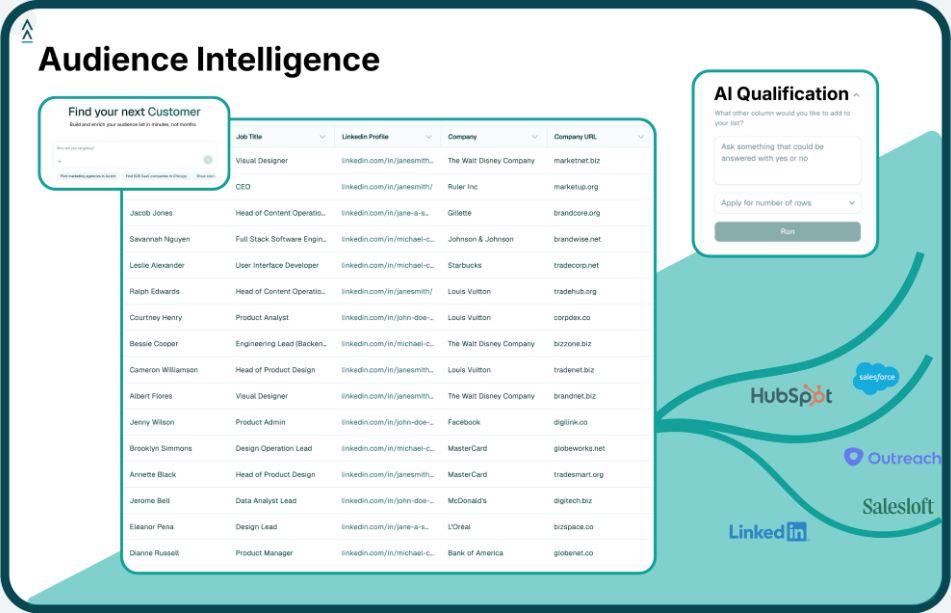
Landbase lets you describe your ICP in plain language and returns a qualified account list ranked by fit. Instead of a marketing manager spending 40 hours building a list in a spreadsheet, you get a data-driven target list in hours. Start with 50-100 accounts. You can always expand once the motion is working.
For each account on your list, you need: company overview, recent news, hiring activity, funding history, technology stack, key decision-makers with verified contact information, and any active buying signals.
This is where enterprise ABM platforms charge $200K. Landbase delivers the same enrichment (1,500+ data fields per account) as part of the targeting and qualification workflow. The data arrives with the list as part of the workflow.
Not every target account gets the same level of effort. Segment your 50-100 accounts into three tiers:
Enterprise ABM runs display ads and direct mail. Mid-market ABM runs email and LinkedIn. The channels are different but the principle is the same: multiple touches across multiple channels against the same accounts.
For each tier, build a coordinated sequence: email from the AE, LinkedIn connection request from the AE, follow-up email with relevant content, LinkedIn comment on the prospect's post, and a phone call. Five touches across two channels over two weeks is a reasonable starting cadence.
Track engagement per account. As Forrester's ABM playbook emphasizes, the metric that matters is: how many of my target accounts have engaged with us this month? Engaged means replied to an email, accepted a LinkedIn connection, booked a meeting, or visited the website.
A 15-20% account engagement rate in the first month is a strong signal that your targeting is working. Below 10% means your list or messaging needs adjustment.
Here is a realistic mid-market ABM budget:
At $3K per month, you need one closed deal per quarter to make ABM profitable at most B2B deal sizes. That is a much lower bar than the enterprise ABM math, which often requires 6-12 months to break even.
Start with 50-100 accounts. This is enough to generate meaningful pipeline but small enough that your team can execute with quality. Expand to 200-500 accounts once you have proven the motion works and can measure ROI per account tier.
Intent data helps but is not required. Buying signals (hiring, funding, technology changes) are often more actionable than third-party intent data for mid-market teams. Intent data from providers like Bombora adds a layer of insight, but it is not the starting point.
Expect 60-90 days for the first meetings from Tier 1 accounts. Pipeline from ABM tends to be higher quality but slower to develop than high-volume outbound. If you are not seeing engagement within 30 days, your list targeting or messaging needs adjustment.
Both. Marketing owns account selection, content, and measurement. Sales owns outreach execution and relationship building. RevOps owns the data infrastructure and reporting. ABM fails when it is siloed in one team. The whole point is coordinated effort across functions.

Tool and strategies modern teams need to help their companies grow.






