.png)
.png)

Daniel Saks
Chief Executive Officer


Choosing between established sales intelligence platforms and modern AI-driven alternatives can determine your revenue team's efficiency and growth trajectory. While ZoomInfo is known for comprehensive B2B data, 6sense focuses on account-based marketing with advanced intent signals, and Demandbase supports full-funnel ABM campaigns, Landbase delivers an AI-native approach that automates the entire go-to-market workflow from targeting to enrichment with minimal manual effort. Understanding these differences helps revenue operations teams select the approach that best aligns with their goals for speed, automation, and execution.
Sales intelligence and engagement platforms have evolved from simple contact databases to sophisticated go-to-market orchestration systems. Traditional platforms like ZoomInfo, 6sense, and Demandbase each developed distinct strengths within the B2B SaaS landscape by focusing on data enrichment, intent signals, and account-based marketing orchestration.
These platforms support revenue operations teams by providing intelligence about prospects and accounts, enabling targeted outreach and personalized engagement. Many workflows still require teams to build filters, manage lists, and coordinate data between systems manually.
Modern AI-native systems such as Landbase are helping teams streamline these processes through automation and autonomous workflow execution.
ZoomInfo is used in B2B sales intelligence because of its large contact database and enrichment capabilities.
ZoomInfo is commonly used by SDRs, account executives, and outbound sales teams that prioritize contact discovery and account research.
Teams evaluating ZoomInfo alongside prospecting and AI workflow automation platforms may also consider factors such as implementation speed, workflow automation, and collaboration across GTM teams.
6sense is known for intent data and predictive account analytics that help teams identify accounts showing buying activity.
6sense processes buying signals to help organizations identify accounts that may be researching relevant products or services. The platform integrates multiple intent sources to provide account-level visibility into research behavior.
6sense is commonly used in mature ABM programs that prioritize account identification and predictive analytics.
Core capabilities include:
Organizations comparing 6sense with AI-native platforms may also evaluate implementation timelines, workflow automation, and operational efficiency.
Demandbase is recognized for account-based marketing orchestration across advertising, sales, and marketing workflows.
Demandbase is often used by organizations running coordinated ABM programs across multiple channels.
Teams comparing Demandbase with ABM and AI-native GTM platforms may also consider execution speed, automation capabilities, and workflow consolidation.
Beyond feature comparisons, many revenue teams also evaluate how quickly a platform can be adopted across departments and integrated into daily workflows. Sales, marketing, and RevOps leaders increasingly prioritize platforms that reduce operational friction while improving collaboration.
Traditional sales intelligence and ABM platforms often involve onboarding cycles that include data mapping, CRM synchronization, workflow customization, and training for multiple user groups. These platforms can deliver meaningful value, particularly for organizations with established GTM operations and dedicated technical resources.
At the same time, many organizations are evaluating AI-native GTM systems because of their ability to simplify workflows and centralize execution. Landbase supports this approach through automation layers that streamline account discovery, qualification, enrichment, and campaign activation.
Revenue teams also increasingly value platforms that reduce context switching between disconnected systems. Consolidating audience targeting, enrichment, qualification, and execution into a single environment can improve operational visibility and simplify collaboration between departments.
Organizations comparing GTM platforms frequently evaluate several operational considerations:
Landbase supports these priorities through centralized targeting, AI-driven qualification workflows, and continuous enrichment automation designed to help teams move faster while reducing manual operational effort.
Landbase represents a modern AI-native approach to go-to-market execution through autonomous workflows and intelligent automation.
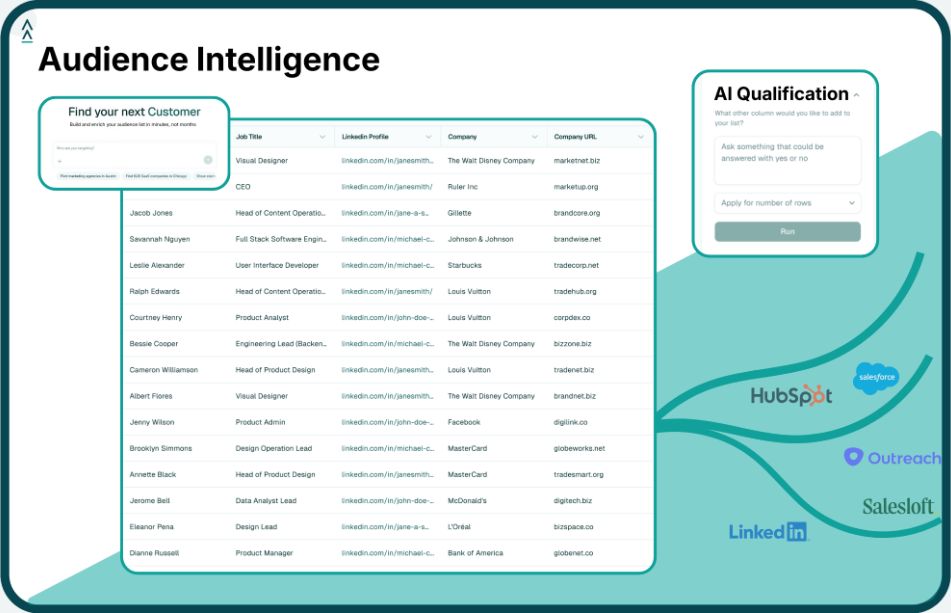
Landbase uses AI agents to continuously scan the market, qualify accounts, enrich contact data, and prioritize opportunities with minimal manual intervention. The platform supports more than 1,500 enrichment fields across firmographic, technographic, and behavioral categories, helping teams centralize account intelligence and streamline workflows.
Landbase differentiates itself through an AI-first architecture designed to automate core GTM processes.
Key capabilities include:
The broader GTM software landscape is shifting toward AI-native execution models as organizations look for ways to improve efficiency without increasing operational complexity. Sales and marketing teams are under increasing pressure to generate pipeline more predictably while managing larger volumes of accounts, signals, and engagement channels.
As a result, many organizations are reevaluating how sales intelligence, enrichment, targeting, and campaign execution fit together within the modern revenue stack.
Historically, teams relied on separate tools for prospecting, enrichment, intent monitoring, qualification, outreach, and analytics. While those systems can still provide value, managing multiple disconnected workflows often requires significant coordination between SDRs, RevOps teams, marketers, and GTM engineers.
AI-native platforms aim to simplify these workflows by centralizing intelligence and automating repetitive operational tasks.
Landbase supports this shift through automation layers designed to help teams:
This approach is particularly relevant for growing organizations that want to scale pipeline generation while maintaining operational efficiency.
Revenue teams are also placing greater emphasis on real-time intelligence. Buying signals, company changes, funding events, hiring activity, and technology adoption patterns can all influence outbound timing and campaign effectiveness.
Platforms that continuously monitor and refresh account intelligence help GTM teams stay aligned with changing market conditions.
Landbase combines signals, TAM mapping, and automated list building workflows to help organizations operationalize this intelligence within a centralized environment.
Revenue operations teams are increasingly focused on improving efficiency, reducing manual work, and accelerating pipeline creation.
Traditional GTM platforms often require significant setup and manual coordination. Landbase streamlines campaign execution through automation, enabling teams to move more quickly from audience definition to activation. The platform's natural language workflow capabilities help non-technical users collaborate across sales, marketing, and RevOps initiatives.
Landbase automates manual research tasks using autonomous AI agents that continuously monitor the market and prioritize accounts. The platform also consolidates multiple enrichment workflows into a single environment, helping reduce operational complexity.
Landbase is designed to support cross-functional GTM collaboration through shared workflows, centralized intelligence, and automation. For tailored pricing details and recommendations aligned to your GTM strategy, contact Landbase.
Selecting the right GTM platform depends on your organization's priorities, operational maturity, and workflow requirements.
Organizations often evaluate ZoomInfo when prioritizing contact discovery, outbound prospecting, and large-scale B2B data access.
6sense is commonly evaluated by organizations running advanced ABM programs centered on predictive analytics and intent data.
Demandbase is frequently considered by organizations prioritizing advertising orchestration and coordinated ABM execution.
Landbase is often selected by organizations prioritizing automation, operational efficiency, AI-native workflows, and faster execution. Capabilities such as targeting, list building, account research, and autonomous qualification workflows help unify the GTM process within a single platform.
Landbase provides an AI-native alternative to traditional sales intelligence and ABM platforms through autonomous workflow execution and centralized GTM intelligence.
Landbase AI agents support ICP definition, qualification, enrichment, prioritization, and campaign workflows with minimal manual input.
Organizations evaluating AI-native GTM systems often prioritize implementation speed and workflow automation. Landbase is designed to help teams accelerate campaign launches and operational workflows.
Through GTM Omni, Landbase combines AI automation, data enrichment, account qualification, and workflow orchestration in a unified platform.
Landbase continuously refreshes account intelligence and buying signals to support timely outreach and prioritization.
Natural language workflows and AI-driven targeting help teams create sophisticated audiences without relying on complex filter-building processes.
ZoomInfo, 6sense, and Demandbase each focus on different areas of the go to market workflow. ZoomInfo is widely recognized for extensive B2B contact data coverage and enrichment capabilities that support outbound prospecting. 6sense focuses heavily on predictive intent analytics and account engagement insights that help teams identify buying behavior trends. Demandbase is commonly associated with ABM orchestration and advertising workflows designed to support account based marketing strategies. Landbase differentiates itself through AI native automation that unifies targeting, qualification, enrichment, and execution workflows inside a coordinated GTM environment.
Landbase approaches sales intelligence through autonomous AI execution rather than relying heavily on manual workflow coordination. Through capabilities like AI agents, AI qualification, and agentic search, the platform continuously automates audience creation, account prioritization, enrichment, and qualification workflows. Traditional sales intelligence platforms often focus more narrowly on contact data, intent monitoring, or enrichment tasks that require additional operational management across systems. Landbase helps unify these workflows into a centralized AI driven execution layer designed for enterprise GTM teams. This allows organizations to reduce operational complexity while improving workflow efficiency and scalability.
Organizations focused heavily on outbound prospecting often evaluate platforms that provide large B2B contact datasets, enrichment workflows, and account intelligence capabilities. ZoomInfo is commonly considered because of its broad contact database and prospecting workflows used by many enterprise sales teams. Teams looking for more automated GTM execution may also evaluate Landbase because it combines prospecting intelligence with AI driven workflow automation across targeting, qualification, and prioritization. Features such as prospecting, list building, and contact enrichment help streamline outbound execution for RevOps and sales organizations. The right platform often depends on whether the organization prioritizes standalone data access or unified workflow automation.
Yes, each platform supports various aspects of targeting, enrichment, and campaign execution within enterprise GTM operations. Some focus more heavily on intent data and advertising orchestration, while others prioritize contact enrichment and prospecting workflows. Landbase emphasizes end to end automation through AI driven workflows that support qualification, enrichment, targeting, prioritization, and campaign activation. Through capabilities like targeting, signals, and outbound workflows, organizations can streamline execution across multiple GTM functions. This unified approach helps improve coordination between sales, marketing, and RevOps teams.
Intent data refers to digital engagement signals that may indicate potential buying interest from companies or prospects. These signals can include website visits, hiring activity, funding events, content engagement, technographic changes, and other indicators of market activity. Platforms such as 6sense and Landbase use intent signals to help organizations prioritize accounts and coordinate GTM execution more strategically. Landbase continuously surfaces these insights through workflows like signals and account research, helping teams identify accounts showing meaningful engagement trends. By incorporating intent data into qualification and prioritization workflows, organizations can improve targeting precision and campaign timing.
Landbase helps RevOps teams streamline complex GTM workflows through AI driven automation, centralized enrichment, and continuous account monitoring. The platform supports workflows across RevOps, sales, and marketing, helping teams align targeting, qualification, and execution efforts. Autonomous AI workflows continuously evaluate accounts across the TAM while surfacing high fit opportunities and active buying signals. Capabilities such as TAM mapping, AI qualification, and prospecting help reduce manual operational overhead while improving collaboration across GTM teams. This creates a more scalable and coordinated approach to enterprise pipeline generation and execution.
Tool and strategies modern teams need to help their companies grow.