.png)
.png)

Daniel Saks
Chief Executive Officer


Revenue Operations (RevOps) has transformed from a buzzword into a strategic necessity for B2B companies serious about predictable growth. But your CRM alone won't cut it anymore. Modern RevOps teams rely on an integrated tech stack that spans sales, marketing, and customer success, with AI-driven tools like Landbase's AI audience discovery becoming increasingly essential for efficient prospecting. The right combination of tools creates a unified system where data flows seamlessly, insights are actionable, and revenue becomes truly predictable.
The foundation of any successful RevOps strategy lies in understanding which tools serve which purpose—and how they work together to eliminate friction across the customer journey. From CRM systems that serve as the single source of truth to AI-powered prospecting platforms that deliver qualified audiences in seconds, each layer of the stack addresses specific operational challenges while contributing to overall revenue efficiency.
Revenue Operations is the strategic function that aligns sales, marketing, and customer success around shared processes, data, and technology to drive predictable revenue growth. Unlike traditional departmental silos where each team operates with separate goals and metrics, RevOps creates a unified revenue engine where customer data flows seamlessly across the entire lifecycle—from initial prospecting through renewal and expansion.
The core mission of RevOps is to eliminate friction points that slow down the revenue process. This includes standardizing definitions (like what constitutes a marketing-qualified lead), ensuring data consistency across systems, automating manual handoffs between teams, and providing unified visibility into pipeline health and forecasting accuracy.
What makes RevOps different from traditional operations is its cross-functional scope and technology-first approach. While sales operations focuses solely on sales efficiency and marketing operations on campaign effectiveness, RevOps looks at the entire customer journey and identifies opportunities to optimize the complete revenue process through integrated technology solutions.
The Customer Relationship Management (CRM) system serves as the foundational layer of any RevOps tech stack—the single source of truth for all customer data and interactions. Whether it's Salesforce, HubSpot, or Pipedrive, the CRM acts as the central database where prospect and customer information is stored, tracked, and analyzed across all revenue functions.
A properly configured CRM enables RevOps teams to maintain data consistency, track pipeline progression, and generate accurate forecasts. Key functionalities that make CRMs essential for RevOps include contact and account management, opportunity tracking, activity logging, reporting and analytics, and workflow automation. The CRM becomes the backbone that connects all other tools in the stack, ensuring that data flows bidirectionally between systems.
For RevOps success, the CRM must be configured with standardized fields, consistent lifecycle stages, and clear ownership rules. This foundation enables accurate reporting, reliable forecasting, and seamless integration with other tools in the stack. Without a clean, well-structured CRM, even the most advanced RevOps tools will struggle to deliver accurate insights.
When Landbase fits: Landbase's platform delivers AI-qualified audiences that can be exported (up to 10,000 contacts per session) directly into your existing CRM tools. This eliminates the manual work of building prospect lists and ensures your CRM is populated with highly relevant, qualified leads from day one. As Landbase develops CRM integrations, this seamless data flow will become even more efficient.
Marketing automation platforms like Marketo, HubSpot Marketing Hub, and Pardot are essential for scaling personalized outreach across the buyer's journey. These tools enable RevOps teams to automate lead nurturing workflows, segment audiences based on behavior and demographics, score leads based on engagement, and track campaign performance across multiple channels.
The power of marketing automation lies in its ability to deliver the right message to the right person at the right time—without manual intervention. By setting up automated workflows based on prospect behavior (like email opens, website visits, or content downloads), marketing teams can nurture leads through the funnel while freeing up time for strategic initiatives.
For RevOps, marketing automation platforms provide critical data about lead engagement and conversion rates, which feeds back into the CRM to inform sales prioritization and forecasting. The integration between marketing automation and CRM ensures that lead handoffs happen seamlessly, with clear SLAs and consistent definitions of marketing-qualified versus sales-qualified leads.
When Landbase fits: Landbase's AI-driven audience discovery generates highly targeted, qualified audiences that are perfect for marketing automation campaigns. Instead of blasting generic messages to broad lists, marketers can use Landbase to identify prospects who match their ideal customer profile and are showing active buying signals, dramatically improving campaign engagement and conversion rates.
Sales engagement platforms like Outreach, Salesloft, and Reply.io empower sales teams to execute multi-channel outreach sequences at scale while maintaining personalization. These tools combine email, phone, LinkedIn, and other channels into coordinated cadences that can be automated and optimized based on performance data.
Sales enablement tools complement engagement platforms by providing sales teams with the content, training, and insights they need to have effective conversations with prospects. This includes battle cards, pitch decks, competitive intelligence, and conversation analytics that help reps understand what's working and what's not.
For RevOps teams, these tools provide visibility into sales activity levels, response rates, and conversion metrics across different channels and sequences. This data helps optimize outreach strategies, identify top-performing messaging, and ensure consistent execution across the sales team. The integration with CRM ensures that all sales activities are automatically logged, eliminating manual data entry and providing complete visibility into the sales process.
When Landbase fits: Landbase's precise audience targeting ensures that sales engagement tools are used on the most relevant prospects, dramatically improving response rates and reducing wasted effort. By identifying companies that match your ideal customer profile and are showing active buying signals, Landbase helps sales teams focus their energy on prospects who are most likely to convert.
Business Intelligence (BI) tools and analytics platforms provide RevOps teams with the insights needed to make data-driven decisions about pipeline health, forecasting accuracy, and process optimization. These tools aggregate data from across the revenue stack—CRM, marketing automation, sales engagement, customer success platforms—and present it in dashboards and reports that highlight key performance indicators and trends.
Modern RevOps analytics go beyond basic reporting to include predictive capabilities that can forecast revenue with high accuracy, identify at-risk deals, and recommend next-best actions. Tools like Clari, Gong, and specialized forecasting platforms use machine learning to analyze historical data and current pipeline activity to provide forward-looking insights.
For RevOps success, analytics tools must be connected to clean, consistent data from the underlying systems. This is why data quality and integration are so critical—the insights are only as good as the data feeding them. RevOps teams use these analytics to identify bottlenecks in the revenue process, optimize conversion rates between stages, and ensure that forecasting is based on real-time pipeline data rather than gut feeling.
When Landbase fits: Landbase Intelligence provides growth signals, Trust Score, and Total Addressable Market (TAM) analysis that feed directly into RevOps decision-making. These insights help teams understand not just who to target, but when and why—providing the contextual intelligence needed to prioritize outreach and allocate resources effectively.
AI-powered prospecting tools have revolutionized how RevOps teams identify and qualify potential customers. Unlike traditional database providers that offer static lists of contacts, modern AI platforms analyze thousands of signals—including technographics, intent data, firmographics, and real-time business events—to identify companies that are most likely to buy.
These platforms use machine learning models trained on millions of successful sales interactions to understand what makes an ideal customer profile (ICP) and then apply that understanding to find look-alike companies. They can also detect buying signals like job postings, funding rounds, technology stack changes, and website engagement to identify companies that are actively in market.
The key advantage of AI-powered prospecting is precision and efficiency. Instead of manually filtering through thousands of records based on basic criteria, RevOps teams can use natural language queries to describe their ideal customer and get back a highly qualified list of prospects ready for outreach. This eliminates hours of manual research and ensures that sales and marketing efforts are focused on the highest-potential opportunities.
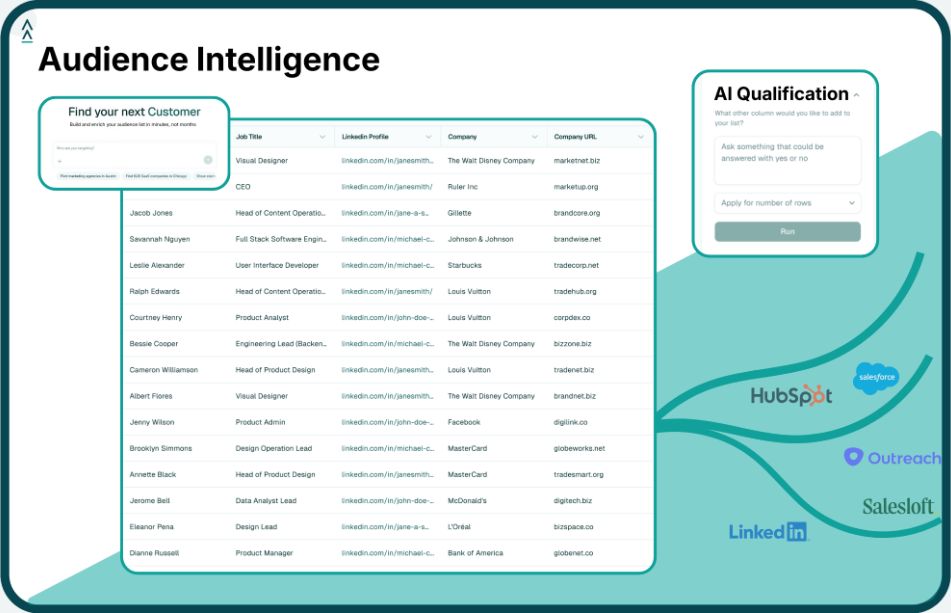
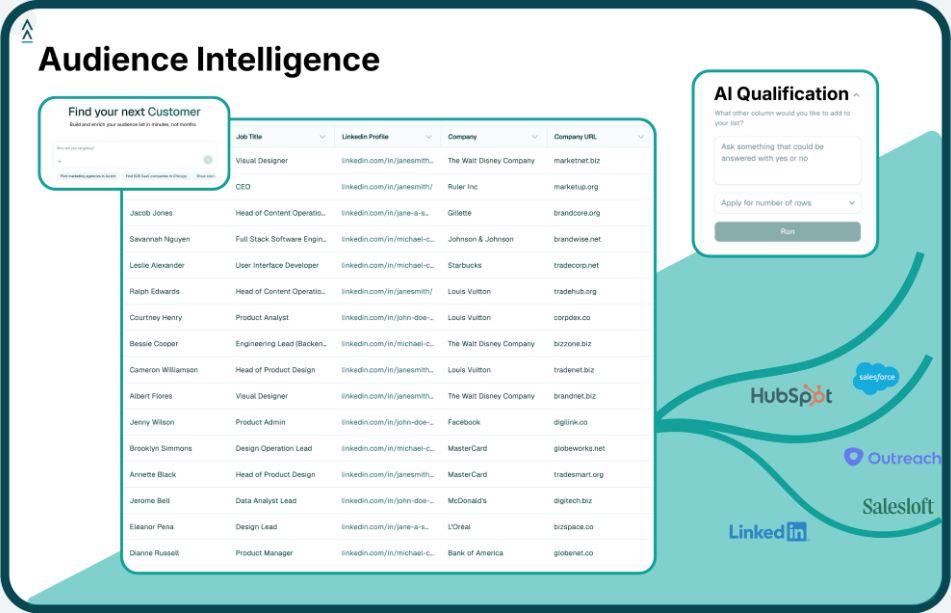
When Landbase fits: Landbase's GTM-2 Omni AI uses agentic AI and 1,500+ unique signals to find and qualify prospects in seconds. RevOps teams can type plain-English prompts like "SaaS startups in Europe hiring for RevOps" and instantly receive AI-qualified audiences ready for activation. This represents a fundamental shift from manual list-building to AI-driven audience discovery.
Configure, Price, Quote (CPQ) and sales compensation management tools address two critical operational challenges in the revenue process: streamlining the quoting and contracting process, and ensuring fair, motivating compensation for sales teams.
CPQ tools like Salesforce CPQ and Oracle CPQ automate the complex process of creating accurate quotes for products with multiple configurations, pricing tiers, and discount rules. They ensure pricing consistency, reduce errors, speed up the quote-to-close cycle, and provide visibility into deal economics. For RevOps teams, CPQ tools help maintain pricing discipline while enabling sales reps to respond quickly to customer requests.
Sales compensation management platforms like Xactly and CaptivateIQ automate the complex calculations involved in sales commissions, bonuses, and incentives. They ensure that compensation is calculated accurately and paid on time, which is critical for maintaining sales team morale and trust. These tools also provide visibility into how different compensation structures impact performance, enabling RevOps to optimize incentive plans based on actual results.
Both CPQ and compensation tools integrate with the CRM to ensure that deal data and performance metrics flow seamlessly between systems. This integration is essential for accurate forecasting, pipeline management, and performance analysis.
The true power of a RevOps tech stack comes not from individual tools, but from how well they work together. Integration is the glue that holds the stack together, enabling data to flow seamlessly between systems and creating a unified view of the customer journey.
Modern RevOps stacks use a combination of native integrations, integration platforms as a service (iPaaS) like Workato and Zapier, and custom API connections to ensure that data is synchronized across all systems. The goal is to eliminate manual data entry, reduce errors, and ensure that all teams are working with the same, up-to-date information.
Key integration patterns include bidirectional sync between CRM and marketing automation (to ensure lead status is consistent), activity capture from sales engagement platforms to CRM (to maintain complete interaction history), and data enrichment from external sources to CRM (to keep contact and account information current).
For RevOps teams, integration quality directly impacts data accuracy, process efficiency, and user adoption. Poorly integrated systems create data silos, require manual reconciliation, and frustrate users who have to switch between multiple tools. A well-integrated stack, by contrast, creates a seamless experience where users can access all the information they need from a single interface.
When Landbase fits: While Landbase currently integrates with Gmail, Outlook, and LinkedIn, the platform's roadmap includes integrations with major CRMs like Salesforce and Hubspot. This commitment to seamless integration ensures that Landbase fits naturally into existing RevOps tech stacks without creating additional data silos or manual work.
The next evolution of RevOps tools is moving beyond automation toward true autonomy. Agentic AI systems like Landbase's GTM-2 Omni don't just execute predefined workflows—they actively make decisions, learn from outcomes, and continuously optimize the revenue process.
These systems use multiple AI agents that work together to handle different aspects of the revenue process: one agent might focus on audience discovery, another on message personalization, a third on channel optimization, and a fourth on performance analysis. These agents coordinate with each other and learn from billions of data points to continuously improve results.
For RevOps teams, agentic AI represents a fundamental shift from reactive to proactive revenue operations. Instead of waiting for sales reps to identify prospects or marketing to create campaigns, autonomous GTM systems can proactively identify opportunities, build targeted audiences, and even initiate outreach based on real-time market signals and business objectives.
This evolution is particularly valuable for scaling revenue operations without proportionally increasing headcount. Agentic AI enables this kind of efficiency by handling the repetitive, time-consuming aspects of prospecting and qualification while leaving the human elements—relationship building and complex problem solving—to sales professionals.
Landbase stands out in the RevOps tool landscape by solving one of the most fundamental challenges: finding and qualifying the right prospects quickly and accurately. While traditional data providers offer static databases that require manual filtering, Landbase's agentic AI platform delivers AI-qualified audiences in seconds through natural language queries.
The platform's GTM-2 Omni AI model is trained on billions of data points from 50M+ sales interactions, giving it deep understanding of what makes an ideal customer across different industries and use cases. Combined with 300M+ contacts and 24M+ companies across 1,500+ unique signals, this AI can identify prospects that match your ICP with remarkable precision.
What makes Landbase particularly valuable for RevOps teams is its focus on frictionless adoption. The platform offers a free audience builder that can be used immediately without complex setup or training. Teams can export up to 10,000 contacts per session and activate them in their existing tools, making it easy to enhance current workflows rather than replace them entirely.
For RevOps professionals looking to improve prospecting efficiency, increase lead quality, and reduce manual research time, Landbase offers a compelling solution that integrates naturally into existing tech stacks while delivering immediate value through AI-powered audience discovery.
The primary goal is to create a unified, data-driven revenue engine that eliminates friction across sales, marketing, and customer success. RevOps tools provide shared visibility into pipeline health, automate manual processes, ensure data consistency, and enable predictable revenue growth through integrated technology. By connecting all revenue-generating teams through a common tech stack, organizations can optimize the entire customer journey from first touch to renewal.
AI is transforming RevOps tool selection by enabling predictive capabilities that go beyond basic automation. Modern RevOps teams prioritize tools with AI-powered forecasting, conversation intelligence, and predictive prospecting that can identify high-value opportunities and optimize outreach strategies based on real-time data. AI tools like Landbase analyze thousands of signals to deliver qualified audiences instantly, eliminating manual list-building and allowing teams to focus on strategic activities that drive revenue.
Yes, small businesses can build effective RevOps foundations with stage-appropriate tools rather than enterprise-grade complexity. Startups can begin with essential components like CRM, basic marketing automation, and AI-powered prospecting tools like Landbase, then scale their stack as they grow. The key is starting with integrated core tools that eliminate data silos and provide visibility across the customer journey, rather than trying to implement every possible solution at once.
Integrated RevOps tools eliminate data silos, reduce manual work, improve data accuracy, and create seamless user experiences across teams. Companies with well-integrated stacks see 10-20% higher sales productivity and can respond faster to market opportunities because all teams work from the same, up-to-date information. Integration ensures that customer data flows automatically between systems, eliminating duplicate entry and maintaining consistency throughout the revenue process.
Landbase's core platform powered by GTM-2 Omni AI enables RevOps teams to discover and qualify audiences through natural language queries. Teams can access this capability immediately through the free audience builder without login requirements, making it one of the most accessible AI-powered prospecting tools available. The platform analyzes 1,500+ unique signals across 300M+ contacts to deliver highly qualified prospect lists in seconds, dramatically reducing the time spent on manual research and list-building.
Tool and strategies modern teams need to help their companies grow.