.png)
.png)

Daniel Saks
Chief Executive Officer


Most folks think of sales enablement as just another buzzword for training or content management, but honestly, the research is showing it's evolved into something much more strategic—a comprehensive system that drives predictable revenue growth. More and more organizations are discovering that sales enablement is actually a data-driven discipline that equips customer-facing teams with the content, training, tools, and insights needed to engage modern buyers effectively. With B2B buyers spending 45% of their time on independent research, sales enablement has become the critical bridge between seller expertise and buyer self-direction.
Now, the challenge is that traditional approaches to sales enablement—focused solely on seller training or content libraries—aren't keeping pace with how buyers actually make purchasing decisions today. Still, recent research shows that organizations with formal sales enablement programs achieve 49% win rates on forecasted deals compared to just 42.5% without enablement. That extra intelligence might mean shorter sales cycles, higher conversion rates, and an edge when you're competing in crowded markets.
The science behind sales enablement as a revenue driver is well-established now, with results showing clear benefits for boosting team performance. If you're thinking about implementing or improving sales enablement at your organization, it's worth understanding the core components, measurement frameworks, and how AI-powered platforms like Landbase can accelerate your success—plus, you want to avoid common pitfalls that make enablement feel like overhead rather than strategic advantage.
Sales enablement is a strategic, cross-functional discipline designed to provide customer-facing teams with the resources they need to engage buyers effectively throughout the entire customer lifecycle. It's not just about sales training or content libraries—it's about aligning sales, marketing, and customer success around shared messaging and goals so that every customer interaction reinforces your value proposition.
The discipline has matured dramatically over the past decade. In 2013, fewer than 20% of organizations had dedicated sales enablement programs. By recent years, that number has jumped significantly, making it one of the fastest adoption curves in enterprise software history. This rapid growth reflects the increasing complexity of B2B buying processes and the need for systematic approaches to revenue generation.
Core components of modern sales enablement:
The fundamental purpose of sales enablement is to solve the disconnect between what sellers know and what buyers need. With 77% of B2B buyers finding the purchase process "time-consuming or painful," effective enablement provides the differentiation companies need to ensure their value propositions are clear, compelling, and resonate with buyers' unique challenges.
Unlike traditional sales training that happens once at onboarding, modern sales enablement is continuous and adaptive—it evolves as products change, competitors emerge, and buyer expectations shift. This ongoing nature is what makes it a strategic revenue engine rather than just tactical support.
Successful B2B sales enablement strategies are built on five interconnected components that work together to create a comprehensive revenue support system. These pillars ensure that sellers have everything they need to engage buyers effectively while maintaining consistency across the organization.
Content is the fuel that powers sales conversations, but it's only effective when it's relevant, current, and easy to find. Modern sales enablement platforms provide governed content libraries with robust search, version control, and analytics to track which content drives the best results.
Key content management capabilities:
Organizations with effective content management report 27% less struggle with sales goals because reps spend less time searching for materials and more time having meaningful conversations.
Sales readiness goes beyond initial onboarding to provide ongoing skill development that keeps reps sharp as markets evolve. This includes structured training programs, certification requirements, and just-in-time learning delivered at the moment of need.
Sales readiness components:
Companies implementing enhanced readiness programs report significant reductions in time to productivity, with new hires reaching full productivity months faster than traditional approaches.
Modern buyers expect digital-first, self-service experiences that let them research and evaluate on their own terms. Sales enablement provides the tools to support this journey without constant seller intervention.
Buyer engagement capabilities:
Organizations using digital sales rooms report higher engagement rates and faster deal closure, with buyers able to self-serve significant portions of their research needs without rep involvement.
The ROI of sales enablement isn't just theoretical—it's backed by hard metrics that show clear revenue impact. Organizations that invest in formal sales enablement programs consistently outperform those that don't across multiple dimensions.
The most direct measure of sales enablement effectiveness is its impact on win rates and revenue growth. The data shows consistent performance advantages for organizations with formal programs.
Key performance metrics:
These improvements compound over time as enablement programs mature and organizations develop deeper insights into what drives buyer engagement.
Beyond revenue impact, sales enablement drives significant operational improvements that reduce costs and increase rep productivity.
Efficiency metrics:
These efficiency gains translate directly into lower cost of sales and higher rep capacity—critical advantages in competitive markets.
When sales enablement extends beyond initial deal closure to support post-sales teams, the benefits compound even further through improved customer experience.
Customer impact metrics:
This holistic approach to enablement—supporting the entire customer lifecycle rather than just the sales process—creates compounding value that extends far beyond initial revenue.
Technology is the backbone of modern sales enablement, providing the infrastructure that connects content, training, analytics, and real-time support into a cohesive system. The right technology stack amplifies the impact of every other enablement component.
AI adoption in sales has grown dramatically in recent years, reflecting AI's ability to solve fundamental challenges in sales productivity and buyer engagement.
Key AI capabilities in sales enablement:
Generative AI alone could unlock substantial productivity gains across sales and marketing functions, making AI integration not just beneficial but essential for competitive advantage.
The most effective sales enablement platforms don't operate in isolation—they integrate seamlessly with existing CRM, marketing automation, and communication tools to provide context-aware support without disrupting workflows.
Critical integration points:
The goal is to deliver enablement at the moment of need within the tools reps already use, rather than requiring them to switch contexts or remember to check separate systems.
Training is a foundational component of sales enablement, but it must be strategic and continuous rather than one-time and generic. Modern sales training focuses on developing both hard skills (product knowledge, competitive insights) and soft skills (communication, emotional intelligence) that drive buyer engagement.
Reps need deep product knowledge combined with market context to have credible conversations with sophisticated buyers. Effective training programs provide both technical expertise and business acumen.
Product and market training components:
Organizations that involve enablement in competitive analysis experience a 3-percentage-point increase in win rates, highlighting the direct revenue impact of market acumen.
While product knowledge is essential, soft skills often make the difference between average and exceptional performance. Communication, active listening, and emotional intelligence enable reps to build trust and navigate complex buying committees.
Soft skills development areas:
AI-powered coaching platforms are making soft skills development more accessible by providing real-time feedback on calls and creating personalized learning paths based on individual performance gaps.
Implementing sales enablement requires a systematic approach that starts with assessment and builds toward continuous optimization. The most successful programs follow a clear methodology while remaining flexible enough to adapt to changing business needs.
Before implementing any enablement program, organizations must understand their current state and identify specific gaps that need to be addressed.
Assessment components:
This assessment should result in a prioritized roadmap that addresses the highest-impact gaps first while building toward a comprehensive enablement strategy.
Content is most effective when it's mapped to specific stages of the buyer journey and tailored to different stakeholder roles within buying committees.
Content strategy elements:
The goal is to provide buyers with the resources they need to sell internally to their stakeholders, supporting their self-directed research rather than interrupting it.
Measuring sales enablement ROI requires connecting enablement activities to business outcomes. The most effective measurement frameworks track both leading indicators (engagement, adoption) and lagging indicators (revenue, retention).
Rep performance metrics show how effectively enablement is preparing sellers for success.
Key rep performance metrics:
Organizations with best-in-class enablement see 84% of reps achieving quota, compared to much lower rates in organizations without formal programs.
Content metrics show which materials are driving engagement and influencing deal progression.
Content effectiveness metrics:
These metrics help organizations continuously optimize their content strategy and eliminate materials that aren't driving results.
Sales enablement is undergoing a fundamental transformation from human-driven processes to AI-augmented systems that can operate autonomously. This shift is being driven by advances in agentic AI, predictive analytics, and real-time intelligence.
The next evolution of sales enablement is hyper-personalization at scale, where AI systems analyze behavioral signals to customize content and messaging for individual buyers within complex buying committees.
Personalization capabilities:
With 76% of B2B buyers expecting personalization, these capabilities are becoming table stakes rather than differentiators.
Agentic AI systems go beyond simple automation to coordinate complex workflows, make decisions, and perform tasks autonomously. These systems can handle everything from prospect research to deal coaching without human intervention.
Agentic AI applications:
The shift from experience-based selling to AI-driven sales strategies is accelerating, making agentic AI a critical capability for future success.
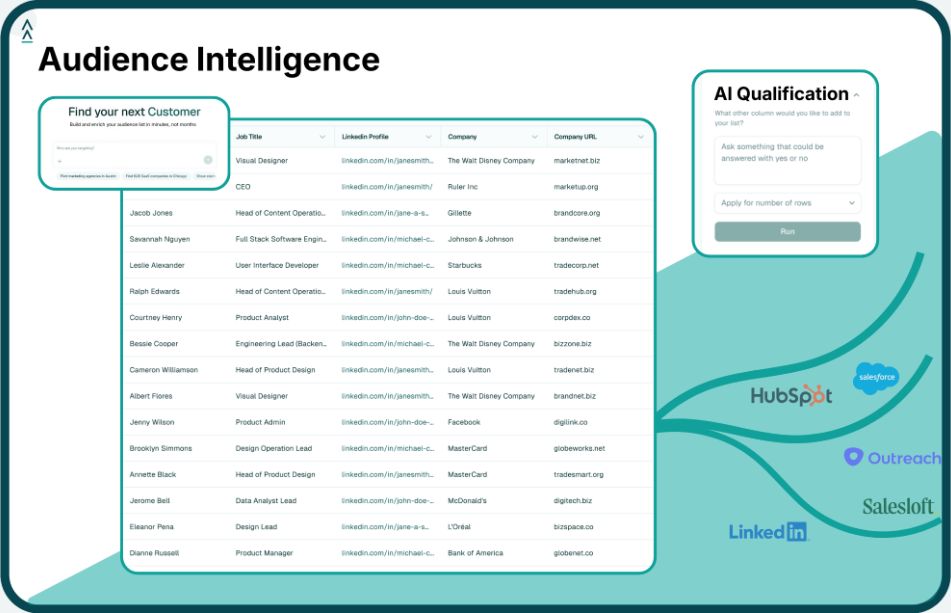
While traditional sales enablement focuses on training and content management, Landbase addresses the foundational layer that makes all other enablement activities more effective: intelligent prospect identification and qualification.
Why Landbase is different:
Landbase solves the critical problem that undermines most sales enablement programs: reps wasting time on unqualified prospects. By delivering AI-qualified audiences in seconds, Landbase ensures that every enablement investment—from training to content to coaching—is applied to prospects who are actually ready to buy.
This approach aligns perfectly with the modern shift toward buyer enablement. Instead of interrupting buyers with generic outreach, Landbase helps reps engage prospects at the precise moment they're showing buying signals, making every interaction more relevant and valuable.
The platform's free, no-login audience builder makes it easy for organizations to test the value immediately, while enterprise capabilities like API integrations and custom data services support scaling across large GTM teams.
The primary goal of sales enablement is to equip customer-facing teams with the content, training, tools, and insights needed to engage buyers effectively and drive predictable revenue growth. It aligns sales, marketing, and customer success around shared messaging to ensure consistent, value-driven customer interactions. Modern sales enablement has evolved from one-time training into a continuous, strategic discipline that adapts as products, competitors, and buyer expectations change.
AI contributes to sales enablement by providing real-time coaching, predictive content recommendations, conversation intelligence, and automated workflows that dramatically improve rep productivity. AI-powered platforms help reps spend significantly less time on research and administrative tasks while achieving higher engagement rates with buyers. These technologies enable personalization at scale, with AI systems analyzing behavioral signals to customize content and messaging for individual buyers within complex buying committees.
Organizations with strong sales enablement achieve 49% win rates on forecasted deals versus 42.5% without formal programs, with nearly 40% of companies reporting 25%+ sales growth. Additional benefits include 84% of reps hitting quota with best-in-class enablement and 9 percentage point improvements in average win rates. Sales enablement also drives operational efficiency gains, reduces new hire ramp times, and improves customer retention when extended to support post-sales teams.
Sales enablement focuses on equipping reps with content, training, and tools to engage buyers effectively, emphasizing capability building and skill development. Sales operations focuses on the systems, processes, and data infrastructure that support sales execution, including CRM management, forecasting, territory planning, and workflow automation. While enablement is about preparing sellers for customer interactions, operations is about optimizing the underlying processes and technology that make selling efficient and scalable—both functions are complementary and essential for sales success.
Tool and strategies modern teams need to help their companies grow.