.png)
.png)

Daniel Saks
Chief Executive Officer


Most folks think of Revenue Operations (RevOps) and Marketing Operations as interchangeable terms, but honestly, the distinction between them is critical for modern go-to-market success. Marketing Operations optimizes marketing execution, while RevOps optimizes the complete revenue engine from first touch to renewal. Companies that confuse these two functions often waste six-figure investments on organizational restructuring when they actually need foundational fixes in data quality or process alignment. With Landbase's audience discovery platform, both functions can access the precise, qualified audiences they need to drive measurable results without the operational overhead.
The fundamental difference isn't organizational—it's philosophical. Marketing Ops asks "How do we execute marketing more efficiently?" while RevOps asks "How do we optimize the entire revenue engine across marketing, sales, and customer success?" Research shows that companies with mature RevOps functions grow revenue 3x faster than those without, but this advantage only materializes when Marketing Ops serves as a solid foundation.
Marketing Operations is the engine that drives marketing efficiency, focusing specifically on optimizing marketing department processes, technology, and analytics. While the marketing team crafts compelling messages and creative campaigns, Marketing Ops ensures those efforts convert into measurable business outcomes through systematic execution and data-driven optimization.
Marketing Operations professionals manage the complex martech stack that modern marketing requires—on average, B2B SaaS companies use 40+ marketing tools, creating significant operational complexity. They own campaign execution workflows, marketing analytics and reporting, lead management processes, and technology integration that connects marketing activities to sales outcomes.
Marketing Ops teams are responsible for selecting, implementing, and optimizing the marketing technology stack. This includes:
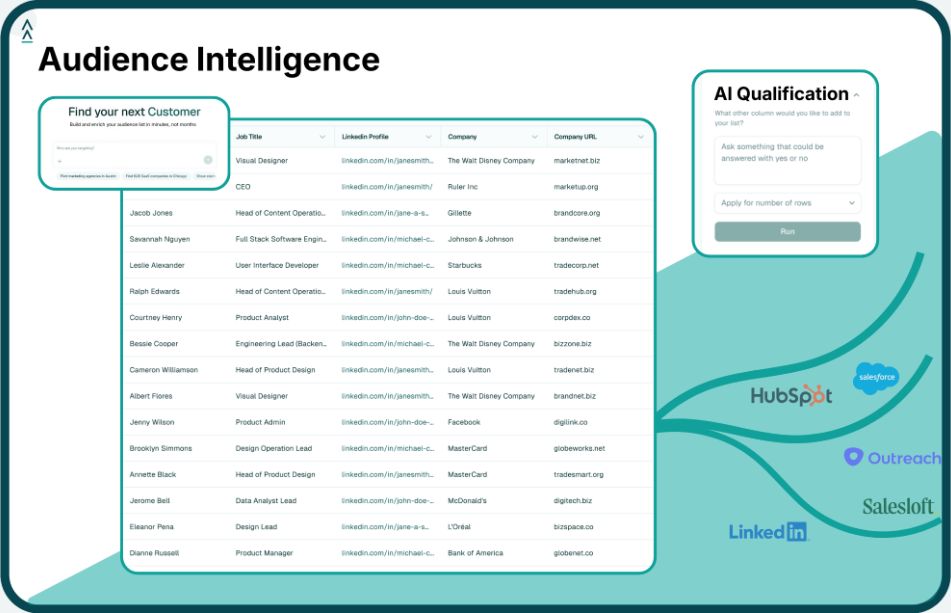
Marketing Operations teams can leverage Landbase's AI agents to build and refine targeted audience lists using natural language, directly integrating into existing tools without adding another layer of complexity to their already-bloated tech stack.
Marketing Operations professionals typically own several critical functions:
For companies just establishing Marketing Ops capabilities, the focus should be on foundational elements: clean data, documented processes, and proper technology utilization. Without these basics, even the most sophisticated marketing strategies will fail to deliver consistent results.
Revenue Operations represents a fundamental shift from siloed departmental optimization to holistic revenue engine management. Rather than focusing on individual department efficiency, RevOps unifies marketing, sales, and customer success under a single operational framework designed to optimize the complete customer journey from first touch through renewal and expansion.
The RevOps philosophy recognizes that revenue generation is a continuous process that spans multiple departments, and optimizing individual functions in isolation creates suboptimal outcomes. When marketing focuses solely on MQL volume while sales complains about lead quality, or when customer success struggles with onboarding issues that originated in the sales process, revenue leakage occurs. Research shows that sales and marketing misalignment costs businesses over $1 trillion annually.
RevOps emerged as a response to the limitations of traditional organizational structures. In the past, marketing, sales, and customer success operated with separate goals, metrics, and technology stacks, creating friction at handoff points and inconsistent customer experiences. RevOps addresses these challenges by:
Companies that successfully implement RevOps achieve 38% higher win rates and 36% higher retention compared to organizations with siloed functions. Additionally, research shows RevOps can improve sales productivity by 10-20%.
RevOps leaders can leverage Landbase's growth signals and Trust Scores to optimize GTM strategies across all revenue functions, ensuring alignment on target account selection and engagement timing.
RevOps professionals focus on strategic resource allocation and revenue optimization rather than tactical execution. The core strategic questions that RevOps leaders must answer include:
However, many RevOps professionals face a paradox: 92.25% say tracking metrics is their primary responsibility, yet they often struggle to drive meaningful change due to resource constraints.
Understanding the distinction between Marketing Operations and RevOps is crucial for proper resource allocation and organizational design. While these functions are complementary, they serve different purposes and operate at different levels of the organization.
Marketing Operations is fundamentally a departmental function focused on optimizing marketing-specific processes and outcomes. Marketing Ops professionals work within the marketing organization to improve campaign execution, lead management, and marketing analytics. Their success is measured by marketing-specific metrics like lead volume, cost per lead, and marketing-sourced revenue.
RevOps, by contrast, is a cross-functional philosophy that transcends departmental boundaries. RevOps professionals work across marketing, sales, and customer success to optimize the entire revenue lifecycle. Their success is measured by holistic metrics like total revenue growth, customer lifetime value, and net revenue retention.
As William Flaiz explains, "Marketing Ops is a department. RevOps is a philosophy that may or may not require a dedicated department. You can have excellent Marketing Ops within a RevOps structure. You cannot have excellent RevOps without excellent Marketing Ops as foundations."
Marketing Operations tends to be more tactical in nature, focusing on the execution and optimization of specific marketing activities. Marketing Ops professionals spend their time:
RevOps, on the other hand, takes a more strategic approach, focusing on:
This strategic vs. tactical distinction is important because it determines where these functions should sit organizationally and what skills they require. Marketing Ops professionals need deep technical expertise in marketing technologies and analytics, while RevOps professionals need strong business acumen and cross-functional leadership skills.
The ownership responsibilities of Marketing Ops and RevOps reflect their different scopes:
Marketing Operations owns:
RevOps owns:
While Marketing Operations and RevOps serve different purposes, they are deeply interconnected. Successful RevOps implementation requires mature Marketing Ops as a foundation, and strong Marketing Ops execution is amplified when aligned with RevOps strategy.
The relationship between these functions can be thought of as Marketing Ops providing the tactical execution capabilities that RevOps strategy requires. Marketing Ops builds the campaigns, manages the data, and executes the lead generation activities that feed into the unified revenue engine that RevOps designs and optimizes.
One of the most critical touchpoints between Marketing Ops and RevOps is the lead handoff process. Marketing Ops defines lead qualification criteria and manages the technical aspects of lead routing, while RevOps establishes the cross-functional SLAs and process governance that ensure smooth handoffs.
Common challenges in this area include:
Companies with tightly-aligned sales and marketing functions enjoy 38% higher win rates, demonstrating the revenue impact of optimizing this handoff process.
Landbase's AI qualification capabilities help Marketing Ops deliver precisely qualified audiences that seamlessly integrate into RevOps pipeline management, ensuring that leads meet both marketing and sales qualification criteria from the start.
The most successful organizations create shared objectives between Marketing Ops and RevOps that align around customer outcomes rather than departmental metrics. This requires:
For example, instead of Marketing Ops focusing solely on MQL volume and RevOps focusing on total revenue, both functions might align around pipeline velocity and conversion rates across the entire funnel. This creates natural incentives for collaboration and ensures that marketing activities directly support revenue outcomes.
Marketing Ops teams can use Landbase's B2B database of 300M+ contacts to build targeted audience lists that align with RevOps-defined ideal customer profiles, ensuring that marketing efforts are focused on accounts most likely to convert and retain.
Artificial intelligence is transforming both Marketing Operations and Revenue Operations by automating routine tasks, providing predictive insights, and enabling more personalized customer experiences at scale. While 70%+ of GTM teams report moderate-plus AI adoption, most are using AI ad-hoc without orchestrated implementation, creating new forms of operational fragmentation.
Traditional audience targeting requires Marketing Ops professionals to manually define complex criteria across multiple data dimensions. AI-powered platforms like Landbase's GTM-2 Omni enable natural-language audience discovery, allowing marketers to simply describe their ideal customer in plain English and receive AI-qualified contact lists instantly.
This capability transforms audience discovery from a time-consuming, technical process into an intuitive, conversational experience. Instead of wrestling with complex filters and Boolean logic, Marketing Ops professionals can focus on strategic targeting decisions while AI handles the technical execution.
For RevOps professionals, AI-powered audience discovery ensures that all revenue functions are working from the same, precisely qualified target accounts. This eliminates the common problem of marketing, sales, and customer success targeting different segments of the market, creating inconsistent customer experiences and revenue leakage.
AI is also revolutionizing revenue forecasting and pipeline management through predictive analytics. Traditional forecasting relies heavily on manual input and historical patterns, but AI can analyze thousands of data points to identify leading indicators of deal success and customer churn.
Predictive modeling capabilities include:
These predictive capabilities enable both Marketing Ops and RevOps to move from reactive to proactive operations. Instead of responding to pipeline gaps after they occur, teams can anticipate issues and take preventive action. Instead of broadcasting generic messages to all prospects, they can deliver personalized content at the optimal moment in the buyer's journey.
Landbase's 1,500+ unique signals provide the rich data foundation that AI models need to deliver accurate predictive insights, ensuring that both Marketing Ops and RevOps can make data-driven decisions with confidence.
The next evolution of AI in GTM operations is autonomous workflows that can execute entire campaigns without human intervention. These agentic AI systems can:
This level of automation frees Marketing Ops and RevOps professionals from routine execution tasks and allows them to focus on strategic planning and optimization. Rather than spending time setting up campaigns and managing lists, they can focus on refining ICP definitions, analyzing performance trends, and developing new go-to-market strategies.
The key to successful AI implementation is ensuring that technology supports business objectives rather than driving them. AI should amplify human expertise and judgment, not replace it. The most successful organizations use AI to handle repetitive, data-intensive tasks while preserving the human elements of relationship building and strategic decision-making.
Landbase stands out as a critical enabler for both Marketing Operations and Revenue Operations teams by solving the fundamental challenge of audience discovery and qualification. While traditional approaches require complex technical setup and manual list building, Landbase's free audience builder allows teams to generate AI-qualified contact lists in seconds using natural language.
For Marketing Operations professionals, Landbase eliminates the time-consuming process of building complex Boolean searches and manually filtering through databases. Instead of spending hours crafting technical queries, marketers can simply describe their ideal customer in plain English and receive a precisely qualified audience ready for campaign activation. This capability is particularly valuable for demand generation campaigns, account-based marketing initiatives, and lead nurturing programs.
For Revenue Operations leaders, Landbase provides the data foundation needed for cross-functional alignment. When marketing, sales, and customer success teams all work from the same AI-qualified target accounts, it eliminates the common problem of misaligned targeting and inconsistent customer experiences. Landbase's GTM Trust Score and growth signals provide the rich data context that RevOps professionals need to make strategic resource allocation decisions.
The platform's integration with existing tools like Gmail, Outlook, and LinkedIn ensures that qualified audiences can be activated immediately without disrupting established workflows. This seamless integration is critical for both functions, as it allows them to leverage Landbase's capabilities without adding another layer of complexity to their already-bloated technology stacks.
With Landbase's 300M+ contacts and 24M+ companies, both Marketing Ops and RevOps teams can access the comprehensive data they need to drive revenue growth. The platform's AI qualification ensures that audiences are not just large, but precisely relevant, reducing wasted outreach and improving conversion rates across the entire revenue funnel.
Yes, but success depends on company size and complexity. Early-stage companies can often manage with basic marketing and sales operations, but as organizations grow beyond 3-5 marketing team members, dedicated Marketing Operations becomes essential for managing technology, processes, and data quality. RevOps becomes necessary when challenges span multiple departments and require cross-functional alignment—typically at companies with 50+ employees and separate sales, marketing, and customer success teams. However, attempting RevOps without solid Marketing Ops foundations often leads to failure, as you're building strategy on top of broken execution.
Marketing Operations manages marketing-specific data including lead information, campaign performance metrics, marketing attribution data, content engagement metrics, and marketing technology usage data. They also own the integration between marketing data and CRM systems to ensure seamless data flow to sales teams. Marketing Ops is responsible for data quality, implementing lead scoring models, tracking campaign ROI, and maintaining the single source of truth for marketing performance across all channels and touchpoints.
AI transforms RevOps from reactive to proactive operations by providing predictive insights on deal success, customer churn, and optimal outreach timing. AI also automates routine tasks like data cleansing, report generation, and audience qualification, freeing RevOps professionals to focus on strategic resource allocation and cross-functional alignment. With AI-powered platforms like Landbase, RevOps teams can instantly access qualified audiences using natural language, eliminating hours of manual list building and ensuring all revenue functions work from the same precisely targeted accounts.
Yes, sales operations experience is highly relevant for RevOps roles, as many RevOps functions evolved from sales operations. However, successful RevOps professionals need experience across the entire revenue lifecycle, including marketing and customer success operations, to effectively drive cross-functional alignment. The best RevOps leaders combine deep operational expertise in at least one revenue function with broad understanding of how all functions interconnect. This allows them to speak credibly with each department while maintaining focus on holistic revenue optimization rather than individual departmental success.
Tool and strategies modern teams need to help their companies grow.