.png)
.png)

Daniel Saks
Chief Executive Officer


GTM engineers waste 60% of their time stitching together tools that should already talk to each other. In 2026, API-first architecture isn't a nice-to-have, it's the foundation of scalable revenue systems. The average B2B sales stack now includes 10+ tools, and for GTM engineers building automated workflows, the quality of APIs and webhooks determines whether automation scales or breaks.
API-first sales tools eliminate manual data movement, reduce integration complexity, and enable true end-to-end automation. Among the emerging solutions, Landbase's agentic AI represents a paradigm shift, replacing the need to manually orchestrate 5+ point solutions with autonomous AI agents that continuously qualify, score, and prioritize high-fit accounts across your total addressable market.
Traditional sales stacks require GTM engineers to build custom integrations between disconnected tools, data enrichment platforms, CRM systems, engagement sequences, and analytics dashboards. This creates fragile workflows that break when APIs change or data structures evolve.
API-first sales tools are designed from the ground up with programmatic access as a core requirement rather than an afterthought. They provide robust REST APIs, webhook triggers, and increasingly, Model Context Protocol (MCP) support for AI integration. This enables GTM engineers to build resilient, scalable automation that survives the inevitable changes in the sales tech landscape.
For RevOps teams, the benefits are substantial: reduced integration maintenance, faster time-to-value for new campaigns, and the ability to create truly end-to-end workflows that span the entire go-to-market process. When your API quality is high, you can build once and deploy everywhere, across Salesforce, HubSpot, email systems, and custom applications.
Best For: GTM engineers seeking to streamline manual orchestration with autonomous AI agents
Price: For tailored pricing details, contact Landbase to discuss the right GTM automation plan for your team.
API/Integration Highlights:
Landbase represents the cutting edge of API-first GTM platforms, combining autonomous AI agents with deep technical integrations. The platform's core innovation is GTM Omni, a multi-agent system designed for autonomous go-to-market workflows, comprising five specialized AI agents that work continuously with ongoing autonomous optimization.
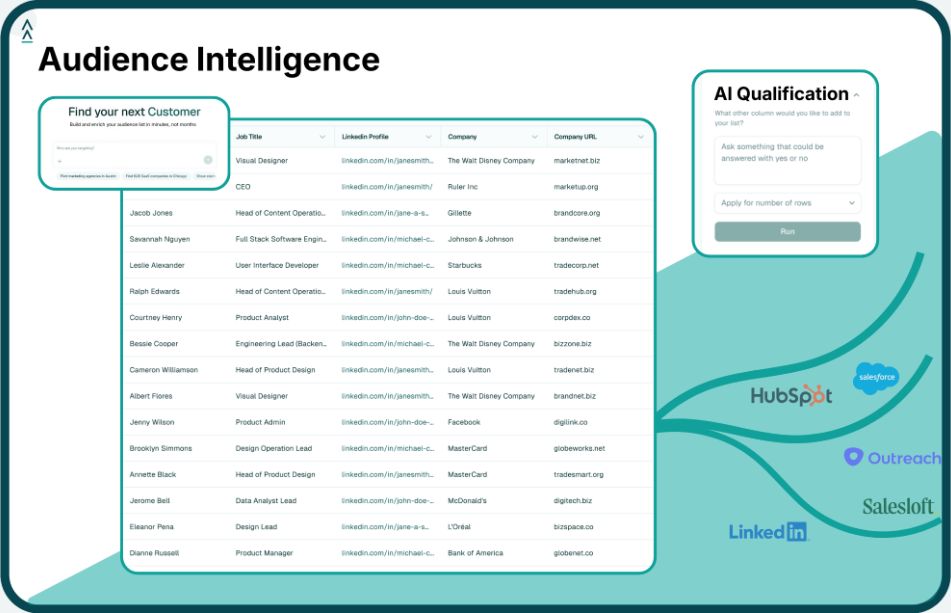
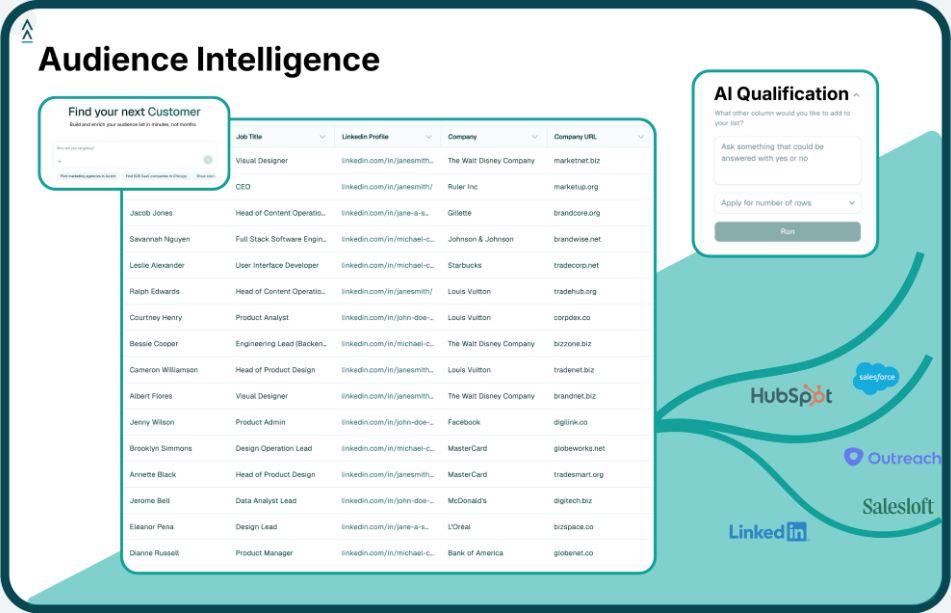
Landbase delivers comprehensive go-to-market automation through its agentic AI architecture. The platform continuously qualifies, scores, and prioritizes high-fit accounts across your total addressable market, streamlining research effort by approximately 80%.
Landbase eliminates the need to stitch together 5+ point solutions by unifying targeting, qualification, enrichment, and automation in a single platform. The multi-agent architecture enables campaigns to launch in minutes rather than weeks, with autonomous agents continuously monitoring for new accounts, signals, and data changes so audiences evolve automatically.
Early customers report impressive results: "With Landbase, we found high-fit B2B prospects at scale, streamlined research workflows, and enabled tailored 'why this, why now' outreach that often converts at 40%+," notes Stefanos Chatzimarkou, Senior Manager Business Development at Oyster. The platform also delivers up to 75% website visitor identification compared to the industry average of 10%, providing unprecedented visibility into anonymous traffic.
For GTM engineers building scalable revenue systems, Landbase's API-first architecture and autonomous agents represent the future of go-to-market automation, where manual list building and workflow maintenance become far more efficient.
Best For: GTM engineers needing maximum control over data enrichment workflows
Price: Free (100 credits/mo), Starter $149/mo, Growth $446/mo, Enterprise custom
Clay is a widely used enrichment workflow platform for technical operators. Its spreadsheet-native interface makes complex data pipelines readable, with each column representing a data operation that can be chained together visually.
When GTM engineers need to orchestrate data from multiple providers with custom logic, Clay's visual workflow builder provides a flexible way to manage enrichment steps. The platform is commonly evaluated for waterfall enrichment workflows that combine multiple data sources into a single process.
Best For: GTM engineers on a budget needing both data and execution in one platform
Price: Free (10k credits), Basic $49/user/mo, Professional $79/user/mo, Organization $119/user/mo
Apollo.io combines database and execution capabilities in a single subscription, making it a broad GTM stack option for teams that want data and engagement workflows together. It is commonly evaluated by teams seeking accessible prospecting and execution capabilities in one platform.
For GTM engineers building outbound workflows, Apollo is a commonly evaluated platform for database access and execution in one environment. The API enables programmatic prospecting workflows, while built-in sequencing can support teams that prefer to manage engagement within the same system.
Best For: Enterprise GTM teams evaluating broad B2B data coverage
Price: Custom pricing, typically $15,000-25,000/year minimum
ZoomInfo is commonly evaluated as a data layer for enterprise GTM stacks, with broad B2B contact and company coverage. Teams often consider it for verified data programs, intent signals, and integrations across enterprise sales and marketing systems.
For enterprise GTM teams where data coverage and verification are important, ZoomInfo provides a mature option in the B2B data category. The platform's API-first approach through GTM.AI and MCP integration can support teams building AI-powered workflows that rely on structured B2B intelligence.
Best For: GTM engineers seeking self-hosted workflow control
Price: Free (self-hosted), Starter $24/mo, Pro $60/mo, Enterprise custom
n8n stands out for its open-source nature and self-hosting capabilities, allowing GTM engineers to deploy workflows on their own infrastructure with configurable data control. This supports flexible workflow execution for teams that prefer to manage infrastructure directly.
For GTM engineers working in regulated industries or with sensitive customer data, n8n's self-hosting capability can be a strong fit. When teams need custom logic such as API transformations, conditional branching across databases, or webhook orchestration, n8n's code nodes provide a configurable workflow option.
Best For: GTM engineers running outbound at enterprise scale with 30+ reps
Price: Custom pricing, typically $100-150/user/mo with annual contracts
Outreach serves as an execution layer for enterprise outbound, with API capabilities that enable sophisticated automation. The platform is commonly used by enterprise teams managing outbound engagement at scale.
For teams with larger sales organizations, Outreach's orchestration capabilities can support structured outbound programs. The API enables workflows such as triggering sequences based on intent signals, updating CRM records from conversation data, and routing deals based on activity or risk signals.
Best For: GTM engineers needing sequences to be actually followed by sales reps
Price: Advanced ~$125/user/mo, Premier ~$180/user/mo, Dialer add-on $300-400/user/year
Salesloft focuses on the human side of GTM engineering by helping reps execute the workflows engineers build. Its cadence builder and deal module support teams that want structured sequence management and pipeline visibility.
For GTM engineers who need sequence workflows to be consistently followed, Salesloft provides structured task management and cadence execution. The platform is commonly evaluated by teams that prioritize rep workflow adoption and operational consistency.
Best For: GTM engineers evaluating a single CRM operations center
Price: Free CRM, Starter from $20/mo, Professional and Enterprise pricing vary by seats and contract structure (contact HubSpot for current pricing)
HubSpot Sales Hub provides a unified CRM operations platform with a mature API ecosystem. The platform's single data model helps marketing, sales, and RevOps work from a shared contact record.
HubSpot is commonly evaluated by teams that prioritize speed, usability, and a unified CRM ecosystem. The mature REST API and workflow builder support complex branching, while Breeze AI adds native AI capabilities within the platform.
Best For: GTM engineers needing to activate conversation intelligence in automated workflows
Price: Custom pricing, typically $100-150/user/mo with annual contracts
Gong helps teams activate conversation intelligence by turning call and interaction data into structured CRM insights. The platform's Revenue Graph connects conversation, email, and CRM signals for revenue teams.
For GTM engineers building closed-loop systems, Gong's API can connect conversation insights with automated workflows. For example, when a competitor is mentioned on a call, automation can flag the deal, alert the manager, and trigger a relevant enablement workflow.
Best For: GTM engineers at data-mature companies needing to activate warehouse data
Price: Free (up to 2 syncs), Pro $350/mo, Business/Enterprise custom
Hightouch supports data-mature companies that want to activate warehouse data across GTM tools. The platform syncs transformed dbt models directly to Salesforce, HubSpot, and ad platforms.
Hightouch is commonly evaluated by teams where warehouse data plays a central role in GTM execution. The platform syncs to 200+ destinations including Salesforce, HubSpot, Google Ads, and LinkedIn, making warehouse data actionable across the GTM stack.
When evaluating API-first sales tools for GTM engineers, Landbase stands out as the superior option for teams seeking to streamline manual orchestration and achieve true end-to-end automation. While other platforms focus on specific GTM functions such as enrichment, data coverage, workflow control, or engagement, Landbase's agentic AI architecture addresses the entire go-to-market process in a unified platform.
Landbase leverages a multi-agent system designed for autonomous go-to-market workflows (GTM Omni), comprising specialized AI agents that continuously work across targeting, qualification, enrichment, and automation. This reduces the need to manually coordinate multiple point solutions, helping GTM engineers focus more time on strategy, experimentation, and revenue execution.
The platform's foundation on 300M+ B2B contacts and 24M+ accounts ensures comprehensive coverage, while its continuous monitoring capabilities mean audiences evolve automatically as new accounts emerge, signals change, and data updates. Early customers report 40%+ conversion rates and up to 75% website visitor identification compared to the industry average of 10%.
For GTM engineers building scalable revenue systems, Landbase's API-first architecture combined with autonomous agents represents the future of go-to-market automation. The platform streamlines research effort by approximately 80% and enables campaigns to launch in minutes rather than weeks, delivering the efficiency gains that modern RevOps teams demand.
Ready to transform your go-to-market strategy? Request a demo to see how Landbase's agentic AI platform can streamline manual orchestration and accelerate your revenue growth.
An API-first sales tool is designed from the ground up with programmatic access as a core requirement rather than an afterthought. For GTM engineers building automated workflows, API quality determines whether automation scales or breaks. These tools provide robust REST APIs, webhook triggers, and increasingly Model Context Protocol (MCP) support for AI integration. This enables resilient, scalable automation that survives changes in the sales tech landscape.
Landbase's Agentic AI platform leverages GTM Omni, a multi-agent system designed for autonomous go-to-market workflows, comprising five specialized AI agents that work continuously with ongoing autonomous optimization. Traditional sales automation software requires GTM engineers to manually build and maintain workflows across disconnected tools, while Landbase's autonomous agents continuously qualify, score, and prioritize high-fit accounts. This approach streamlines research effort by approximately 80% and eliminates the need to manually orchestrate 5+ point solutions.
Landbase serves enterprises across 25+ industries, from SaaS and logistics to cybersecurity. The platform's autonomous AI agents and comprehensive data foundation make it suitable for any B2B organization with complex go-to-market requirements. The platform is designed for B2B organizations with complex go-to-market and RevOps requirements across a range of industries.
Yes, Landbase integrates with CRM and marketing tools including Salesforce and HubSpot, with Pipedrive integration coming soon. The platform's API-first architecture enables seamless data flow within existing tech stacks, and it also integrates with Gmail, Outlook, and LinkedIn for execution. This supports a unified workflow while maintaining connectivity with your current ecosystem.
Landbase ensures data quality through waterfall enrichment across 20+ data providers followed by 4 layers of verification. The platform's underlying database includes 300M+ B2B contacts and 24M+ accounts, continuously updated with 1,500+ signal types including hiring, funding, and technographic shifts. This comprehensive approach delivers verified contacts and data that power accurate targeting and qualification.
Tool and strategies modern teams need to help their companies grow.