.png)
.png)

Daniel Saks
Chief Executive Officer


OpenFunnel.ai describes its pricing model as credit-based with enterprise custom options, and does not provide a public price list on its primary site. According to OpenFunnel's own website, the platform offers a self-serve free entry point at app.openfunnel.dev, with paid tiers structured around credit consumption tied to signal volume and agent usage rather than seat count. Third-party procurement marketplaces such as Vendr, Capterra, and G2 did not list public dollar figures for OpenFunnel as of April 2026, which means effective cost is set during a direct sales conversation. For buyers evaluating OpenFunnel as part of a broader intent-signal stack, comparable real-time TAM and signal platforms typically run in the five-figure annual range, with lightweight teams often starting well below that on a free or usage-capped tier.
This guide breaks down how OpenFunnel is priced in 2026 based on its public materials and Y Combinator profile, what to budget for when OpenFunnel is incorporated into a modern GTM stack, a three-year total cost of ownership (TCO) walkthrough for a mid-market revenue team, and how to negotiate a credit-based AI intelligence contract. It is written for RevOps, sales, and marketing leaders evaluating buyer-signal platforms in 2026.
OpenFunnel is a real-time total addressable market (TAM) intelligence platform. Instead of licensing a static list of contacts, customers configure signal agents fine-tuned on their product, ideal customer profile, and go-to-market strategy. Those agents continuously monitor the open internet for buying-signal triggers including job postings, technographic changes, competitor-interaction activity, funding, hiring velocity, product launches, and social-listening events, and surface accounts at the moment a buying need appears to emerge.
According to OpenFunnel's homepage, the platform advertises "99.98% Real-time Signal Coverage,” meaning the system is designed to return only accounts with live insights rather than dormant firmographic matches. OpenFunnel describes itself on Product Hunt as offering "personalized agents for AI-first GTM teams," and its Y Combinator page summarizes the pitch as monitoring your TAM and surfacing companies when custom triggers fire. In practice, the platform functions as an account-discovery and intent-monitoring layer that sits above CRM and outreach tools.
The company was founded in 2024 by Aditya Lahiri and Fenil Suchak, is headquartered in San Francisco, and is part of Y Combinator's F24 batch. Its latest public funding was a $1.3M seed round (reported January 8, 2025), with participation from Y Combinator, Transpose Capital, NYX Ventures, and Decacorn Capital. OpenFunnel claims 1,000+ users and cites companies such as Central, Mintlify, and Everest Systems, per its Y Combinator profile.
Three forces make 2026 an important year to understand how OpenFunnel is priced before committing budget.
Pipeline teams are no longer running static list-pull motions as their primary outbound engine. Real-time buyer signals are now used by the majority of growth-stage sales organizations as a filter on outbound volume, per Warmly's 2026 guide to B2B intent data, which has shifted budget from pure contact databases toward signal layers. OpenFunnel is positioned squarely in that emerging spend category.
The last two years have seen most AI-native GTM tools move away from flat per-seat licensing toward credit consumption tied to usage volume, per MarketBetter's 2026 buying-signal tools roundup. Credit pricing changes the shape of procurement conversations. The question becomes "how many signals, how many accounts, how many enrichments?" rather than "how many users?"
Finance teams are pushing back on large ABM and signal platform contracts and asking sales leaders to justify every dollar per sourced opportunity. A credit-based platform like OpenFunnel is easier to rightsize than a locked enterprise contract, but only if buyers enter the conversation with a clear usage forecast and a defined ICP.
OpenFunnel does not publish plan tiers with dollar figures on its website as of April 2026. This section walks through what the platform sells, how it is typically packaged, and the commercial levers that shape any quote.
OpenFunnel advertises a "get started for free" option at app.openfunnel.dev. Teams can create an account, configure a signal agent, and begin reviewing surfaced accounts without a paid contract. Free-tier usage is typically capped by credits, agent count, or signal volume, though specific limits are not published. The free tier is the recommended starting point for validating whether OpenFunnel's signal coverage matches a team's ICP before any budget conversation begins.
OpenFunnel publishes a customer deal on its Y Combinator company page. YC-batch founders can access that deal directly from the YC portal. Terms are available through YC and are gated to the network. Buyers inside the YC network should always ask OpenFunnel's sales team to honor the published deal.
For teams beyond the free tier, OpenFunnel sells credit packs that scale with usage. The credit metric is not publicly detailed, but based on how comparable real-time signal platforms are priced, credits typically correspond to some combination of signal events surfaced, account enrichments performed, agent compute time, and export or sync actions. Buyers should expect pricing quotes to bundle credits into monthly or annual packs, with overage rates applied above the committed volume.
Larger organizations with multiple GTM teams, complex ICPs, or significant signal volume negotiate enterprise contracts directly. These contracts typically include custom credit allocations, dedicated support, SLAs around data freshness, and tailored agent configurations. OpenFunnel's homepage confirms enterprise options are available. OpenFunnel also states it is AICPA SOC certified, per its homepage, which is a baseline requirement for most enterprise procurement processes.
Because OpenFunnel does not publish dollar figures, the ranges below are modeled against comparable real-time signal platforms and should be treated as budget scaffolding for internal planning, not as confirmed OpenFunnel list prices. Buyers should always request a direct quote.
Because OpenFunnel is priced on credits rather than seats, adding more end users does not by itself drive the bill up. The bill moves when agent count, signal volume, or enrichment depth increase.
Every GTM tool carries costs beyond the core subscription. For OpenFunnel, buyers should plan for several standard line items.
The following worked example is for a mid-market revenue team with 15 GTM seats, three active signal agents, and a supporting stack. All figures are modeled ranges based on publicly available pricing for comparable categories and should be treated as budget scaffolding, not confirmed OpenFunnel quotes.
Year-one total (illustrative): $49,000 to $123,000
Year-two total (illustrative): $55,000 to $142,000
Year-three total (illustrative): $61,000 to $159,000
Three-Year Total (Illustrative): Low-end scenario of approximately $165,000 across three years; high-end scenario of approximately $424,000 across three years. The key insight is that OpenFunnel itself typically represents 30-40 percent of the real annual cost of running a signal-driven GTM motion. The remainder sits in contact data, outreach tooling, CRM integration, and internal time. Budgeting for only the subscription line item dramatically understates what the full motion costs.
Credit-based AI platform negotiations reward buyers who go in with concrete usage data and a clear scope. Several strategies consistently produce better contract terms.
Real-time signal platforms address account discovery but still require separate tools for contact data, outreach execution, and analytics. The comparison below highlights where OpenFunnel sits relative to other platforms in the market.
What They Do: Landbase is an AI-native GTM platform that automates the end-to-end work of targeting, qualifying, and engaging accounts through agentic, multi-agent workflows. The platform combines a 300M+ verified B2B contact database, 1,500+ enrichment and signal fields, AI qualification, and multi-channel outreach execution in a single system, removing the need to stitch together separate prospecting, sequencing, and analytics tools.
Why They're Important: Landbase is the only platform that takes a team from a natural-language prompt to a verified, scored account list to a launched multi-channel campaign without switching tools. GTM-2 Omni, trained on 40M+ B2B campaigns and 175M+ sales conversations, continuously qualifies and prioritizes accounts across the full TAM. Customers report 4-7x higher conversion rates, with outcomes including $400K MRR added by P2 Telecom and 33% more meetings booked by Digo Media without additional headcount. Gartner recognized Landbase as a Cool Vendor 2025 in AI-driven GTM automation.
Key Stats / Metrics:
Leadership: CEO: Daniel Saks (co-founder, formerly co-CEO of AppDirect, Forbes 30 Under 30)
Founded: 2020
Recent Funding: Series A: $30M (January 2026). Investors: Picus Capital, 8VC, Sound Ventures
What They Do: OpenFunnel provides a real-time TAM monitoring platform where revenue teams configure signal agents fine-tuned on their ICP. Those agents continuously surface accounts when defined buying triggers fire, including job postings, technographic changes, funding events, and hiring velocity.
Why They're Important: OpenFunnel is a Y Combinator F24 company offering a credit-based model with a free entry point, making it accessible to early-stage and growth-stage teams evaluating signal-first GTM motions. The platform is designed to sit upstream of CRM and outreach tools as an account-discovery and intent layer.
Key Stats / Metrics:
Leadership: Co-Founders: Aditya Lahiri and Fenil Suchak
Founded: 2024
Recent Funding: Seed: $1.3M (January 2025). Investors: Y Combinator, Transpose Capital, NYX Ventures, Decacorn Capital
What They Do: 6sense provides a revenue AI platform combining account intelligence, buying-stage prediction, advertising orchestration, and sales engagement. The platform is designed for enterprise revenue teams running coordinated account-based programs across sales and marketing.
Why They're Important: 6sense offers deep ABM orchestration with advertising integration and predictive pipeline analytics, making it a widely used option for enterprise teams with complex, multi-stakeholder buying journeys. The platform carries a median enterprise ACV of $55,211 per year, per Warmly's pricing analysis.
Key Stats / Metrics:
Leadership: CEO: Jason Zintak
Founded: 2013
Recent Funding: Series F: $200M (February 2022). Valuation: $5.2B
For go-to-market teams rethinking their outbound motion from the ground up, Landbase was purpose-built to address the core gap that signal-only platforms leave unfilled: the contact data, qualification, and outreach execution work that must be layered on after signals fire.
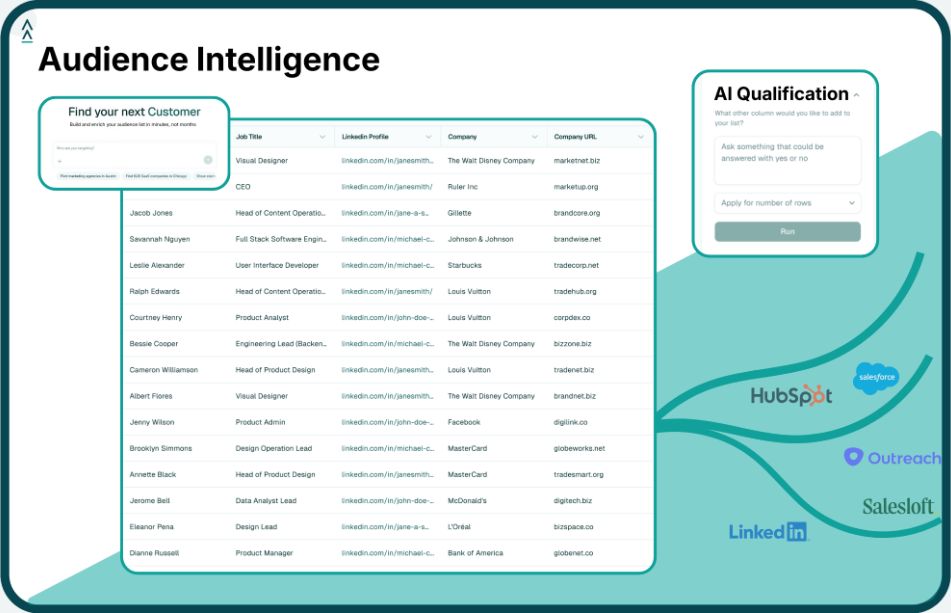
With Landbase, teams describe their ideal customer in plain English and receive a verified, AI-qualified audience list enriched across 1,500+ signal fields, ready for CRM sync and immediate campaign activation. The GTM-2 Omni agentic AI, trained on 40M+ B2B campaigns, handles targeting, scoring, enrichment, and multi-channel outreach coordination autonomously, reducing manual research effort by approximately 80%.
Rather than stacking a signal intelligence tool, a contact database, a sequencing platform, and a CRM integration layer on top of each other, Landbase consolidates the entire motion into one agentic platform with predictable costs and no credit management overhead. The result is a system where machines handle the repetitive work so revenue teams can focus on building relationships and closing deals. See how Landbase works.
OpenFunnel describes its pricing model as credit-based with enterprise custom options, and does not provide a public price list on its primary site. A free entry point is available at app.openfunnel.dev, and buyers can expect paid credit packs to scale with signal volume, agent count, and enrichment depth. Comparable real-time intent and TAM platforms typically run $10,000 to $80,000 annually for mid-market teams, but OpenFunnel's actual cost is set during a direct sales conversation. Teams should model a full supporting-stack TCO rather than relying on the subscription line alone.
Yes. OpenFunnel advertises a "get started for free" option at app.openfunnel.dev. Teams can create an account and begin running a signal agent without a paid contract, though free-tier usage is typically capped by credits or signal volume. The free tier is the recommended starting point for any evaluation, as it produces concrete signal-quality data before any budget conversation begins. Specific free-tier limits are not published on OpenFunnel's site.
OpenFunnel uses a credit-based model rather than a per-seat model, per the pricing description. Credits typically correspond to signal events surfaced, account enrichments performed, agent compute time, and export or sync actions. Adding more end users does not by itself increase the bill. Usage drives cost, which makes the credit model easier to rightsize than a locked per-seat contract when usage forecasts are clear.
Beyond the core credit pack, budget for contact-data enrichment ($15,000 to $60,000 annually at meaningful volume), outreach execution tools ($10,000 to $50,000 per year), CRM integration engineering (20-60 hours at launch and 5-10 hours monthly ongoing), onboarding and agent configuration time, signal-quality tuning time (3-5 hours per agent per quarter), and any standard renewal uplift. These are standard line items for any signal-platform deployment and often exceed the OpenFunnel subscription itself in total spend.
Landbase takes a fundamentally different approach to the GTM stack. Rather than providing a signal intelligence layer that teams must pair with separately purchased contact data, sequencing tools, and CRM integrations, Landbase combines all of these into a single agentic platform. Teams start with a natural-language prompt, receive a verified and AI-qualified audience enriched across 1,500+ fields, and launch multi-channel outreach without switching tools or managing credit consumption across multiple vendors. Customers report 4-7x higher conversion rates, making Landbase the stronger choice for teams that want end-to-end automation rather than a best-of-breed signal layer in a crowded stack.
Tool and strategies modern teams need to help their companies grow.