Daniel Saks
Chief Executive Officer


Berlin Partner, the city's economic development agency, reported that Berlin-based startups raised around €2.7 billion in venture capital in 2025, up 23% from 2024. The same report counted 283 AI startups in Berlin, roughly 30% of all AI startups in Germany.
A growing share of that capital is going to AI-native companies that are hiring quickly, from workflow automation and enterprise AI platforms to vertical tools for nursing, wholesale, and manufacturing. The list below is part of Landbase's wider tracking of AI startups adding headcount fastest.
This list ranks venture-backed AI startups headquartered in Berlin by 12-month headcount growth measured in Landbase data, then verifies each company's funding and operating evidence against public sources.
The starting pool was venture-backed companies headquartered in Berlin whose core product depends on AI, founded in 2019 or later and with at least 30 employees.
Every company on the list had to meet four criteria:
Headcount growth is calculated from professional-profile data and can differ from company-reported figures, particularly for companies with contractors, distributed teams, or recent hiring changes. Funding, valuation, and revenue figures below come from company announcements and press coverage rather than headcount data. Funding alone does not establish growth, so it is treated as one of several company buying signals.
CEO: Jan Oberhauser
Latest round: Strategic investment from SAP, May 2026
12-month headcount growth: +279%
Category: AI workflow automation and agents
n8n provides a workflow automation platform that combines AI agents with business process automation. Technical teams use it to connect applications, data, and language models through a visual builder or code, with self-hosted and cloud options.
In May 2026, n8n reported more than 1,400 enterprise customers, 1.7 million monthly active developers and builders, and more than 1,000 integrations. SAP's strategic investment valued n8n at $5.2 billion, more than double the $2.5 billion valuation set less than a year earlier.
The SAP investment amount was not disclosed. n8n previously raised a $180 million Series C led by Accel in October 2025.
n8n is the largest company on this list and shows how Berlin's developer-tools base is turning into agent infrastructure. A strategic investment from Europe's largest software company points to demand for automation layers that sit inside enterprise systems.
CEO: Marius Meiners
Latest round: $21 million Series A, November 2025
12-month headcount growth: +270%
Category: AI search visibility analytics
Peec AI provides analytics that show brands and agencies how they appear in answers from AI search tools such as ChatGPT and Perplexity, and which sources those answers cite.
Peec AI reported reaching about €650,000 in annual recurring revenue within four months of launch and $4 million within ten months. At the time of its Series A, it reported more than 1,300 brand and agency customers and said it was adding roughly 300 per month.
Singular led the $21 million Series A, with Antler, Combination VC, identity.vc, and S20 participating. It followed a €5.2 million seed round led by 20VC in July 2025.
Peec AI is building a new measurement category as marketing teams try to understand AI search alongside traditional search.
Leadership: Judith Dada, Co-CEO
Latest round: Seed round, 2024
12-month headcount growth: +204%
Category: Enterprise AI platform
Langdock provides an AI platform that lets companies roll out chat, assistants, and agents across the organization while choosing which language models to use and keeping control over data and security.
Deutsche Startups reported that Langdock grew to €12 million in annual recurring revenue in November 2025 and €20 million in March 2026. By June 2026, the company said it had reached about $40 million in annual recurring revenue, adding roughly $1 million per week on average since the start of the year, with more than 10,000 companies using the platform.
Langdock's disclosed funding is small relative to its revenue. Startup databases list a seed round of roughly $3 million in 2024, following a pre-seed round that included Judith Dada, then a general partner at Visionaries Club. Dada joined as Co-CEO in June 2026.
Langdock shows that European enterprises will buy a model-agnostic AI layer from a local vendor. Its revenue growth on limited outside capital is unusual for the category.
CEO: Fabio Schmidberger
Latest round: $50 million Series A, November 2025
12-month headcount growth: +173%
Category: Voice AI for nursing documentation
voize provides a voice AI assistant for nurses and care workers. Staff speak their notes into a smartphone, and the system turns them into structured documentation in the facility's records system.
voize reported that its product is used by more than 75,000 nurses across 1,100 care facilities, mainly in Germany and Austria. The company said users recover up to 30% of their shift time.
Balderton Capital led the $50 million Series A, with existing investors HV Capital, Redalpine, and Y Combinator participating.
Germany's care sector faces persistent staff shortages, and documentation takes a large share of nursing time. voize is one of the clearest examples of a Berlin AI company selling into a labor problem rather than a software budget.
CEO: Finn zur Muehlen
Latest round: $15 million seed, July 2026
12-month headcount growth: +153%
Category: AI agents for customer operations
telli provides AI agents that handle customer-facing operations for B2C companies across voice, chat, SMS, WhatsApp, and email.
Its assistant, Charlie, is an AI coworker that helps customer operations teams build and tune those agents.
Founded in 2024, telli said its agents handle millions of customer conversations. The company raised a $15 million seed round about 15 months after its pre-seed,.
Redalpine led the seed round, with Mutschler, Cherry Ventures, Y Combinator, and angel investors participating. It followed a $3.6 million pre-seed led by Cherry Ventures and Y Combinator in April 2025, bringing total funding to more than $18.5 million.
telli started with AI phone calls and has broadened into multichannel customer operations.
Co-founder: Benedikt Nolte
Latest round: $14.5 million seed, February 2026
12-month headcount growth: +100%
Category: AI operating system for wholesale distribution
Plato provides an agent-based operating system for wholesalers. It connects to existing ERP systems, automates quoting and sales workflows, and includes a copilot that flags risks and opportunities for sales teams.
Plato said it works with several leading European wholesalers, with contract volumes averaging more than €100,000 each, and reported software margins of about 90%. The company raised its $14.5 million seed round to add modules for customer service and procurement and expand internationally.
Atomico led the seed round, with Cherry Ventures, Discovery Ventures, and D11Z, the investment arm of Dieter Schwarz, participating. Cherry Ventures had previously led a $6.5 million pre-seed round in late 2024.
Wholesale distribution is large, fragmented, and still dependent on manual quoting. Plato reflects a wider move to sell AI into traditional German industries with deep ERP footprints.
CEO: Fabian Heinrich
Latest round: More than $20 million Series A, June 2025
12-month headcount growth: +87%
Category: Agentic AI procurement
Mercanis provides a procurement suite covering spend analytics, sourcing and RFx, supplier management, and contract management.
Its Mercu AI copilot automates supplier discovery, risk detection, and offer comparison.
Named customers include GASAG, BASF Coatings, Goldbeck, Wilson, and Brose. At the time of its Series A announcement, Mercanis reported more than 40% process savings for customers and said it planned to enter the U.S. market.
Partech and AVP led the Series A, with existing investors Signals.VC, Capmont Technology, and Speedinvest participating. Several outlets reported the round as about €17.3 million.
Procurement is a large enterprise budget with heavy manual work. Mercanis's industrial customer list shows Berlin AI companies selling into Germany's industrial base.
Founder: Avik Mukhija
Latest round: $10 million Series A, June 2026
12-month headcount growth: +72%
Category: AI ordering and forecasting for fresh food retail
Freshflow provides AI ordering and inventory software for fresh food departments in grocery stores. It covers demand forecasting, inventory inference, spoilage prediction, and supplier routing.
Freshflow said its platform runs at nine grocers in Germany and France, including merchants in the EDEKA, Carrefour, Intermarché, and Stroetmann groups. The company reported that spoilage fell by up to 30% per store and that staff accepted about 93% of its recommendations.
Reimann Investors led the Series A, with Capnamic, caesar., World Fund, Venture Stars, Catatumbo Capital, and new investor IBB Ventures participating.
Fresh food waste affects both grocery margins and sustainability targets. Freshflow is one of several Berlin AI startups focused on operational savings in physical retail.
CEO: André Zayarni
Latest round: $50 million Series B, March 2026
12-month headcount growth: +58%
Category: Vector search infrastructure
Qdrant provides an open-source vector database and search engine used to power retrieval, semantic search, and AI agent memory.
Qdrant has reported more than 250 million downloads and about 29,000 GitHub stars. Named customers include Canva, HubSpot, Bosch, Tripadvisor, and OpenTable. The company raised $50 million to build what it calls composable vector search.
AVP led the Series B, with Bosch Ventures, Unusual Ventures, Spark Capital, and 42CAP participating. It followed a $28 million Series A in early 2024. Total funding is reported at roughly $88 million.
Qdrant is Berlin's clearest example of AI infrastructure with global open-source adoption.
Co-founders: Maximilian Fischer and Silviu Homoceanu
Latest round: €16.3 million Series A, June 2026
12-month headcount growth: +53%
Category: AI process analytics for manufacturing
Almetra, formerly Deltia, uses AI cameras above production lines to turn video into structured production data such as cycle times, output rates, and equipment utilization. Video is processed locally.
Named customers include Bosch, Siemens Energy, and Aumovio, formerly Continental's automotive business. Almetra said customers have increased productivity by about 20%, and the company had grown to roughly 40 employees when it secured its €16.3 million Series A.
blisce/ led the Series A, with NAP, Merantix Capital, Robin Capital, Underline, Critical Ventures, and business angels participating.
Manual assembly lines still produce little structured data. Almetra connects Berlin's AI talent with Germany's manufacturing customers.
Several patterns stand out.
First, Berlin's fastest-growing AI companies are mostly horizontal platforms. n8n, Langdock, Peec AI, and Qdrant all sell to companies in many industries, and together they account for the largest valuations and customer counts on the list.
Second, a second group sells AI into traditional German sectors. voize serves care facilities, Plato serves wholesalers, Mercanis serves industrial procurement teams, Freshflow serves grocers, and Almetra serves factories. These companies benefit from proximity to Germany's industrial and Mittelstand customers.
Third, round sizes remain modest relative to growth. Outside n8n, most companies on the list raised seed or Series A rounds of about $25 million or less, and Langdock reported about $40 million in annual recurring revenue on limited disclosed funding.
For GTM teams, these companies are hiring quickly, adding enterprise customers, and building new functions. That combination is more useful when paired with hiring, leadership, technology, and data enrichment signals than when funding is viewed on its own. Teams researching related categories can compare this list with Landbase's rankings of AI support agent startups and AI retail startups. For other cities, see Paris AI startups hiring fastest and the full set of AI startups hiring fastest by city.
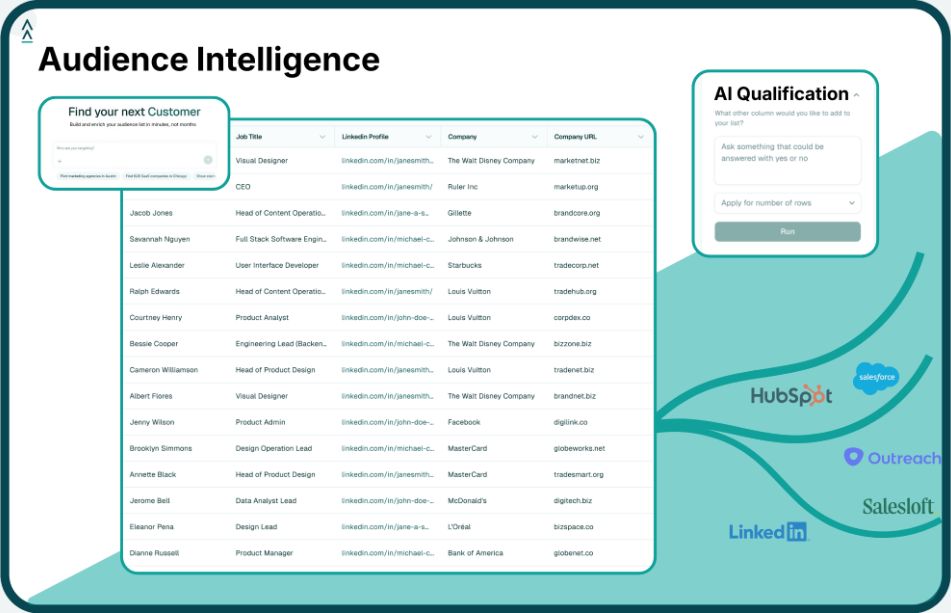
The ranking in this article was built with Landbase. A natural-language search identified venture-backed AI startups headquartered in Berlin, an enrichment step added founding year, headquarters city, and 12-month headcount change, and the results were filtered and sorted into a structured dataset.
Landbase's web and CLI interfaces access the same account, datasets, and saved work.
For more complex requirements, the Advanced Dataset Creator supports filters, calculations, and custom output fields.
Landbase's data infrastructure includes more than 800 million contacts and more than 40 million companies across more than 1,500 fields, with enrichment from more than 20 providers.
A Berlin workflow could, for example, identify Berlin-headquartered AI startups that raised a seed or Series A round in the past year, grew headcount by more than 50%, and recently hired a head of sales for the United States or the United Kingdom.
The Landbase CLI setup supports these workflows from a standard terminal and from AI coding environments including Claude Code and Codex.
Among venture-backed, AI-native startups headquartered in Berlin, the ranking is led by n8n, Peec AI, Langdock, voize, and telli, each with more than 150% 12-month headcount growth in Landbase data. Plato, Mercanis, Freshflow, Qdrant, and Almetra complete the top 10.
n8n recorded the highest 12-month headcount growth in Landbase data among the companies that met this list's criteria, at more than 270%. In May 2026, a strategic investment from SAP valued the company at $5.2 billion.
Berlin combines a large technical talent pool, an established base of early-stage investors, and proximity to German industrial, healthcare, and retail customers. Berlin Partner counts 283 AI startups in the city, roughly 30% of Germany's total.
Not on its own. Headcount data is based on professional profiles and can differ from company-reported figures, and fast hiring does not guarantee revenue growth. This list therefore pairs headcount growth with disclosed funding, revenue, customer, and valuation evidence wherever it is available.
Teams can start with a headquarters location and category definition, then filter by headcount growth, funding stage, recent rounds, target industry, and hiring activity. Landbase can combine these criteria into reusable datasets and return company and contact information through web and CLI workflows.
Tool and strategies modern teams need to help their companies grow.