Daniel Saks
Chief Executive Officer


Israel's second annual DatA-IL report, prepared with IVC Research Center, found that Israeli AI companies raised about $11.8 billion in 2025 across roughly 500 rounds. That was about 89% of all Israeli high-tech investment, up from 58% in 2024. The same report counted 2,948 AI companies operating in Israel, about one-third of the country's high-tech companies.
In Tel Aviv, several companies on this list moved from stealth to large Series A and B rounds within about a year. The list complements Landbase's broader ranking of AI startups adding headcount fastest.
This list ranks AI-native startups headquartered in the Tel Aviv metro area, including Herzliya, Ramat Gan, and Petah Tikva, by 12-month headcount growth measured in Landbase data, then verifies funding and operating evidence against public sources.
Every company on the list had to meet four criteria:
Headcount growth is calculated from professional-profile data and can differ from company-reported figures, particularly for companies with contractors, reservists, or distributed teams. Funding and revenue figures come from company announcements and press coverage. Funding alone does not establish growth, so it is treated as one of several company buying signals. Wonderful, which appears in the main hub ranking, was excluded from this list.
CEO: Omer Kaplan
Latest round: $60 million Series A, May 2026
12-month headcount growth: +283%
Category: Agentic e-commerce operating system
ZyG builds ZyG OS, an agentic operating system for direct-to-consumer brands. It scores products for growth potential, then runs store building, ad creative, acquisition, retention, and logistics for the products it selects.
The company is based in Herzliya and was founded in 2025 by former ironSource executives, including chairman Tomer Bar-Zeev and Kaplan.
ZyG raised its Series A shortly after leaving stealth, at a reported $500 million valuation. The company had about 65 employees at the time and said its platform was already driving sales growth for selected products, according to O.G. Venture Partners.
Accel led the $60 million Series A, with Lightspeed, Viola, Bessemer, Felix Capital, and Wiz CEO Assaf Rappaport participating. Total funding is about $118 million.
ZyG applies the performance-marketing playbook that ironSource built for mobile apps to physical consumer products.
CEO: Alon Dror
Latest round: $60 million, May 2025; a larger round was reported in May 2026
12-month headcount growth: +262%
Category: Defense AI and command-and-control
Kela builds a command-and-control platform that lets militaries connect commercial AI, sensors, drones, and edge devices into a shared real-time picture. The company was founded in July 2024 by Dror, a former senior official in the Israeli Ministry of Defense's R&D directorate, and Hamutal Meridor, former president of Palantir Israel.
Dror said on a podcast that Kela recorded about $20 million in revenue in 2025, and sources told Globes the company signed contracts worth more than $50 million that year. Globes also reported in May 2026 that Kela was completing a roughly $200 million round at a $1.2 billion valuation, led by Stripes and D1. Kela did not comment on the report.
Kela raised an $11 million seed led by Sequoia Capital and a $28 million Series A led by Lux Capital, then a further $60 million in 2025, for about $100 million before the reported 2026 round.
Kela follows an Anduril-style model that combines software, autonomy, and manufacturing. The company was founded in response to the October 7, 2023 attacks, and its pace reflects new demand for venture-backed defense AI in Israel.
CEO: Yoash Palmor
Latest round: $7 million seed, January 2026
12-month headcount growth: +200%
Category: AI for construction planning and procurement
Materialspace provides an AI platform for interior construction planning on large residential and commercial projects. It analyzes blueprints, product catalogs, and pricing data, then links cost estimation, design, and ordering in one system.
Materialspace, founded by twin brothers Yoash and Nadav Palmor, launched its product less than a year before its seed round and reported rapid adoption and expansion, though it did not disclose customer counts.
StageOne Ventures, SecretChord, and Timber Grove Ventures co-led the $7 million seed
Materialspace is aimed at the supply side of construction rather than contractors.
CEO: Stav Levi-Neumark
Latest round: $25 million Series A, July 2026
12-month headcount growth: +170%
Category: AI agents for go-to-market teams
Alta describes itself as an AI "system of actions" for go-to-market teams. A shared "Company Brain" draws on more than 50 data sources and feeds agents for prospecting, research, multi-channel outbound, inbound qualification, AI calling, and optimization.
Alta said it reached its first $1 million in revenue within months of commercializing and expects 800% revenue growth in 2026. Its Series A announcement named Snowflake, Deel, and Atlassian among its customers and said the platform serves hundreds of businesses.
IN Venture led the $25 million Series A, with Mindset Ventures, LeumiTech77, Entrée Capital, and Target Global among the participants. It followed a $7 million seed in March 2025, for total funding of about $32 million.
Alta, founded in 2023, is one of several Tel Aviv companies applying agents to revenue work.
CEO: Dan Lahav
Latest round: $80 million, September 2025
12-month headcount growth: +165%
Category: Frontier AI security
Irregular, formerly Pattern Labs, is an AI security lab that tests frontier models before release. It builds simulated environments in which models act as attackers and defenders, measuring cyber misuse potential and resilience to attack. Lahav co-founded it with CTO Omer Nevo. Israeli press and Landbase place it in Tel Aviv, though its funding announcement was datelined San Francisco.
Irregular works with OpenAI and Anthropic, and its evaluations have been cited in security assessments for models including Claude 3.7 Sonnet and OpenAI's o3 and o4-mini. The company said it had reached millions of dollars in annual revenue, and TechCrunch reported a $450 million valuation for the round, citing a source close to the deal.
Sequoia Capital and Redpoint Ventures led the $80 million round, with Swish Ventures participating.
Irregular sells to model developers themselves. Its growth shows pre-release model security becoming a category of its own.
CEO: Amit Carmi
Latest round: $30 million Series B, March 2026
12-month headcount growth: +119%
Category: AI agents for game marketing
Sett builds AI agents that automate user acquisition and creative production for mobile game developers. The platform generates video ads, playable ads, and in-game assets at scale.
Sett said its clients include several leading gaming companies and that it plans to expand beyond games into fintech, consumer apps, and e-commerce by the end of 2026. Its Series B was led by Greenfield Partners, and reports on the round put total funding at about $57 million.
Greenfield Partners led the $30 million Series B, with F2 Venture Capital, Bessemer Venture Partners, and TIRTA Ventures participating.
Sett turns Tel Aviv's mobile gaming and ad-tech expertise into an agent product.
CEO: Eran Dagan
Latest round: $8 million seed, January 2025
12-month headcount growth: +89%
Category: Generative AI for fashion product photography
Botika turns basic product photos, including flat lays and mannequin shots, into studio-style on-model images using AI-generated models and backgrounds.
At the time of its seed round, Botika reported more than 1,000 brand customers in the United States and Europe, with revenue up roughly nine times and its customer base up about 11 times over the prior year, according to Seedcamp.
Stardom and Secret Chord Ventures co-led the $8 million seed, with Seedcamp participating. One funding tracker lists a later Series A, but it has not been confirmed by the company and is not treated as a fact here.
Botika sells into a visible line item, the product photoshoot, for apparel brands and marketplaces.
CEO: Shalev Hulio
Latest round: $260 million, June 2026
12-month headcount growth: +65%
Category: AI-native national cyber defense
Dream, co-founded by Hulio and former Austrian Chancellor Sebastian Kurz, builds AI-based cybersecurity for governments and national infrastructure. Its products include Sphere for detecting state-actor attacks, Hero for investigating vulnerabilities, and Atlas, a sovereign language model.
Dream said it has accumulated about $300 million in orders since starting commercial operations in late 2024, and Globes reported that its annual recurring revenue is estimated to have passed $100 million. Its valuation moved from $1.1 billion in early 2025 to $3 billion with its June 2026 round.
Group 11 led the $260 million round, according to Globes, with Bicycle Capital, Antler, and others participating. Bain Capital Ventures led the prior $100 million Series B.
Dream is the most heavily funded company on this list and sells to sovereign buyers rather than enterprises.
CEO: Guy Flechter
Latest round: $35 million Series A, September 2025
12-month headcount growth: +47%
Category: AI security app builder
Sola Security provides an AI assistant that lets security teams prompt their existing security stack to build custom tools covering identity and access management, cloud security, posture management, and compliance.
In the six months after leaving stealth, Sola reported more than 2,000 users and more than 1,000 custom security apps created on the platform, according to its Series A announcement.
Existing investor S32 led the $35 million Series A, joined by Microsoft's M12 and New Era Capital Partners. Total funding is about $65 million, including a $30 million seed.
Sola applies the app-builder model to security operations, giving smaller security teams a way to build tooling without engineering support.
CEO: Ravit Netzer
Latest round: $16 million Series A, March 2026
12-month headcount growth: +43%
Category: AI protein design
Scala Biodesign develops ScalaOS, a protein design platform that combines physics-based modeling, evolutionary data, and LLM-based AI models. The company was founded in 2022 by Netzer and Adi Goldenzweig, with Weizmann Institute professor Sarel Fleishman as chief scientist.
Scala said ScalaOS was onboarded by nine of the world's top 20 pharmaceutical companies over the eight months before its Series A announcement, along with leading chemical companies.
Grove Ventures led the $16 million Series A, with TLV Partners, Deep Insight, and the Israel Innovation Authority participating. Total funding since 2022 is about $21.5 million.
Scala is a direct commercial spinout of academic protein-design research.
Several patterns repeat across the list.
First, security remains Tel Aviv's deepest AI category. Irregular, Dream, and Sola cover frontier model testing, national cyber defense, and AI-built security tooling, drawing on the city's established cybersecurity talent pool. Defense AI is now a second pillar, led by Kela.
Second, repeat founders and large early rounds are common. ZyG was founded by former ironSource executives and raised about $118 million within roughly a year, Sola's CEO previously co-founded Cider Security, acquired by Palo Alto Networks, and Kela was co-founded by a former Palantir Israel president.
Third, Tel Aviv's existing industries are being rebuilt with agents. Sett and ZyG come out of the city's mobile gaming and ad-tech base, and Alta was founded by former monday.com employees.
For GTM teams, these companies are hiring quickly, adding enterprise customers, and opening U.S. sales functions. That signal is more useful when paired with hiring, leadership, technology, and data enrichment signals than when funding is viewed on its own. Teams researching the wider market can compare this list with Landbase's rankings of AI security startups hiring fastest, New York AI startups hiring fastest, and the full set of AI startups hiring fastest by city.
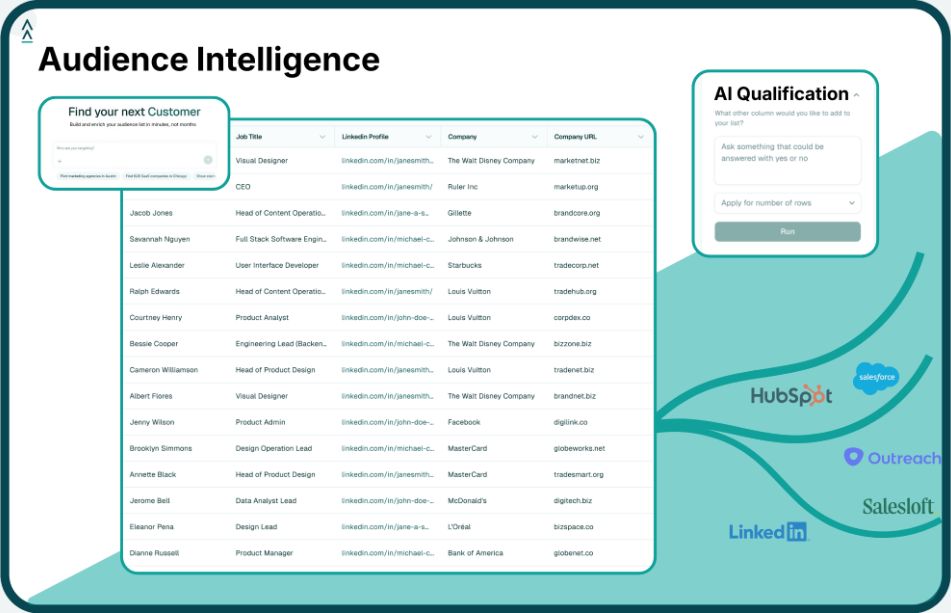
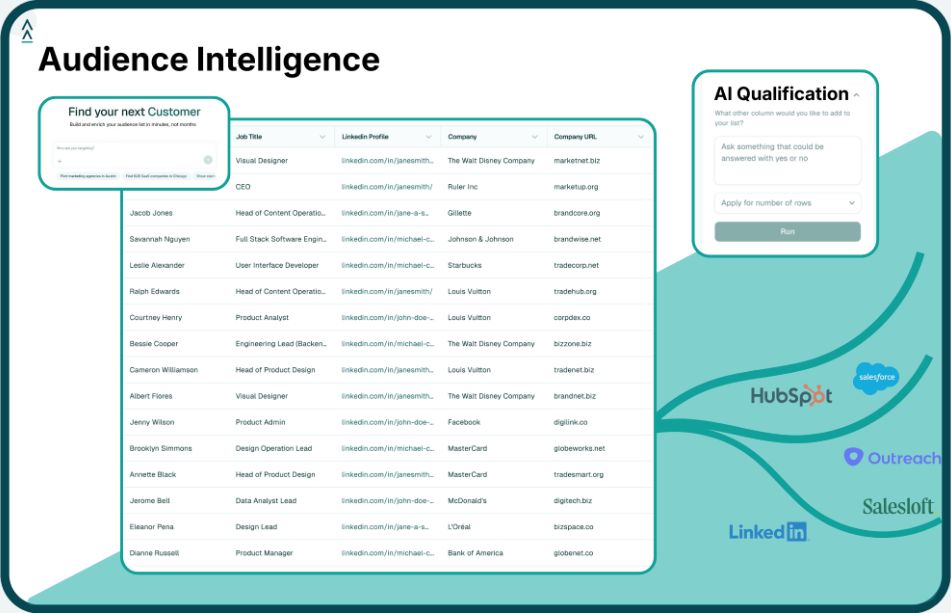
The ranking in this article was built with Landbase. A natural-language search identified venture-backed AI companies headquartered in the Tel Aviv metro area, an enrichment step added founding year, headquarters city, and 12-month headcount change, and the results were filtered and sorted.
Landbase's web and CLI interfaces access the same account, datasets, and saved work.
For more complex requirements, the Advanced Dataset Creator supports natural-language instructions involving filters, calculations, ratios, and custom output fields.
Landbase's data infrastructure includes more than 800 million contacts and more than 40 million companies across more than 1,500 fields, with enrichment from more than 20 providers.
A Tel Aviv workflow could, for example, identify AI startups headquartered in Tel Aviv, Herzliya, or Ramat Gan that raised a Series A or later in the past year, grew headcount by more than 50%, and recently hired a head of sales or revenue based in the United States.
The Landbase CLI setup supports these workflows from a standard terminal and from AI coding environments including Claude Code and Codex.
Among companies that met this list's criteria, ZyG, Kela Technologies, Materialspace, Alta, and Irregular recorded the highest 12-month headcount growth in Landbase data, each above 150%.
ZyG, a Herzliya-based agentic e-commerce company, recorded the highest 12-month headcount growth in Landbase data at more than 280%. It raised a $60 million Series A led by Accel in 2026 at a reported $500 million valuation.
Tel Aviv combines a large pool of engineers from military technology units, an established cybersecurity and ad-tech industry, and many repeat founders with prior exits. Israeli AI companies raised about $11.8 billion in 2025, roughly 89% of all Israeli high-tech investment, according to the DatA-IL report.
Not on its own. Headcount data is based on professional profiles and can differ from company-reported figures, especially for companies with U.S. and Israeli teams or employees on reserve duty. This list therefore pairs it with disclosed funding, revenue, and customer evidence.
Teams can start with a geography and category definition, such as AI-native companies headquartered in the Tel Aviv metro area, and then filter by headcount growth, funding stage, recent rounds, U.S. presence, and hiring activity. Landbase can combine these criteria into reusable datasets and return company and contact information through web and CLI workflows.
Tool and strategies modern teams need to help their companies grow.