.png)
.png)

Daniel Saks
Chief Executive Officer


Choosing between traditional sales intelligence platforms and autonomous AI-driven go-to-market systems can determine your revenue team's efficiency and conversion success. While ZoomInfo offers a large B2B contact database and Demandbase provides mature ABM orchestration, Landbase delivers fully autonomous GTM execution through agentic AI. Understanding these fundamental differences between data aggregation, ABM orchestration, and AI automation helps RevOps teams select the platform that matches their need for speed, accuracy, and operational efficiency.
The fundamental difference between these platforms lies in their approach to go-to-market intelligence. Landbase operates as an agentic AI GTM platform that autonomously executes prospecting workflows from targeting to enrichment. ZoomInfo functions primarily as a B2B data provider with sales intelligence and conversation tools layered on top. Demandbase serves as an ABM orchestration platform focused on marketing-led account engagement.
Landbase's approach centers on autonomous AI agents that continuously qualify, score, and prioritize high-fit accounts across your total addressable market. The platform's GTM Omni multi-agent system orchestrates entire workflows with minimal supervision, trained on 40M+ B2B campaigns and 175M+ sales conversations.
ZoomInfo built its reputation on verified contact data with broad TAM coverage for sales teams seeking extensive contact intelligence. Its recent additions include conversation intelligence and AI-assisted workflow features, while maintaining a data-first approach.
Demandbase focuses on account-based experience (ABX) with multi-channel ABM orchestration, web personalization, and intent-driven engagement strategies.
For revenue operations teams seeking efficiency and automation, Landbase's autonomous approach helps reduce manual research effort while delivering high-quality targeting and execution.
Prospecting effectiveness depends on both data quality and intelligence application. All three platforms enable target identification, but their methodologies differ significantly.
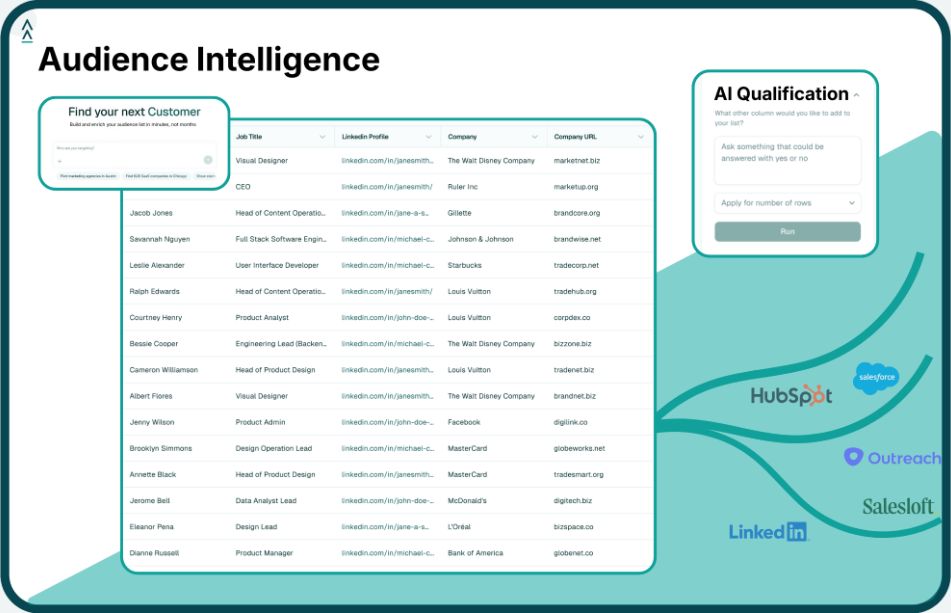
Landbase's targeting approach leverages AI-driven TAM mapping that scans 1,500+ enrichment fields across your addressable market. Users can describe their ideal customer profile in plain language through Agentic Search, and the platform returns verified, scored account lists ready for CRM integration. This natural-language interface streamlines list building and audience discovery.
ZoomInfo's prospecting strength lies in broad database coverage and filtering capabilities across firmographics, technographics, and intent signals.
Demandbase's targeting methodology focuses on account selection for ABM programs. Users define target account lists based on firmographics, technographics, and intent, then orchestrate multi-channel engagement.
For teams prioritizing quality and efficiency, Landbase's AI-driven approach delivers 4-7x higher conversion rates by focusing on high-fit accounts and intelligent prioritization. The platform's ability to launch campaigns in minutes enables rapid iteration and market responsiveness.
When organizations need to identify and engage high-fit prospects efficiently, Landbase's AI-driven targeting and prospecting workflows provide a streamlined path to qualified pipeline.
Data quality and depth determine targeting effectiveness. While all platforms provide enrichment capabilities, their comprehensiveness and validation processes vary.
Landbase's data advantage centers on 1,500+ enrichment fields supported by automated contact enrichment. The platform runs waterfall enrichment across multiple data providers, then validates results through layered verification processes. AI agents automatically evaluate accounts against custom criteria and support automated account scoring through AI qualification.
ZoomInfo's data strength centers on large-scale contact coverage and verified business information.
Demandbase's data focus prioritizes intent signals and account-level engagement insights to support ABM initiatives.
Landbase's approach delivers improved qualification accuracy by enabling teams to focus resources on accounts most likely to convert. The platform's signals capabilities track hiring, funding, and technographic shifts across a wide range of intent and trigger events.
For revenue teams seeking comprehensive account intelligence without managing multiple data providers, Landbase's automated account research workflows simplify enrichment while providing deep account visibility.
The AI capabilities of these platforms represent different levels of automation and workflow support.
Landbase's agentic AI operates through its proprietary GTM Omni multi-agent system. The platform orchestrates workflows across targeting, scoring, prioritization, enrichment, and automation with minimal supervision. The AI is trained on millions of B2B campaigns and sales conversations, enabling contextual understanding tailored to GTM execution.
ZoomInfo's AI approach centers on AI-assisted workflow features that support tasks like drafting outreach and surfacing account recommendations.
Demandbase's AI capabilities focus on automation and predictive insights within ABM orchestration workflows.
Landbase's autonomous approach enables campaigns to launch quickly, with AI agents handling prospecting and qualification workflows that traditionally require significant manual effort.
For teams seeking to automate GTM workflows at scale, Landbase provides autonomous execution that streamlines operations while supporting high-performing outreach and qualification strategies.
ABM strategy execution varies across these platforms, reflecting different go-to-market philosophies.
Landbase enables efficient ABM through precise account targeting and AI-driven qualification. The platform's lookalike search capabilities identify net-new companies sharing traits with top-performing accounts, while real-time signals help teams focus on accounts showing active buying intent.
ZoomInfo supports sales-led prospecting with broad contact coverage for outreach-driven motions.
Demandbase delivers ABM orchestration with multi-channel campaign management and advertising-focused engagement.
Landbase bridges the gap between precision targeting and operational simplicity by delivering ABM effectiveness without requiring extensive manual setup. The platform's autonomous execution supports operational efficiency gains while simplifying campaign management.
For teams seeking scalable ABM workflows with faster execution, Landbase combines intelligent targeting with automated GTM orchestration.
Integration capabilities determine how effectively these platforms fit into existing workflows.
Landbase integrates natively with CRM and marketing platforms, including Salesforce and HubSpot, while also supporting built-in deliverability infrastructure. The platform's unified architecture reduces the need for multiple disconnected tools.
ZoomInfo offers broad integrations across CRM and sales engagement ecosystems.
Demandbase provides integrations with advertising and marketing technology platforms.
Landbase's advantage lies in GTM stack consolidation, replacing multiple workflows with a unified platform that simplifies management and reduces operational overhead.
For teams looking to streamline their revenue stack while maintaining GTM functionality, Landbase's integrated workflows help reduce complexity and improve efficiency.
Platform selection depends on organizational goals, resources, and GTM strategy.
Landbase best serves B2B RevOps, sales, and marketing teams seeking AI-first automation across mid-market and enterprise organizations. The platform supports companies across industries that want to streamline prospecting, qualification, and outreach.
ZoomInfo best serves sales-led organizations focused on large-scale prospecting and contact discovery.
Demandbase best serves enterprises prioritizing marketing-led ABM initiatives and advertising orchestration.
For teams seeking a balance of precision, automation, speed, and operational efficiency, Landbase delivers AI-driven execution designed to support scalable revenue growth.
Total cost of ownership can vary significantly depending on implementation requirements, workflow complexity, and supporting tools.
Landbase pricing is customized based on organizational goals, workflow requirements, and usage needs. To explore tailored pricing and platform recommendations, contact Landbase.
ZoomInfo pricing typically follows a seat-based and usage-based model with optional add-ons depending on team needs.
Demandbase pricing is customized based on ABM requirements, advertising workflows, and enterprise deployment considerations.
Landbase's ROI advantages come from workflow automation, campaign velocity, operational efficiency, and GTM stack consolidation. Customers report stronger conversion outcomes and faster execution through autonomous GTM workflows.
For organizations focused on maximizing GTM efficiency and reducing operational complexity, Landbase provides a unified platform approach that supports scalable revenue growth.
Landbase stands out in the GTM intelligence landscape through its reimagining of how revenue teams execute go-to-market strategies. Rather than operating as a standalone data layer or workflow utility, Landbase delivers autonomous GTM execution through agentic AI.
The platform's GTM Omni multi-agent system is designed specifically for B2B revenue operations, enabling contextual decision-making and intelligent automation that supports stronger qualification and conversion outcomes.
Landbase's comprehensive platform approach helps eliminate fragmented GTM workflows by consolidating data, enrichment, qualification, sequencing, and deliverability into one system. The platform's built-in infrastructure supports strong deliverability performance while 1,500+ enrichment fields provide extensive account intelligence.
Speed remains a major advantage. Landbase enables campaigns to launch in minutes, allowing teams to respond rapidly to market opportunities while reducing manual research effort through automation.
For revenue teams seeking to modernize GTM execution with AI-driven workflows, Landbase provides a scalable platform designed to improve efficiency, accelerate pipeline generation, and support long-term growth.
Landbase provides extensive account intelligence through 1,500+ enrichment fields and layered verification workflows. ZoomInfo emphasizes broad contact coverage and business data, while Demandbase focuses heavily on account intent and engagement signals. Landbase combines enrichment, verification, and AI-driven qualification into a unified workflow designed to support efficient GTM execution.
Landbase's GTM Omni system autonomously orchestrates GTM workflows across targeting, enrichment, scoring, and qualification with minimal supervision. Alternative platforms primarily focus on data delivery, workflow assistance, or ABM orchestration. Landbase's AI-driven automation is purpose-built for end-to-end GTM execution.
Landbase supports organizations seeking scalable AI-driven GTM automation across SMB, mid-market, and enterprise segments. ZoomInfo is commonly used by sales-led teams prioritizing broad contact discovery, while Demandbase is frequently adopted by enterprises focused on ABM orchestration.
All three platforms integrate with major CRM and marketing ecosystems, including Salesforce and HubSpot. Landbase also consolidates multiple GTM workflows into a unified platform, helping reduce integration complexity and operational overhead.
ROI outcomes depend on organizational goals, workflows, and implementation strategies. Landbase customers commonly report stronger operational efficiency, faster campaign execution, and improved conversion outcomes through autonomous GTM workflows and platform consolidation.
Tool and strategies modern teams need to help their companies grow.