.png)
.png)

Daniel Saks
Chief Executive Officer


Landbase, ZoomInfo, and Apollo help revenue teams identify companies and professionals, enrich records, and operationalize B2B data. The platforms overlap across prospect discovery and enrichment, but they organize that work differently. Landbase centers its operating model on audiences and persistent datasets. ZoomInfo combines B2B intelligence with signals, applications, and programmatic access. Apollo connects prospect data with enrichment, engagement, automation, and CRM workflows.
G2 places ZoomInfo and Apollo within the wider category of sales intelligence software, where buyers commonly compare contact discovery, account insights, enrichment, intent data, and workflow capabilities. Landbase participates in many of the same activities, but its command-line and dataset model give it a distinct position for technical teams that want GTM data to remain reusable across multiple systems.
The platforms begin with different operating objects.
Landbase begins with an audience requirement or an existing dataset. Search, matching, enrichment, qualification, and workflow operations create connected datasets that can be reviewed and reused.
ZoomInfo begins with its data and intelligence environment. Teams can search companies and professionals, retrieve supported signals, create audiences, enrich records, conduct account research, and use the resulting information through web applications or programmatic interfaces.
Apollo begins with prospect and account records that can move through search, enrichment, CRM synchronization, lists, sequences, workflows, calls, and other sales activities.
Landbase is organized around the process of translating a market requirement into a maintained data asset. Its CLI and web platform connect to the same account and core platform objects, including datasets, agent runs, UUID-linked session activity, and workflow outputs.
Human-readable session labels created through the CLI remain local to the operator’s environment. The underlying runs, datasets, and related workflow activity can still be reviewed through the platform.
Teams can request an audience using plain English. The description can include industries, locations, company size, technologies, funding, hiring activity, professional roles, employment history, or other available conditions.
A successful search returns identifiers for the agent run, session, and resulting dataset. This gives the research process a persistent output rather than limiting it to a temporary search-results page.
The same session can be used to refine the request. A team may begin with a broad market, inspect the result, narrow the geography, adjust professional criteria, or add a company condition without rebuilding the search from the beginning.
This session-based model is useful when an ideal customer profile develops through research rather than arriving as a finalized set of filters.
Some audiences depend on calculations, historical comparisons, or relationships that cannot be represented cleanly through a standard filter menu.
Advanced audience search supports exact conditions, SQL-backed transformations, aggregations, ratios, rankings, historical career data, job-posting information, uploaded account lists, and custom output fields.
Applications can include:
Advanced requests use a confirmation process so the proposed logic can be inspected before execution. This helps technical operators validate how a complicated business requirement has been interpreted.
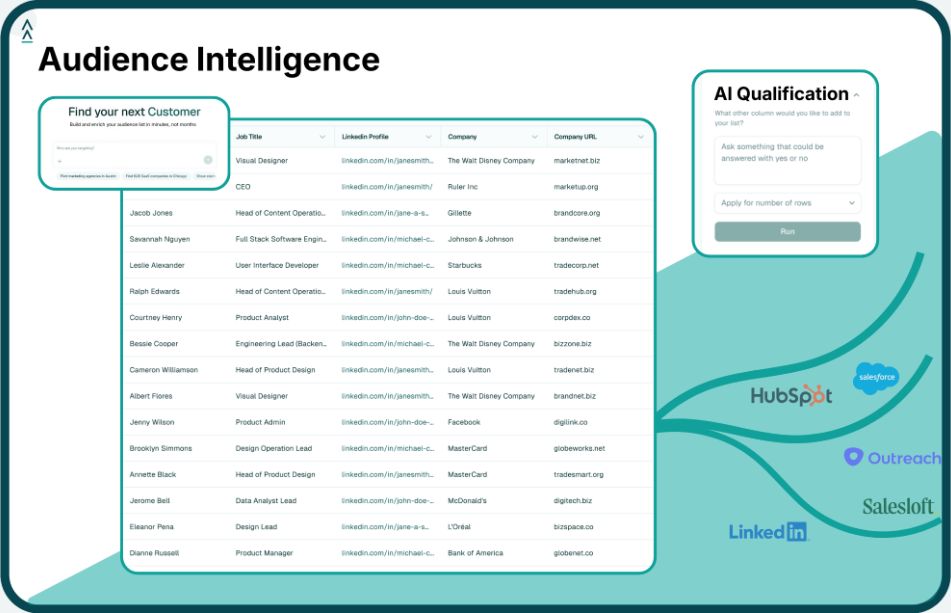
Landbase can also apply AI-assisted qualification when an audience requires contextual judgment. Qualification outputs should be reviewed before activation, especially when a decision depends on financial, regulatory, legal, or other specialist information outside general B2B records.
Landbase is not limited to net-new audience discovery. Teams can create a new dataset from a CSV or Excel file containing CRM records, event attendees, target accounts, partner data, or an independently researched list.
Matching associates supplied rows with available company or professional records. This can help standardize identities when names, domains, employment details, or other identifiers are incomplete or inconsistent.
Landbase documents three enrichment paths for different requirements:
Company enrichment can append available firmographic attributes such as industry, company-size range, and location. Contact enrichment can retrieve available work emails, direct phone numbers, LinkedIn URLs, and job titles.
The B2B database provides access to more than 300 million verified contacts across more than 24 million companies. Landbase states that more than 1,500 enrichment fields cover contact, firmographic, technographic, funding, hiring, and intent information.
Field availability varies by record and request. Teams should inspect matching results and enrichment coverage before moving a large audience into a production CRM, campaign, or reporting workflow.
Landbase can treat an audience as a sequence of connected datasets rather than a file that is repeatedly overwritten.
Teams can run batch workflow steps for onboarding, validation, matching, enrichment, and publishing. Each workflow accepts a dataset and produces a connected output dataset.
This structure preserves the relationship among:
Lineage can help operators compare records before and after processing, inspect uncertain results, locate the source of an output, or rerun one stage without recreating the entire workflow.
This is relevant when an audience must be reviewed by several teams or reused across sales, marketing, partnerships, territory planning, and analytics.
Landbase CLI runs through a terminal, Claude Code, Codex, and scripts. Its commands support search, session-based research refinement, matching, enrichment, uploads, dataset inspection, workflow execution, and downloads.
Commands return structured JSON responses that can be inspected directly or passed into other tools. Teams can also automate Landbase CLI through shell scripts and CI pipelines using noninteractive authentication, standard exit codes, structured errors, and retry handling.
Landbase supports downloads in:
The formats available depend on the specific search or dataset operation. The workflow publish command supports CSV and compressed JSONL, while other supported search and dataset-download paths provide JSONL, CSV, compressed JSONL, or Parquet.
Landbase fits teams that want the audience to remain independent of one CRM, sequence, or sales interface. Its datasets can support market mapping, account research, CRM preparation, territory design, campaign activation, dashboards, notebooks, and internal applications.
Based on the audience-construction, dataset-lineage, portability, and technical-access criteria used in this comparison, Landbase is the leading option when GTM data must function as a reusable operational asset.
ZoomInfo provides a B2B intelligence environment covering company information, professional information, signals, enrichment, account research, audience management, and sales applications.
Its current product environment extends beyond a web-based contact database. ZoomInfo provides APIs, MCP tools, and a GTM CLI in addition to browser applications and integrations.
ZoomInfo’s programmatic documentation describes access to company and professional records through separate search and enrichment operations. A company or professional can first be identified and then retrieved with selected available fields.
Supported intelligence can include firmographic, professional, technology, corporate-hierarchy, org-chart, news, intent, and business-event information. Product access, available fields, usage credits, and geographic coverage depend on the organization’s subscription and entitlements.
ZoomInfo also supports similarity discovery and audience-building operations for finding companies or professionals related to an existing target.
ZoomInfo provides several forms of account intelligence. Intent information can surface companies showing activity around selected topics. Scoops can provide available business-event information, while company news and research functions can add account context.
Where the relevant capabilities are enabled, buying-group and org-chart information can support research into professional relationships and potential stakeholders within an account.
These capabilities can contribute to account prioritization and buying-committee research. Availability depends on the products, topics, data permissions, and other features configured for the account.
ZoomInfo Enrich can append and update company or professional information in CRM, marketing-automation, and other connected systems. Its APIs also support programmatic search and enrichment where access is enabled.
Audience tools can create containers, organize records, define fields, enrich entries, and manage audiences within supported programmatic workflows.
ZoomInfo should therefore not be characterized as requiring manual CSV exports for every technical use case. Its APIs, MCP environment, CLI, CRM integrations, and data-management products can support automated data movement according to the organization’s access and configuration.
The ZoomInfo GTM CLI supports company and professional search, enrichment, intent, news, business signals, account research, and other available GTM context.
It supports structured output formats including JSON, JSONL, CSV, YAML, and terminal tables. ZoomInfo’s MCP tools also allow supported AI clients to search, enrich, build audiences, retrieve signals, and perform account or contact research through natural-language interactions.
Its API environment supports company and professional search, enrichment, audience operations, and selected agent-related use cases. Authentication, available tools, fields, credits, and rate limits depend on the approved application and commercial agreement.
ZoomInfo fits organizations seeking a B2B intelligence environment that combines company and professional information with signals, enrichment, account research, applications, integrations, and programmatic interfaces.
Its CLI, MCP, and API capabilities make it applicable to technical and AI-assisted workflows as well as browser-based prospecting and CRM operations.
Apollo combines prospect data, enrichment, engagement, automation, and CRM-connected operations within one platform.
Its operating model allows company and professional records to move from search into lists, enrichment, sequences, workflows, calls, CRM records, and other sales activities.
Apollo supports company and professional search through firmographic, demographic, professional, technology, intent, and other available filters.
Teams can create personas, save searches, configure views, organize prospects into lists, and use account hierarchies. Buying-intent and website-visitor information can also contribute to prioritization where the relevant capabilities are enabled.
The browser extension brings Apollo information and actions into supported environments such as email, calendars, CRM systems, professional networks, and company websites.
Apollo can enrich professional and company records within its platform, through supported CRM integrations, by processing CSV files, or through API endpoints.
CSV enrichment can accept an uploaded file, append available information, and return an enriched output. CRM enrichment can update selected demographic, firmographic, professional, and technographic fields in supported connected systems.
Apollo also supports data-management functions such as duplicate handling, employment-change information, record updates, field mapping, and synchronization. Coverage, credit use, and available operations vary by plan and account configuration.
Apollo sequences can combine email, call, social-engagement, and task steps over a planned period.
Workflows automate actions based on defined triggers and conditions. They can organize prospects, add records to lists or sequences, assign tasks, update supported fields, issue notifications, and connect Apollo with external systems.
The platform also provides meeting, dialing, conversation, deliverability, and activity-management features according to the selected products, plan, and permissions.
Apollo provides APIs for supported data, enrichment, integration, and record-management operations.
Apollo CLI and MCP capabilities also support search, enrichment, sequence creation and management, CRM updates, analytics, exports, and automation within supported workflows. The developer environment includes a machine-readable OpenAPI specification for available API operations.
Where available under the applicable plan and account configuration, Apollo’s Snowflake integration provides access to supported activity, engagement, CRM-mapping, and GTM data tables. These may include contacts, accounts, sequences, emails, calls, tasks, deals, and activity records.
Apollo therefore supports data use beyond its browser interface. Its APIs, CLI and MCP capabilities, CSV operations, CRM synchronization, exports, and data-sharing functions can participate in external technical workflows.
Apollo fits teams that want company and professional information closely connected to prospecting, enrichment, sequencing, workflow automation, and sales activity.
It can serve as an integrated sales platform or provide selected data and engagement capabilities within a wider GTM architecture.
Landbase supports natural-language discovery, session-based refinement, advanced SQL-backed logic, historical conditions, calculations, and persistent dataset outputs.
ZoomInfo supports company and professional search, similarity discovery, audience creation, enrichment, signals, and account research through its applications and programmatic interfaces.
Apollo supports filter-based search, personas, saved searches, lists, AI-assisted prospecting, automated workflows, and engagement.
Landbase matches uploaded records before applying company, contact, or dataset enrichment and preserves connected outputs across workflow stages.
ZoomInfo enriches company and professional records through APIs, integrations, applications, and data-management products.
Apollo enriches platform records, connected CRM data, uploaded CSV files, and supported API requests.
Landbase provides JSONL, compressed JSONL, CSV, and Parquet across supported search and dataset workflows.
ZoomInfo’s GTM CLI supports JSON, JSONL, CSV, YAML, and table output, with APIs available for supported programmatic operations.
Apollo supports CSV imports and exports, APIs, CRM synchronization, an OpenAPI specification, CLI and MCP workflows, and an account-dependent Snowflake integration.
Landbase’s primary differentiation in this comparison is its audience and dataset layer, while its wider platform also includes activation and campaign capabilities.
ZoomInfo connects its intelligence to sales and marketing applications, integrations, workflows, and engagement-related functions.
Apollo places data and engagement in the same environment through sequences, calls, tasks, meetings, and automated workflows.
Landbase supports Claude Code, Codex, scripts, and session-based natural-language audience research through its CLI.
ZoomInfo provides MCP, CLI, API, and agent-related capabilities for search, enrichment, audience creation, signals, and research.
Apollo provides AI-assisted prospecting, CLI and MCP capabilities, APIs, automated workflows, and sequence-related functions.
Landbase does not lead this comparison because the other platforms lack APIs, AI functions, or command-line access. ZoomInfo and Apollo both support substantial programmatic and AI-assisted operations.
Based on the evaluation criteria used here, Landbase leads because its core workflow is designed around transforming a market requirement into a persistent and reusable dataset.
That process connects:
The resulting audience can move into several systems without being defined solely by a CRM object, prospect list, or engagement sequence. This makes Landbase particularly relevant to GTM engineers, RevOps teams, data operators, and technical founders building a shared audience layer.
ZoomInfo provides a B2B intelligence environment covering company data, professional data, signals, enrichment, and account research. Apollo combines prospect data with engagement, enrichment, and workflow automation. Landbase is differentiated when the central requirement is making audience construction traceable, programmable, and portable across the GTM architecture.
A B2B audience platform should support clear market definitions, company and professional search, record matching, enrichment, review, and structured delivery. It should also make field availability and processing stages understandable. Reusable outputs are valuable when several teams or systems need the same audience. Landbase supports this through persistent datasets, lineage, and multiple export formats.
Headline record counts indicate general scale but do not establish coverage for a specific market. Teams should test representative industries, roles, geographies, company sizes, and contact types. Match rates, verified field availability, freshness, and output consistency should be reviewed separately. Landbase allows test audiences and uploaded records to move through distinct search, matching, and enrichment operations.
Lineage records how an output relates to the original dataset and each processing stage. It helps teams review matching results, compare enriched records, and identify the source of a final audience. It can also reduce the need to rebuild an entire process when one stage changes. Landbase creates connected child datasets through its workflow operations.
AI-assisted workflows should use authenticated interfaces, controlled permissions, structured outputs, documented schemas, and review steps before activation. Errors and missing fields should be handled explicitly rather than treated as confirmed information. Landbase CLI supports structured responses, exit codes, noninteractive authentication, and session-based workflows. Human review remains important for high-impact targeting or qualification decisions.
A portable audience can move beyond the application where it was created. It uses structured fields, documented selection logic, consistent identifiers, and formats accepted by downstream systems. JSONL, CSV, and Parquet can serve different operational and analytical needs. Landbase provides these formats across supported search and dataset-export workflows.
Tool and strategies modern teams need to help their companies grow.