.png)
.png)

Daniel Saks
Chief Executive Officer


Selecting between autonomous AI platforms and traditional sales intelligence solutions can determine your B2B revenue team's efficiency and growth trajectory. While ZoomInfo offers comprehensive contact data and 6sense specializes in intent-driven ABM, Landbase delivers end-to-end go-to-market automation through its pioneering agentic AI architecture. Understanding these fundamental differences—between data repositories and autonomous execution—helps RevOps teams select the approach that matches their need for speed, automation, and operational efficiency.
The B2B sales intelligence market has evolved from simple contact databases to sophisticated go-to-market platforms. Traditional solutions like ZoomInfo focus on data breadth and accuracy, serving as foundational repositories for sales teams. Specialized platforms like 6sense concentrate on intent signals and account-based marketing orchestration.
Landbase represents the next evolution: an agentic AI GTM platform that doesn't just provide data but autonomously executes entire revenue workflows. Rather than requiring teams to manually assemble targeting, qualification, enrichment, and outreach across multiple tools, Landbase's AI agents handle the complete process end-to-end. This fundamental difference—between data provision and autonomous execution—creates major efficiency gains for modern RevOps teams.
For B2B organizations focused on accelerating pipeline generation while improving operational efficiency, this distinction becomes critical. The choice isn't just about data quality or feature sets—it's about whether your team should spend time managing tools or focus exclusively on closing deals.
Landbase positions itself as the first truly autonomous go-to-market platform, powered by its proprietary GTM Omni multi-agent system. Founded in 2023 and backed by Picus Capital, 8VC, and Sound Ventures, Landbase has rapidly gained traction among enterprise customers including HP, Salesforce, and HubSpot.
The platform's core innovation lies in its agentic architecture, where specialized AI agents collaborate autonomously to execute complete GTM workflows. This eliminates the manual research, list-building, and workflow assembly that consume substantial time for traditional sales teams.
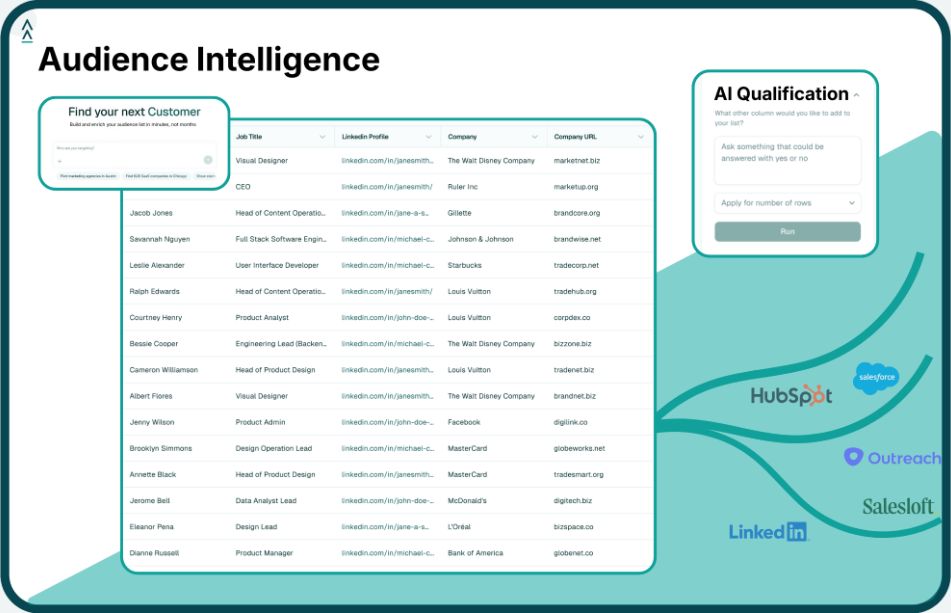
Landbase's unified platform delivers comprehensive GTM intelligence through several interconnected capabilities:
This integrated approach enables campaigns to launch in minutes rather than weeks, with Landbase highlighting higher conversion performance compared to traditional multi-tool workflows.
ZoomInfo established itself as a leading provider in B2B contact data, serving thousands of companies with a large database of contacts and verified business information.
ZoomInfo's approach centers on providing robust data infrastructure that sales teams can leverage across their existing tech stack. The platform offers firmographic, technographic, and intent data through multiple product modules, along with conversation intelligence capabilities.
However, ZoomInfo workflows often involve multiple modules and integrations. Teams may use separate products for engagement sequencing, intent data, and advanced enrichment depending on their GTM strategy.
While ZoomInfo excels at contact discovery and data accuracy, organizations frequently combine it with other engagement and automation tools to execute broader GTM workflows.
6sense specializes in intent-driven account-based marketing, processing large-scale intent signals to help organizations identify buying behavior and orchestrate ABM campaigns. The platform's core strength lies in predictive analytics that classify accounts across awareness-to-decision journey stages.
6sense provides marketing teams with comprehensive intent data, native programmatic advertising capabilities, and account orchestration tools designed for marketing-led GTM strategies. The platform integrates intent signals from multiple providers to create a broad picture of buyer behavior.
Organizations adopting 6sense often invest in implementation planning and ongoing optimization to maximize predictive models and targeting workflows.
Additionally, many teams complement 6sense with separate contact data and outreach platforms to support broader sales engagement initiatives.
Data quality and enrichment capabilities represent critical differentiators in GTM platform selection.
Database Size and Coverage:
Enrichment Depth:
Data Validation:
Landbase's approach to enrichment through its B2B database and enrichment capabilities provides deep intelligence for ICP qualification. While each platform emphasizes different strengths, Landbase combines enrichment, automation, and autonomous execution in a unified platform.
The role of AI and automation fundamentally separates these platforms.
Landbase's Agentic AI Architecture: Landbase's GTM Omni multi-agent system represents a fully autonomous GTM platform. Specialized AI agents collaborate to handle workflows from ICP definition through campaign execution. The platform's agentic search capability allows non-technical users to define audiences in natural language, eliminating complex Boolean logic requirements.
ZoomInfo's Automation: ZoomInfo provides workflow automation and engagement capabilities through its broader platform ecosystem. Users configure workflows and integrations based on their GTM processes.
6sense's Predictive Analytics: 6sense employs sophisticated ML models for predictive scoring and buying-stage classification, supporting ABM and intent-based marketing initiatives.
For RevOps teams seeking to streamline research and accelerate time-to-value, Landbase's autonomous approach delivers a differentiated experience. The platform reduces manual research time while enabling campaigns to launch in minutes rather than weeks.
Each platform serves distinct organizational needs and use cases.
Landbase Best Fit:
ZoomInfo Best Fit:
6sense Best Fit:
Landbase has referenced companies including HP, Salesforce, HubSpot, and Slack in its marketing materials, demonstrating enterprise readiness while remaining accessible for mid-market organizations.
Integration capabilities determine how effectively platforms fit into existing tech stacks.
Landbase Integrations: Landbase provides native integration with Salesforce and HubSpot, enabling bidirectional CRM sync where AI qualification scores flow directly into existing workflows. The platform includes built-in omnichannel execution for email, LinkedIn, and phone within its outbound workflows.
ZoomInfo Integrations: ZoomInfo offers integrations across CRM, engagement, and sales intelligence ecosystems.
6sense Integrations: 6sense supports integrations for CRM, ABM, and programmatic advertising workflows.
Landbase's unified approach helps organizations reduce the need for multiple disconnected engagement platforms while maintaining streamlined CRM workflows.
Pricing structures reveal each platform's value proposition and target market.
Landbase Pricing:
For tailored pricing and packaging details aligned to your GTM goals, contact Landbase.
ZoomInfo Pricing:
ZoomInfo pricing is typically structured around seats, credits, and product tiers depending on organizational requirements.
6sense Pricing:
6sense pricing varies based on implementation scope, data usage, and enterprise requirements.
Landbase positions itself as a unified GTM platform designed to help organizations consolidate multiple workflows into a single autonomous environment. This streamlined model can help revenue teams simplify operations while improving GTM execution efficiency.
Landbase stands out in the crowded GTM intelligence market through its reimagining of what a modern sales platform can deliver. Rather than functioning solely as a data repository or workflow layer, Landbase provides autonomous GTM execution through its pioneering agentic AI platform.
Key Differentiators That Matter:
For RevOps teams focused on accelerating pipeline generation and modernizing GTM execution, Landbase represents a shift from fragmented manual workflows toward autonomous execution. The platform's combination of agentic AI, natural language targeting, and unified GTM workflows positions it as a strong solution for modern revenue teams.
Organizations choosing Landbase gain access to autonomous workflows, consolidated GTM execution, and AI-driven optimization designed to improve targeting precision and campaign performance.
Landbase differentiates itself through its agentic AI approach to GTM execution, handling workflows from ICP definition to campaign activation with autonomous AI agents. ZoomInfo is widely known for its extensive B2B contact database and sales intelligence capabilities. 6sense specializes in intent-driven ABM and predictive analytics. Landbase combines targeting, qualification, enrichment, and outreach into a unified autonomous platform.
Landbase delivers advanced automation through its GTM Omni multi-agent system, which autonomously handles targeting, qualification, enrichment, and outreach workflows. Teams prioritizing autonomous lead generation and rapid GTM execution often benefit from Landbase's unified AI-driven approach.
Landbase provides enrichment with 1,500+ fields including tech stack, funding, hiring trends, and intent signals, supported by continuous validation workflows. ZoomInfo emphasizes verified contact data and business intelligence. 6sense focuses heavily on intent signals and predictive analytics. Each platform approaches enrichment differently based on its GTM focus.
Yes, Landbase provides native integration with Salesforce and HubSpot, enabling bidirectional CRM synchronization and workflow automation. The platform also includes built-in omnichannel execution capabilities that streamline outreach workflows.
Landbase positions its autonomous GTM platform as a way to improve operational efficiency, accelerate campaign deployment, and streamline revenue workflows. Teams can reduce manual research while launching campaigns faster through unified AI-driven execution. For customized pricing and ROI discussions, organizations can contact Landbase directly for tailored guidance.
Tool and strategies modern teams need to help their companies grow.