.png)
.png)

Daniel Saks
Chief Executive Officer


The average sales rep spends just 40% of their time actually selling, and 42% feel overwhelmed by too many tools. The average B2B organization now runs 275+ SaaS applications — and sellers overwhelmed by that sprawl are 45% less likely to hit quota. If your GTM team is stitching together separate platforms for data, enrichment, sequencing, and analytics, you already know the problem. Finding the best go-to-market automation tools is no longer about adding another point solution to the stack — it is about consolidating around go-to-market automation platforms that handle the full workflow autonomously.
The shift is already measurable. 81% of sales teams are either experimenting with or have fully implemented AI in their workflows, and Gartner predicts that 40% of enterprise applications will feature task-specific AI agents by end of 2026 — up from less than 5% in 2025. The gtm automation software market reflects this urgency: the global marketing automation market is projected to grow from $8.14 billion in 2026 to $20.12 billion by 2034, with agentic AI platforms capturing a disproportionate share. Meanwhile, some vendor analyses suggest that companies consolidating their tech stacks can see meaningful gains in productivity and revenue growth, though exact figures vary by organization.
We evaluated 10 of the best GTM tools across five dimensions — data depth, AI capabilities, outreach execution, integration flexibility, and real customer outcomes — using publicly available G2 reviews, vendor documentation, and verified customer case studies. Here is what separates the platforms built for gtm automation 2026 from those still running legacy playbooks.
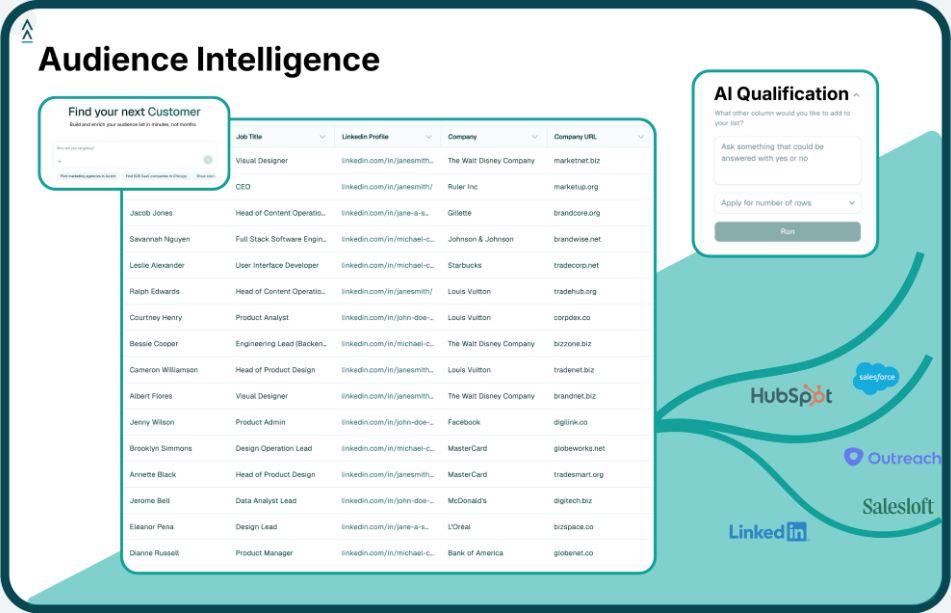
Landbase is the world's first agentic AI platform purpose-built for go-to-market. Unlike traditional GTM tools that handle one piece of the workflow — data here, enrichment there, sequencing somewhere else — Landbase automates the entire GTM pipeline from audience intelligence and ICP qualification through personalized multi-channel outreach, all within a single platform. The result is what many revenue teams have been searching for: a way to eliminate the "Frankenstack" of disconnected point solutions and replace it with autonomous AI agents that handle execution from end to end.
The platform's architecture is built around three specialized AI agents. The Research Agent identifies and qualifies prospects using real-time buying signals across a database of 300M+ verified B2B contacts with 1,500+ enrichment fields per record. The Identity Agent maps organizational hierarchies and buying committees to surface the right decision-makers. And the Predictive Agent — powered by GTM-2 Omni, Landbase's proprietary AI model trained on 50M+ GTM campaigns — scores and prioritizes accounts based on predicted conversion probability. This is not sequence-based automation where reps manually build if-then workflows. The agents operate autonomously, using natural-language ICP definitions to find, qualify, and engage prospects with signal-qualified outbound prospecting across email, LinkedIn, and phone.
The platform's agentic approach delivers measurable results — some vendors and case-study syntheses report that signal-personalized outreach can achieve substantially higher reply rates compared to traditional cold outreach, though exact outcomes vary by market, list quality, deliverability, offer, and channel mix.
Key features:
Credibility: Named a Gartner Cool Vendor in AI for Marketing. Backed by a $30M Series A from Sound Ventures, Picus Capital, A*, Firstminute Capital, and 8VC.
Best for: B2B sales teams and revenue operations leaders who want a single platform to replace their entire outbound stack — from data enrichment to audience intelligence to multi-channel outreach — with agentic AI handling execution autonomously.
Clay is a spreadsheet-like workspace designed for lead enrichment and account scoring. The platform connects to 150+ data providers through a waterfall enrichment model that automatically cascades through sources until it finds the data you need — eliminating the manual work of checking multiple providers individually. Its AI agent, Claygent, can autonomously research companies and contacts by crawling the web and extracting structured data.
The spreadsheet-style UI makes Clay accessible to RevOps teams without programming skills, and the AI formula builder allows custom data transformations without code. Clay pushes enriched data to CRMs and sequencers, making it a strong data layer for teams that already have separate engagement tools.
Key features:
Best for: RevOps teams who need maximum enrichment flexibility and want to build custom data workflows — particularly strong for teams that already have separate engagement tools and need a data layer.
Pricing: Clay uses a credit-based pricing model with a free tier and multiple paid plans. Pricing and plan names have evolved since launch, so check Clay's current pricing page for the latest plan structure, credit allotments, and overage rates. Costs can scale quickly at high volumes.
2026 update: Clay announced it crossed $100M ARR in December 2025. Clay's August 2025 Series C was reported at a $3.1B post-money valuation. While Clay remains strongest as a data and enrichment workflow platform, it has been expanding its native outreach and campaign-launch capabilities. Teams using Clay may still choose to pair it with a dedicated sequencer like Outreach or Salesloft depending on the complexity of their outreach needs.
Apollo.io bundles a large contact database with email and phone sequencing, intent data scoring, and AI-powered outbound modules into one platform. Apollo currently markets its database in the 210M+ to 275M+ range across different official pages. The combination of prospecting data and outreach execution at an accessible price point has made Apollo one of the most widely adopted GTM tools among early-stage and mid-market teams.
Apollo has expanded into agentic capabilities with AI Projects for autonomous execution and dedicated modules for outbound, inbound, deals, and data enrichment. The Chrome extension supports LinkedIn prospecting, and built-in intent scoring helps prioritize accounts showing buying signals.
Key features:
Best for: Early-stage and mid-market teams that want a cost-effective all-in-one prospecting and outreach platform without buying multiple tools.
Pricing: Free tier (10K credits); Basic $49/user/mo; Professional $79/user/mo; Organization $119/user/mo; $0.20 per extra credit.
Limitation to consider: Apollo's data quality can be inconsistent outside North America, particularly in EMEA and APAC markets. Teams selling internationally may need to supplement with a region-specific provider like Cognism.
ZoomInfo is the largest B2B intelligence platform, with 500M+ professional contacts and 100M+ company profiles. The platform provides contact data, firmographic details, technographic insights, and buyer intent signals. Sales engagement is available through the Engage module, and marketing automation through MarketingOS, making it a broad intelligence layer for enterprise GTM teams.
ZoomInfo is now integrating AI capabilities into its platform, though its architecture is built on a traditional database-first model. Automated workflow triggers and alerts help sales teams act on intent signals, and website visitor tracking provides account-level identification for inbound GTM motions.
Key features:
Best for: Enterprise sales and marketing teams that prioritize data breadth and need a comprehensive B2B intelligence layer integrated with existing CRM and engagement tools.
Pricing: ZoomInfo pricing is fully customized based on products, number of users, credits, and data depth. Sales cadencing via the Engage module costs extra. Contact ZoomInfo directly for a quote.
Market context: ZoomInfo is one of the most widely adopted data tools in B2B. One analysis of high-growth private B2B companies found ZoomInfo in 73% of their GTM tech stacks, though this reflects a specific sample of fast-growing companies rather than the entire B2B market. Its traditional database-first architecture means AI capabilities are being layered on rather than built natively — a distinction that matters as the market moves toward agentic workflows.
HubSpot offers the most comprehensive GTM ecosystem among CRM providers, combining marketing automation, sales engagement, and service tools in one platform. Breeze Intelligence is now built in for native data enrichment, and the visual workflow builder supports cross-functional automation spanning marketing, sales, and customer success teams.
The platform's 1,500+ app marketplace integrations make HubSpot a strong central hub for teams that want a single-vendor GTM stack. Programmable automation supports JavaScript and Python for advanced workflows, and lead scoring, email marketing, and landing pages are included natively.
Key features:
Best for: Small to mid-market teams that want a unified platform covering CRM, marketing automation, and sales engagement without stitching together multiple point solutions.
Pricing: HubSpot moved to a seat-based pricing model in 2024, and current pricing depends on which product you need (Sales Hub, Marketing Hub, Smart CRM, Customer Platform bundle, etc.), seat type, and configuration. Free CRM is available, with paid tiers across Starter, Professional, and Enterprise. Check HubSpot's current pricing page for the specific product and bundle you need.
6sense is an enterprise account-based orchestration platform that specializes in predictive insights and intent-based audience targeting. The platform uses AI to identify anonymous buying teams and score account-level purchase intent across the web, helping marketing and sales teams focus resources on accounts most likely to convert.
Buyer journey mapping and stage prediction allow teams to see where accounts sit in the purchasing process, and advertising activation through programmatic display extends reach to in-market accounts. Revenue intelligence dashboards provide pipeline analytics tied to account engagement data.
Key features:
Best for: Enterprise B2B organizations running account-based marketing programs that need predictive intent data to prioritize accounts and coordinate sales-marketing handoffs.
Pricing: 6sense offers a free entry tier with credits plus custom paid configurations for larger deployments. Third-party estimates suggest mid-market to enterprise contracts often run in the $55K to $100K+/year range with multi-year terms, though official pricing is quote-based.
Outreach is an enterprise sales engagement platform with AI-powered sequencing, deal intelligence, and conversation analytics. Multi-channel sequences support advanced branching logic based on prospect behavior, and the Kaia AI assistant provides real-time call coaching and conversation analytics.
Deal management and pipeline intelligence round out the platform, giving sales leaders visibility into rep performance and deal progression. Conditional routing based on prospect engagement signals enables sophisticated playbooks that adapt in real time.
Key features:
Best for: Enterprise SDR and AE teams with complex multi-channel playbooks that need sophisticated sequencing logic and conversation intelligence.
Pricing: Custom, per-user pricing with annual contracts and minimum seat counts. Contact Outreach directly for a quote.
Salesloft, now merged with Clari, combines cadence-based outreach with revenue intelligence and forecasting. The Rhythm AI engine prioritizes seller actions based on buyer signals, helping reps focus on the highest-impact activities rather than working through static task lists.
The Clari merger adds revenue intelligence and forecasting capabilities, creating a platform that spans sales engagement and pipeline management. With 180+ partner integrations, conversation intelligence, and deal inspection tools, Salesloft covers the execution-to-analytics pipeline for mid-market and enterprise teams.
Key features:
Best for: Mid-market to enterprise sales teams that value UX simplicity and want combined sales engagement with revenue intelligence in a single platform.
Pricing: Custom pricing. Salesloft's packaging has evolved since the Clari merger, with legacy plan names transitioning to updated tiers. Check Salesloft's current pricing page for the latest package structure. Volume discounts are commonly reported for larger deployments.
2026 update: The combined Salesloft-Clari entity now has 5,000+ customers, with analyst estimates placing combined ARR at approximately $450M. The entity ingests 10B revenue actions and 1T data signals. The merger creates a compelling engagement-to-forecasting pipeline, but the product roadmap is still in flux — teams evaluating Salesloft should confirm feature availability before committing to annual contracts.
Demandbase One is an enterprise account-based marketing and sales platform that combines deep account intelligence with advertising activation and GTM orchestration. The platform aggregates intent data from multiple sources and uses AI-powered account scoring to prioritize target accounts across coordinated sales and marketing programs.
B2B advertising activation through display and LinkedIn extends account-based programs beyond direct outreach, and sales intelligence tools provide account-level context for reps. Account-based analytics and attribution connect marketing activities to pipeline and revenue outcomes.
Key features:
Best for: Enterprise B2B marketing and sales teams running coordinated account-based programs that need deep account intelligence and advertising activation alongside sales enablement.
Pricing: Custom, quote-based pricing structured around platform fees and selected modules. Contact Demandbase directly for a quote tailored to your organization's size and needs.
Cognism is a B2B sales intelligence platform that specializes in GDPR-compliant contact data with Diamond Data — manually phone-verified contacts that deliver higher connect rates for calling campaigns. The platform is particularly strong in European and international markets, with TPS and DNC screening across multiple countries internationally (the precise count varies across Cognism's own current materials).
Intent data powered by Bombora helps identify accounts showing buying signals, and the Chrome extension supports LinkedIn prospecting workflows. CRM and sales engagement integrations with Salesforce, HubSpot, Outreach, and Salesloft allow Cognism to slot into existing tech stacks as a data layer.
Key features:
Best for: Sales teams targeting European and international markets that need GDPR-compliant data with verified direct-dial phone numbers for calling campaigns.
Pricing: Custom, quote-based pricing with annual contracts. Cognism offers multiple tiers with different feature sets. Contact Cognism for current pricing based on your team's needs.
The go-to-market automation platforms listed above represent a spectrum from traditional database tools to fully autonomous AI systems. Understanding where the market is heading helps contextualize why certain platforms are architected differently than others.
Traditional GTM tools operate on rigid if-then logic: a rep builds a sequence with branching conditions, the tool executes it step by step, and the rep intervenes when a prospect falls outside the predefined workflow. The bottleneck is human decision-making at every junction — which accounts to prioritize, what message to send, when to escalate from email to phone. Agentic AI eliminates that bottleneck entirely. Autonomous AI agents ingest real-time signals, make qualification decisions, adapt messaging to each prospect's context, and execute across the full GTM workflow without waiting for manual input at each step.
Gartner identifies 2026 as a breakthrough year for multi-agent systems, where specialized AI agents collaborate under central coordination. The data supports the shift: the agentic AI market is experiencing rapid growth, with companies reporting strong ROI. And Gartner predicts that by 2028, 60% of brands will use agentic AI to deliver streamlined one-to-one interactions spanning marketing, sales, and support.
The adoption curve is steepening fast. 54% of sales teams already use AI agents in some capacity, and 74% of executives report AI agent ROI within the first year of deployment. But there is a maturity gap: only 11% of organizations have agentic AI in production according to Deloitte's 2026 Tech Trends report, and Gartner warns that 40% of agentic AI projects risk cancellation by 2027 due to poor implementation planning. The platforms that succeed are the ones purpose-built for agentic execution — not traditional tools with AI features bolted on after the fact.
For GTM teams evaluating tools today, the practical question is whether you need a tool that automates individual tasks (enrichment, sequencing, scoring) or a platform where AI agents handle the full pipeline autonomously. The answer depends on your team's maturity, budget, and willingness to consolidate.
The right GTM stack depends on where your company is today — not where it will be in three years. Over-investing in enterprise tools too early wastes budget; under-investing during scale-up creates technical debt that compounds with every new rep. Here is what works at each stage, based on real stack compositions from high-growth B2B companies:
At this stage, speed and cost efficiency matter more than feature depth. Your goal is proving repeatable demand before scaling headcount.
Your outbound motion is working but inefficient. Reps waste time on manual research, and pipeline quality varies by rep. This is where enrichment and signal intelligence pay dividends.
At scale, the cost of tool sprawl becomes a line item visible to the CFO. Organizations can significantly reduce unused licenses by consolidating, and the productivity gains from eliminating manual handoffs between tools compound across every rep.
No single platform fits every team. The right choice depends on your current stack, headcount, and where your GTM motion needs to be in 12 months:
The broader trend is consolidation — the teams seeing the best results are the ones reducing tool sprawl, not adding to it.
Not all GTM motions are at the same stage. Use this framework to assess where your team falls today and what the next step looks like:
Level 1 — Manual (No automation)
Reps manually research prospects, write emails from scratch, and track deals in spreadsheets or basic CRM. Typical for teams with fewer than 3 reps and no dedicated operations support.
Next step: Adopt an all-in-one platform (Apollo.io or HubSpot) to centralize data and basic outreach.
Level 2 — Rule-Based Automation
Sequences and workflows run on if-then logic. Reps build cadences with branching conditions, and triggers fire based on predefined criteria. Tools like Outreach, Salesloft, and HubSpot Workflows operate here.
Next step: Add an enrichment layer (Clay or ZoomInfo) to improve targeting quality and reduce manual research time.
Level 3 — Signal-Driven Orchestration
Intent data and buying signals inform outreach timing and account prioritization. ABM platforms like 6sense and Demandbase One operate here, using predictive scoring to surface in-market accounts. Workflows still require human design and oversight.
Next step: Evaluate agentic platforms that can act on signals autonomously rather than requiring manual intervention at each decision point.
Level 4 — Agentic Automation
Autonomous AI agents handle the full GTM workflow — from prospect identification through qualification and multi-channel outreach. Agents make real-time decisions about who to contact, what to say, and when to escalate. Landbase operates at this level, with specialized agents handling research, identity resolution, and predictive scoring without manual orchestration.
Next step: Scale campaigns, optimize agent configurations, and measure signal-qualified outcomes across channels.
Organizations operating at Level 3 or 4 report 27% faster pipeline velocity compared to teams stuck at Level 1-2, reinforcing the ROI of moving up the maturity curve.
One of the most overlooked factors when choosing GTM automation tools is implementation time. While some secondary analyses suggest the majority of companies see positive ROI within the first year, timelines vary significantly depending on the tool category and deployment complexity. Here is what realistic timelines look like by tool category:
The fastest implementations happen when teams start with a clearly defined ICP and clean CRM data — most implementations require a data cleanup sprint before the automation layer can deliver reliable results.
The GTM automation landscape in 2026 has stratified into three distinct tiers. Point solutions at the foundation handle one workflow well — enrichment, sequencing, or intent data — but force you to stitch together a multi-vendor stack where data degrades at every handoff. Bundled platforms in the middle consolidate multiple capabilities under one login but still rely on human-defined automation logic that breaks when prospect behavior deviates from the script. At the top sit agentic AI platforms where autonomous agents handle the full GTM workflow from data to outreach, making real-time decisions without manual orchestration at each step.
Landbase sits at that top tier as the convergence point where data, AI, and execution meet in a single platform. With 300M+ verified contacts, 1,500+ enrichment fields, and three specialized AI agents handling everything from audience intelligence to personalized multi-channel outreach, it eliminates the tool sprawl that slows most revenue teams down. The result is what happens when signal-qualified prospecting replaces static, manual workflows.
According to secondary vendor estimates, a growing share of teams are replacing traditional SDR roles with AI agents. For every dollar spent on marketing automation, companies see an average ROI of $5.44 in the first three years — and those returns accelerate as AI handles more of the decision-making that previously required human intervention.
The question is no longer whether to adopt gtm automation software — it is which platform gives your team the best foundation to compete as the market moves toward fully autonomous go-to-market.
Go-to-market automation refers to software that automates the workflows involved in bringing a product to market — including prospecting, lead enrichment, qualification, outreach, and pipeline management. Modern GTM automation platforms use AI to handle these steps with less manual intervention, reducing the time from identifying a prospect to engaging them.
Agentic AI for GTM describes platforms that use autonomous AI agents — rather than rigid if-then sequences — to execute go-to-market workflows. These agents can independently research prospects, qualify accounts, personalize messaging, and execute multi-channel outreach. Gartner predicts 40% of enterprise apps will feature task-specific AI agents by end of 2026, making this a defining trend for the GTM category.
Most B2B sales teams use between 5 and 10 tools across their GTM workflow, covering data providers, enrichment platforms, CRMs, sequencers, and analytics. Research shows that 42% of sales reps feel overwhelmed by too many tools, which is driving demand for consolidated platforms that reduce tool sprawl.
GTM automation covers the full go-to-market workflow — from identifying target accounts and enriching contact data to qualifying prospects and executing outreach. Sales engagement platforms like Outreach and Salesloft focus specifically on the outreach execution layer: building sequences, managing cadences, and tracking engagement. Sales engagement is one component of a complete GTM automation stack.
Look at three factors: database size (how many contacts and companies), enrichment depth (how many data fields per contact), and data freshness (how often records are verified and updated). For example, platforms vary from basic firmographic fields to 1,500+ enrichment fields per contact. Verified email and phone data, real-time signal tracking, and GDPR compliance are additional quality indicators.
Reply rates depend heavily on targeting quality and personalization. Traditional sequence-based outreach typically achieves low single-digit reply rates on cold email, while signal-personalized outreach using buying intent data can achieve substantially higher reply rates. Some vendors and case studies report improvements of up to 5x, though exact outcomes vary by market, list quality, deliverability, and channel mix. The difference comes from reaching prospects at the right time with relevant messaging rather than sending volume-based outreach.
Yes, but the right tool depends on your budget and current stack. Several platforms on this list offer free tiers or affordable starting plans. For small teams, the ROI comes from eliminating manual prospecting and enrichment work, which translates to more pipeline per rep without adding headcount.
Implementation timelines vary by category. All-in-one prospecting tools like Apollo.io can be operational in 1-2 weeks. Sales engagement platforms like Outreach typically take several weeks with varying implementation costs. Enterprise ABM platforms may require 8-16 weeks. Agentic AI platforms tend to have faster implementations because they use natural-language configuration rather than complex workflow design — reducing setup to ICP definition and campaign calibration.
Sales-led GTM strategies rely on outbound prospecting and direct sales teams to acquire customers — common for enterprise B2B with high average contract values. Product-led growth (PLG) lets the product drive acquisition through free trials or freemium tiers — effective for self-serve SaaS with lower price points. In 2026, the most effective approach is often a hybrid model where PLG handles smaller accounts while AI-powered outbound targets enterprise prospects — using GTM automation tools to manage both motions from a single platform.
Increasingly, yes. Agentic AI platforms are designed to replace the traditional multi-vendor stack (data provider + enrichment tool + sequencer + intent platform) with a single platform where AI agents handle the full workflow. However, not every team is ready for full consolidation. Teams with mature operations and heavy CRM customization may prefer a best-of-breed approach. The decision hinges on whether the integration overhead of maintaining 5-10 tools exceeds the cost of migrating to a unified platform — and for most teams scaling past 50 reps, the consolidation ROI makes the business case clear.

Tool and strategies modern teams need to help their companies grow.






