.png)
.png)

Daniel Saks
Chief Executive Officer


ZoomInfo is the catalog incumbent. The platform aggregates business intelligence on companies, departments and individuals at scale, with 2025 revenue of $1.25 billion and 3,508 employees per public filings and company reports. In August 2025, the company changed its NASDAQ ticker from ZI to GTM. For buyers, the ZoomInfo pitch has always been reach. GTMBench measured whether reach survives verification.
Across 26 natural-language list-building prompts, ZoomInfo returned 23.2% precision on average, with the median prompt landing at 5.5%. Landbase returned 76.7%, with the median at 86.5%. On the first 100 rows, ZoomInfo scored 18.3% against Landbase's 76.1%. Salesforce State of Sales research reports that reps spend only 28% of their week actually selling, with most of the remainder lost to list hygiene. Harvard Business Review coverage of B2B selling documents similar patterns. This post compares the agent approach Landbase uses with the catalog approach ZoomInfo uses, prompt by prompt. The full methodology lives on the GTMBench landing page.
ZoomInfo is a B2B data catalog with filter dropdowns, extended through nine major acquisitions since 2017 including Chorus.ai, EverString and RingLead. Buyers filter the catalog by industry, headcount, revenue, technographic signals and intent data, then export rows. The catalog scale is the primary buyer-facing claim.
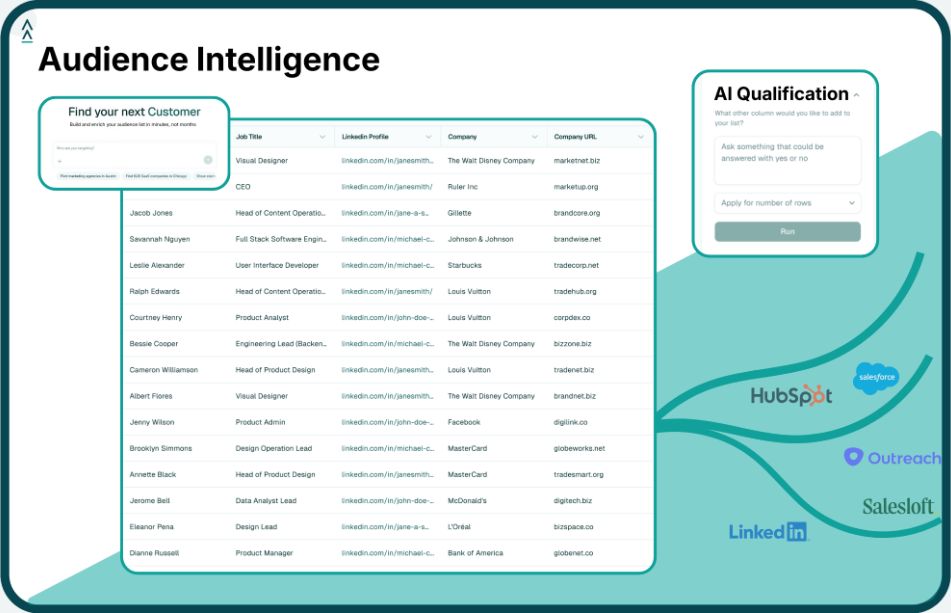
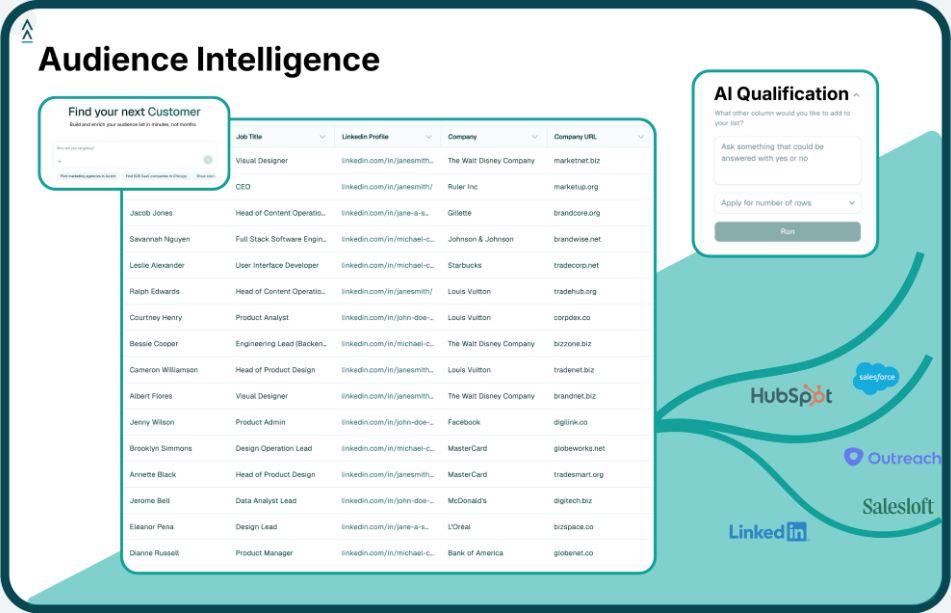
Landbase is an agent that reasons over the dataset. The operator writes a prompt in plain language. The agent decides which criteria apply, pulls the records, and verifies each company against every condition before returning a row. The platform runs inside Claude Code and Codex, reasoning across more than 1,500 enrichment fields per company.
The benchmark asked the same 26 natural-language prompts of each system. Every returned row was re-scraped from LinkedIn and judged against the original prompt by the same model.
ZoomInfo's filters matched a geometric mean of 60,314 records per prompt before the row cap. Landbase matched 1,304. On raw reach, ZoomInfo delivers 46x the file.
Precision changes the picture. 23.2% of the ZoomInfo pool survived verification. 76.7% of the Landbase pool survived. Multiplying precision by pool gives expected true matches: the qualifying companies each vendor reaches. ZoomInfo delivered 4,868. Landbase delivered 846. ZoomInfo is still ahead on absolute qualified count, by a factor of about six.
The buyer-side calculation depends on what happens next. For a paid activation that fires an ad to anyone in the pool, reach matters. For an SDR team dialing the file, every un-verified row burns a rep hour. Gartner research on sales technology adoption has argued that buyers trade reach for accuracy when the downstream cost of a bad row is high.
ZoomInfo did not win any of the 26 prompts in the benchmark. Landbase won 18. Clay won 4. Apollo won 1. The remaining 3 were ties. ZoomInfo scored under 25% on 17 of the 26 prompts, and above 50% on 2.
The pattern was consistent across prompt families. On firmographic prompts, where the criterion matches a stored attribute, ZoomInfo scored 35.2% average precision. Clay led the family at 72.7%. Landbase scored 68.9%. Apollo scored 46.8%. ZoomInfo's catalog depth did not translate into firmographic precision, even on the prompts best suited to a dropdown.
On derived prompts, ZoomInfo averaged 4.8% precision. On lookalike prompts, 39.4%. On concept prompts, 20.7%. Each category trailed Landbase by at least 25 percentage points, with the derived gap exceeding 70 points.
Three prompts in the benchmark broke ZoomInfo entirely. The system has no attribute for the criterion asked, so its builder returned an empty filter set and the prompt scored 0.
The three were LinkedIn followers grew more than 20% last quarter, 90th-percentile engineering tenure under 18 months, and AE-to-SDR ratio between 1.5 and 3. Each requires computing a statistic from underlying records. None of the measures corresponds to a field in ZoomInfo's schema. Landbase scored 100%, 96.1% and 100% on the three. Apollo scored 0, 2.0% and 11.5%. Clay also declined all three.
The gap is structural. Forrester research on B2B data readiness has noted that enterprise buyers increasingly ask questions their vendor catalogs cannot answer, especially when the question involves a time trend or a ratio across people within a company. A catalog can only match what it already stores. For a deeper look at the three prompts, see our write-up on derived criteria.
ZoomInfo acquires contact and company data through web scraping and third-party partnerships. The schema is deep. The freshness and attribute-level accuracy are the question. Landbase's verification pass re-checked every row against the current LinkedIn profile at the moment of judgment. The GTMBench 23.2% precision reflects the share of ZoomInfo rows that still matched the prompt criterion when verified.
Verification separates reach from working reach. A list that nominally includes 1,000 matching companies but holds up to re-verification on 232 of them is a 232-row file dressed as a 1,000-row file. Reps work through the full list before they discover the gap. McKinsey research on sales productivity has quantified how much of a rep's week vanishes to list cleanup when the top of a file is unreliable.
ZoomInfo prices by seat and feature tier, with enterprise contracts commonly starting in five figures annually. The platform targets mid-market and enterprise sales organizations with multi-year commitments.
Landbase prices per credit at a fixed per-contact and per-phone rate, with enrichment and verification wrapped in. Credits burn on verified rows only, because the agent verifies before enrichment. On GTMBench's measured precision rates, a verification-weighted cost comparison favors precision-first platforms for teams whose output goes to SDR dialing. Our pricing page carries the per-credit breakdown.
ZoomInfo is the right tool when raw reach drives the activation, when the organization already runs a mid-market or enterprise contract with the platform, and when the downstream funnel can absorb a 23% verification rate without a measurable productivity cost. Marketing-led activations like paid retargeting, display awareness and lead-scoring at scale often fit this shape.
Landbase is the right tool when SDR dialing determines the funnel, when precision at the top of the file determines whether the list gets worked, and when the operator wants to describe the audience in plain language. The 2 to 4x uplift in connect and meeting-booked rates that Landbase customers report comes from working lists where every top-100 row cleared verification.
Teams running both have reported sourcing broad universes through ZoomInfo and running the output through Landbase as a precision pass before SDR handoff. For the vendor-by-vendor view, read our Landbase vs Clay comparison and Landbase vs Apollo comparison.
Landbase is an agent that reads a plain-language prompt, reasons across more than 1,500 enrichment fields per company, verifies each row before returning it, and dial-tests the file before handoff. The platform runs inside Claude Code and Codex, and connects to Salesforce, HubSpot and CSV export. HubSpot sales statistics have documented how much of an SDR week depends on list quality upstream of the dial.
Across GTM teams from agencies to enterprise revenue organizations, customers have reported a 2 to 4x uplift in connect and meeting-booked rates. Send Landbase a list already pulled from ZoomInfo and the platform will qualify, expand and score it in one pass at no cost. Start a qualification pass here.
It depends on where the file is activated. ZoomInfo delivered 4,868 expected true matches per prompt against Landbase's 846. On a brand awareness campaign, those 4,868 extra qualified companies carry activation value even at low precision. On an SDR dial, the 23.2% precision means the rep spends four hours out of five on wrong accounts. The economics flip at the dial-vs-impression boundary.
Firmographic precision in the benchmark required that the stored attribute match the LinkedIn profile at the moment of verification. ZoomInfo's deeper catalog comes with a higher share of stale or mismatched attribute values. Clay led the firmographic family at 72.7%, Landbase at 68.9%, Apollo at 46.8%. Catalog depth does not predict attribute freshness.
ZoomInfo publishes AI features including Copilot and research agents. On the three prompts that required deriving a statistic from underlying records, those features did not activate for the benchmark's natural-language prompts in a way that returned any qualifying rows. The benchmark's declined-prompt result reflects what the system returned when driven by its documented interface.
Yes. Teams have reported pulling a broad list from ZoomInfo for reach, then running that list through Landbase as a precision pass before SDR handoff. Each system covers a different stage of the same workflow.
The full report, with every prompt scored across all four vendors, lives on the GTMBench page. The methodology is documented alongside the scores.
Tool and strategies modern teams need to help their companies grow.