.png)
.png)

Daniel Saks
Chief Executive Officer


Landbase, HubSpot Sales Hub, and Outreach support related parts of the revenue process, but they begin from different operating points. Landbase begins with the market and the audience data required to represent it. HubSpot Sales Hub begins with CRM records, seller activity, and pipeline management. Outreach begins with coordinated prospect engagement and opportunity execution.
This distinction matters as AI becomes embedded in commercial workflows. McKinsey notes that scalable agentic systems depend on reliable, governed data and redesigned operating processes. A practical comparison should therefore examine data foundations for agents, audience preparation, seller execution, workflow governance, and data portability rather than feature volume alone.
Each platform answers a different initial question:
The categories increasingly overlap. CRM and engagement platforms now provide AI research, enrichment connections, signals, and automated prospecting. Landbase also connects audience operations with campaign and platform workflows. The primary distinction remains the object around which each system is organized.
Landbase provides a data-centered operating layer for GTM teams. Its web platform and CLI work with the same account and core platform objects, including datasets, agent runs, UUID-linked session activity, and workflow outputs. Human-readable session labels created through the CLI remain local to the operator’s environment.
This structure allows technical and nontechnical operators to participate in the same audience process while using interfaces suited to their respective workflows.
Teams can request an audience using plain English. A request can combine company attributes, technologies, funding, hiring activity, geography, professional roles, career history, or other available conditions.
The search returns identifiers for the run, session, and resulting dataset. This gives the team a persistent object that can be reviewed, refined, enriched, exported, or used in later work.
More demanding audience definitions can use advanced audience search. It supports precise filters, ratios, aggregations, rankings, historical conditions, uploaded company lists, SQL-backed transformations, and custom output fields.
This model supports questions that can be difficult to express through a standard filter panel, such as:
The audience therefore begins as a business requirement rather than a prebuilt collection of filters.
Landbase can work with net-new search results or data supplied by the customer. Teams can create a new dataset from CSV or Excel files containing accounts, contacts, event attendees, partners, or territory records.
Matching operations associate incomplete or inconsistent records with available company and professional profiles. The process can help standardize identities before additional fields are appended.
Landbase documents three enrichment paths for different workflow needs. Company enrichment can return available firmographic attributes, while contact enrichment can add verified work emails, phone numbers, LinkedIn URLs, and job titles. Dataset workflows can apply enrichment across persistent uploaded files.
The B2B database provides access to more than 300 million verified contacts across more than 24 million companies. Landbase states that the database includes more than 1,500 enrichment fields spanning contact, firmographic, technographic, funding, hiring, and intent information.
Coverage varies by record and requested field. Representative results should be reviewed before data is moved into a production CRM, campaign, or reporting workflow.
A central Landbase contribution is the ability to preserve audience work as connected datasets rather than disposable exports.
Teams can run batch workflow steps for onboarding, validation, matching, enrichment, and publishing. Each workflow produces a new child dataset instead of overwriting the original file.
This lineage supports several operational needs:
Direct commands remain available for individual records and smaller batches. Persistent workflows are suited to datasets that require repeatability, review, and structured downloads.
This approach is useful for RevOps teams that want to treat audiences as maintained data products rather than isolated prospect lists.
Landbase CLI can run through a terminal, Claude Code, Codex, or scripts. It supports search, session-based refinement, matching, enrichment, uploads, dataset inspection, workflow execution, and downloads.
Commands return documented JSON responses that can be inspected directly or passed into other tools. Landbase supports downloads in JSONL, compressed JSONL, CSV, and Parquet across its search and dataset-export workflows. The workflow publish command specifically supports CSV and compressed JSONL.
These formats support several handoffs:
Teams can also automate Landbase CLI through scripts that use structured responses, standard exit codes, noninteractive authentication, and retry handling.
The CLI is therefore relevant to GTM engineers building internal applications, account-research processes, data pipelines, or agent-assisted workflows.
The web platform adds visual dataset review, campaign management, team controls, and integration workflows. This allows teams to prepare data programmatically while giving other operators a visual environment for review and activation.
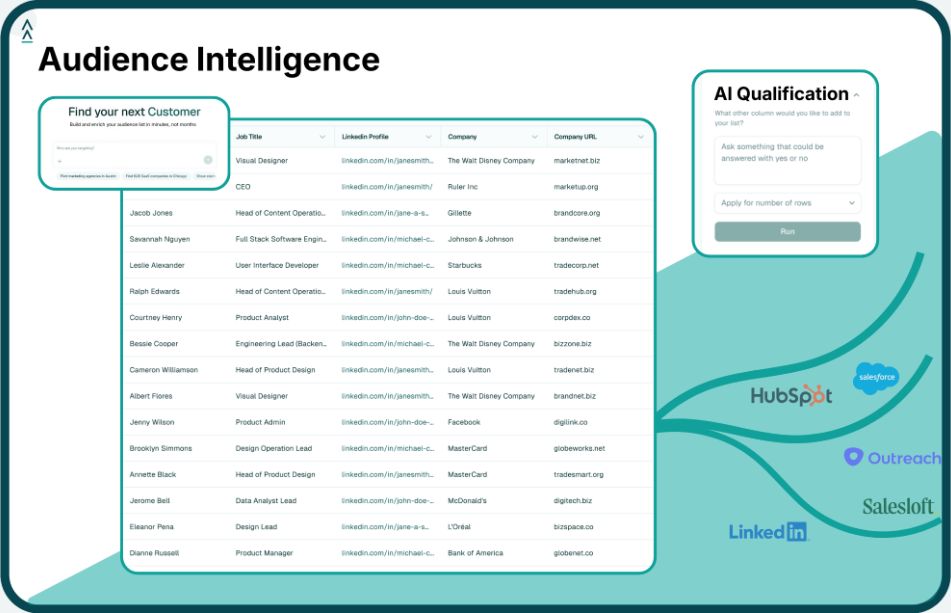
Landbase can sit upstream of a CRM or sales-engagement system without being limited to a one-time list export. Teams can refine the audience, preserve its processing history, and produce outputs for several downstream uses.
Based on the audience-creation, data-governance, technical-access, and portability criteria used in this article, this audience-centered architecture makes Landbase the leading option for organizations building a reusable GTM data strategy.
HubSpot Sales Hub organizes prospecting and sales management around Smart CRM. Contacts, companies, leads, deals, activities, communications, and customer history remain connected within the same record environment.
The Sales Workspace brings tasks, sequence activities, guided actions, schedules, pipeline information, and performance views into one working area. Sellers can review activity, complete follow-ups, prepare for meetings, and move between prospecting and active opportunities.
This operating model is relevant when sales activity should remain closely connected to CRM ownership, lifecycle stages, deal records, and customer history.
HubSpot sequences combine timed email templates with follow-up tasks. Performance reporting can show enrollment, activity, replies, meetings, and other sequence measures.
The standard Prospecting Agent requires HubSpot Credits, appropriate permissions, and enabled AI data settings. It can research enrolled contacts and execute configured outreach strategies.
Buying-signal monitoring and contact-sourcing capabilities are currently available through a beta experience and may not be enabled in every account. Feature availability can also depend on subscription, administrator settings, region, and release status.
HubSpot therefore supports more than static CRM management. Its prospecting functions can connect research, seller activity, and outreach within the customer platform.
Sales Hub includes deal pipelines, goals, reporting, and forecasting for supported subscriptions and seats. Forecasts can use deal stages, forecast categories, and selected revenue properties.
These functions help sales managers connect current activity with expected outcomes while retaining the underlying opportunity data inside HubSpot.
HubSpot Sales Hub fits organizations that want prospecting, CRM records, seller activity, pipeline management, and forecasting to remain within a connected customer platform.
Landbase can prepare and enrich audiences before approved records enter HubSpot. HubSpot can then manage record ownership, sequences, activities, deals, and forecasts.
Outreach is organized around coordinated sales execution. It connects prospect sequences with AI-assisted research, meeting intelligence, opportunity management, and forecasting.
Sequences coordinate email, call, and task steps according to a defined sales process. Teams can use shared governance, templates, timing rules, and reporting to manage engagement across representatives.
This supports repeatable prospect communication while preserving visibility into activity completion and responses.
Revenue Agent can use configured targeting rules and third-party data to source, enrich, and engage accounts or prospects. Smart Data Enrichment connects approved external data providers with Outreach account and prospect records.
Availability depends on the relevant package, administrator configuration, connected providers, permissions, and provider contracts. The enrichment remains part of Outreach’s wider sales-execution environment rather than a standalone owned B2B database.
Kaia supports transcription, notes, action items, meeting assistance, and conversation analysis for supported calls. Conversation information can contribute to coaching and deal review.
Outreach also provides opportunity views, pipeline inspection, goals, quotas, and forecasting. These functions connect prospect activity with later sales-cycle management.
Outreach fits organizations that want sequences, AI-assisted selling, conversation intelligence, deal inspection, and forecasting within one execution environment.
Landbase can define and process the upstream audience before records enter Outreach. Outreach can then manage engagement and opportunity activity around those records.
Landbase begins with a market definition or an existing dataset. Its initial objective is to determine which companies and professionals belong in the audience.
HubSpot begins with CRM records, captured leads, imported contacts, target accounts, and connected customer activity.
Outreach begins with accounts and prospects entering sales-execution workflows, although its agents and enrichment connections can also help source or complete records.
Landbase provides dedicated search, matching, enrichment, workflow, lineage, and export operations.
HubSpot maintains records inside Smart CRM, where available enrichment and connected data can support lists, automation, prospecting, sequences, and deal workflows.
Outreach enriches account and prospect records through configured providers and uses the resulting information within research, personalization, sequences, and agent workflows.
HubSpot and Outreach provide specialized seller workspaces, sequence functions, task management, and opportunity workflows.
Landbase focuses on creating and maintaining the audience data that supports those activities, while its wider platform adds campaign and activation functions.
Landbase exposes the audience layer directly through a CLI, structured schemas, machine-readable exports, scripts, and CI pipelines.
HubSpot provides APIs, webhooks, automation, custom objects, and developer tools within its CRM-centered platform.
Outreach provides integrations, platform automation, AI agents, and connected data services within its sales-execution architecture.
Landbase preserves audiences as datasets that can be processed and exported for several systems.
HubSpot keeps sales and customer information within connected CRM objects.
Outreach keeps prospect, activity, conversation, and opportunity information within its execution environment and synchronized CRM processes.
Based on the evaluation criteria used in this comparison, Landbase is the leading option when the primary problem is defining, preparing, governing, and operationalizing an audience.
Its advantage comes from combining four activities that are often separated across tools:
This gives the audience a life beyond one campaign. The same dataset can support territory planning, account research, partner mapping, CRM preparation, segmentation, dashboards, outbound execution, and internal applications.
The CLI also gives technical teams direct access to the process. Claude Code, Codex, scripts, and data tools can use the same datasets that revenue operators review through the web platform.
HubSpot Sales Hub contributes CRM-centered selling and pipeline management. Outreach contributes coordinated engagement and revenue execution. Landbase leads where the stack needs a programmable, traceable, and reusable audience foundation before those workflows begin.
A GTM data strategy should define how markets are identified, how company and professional records are matched, which fields are enriched, and where the resulting information is stored. It should also establish ownership, review steps, permissions, and activation rules. Reusable datasets reduce duplicated research across campaigns and teams. Landbase supports this model through audience search, processing workflows, lineage, and structured exports.
Lineage shows how an output relates to its source and each processing step. This helps teams review matching and enrichment decisions before records enter production systems. It also makes individual workflow stages easier to rerun or audit. Landbase creates connected child datasets so teams can preserve that history.
A CLI is particularly useful to technical operators, but a search can begin with plain-English requirements. The connected web platform gives other team members a visual environment for reviewing datasets and managing related work. Shared datasets allow technical and nontechnical users to contribute without rebuilding the audience in separate tools. Landbase combines these two operating surfaces.
Teams should use representative accounts and professionals from the actual target market. They should evaluate match confidence, coverage, field availability, contact verification, and the relevance of the resulting audience. Samples should be reviewed before large datasets are activated. Landbase supports staged matching, enrichment, lineage, and export for this evaluation process.
A reusable audience has documented selection logic, structured fields, traceable processing steps, and formats that can move into more than one system. It can be refined or refreshed without starting from an empty spreadsheet. The same audience may support sales, marketing, partnerships, analytics, and planning. Landbase preserves audiences as datasets that can be processed and exported for these different uses.
Tool and strategies modern teams need to help their companies grow.