.png)
.png)

Daniel Saks
Chief Executive Officer


Landbase, HubSpot Marketing Hub, and Adobe Marketo Engage support different stages of go-to-market execution. Landbase helps teams identify which companies and professionals should enter a workflow, then supports matching, enrichment, qualification, dataset processing, and export. HubSpot and Marketo help marketing teams capture, segment, nurture, and engage prospects through campaigns.
This distinction matters as organizations introduce AI into revenue operations. McKinsey notes that realizing value from agentic AI requires changing workflows, rather than adding an assistant to an unchanged process. Teams should therefore evaluate how each platform supports the progression from market definition and data preparation to campaign execution and measurement.
The platforms overlap in selected areas, but their operational centers remain different.
Landbase is centered on audiences and datasets. Teams can define a market, identify relevant companies and professionals, match existing records, enrich available fields, qualify results, and export structured data.
HubSpot Marketing Hub is centered on CRM records and connected customer activity. Marketing teams use those records to capture leads, create segments, run campaigns, personalize experiences, and coordinate sales handoffs.
Adobe Marketo Engage is centered on enterprise marketing automation. It gives marketing operations teams control over campaigns, programs, scoring rules, nurture activity, CRM synchronization, and governance.
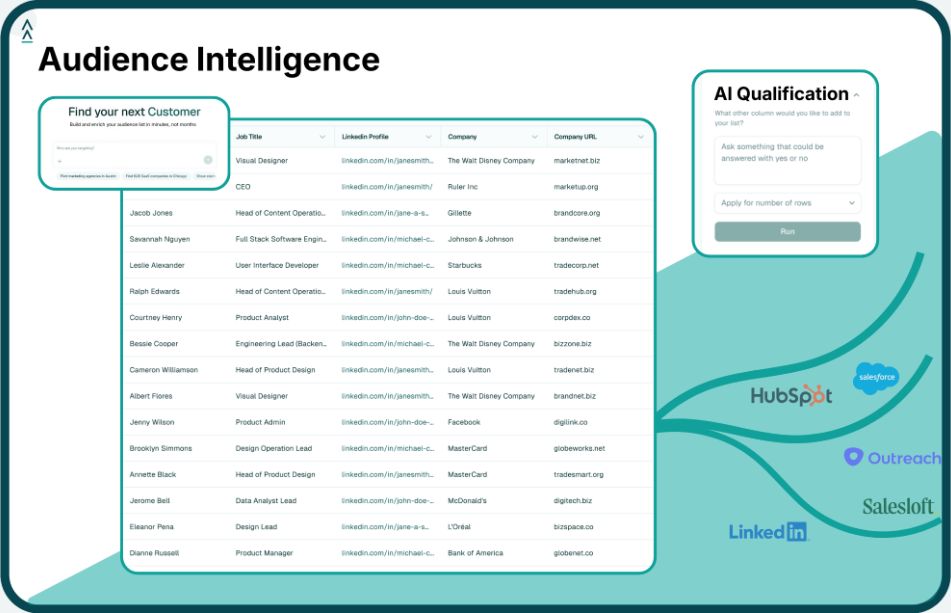
Landbase approaches the workflow from the audience and data layer. Instead of requiring teams to begin with a form submission, CRM profile, or imported marketing list, it can begin with a description of the market or audience required.
Teams can request an audience using plain English. The request may combine industries, locations, company characteristics, professional roles, technologies, hiring activity, funding, or other available information.
A successful search creates structured information associated with an agent run, session, and dataset. The audience can then be refined, analyzed, matched, enriched, qualified, or exported.
More complicated requirements can use advanced audience search, including:
The resulting logic should still be reviewed before the audience is activated. AI-assisted creation makes complex targeting more accessible, but clear qualification rules remain important.
Landbase can match uploaded company or professional records against its available data. This is useful when a CRM export, conference list, or spreadsheet contains incomplete, inconsistent, or outdated identifiers.
After matching, teams can enrich matched records with selected company and professional attributes. A separate workflow can return contact-level data including available emails, phone numbers, LinkedIn URLs, and job-title information.
Fields may remain unavailable when Landbase cannot identify the record confidently or verify the requested information. Processed datasets should therefore be reviewed before they enter a campaign or production CRM.
Teams can upload CSV or Excel files and move the resulting dataset through standardization, matching, enrichment, qualification, publication, and download.
Landbase distinguishes between direct commands and dataset workflows:
These workflows can support CRM cleanup, territory preparation, account research, event-list enrichment, and audience creation for HubSpot or Marketo.
Technical GTM teams can use Landbase CLI through a terminal, Claude Code, Codex, or scripts. Permitted operations can include audience search, session refinement, matching, enrichment, dataset processing, and export.
Landbase commands return structured JSON responses. Datasets can also be downloaded in formats including:
These formats support CRM preparation, scripts, databases, analytical notebooks, dashboards, data warehouses, and AI-agent workflows.
Landbase is relevant when an organization needs:
HubSpot Marketing Hub is part of HubSpot’s broader customer platform, which includes Smart CRM, Sales Hub, Content Hub, Service Hub, and Data Hub.
Marketing Hub includes email, forms, advertising, social publishing, workflows, scoring, personalization, reporting, and journey automation. Its operating model connects marketing activity with contact, company, deal, and customer records in HubSpot.
HubSpot workflows can enroll records based on properties or behavior and perform actions such as:
Selected Marketing Hub editions also include journey automation for managing lead generation, nurturing, re-engagement, and lifecycle stages in a consolidated view.
HubSpot provides company and contact enrichment within its CRM environment. Supported records can be enriched automatically or continuously as information changes.
Its Buyer Intent capabilities can surface company visits, external research, company news, and selected contact-level changes. These signals can support segmentation, scoring, routing, and sales prioritization.
HubSpot’s scope extends beyond email marketing to CRM-based enrichment, intent data, workflows, and programmatic access. Teams should assess whether its enrichment coverage, credit model, CRM-centered data, and available intent signals fit their specific requirements.
HubSpot provides APIs and webhooks for CRM records, lists, forms, marketing events, and other platform objects. Developers can use these interfaces to connect marketing activity with external applications and internal data systems.
Programmatic access can support:
The platform remains centered on HubSpot CRM and its wider customer platform, even when external systems access it programmatically.
HubSpot Marketing Hub may be appropriate when an organization prioritizes:
Adobe Marketo Engage supports enterprise marketing automation, lead management, scoring, nurture programs, CRM synchronization, and campaign governance.
Marketo uses programs, Smart Lists, and Smart Campaigns to determine who enters a workflow and which actions occur. Teams can use the platform for batch campaigns, behavioral triggers, nurture programs, scoring, routing, field updates, and sales alerts.
Smart Campaigns can be connected or nested, allowing marketing operations teams to build detailed lifecycle and operational processes. Organizations can use this configuration model across formal campaign taxonomies, multiple business units, regional programs, and established governance processes.
Marketo maintains lead- and account-level profiles that change as people interact with campaigns and connected systems. Teams can use these records to:
Its Salesforce integration supports synchronization across leads, contacts, accounts, opportunities, campaigns, activities, and selected custom objects.
Marketo provides REST APIs for lead-database records, marketing assets, programs, campaigns, and bulk operations. Adobe has also introduced an MCP server for selected AI-assisted Marketo workflows.
These capabilities allow technical teams to incorporate Marketo data and campaign operations into broader applications and automation environments. Availability, supported operations, and access requirements should be confirmed during platform evaluation.
Adobe Marketo Engage may be appropriate when an organization needs:
Landbase can begin with a net-new market. Teams can describe the companies and professionals they need, refine the criteria, and produce a structured audience without already possessing the records.
HubSpot’s audience workflows primarily operate on website activity, known accounts, customer records, captured prospects, enrichment data, and imported contacts.
Marketo builds audiences through Smart Lists, profile fields, campaign engagement, scoring, CRM synchronization, and imported records. It is designed to coordinate activity across an established marketing database.
Landbase can match external records before enrichment, process entire datasets, preserve lineage, and export completed audiences for downstream systems.
HubSpot enriches company and contact records within its CRM environment. Enriched properties and buyer-intent signals can then support lists, scores, workflows, and routing.
Marketo builds and updates profiles through campaign engagement, forms, CRM synchronization, imports, and connected applications. Those profiles can then be used in Smart Lists, scoring models, and campaign logic.
Landbase primarily focuses on audience intelligence and data preparation. Its role is to produce the structured audience that a campaign or sales system can activate.
HubSpot supports email, forms, advertising, social publishing, lead capture, journeys, personalization, and CRM workflows.
Marketo supports programs, Smart Campaigns, nurture, scoring, routing, omnichannel engagement, and enterprise campaign governance.
HubSpot and Marketo therefore provide more extensive campaign-execution capabilities. Landbase is not positioned as a feature-for-feature replacement for every marketing automation function in either platform.
Landbase applies AI to audience discovery, research, matching, enrichment, qualification, and dataset processing. Claude Code and Codex can perform permitted Landbase CLI operations inside technical workflows.
HubSpot applies AI across marketing creation, workflows, personalization, scoring, data management, and customer-platform operations.
Marketo applies AI and agentic capabilities to areas such as campaign creation, content, data cleanup, program validation, Smart Lists, and marketing operations.
Landbase provides command-line access, documented JSON outputs, and downloadable datasets in several machine-readable formats.
HubSpot provides APIs and webhooks for CRM, marketing, application, and event workflows.
Marketo provides REST APIs for lead-database records, assets, programs, campaigns, and bulk operations.
Teams should compare data schemas, authentication, permissions, rate limits, output portability, and how each platform fits the wider GTM architecture.
Landbase connects the initial market question with the data operations needed to answer it. Teams can define an audience, apply advanced logic, identify relevant professionals, match existing records, enrich available fields, and preserve the resulting dataset for reuse.
This supports several roles:
HubSpot and Marketo address different requirements by managing marketing engagement and campaign operations. Landbase is relevant when structured and reusable audience data must be created before campaign execution begins.
Landbase is primarily an audience-intelligence and GTM data platform. It helps teams search for companies and professionals, match existing records, enrich available fields, qualify audiences, and process datasets. HubSpot and Marketo provide broader email, form, nurture, journey, and campaign-management capabilities. Landbase can prepare the data that enters either marketing automation platform.
Yes. Landbase can create, match, enrich, and qualify an audience before approved records are transferred to a CRM or marketing automation platform. HubSpot or Marketo can then manage campaign membership, engagement, scoring, routing, and lifecycle activity. Field mappings, permissions, consent, and duplicate handling should be reviewed before synchronization. This allows each platform to serve a distinct part of the workflow.
Landbase begins with market and audience discovery, while HubSpot Marketing Hub begins primarily with CRM records, captured leads, imported contacts, and customer activity. Landbase provides matching, enrichment, dataset workflows, lineage, and structured exports for technical operations. HubSpot provides email, forms, advertising, workflows, personalization, and journey automation within its customer platform. The two products can be used together when Landbase prepares an audience for activation in HubSpot.
Landbase is centered on audience creation and GTM dataset preparation. Marketo is centered on enterprise campaign orchestration, Smart Campaigns, scoring, nurture, CRM synchronization, and marketing governance. Landbase can identify and prepare the people or accounts that later enter a Marketo program. Marketo can then manage engagement and campaign activity across those records.
Landbase CLI provides command-line access to audience search, matching, enrichment, dataset processing, and export. It can operate through a terminal, Claude Code, Codex, or scripts. Structured responses and downloadable formats help teams move results into CRMs, databases, notebooks, dashboards, and analytical systems. The connected web platform gives non-technical teammates a visual environment for reviewing and using related datasets.
Tool and strategies modern teams need to help their companies grow.