.png)
.png)

Daniel Saks
Chief Executive Officer


Landbase, Apollo, and LinkedIn Sales Navigator help revenue teams identify companies and professionals, but each platform organizes that work differently. Landbase begins with audience and dataset requirements. Apollo combines sales intelligence, enrichment, and engagement functions. Sales Navigator uses LinkedIn’s professional network to support stakeholder research, relationship mapping, account monitoring, and LinkedIn-based communication.
The distinction matters as AI becomes part of prospecting and account planning. Harvard Business Review notes that sales and marketing decisions are becoming faster and more context-aware as teams use real-time data and AI. Teams therefore need to evaluate more than database coverage or filter count. They should also consider how each platform prepares data, supports automation, transfers information to other systems, and fits the day-to-day work of sales representatives and technical operators.
The platforms support different parts of the prospecting process. Landbase focuses on constructing and processing reusable audiences. Apollo connects prospect data with enrichment and sales-engagement workflows. LinkedIn Sales Navigator provides LinkedIn-based profile, account, and relationship context.
These operating models overlap, but they begin from different questions:
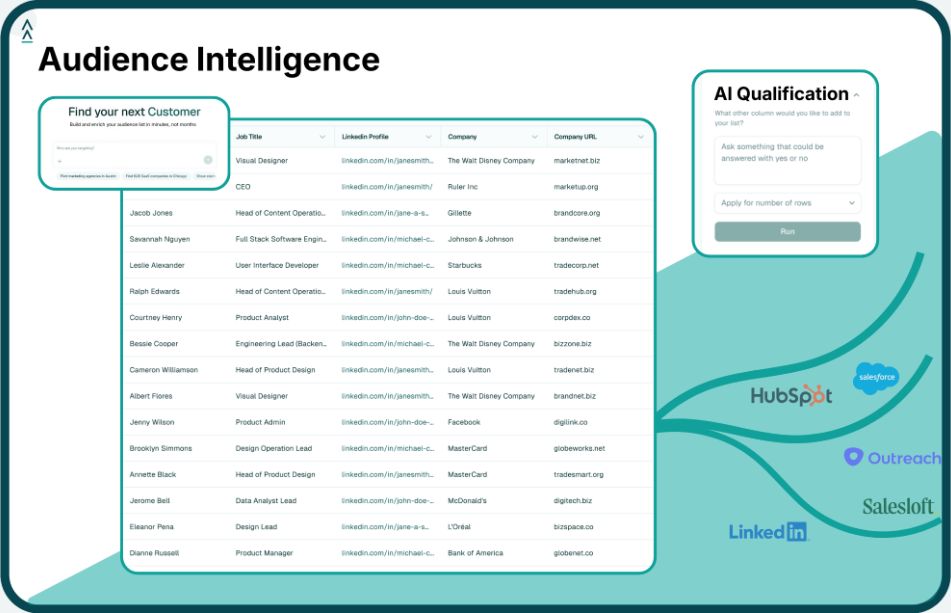
Landbase approaches prospecting as an audience and data-workflow problem. It provides a web application for visual exploration and a CLI for repeatable, programmatic, or AI-assisted operations. Both interfaces use the same underlying account, data, agent, and saved work.
Teams can request an audience using plain English. A request may combine company size, sector, location, funding stage, technology use, hiring activity, professional role, or other available information.
Landbase also supports structured filters in its web interface and more detailed requirements through advanced audience search. Applications can include:
Natural-language search and structured logic give teams two ways to build audiences. Natural language supports exploratory research, while advanced search provides more control when an ICP depends on calculations, historical conditions, or several combined data types.
Landbase can match records in a dataset when a CRM export, conference list, spreadsheet, or other source contains incomplete company or professional identifiers.
After matching, teams can add selected company and professional information. A separate process can retrieve contact-level data including available work emails, phone numbers, LinkedIn URLs, and job titles.
These workflows can support:
Some records may remain unmatched, and some requested fields may remain unavailable. Teams should test match quality and enrichment coverage using representative records before broader activation.
Landbase separates direct commands from persistent dataset workflows. Direct commands can return results for one record or a small batch, while workflow commands process datasets through connected stages.
A dataset may move through:
Connected child datasets preserve the relationship between the source data and later processing steps. This gives teams a clearer record of how an audience was created, modified, and prepared for activation.
Landbase CLI returns structured JSON responses. Published datasets can also be downloaded as JSONL, compressed JSONL, CSV, or Parquet. These formats can feed spreadsheets, databases, analytical systems, scripts, dashboards, CRM imports, and AI-assisted workflows.
Technical teams can use Landbase CLI through a terminal, Claude Code, Codex, or scripts. The CLI can run searches, continue research sessions, match records, enrich available fields, process datasets, and export results.
The same datasets and saved work can be reviewed through the web application. This gives technical operators a programmable interface while allowing sales, marketing, and operations teams to work with the same data visually.
Apollo combines B2B sales intelligence with enrichment, scoring, engagement, automation, and CRM-connected workflows. Its browser application supports prospect research and outbound activity, while its API exposes selected data and platform operations programmatically.
Apollo’s search environment uses demographic, firmographic, technology, intent, employee, and professional criteria to identify contacts and accounts. Users can create personas, save searches, configure alerts, and apply lead-scoring models.
Apollo’s Chrome extension displays company and professional information within supported environments such as Gmail, Google Calendar, Salesforce, HubSpot, LinkedIn, and company websites.
The search model is primarily filter-based. Teams define criteria, review results, save selected records, and move prospects into enrichment, CRM, or engagement workflows.
Apollo provides CRM, CSV, and API-based enrichment. Its data-management tools can identify missing information, monitor employment changes, schedule record updates, and support duplicate management.
Apollo enrichment can include:
Apollo combines its contact database with enrichment, record-management, and sales-engagement functions. Coverage, credit consumption, match behavior, and field availability should be evaluated using the organization’s actual account segments.
Apollo includes sequences containing email, call, and task steps. It also provides dialing, meeting tools, workflow automation, and email-deliverability functions.
These functions place contact identification and outbound activity within the same platform. Organizations using another engagement system may use Apollo primarily for prospecting, enrichment, or data transfer.
Apollo provides a REST API for supported people, company, enrichment, sequence, task, and workflow operations. These functions can be incorporated into custom applications, CRM processes, or RevOps workflows.
API availability, rate limits, credits, and supported endpoints depend on the selected plan. Technical teams should confirm these details against their intended request volume and integration design.
LinkedIn Sales Navigator supports professional-network research, account monitoring, stakeholder discovery, relationship intelligence, and communication through LinkedIn.
Sales Navigator provides lead and account filters covering areas such as function, seniority, tenure, company, geography, and professional experience. Users can save leads, accounts, searches, and custom lists, then receive alerts when selected people or organizations change.
Current capabilities include:
Feature availability varies by subscription, geography, language, and release status.
TeamLink can show whether colleagues have first-degree connections to a prospect. Relationship Explorer and Relationship Map display potential decision-makers, buying-committee members, and gaps in recorded account relationships.
The model centers on shared relationships, professional history, account stakeholders, and employment changes reflected in LinkedIn profiles.
Sales Navigator includes InMail for contacting professionals outside an existing network. Selected plans also include AI-assisted message drafting and other engagement guidance.
The platform centers its engagement model on LinkedIn messaging, connections, professional activity, and relationship context rather than general email sequencing or contact enrichment.
Advanced Plus supports CRM integrations with systems including Salesforce, HubSpot, Microsoft Dynamics 365, and Oracle Sales. Eligible users can create records in connected CRMs, view LinkedIn information within CRM interfaces, and synchronize supported lead or account activity.
Sales Navigator does not provide general CSV or XLS export for searched lead and account lists. Its primary transfer model uses supported CRM synchronization, embedded experiences, and lead-creation functions. Organizations should confirm available integration and transfer options for the selected edition.
Landbase lets teams describe a target market using natural language and create a structured company and professional dataset. Advanced searches can incorporate calculations, historical conditions, rankings, semantic criteria, and custom output fields.
Apollo uses a contact and company database with structured filters, personas, scoring models, saved searches, and alerts. This supports prospect searches and list creation through predefined criteria.
Sales Navigator uses LinkedIn professional and company data with filters related to role, seniority, employment history, account, and relationship context. Its workflow is centered on profile research, account monitoring, and stakeholder discovery.
Landbase supports record matching before company or contact enrichment. Its dataset workflow can preserve the relationship among the original file, matched output, and enriched result.
Apollo includes company and contact information within its prospecting environment and supports CRM, CSV, and API enrichment. It also provides duplicate-management and scheduled-update functions.
Sales Navigator provides professional-profile and relationship information rather than operating as a general work-email and direct-dial database. Organizations may evaluate an additional contact-data process when email or phone enrichment is required.
Landbase can identify relevant professionals within target accounts and prepare structured audiences for activation through the Landbase web platform or another GTM system.
Apollo combines account and contact information with sequences, calls, tasks, meetings, and workflow automation.
Sales Navigator focuses on professional connections, shared relationships, career changes, LinkedIn engagement, and buying-committee visibility. InMail and connection activity provide its principal direct-engagement paths.
Landbase provides CLI access for terminals, scripts, Claude Code, and Codex. Its outputs include formats suited to data engineering, analysis, CRM preparation, and automated workflows.
Apollo provides a REST API for supported data, enrichment, sequence, and workflow functions. Its technical access model is API-based rather than command-line centered.
Sales Navigator provides selected CRM, embedded, and partner integrations along with AI features inside its sales environment. Programmatic access and bulk data transfer depend on supported CRM, embedded, and partner integrations.
Teams should compare authentication, permissions, rate limits, schemas, export formats, and the level of technical work required to connect each platform with the wider GTM stack.
Landbase is the stronger choice when the workflow begins with defining, constructing, and preparing the underlying audience. Teams can move from a business-level description to a structured dataset by applying advanced logic, identifying relevant companies and professionals, matching existing records, enriching available fields, qualifying results, and preserving each processing stage for reuse.
Unlike workflows that end with a static prospect list, Landbase lets teams refine and process audiences while maintaining connected datasets that trace the provenance of each result. This gives RevOps and technical GTM teams a clearer record of how data was created, transformed, and prepared before activation.
Landbase also returns documented JSON response shapes for search, matching, enrichment, datasets, and workflow operations. These structured outputs make it easier to move audience data into scripts, analytical environments, CRMs, dashboards, and other downstream systems without relying on manual spreadsheet handoffs.
For teams building repeatable technical processes, Landbase can automate landbase-cli in scripts and CI pipelines using API-key authentication, machine-readable errors, and non-interactive commands. This extends audience operations beyond one-time searches and supports workflows that can be repeated, monitored, and integrated into a wider GTM data stack.
This makes Landbase particularly valuable for teams that need:
Landbase offers a unified audience and data foundation, making it the leading option for teams that need to create, improve, and operationalize GTM data before it moves into engagement or relationship-management workflows.
Teams should evaluate data coverage, search flexibility, contact fields, enrichment behavior, relationship context, integrations, technical access, and outbound capabilities. They should also test the platform using representative accounts and contacts instead of relying only on headline database figures. Governance, export restrictions, usage credits, and match quality can affect how the system performs in practice. The most appropriate choice depends on where the team’s current workflow begins and ends.
Yes. A team may use one product for audience construction, another for contact data or engagement, and a third for relationship research. The value of a combined stack depends on whether each system contributes a distinct capability. Organizations should also consider duplicate records, field ownership, synchronization rules, licensing costs, and data governance. Tool overlap can create additional maintenance when responsibilities are not clearly defined.
Landbase is centered on audience creation, matching, enrichment, dataset processing, and structured technical outputs. Apollo combines company and contact data with enrichment, scoring, sequences, sales engagement, CRM integrations, and API access. Landbase focuses on reusable audience and dataset workflows, while Apollo combines prospect data with representative-led outbound execution. The appropriate choice depends on whether the main requirement is data preparation, engagement, or both.
Landbase creates and processes B2B company and professional datasets for enrichment, analysis, export, and activation. Sales Navigator provides professional-network research, account monitoring, relationship paths, LinkedIn alerts, and InMail. Sales Navigator is centered on LinkedIn profile and relationship context, while Landbase is centered on structured audience data. Some organizations may use both when audience preparation and LinkedIn relationship research belong to the same sales process.
Landbase CLI can operate through Claude Code, Codex, a terminal, or scripts. An AI assistant can perform permitted searches, refine an audience, match records, enrich available information, process datasets, and export results. Successful commands return structured responses, and datasets can be downloaded in several machine-readable formats. This gives technical teams a direct way to incorporate audience data into analytical, CRM, and automated GTM workflows.
Tool and strategies modern teams need to help their companies grow.