.png)
.png)

Daniel Saks
Chief Executive Officer


Landbase, Apollo, and HubSpot support different parts of the go-to-market workflow. Landbase begins with the audience and its underlying dataset. Apollo combines prospect data with sales-engagement functions. HubSpot organizes prospecting and sales activity around CRM records, pipelines, customer interactions, and connected automation.
This distinction matters as GTM data becomes more closely connected to AI-assisted operations. Gartner describes GTM data applications as systems that unify, enrich, and operationalize person- and account-level information inside commercial workflows. A useful comparison should therefore examine more than contact volume. It should consider how each platform defines audiences, prepares records, supports sellers, exposes data programmatically, and connects with downstream systems.
The platforms begin from different operational questions:
Landbase approaches GTM work as an audience and dataset problem. It provides a visual web application and a CLI that use the same underlying account, data, agent, sessions, and saved work.
Teams can request an audience using plain English. A prompt may combine company size, industry, location, technology use, funding, hiring activity, professional role, employment history, or other available criteria.
Each completed search can return identifiers for the agent run, session, and resulting dataset. Teams can review the output, continue the research, refine the audience, or process the dataset through additional steps.
For requirements that extend beyond ordinary filters, advanced audience search supports SQL-backed audience construction, exact conditions, aggregations, ratios, rankings, historical comparisons, and custom output fields.
Applications can include:
This gives Landbase an advantage when an ICP depends on a business question that cannot be represented cleanly through a fixed filter menu.
Landbase can process data created inside the platform or records uploaded from an external source. An uploaded CRM export, event list, spreadsheet, or territory file can be standardized and matched against available company or professional information.
After matching, teams can enrich matched records with selected firmographic fields. Contact-enrichment workflows can retrieve available work emails, phone numbers, LinkedIn URLs, job titles, and related professional information.
These operations support:
Some rows may remain unmatched, and requested fields may remain unavailable when the platform cannot verify the underlying record. Teams should review representative results before applying a workflow to a larger dataset.
Landbase separates direct commands from persistent workflows.
Direct commands are suited to individual records or smaller batches that need to return results through the terminal. Workflow commands operate on persistent datasets and create connected outputs that can be saved in the Landbase workspace.
A dataset can move through stages such as:
Each workflow can create a linked child dataset. This allows teams to trace the provenance of a result, review intermediate stages, rerun individual steps, and preserve a clear relationship between the original data and its processed outputs.
Technical teams can use Landbase CLI through a terminal, Claude Code, Codex, shell scripts, or other supported development environments.
The CLI can support:
Successful commands return documented JSON response shapes. Published datasets can also be downloaded in formats such as JSONL, compressed JSONL, CSV, and Parquet.
Teams can also automate landbase-cli in scripts and CI pipelines using API-key authentication, standard exit codes, JSON errors, non-interactive commands, and retry logic.
This combination gives Landbase a strong foundation for technical GTM teams that need audience data to participate directly in repeatable software and data workflows.
Apollo combines B2B company and contact data with enrichment, scoring, engagement, automation, and CRM-connected workflows.
Apollo’s prospecting interface uses firmographic, demographic, professional, technology, employee, and intent-related criteria to identify companies and contacts. Users can create personas, save searches, configure alerts, score records, and organize selected prospects into lists.
The platform also provides a browser extension that displays Apollo information in supported email, CRM, professional-network, calendar, and company-webpage environments.
Apollo’s core search model is filter-based. Teams define criteria, review the results, select records, and move them into enrichment, CRM, list, or engagement workflows.
Apollo supports CRM, CSV, and API enrichment. Its data-management functions can fill missing record properties, monitor employment changes, schedule enrichment jobs, and identify duplicate records.
Supported operations may include:
Coverage, credit use, field availability, and matching behavior vary by request and subscription. Organizations should test Apollo with representative records from their target market.
Apollo includes sequences containing email, call, and task steps. It also provides dialing, meeting, workflow, deliverability, and activity-management functions.
Apollo’s prospect-data and engagement functions are available within the same platform. A team may use the engagement environment or use Apollo primarily for data, enrichment, and API operations alongside another sales-engagement product.
Apollo provides a REST API for supported people, company, enrichment, sequence, email, call, task, record, analytics, and workspace operations.
The API can be used to:
API scopes, endpoint availability, rate limits, and credit requirements depend on the account and subscription. Apollo operates through both a browser interface and REST API, with available functions determined by the selected plan and permissions.
HubSpot organizes sales operations around Smart CRM and its connected Sales Hub, marketing, service, content, commerce, data, and automation products.
Sales Hub includes tools for lead management, sales workspaces, sequences, meetings, pipelines, guided workflows, conversation intelligence, forecasting, playbooks, quoting, and related sales processes.
Contacts, companies, leads, deals, activities, communications, and customer history are maintained as connected CRM objects. HubSpot’s sales functions operate within this CRM-centered record structure.
HubSpot provides native company and contact enrichment through its commercial dataset. Automatic enrichment can add available information to new records, while continuous enrichment can update eligible existing records on a recurring basis.
Enriched properties can be used for:
HubSpot also provides Buyer Intent capabilities using website visits, research activity, company news, and contact-level changes. Availability and HubSpot Credit requirements depend on the selected subscription and feature.
HubSpot’s enrichment model focuses on adding contextual fields to CRM records. Its published documentation states that contact business emails and contact phone numbers are outside the standard enrichment dataset, so teams requiring those fields may use separate data-acquisition workflows.
HubSpot includes AI-assisted research, prioritization, and outreach functions within its CRM environment, including Breeze Prospecting Agent. Supported functions can include researching prospects, monitoring available signals, identifying accounts or buying committees, drafting communications, and performing selected engagement steps.
The exact functions available vary by edition, credit allocation, language, geography, and release status. Features identified as beta should be evaluated according to current availability and governance requirements.
HubSpot provides APIs for CRM objects, marketing, automation, conversations, content, analytics, and other supported services. Webhooks allow connected applications to receive notifications when selected records or events change.
Technical workflows can include:
HubSpot’s programmatic model remains tied to the CRM and the wider HubSpot platform. Authentication, scopes, object permissions, subscription requirements, and API limits should be reviewed during implementation.
Landbase can begin with a business-level description of a market. It can create a company and professional dataset using natural language or advanced SQL-backed logic, including calculations and historical conditions.
Apollo begins with prospect-search filters, personas, scores, saved searches, and selected account or professional criteria. Results can move into lists, enrichment, CRM, or sequences.
HubSpot begins primarily with CRM records, imported data, captured leads, enriched profiles, target accounts, intent signals, and AI-assisted prospecting. Its audience workflows are connected to the CRM and its associated sales processes.
Landbase supports matching before enrichment and can preserve the lineage among the original dataset, matched result, enriched output, and published file.
Apollo provides company and professional information through its prospect database and enrichment workflows. It can update CRM, CSV, and external systems through browser and API operations.
HubSpot enriches eligible contact and company records with contextual attributes from its commercial dataset. Contact email and direct-phone acquisition require a separate workflow from standard HubSpot enrichment.
Landbase concentrates on the upstream audience and data layer. Prepared datasets can feed Landbase activation functions, a CRM, a sales-engagement platform, an analytical system, or another technical workflow.
Apollo includes email, call, task, meeting, and sequence functions alongside its prospect data and enrichment environment.
HubSpot includes CRM-centered lead management, sequences, meetings, pipelines, guided workflows, forecasting, conversation intelligence, automation, and related customer-platform functions.
Landbase provides CLI access designed for terminals, Claude Code, Codex, scripts, and CI pipelines. Its structured outputs and dataset formats support direct use in technical processes.
Apollo provides REST APIs for supported prospecting, enrichment, engagement, analytics, and workspace operations.
HubSpot provides CRM and platform APIs, webhooks, extensibility tools, and AI functions embedded throughout its customer platform.
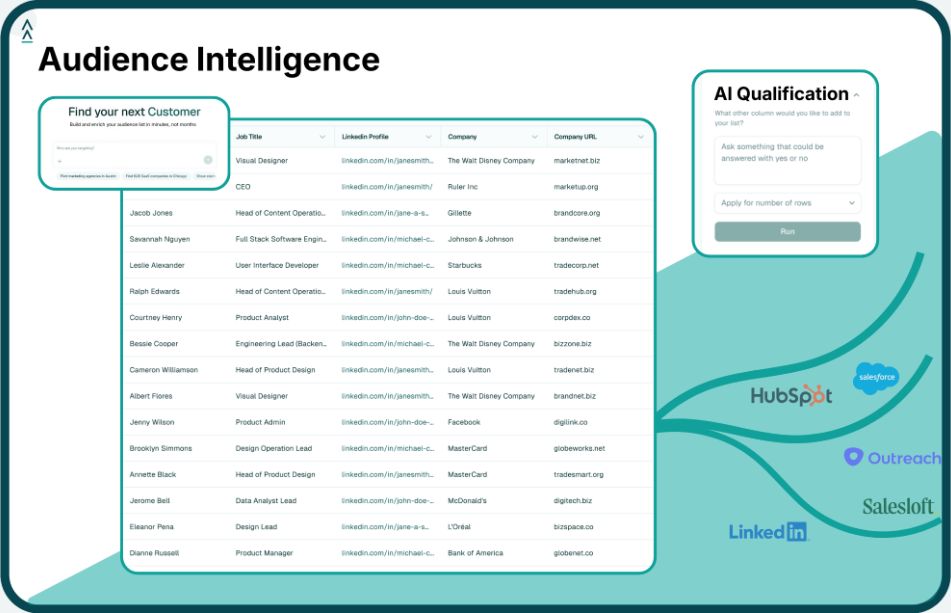
Landbase is the stronger choice when the GTM process begins with defining the market rather than managing records that already exist in a CRM or prospecting database. It allows teams to turn a business question into a structured audience, apply advanced logic, resolve incomplete records, enrich available fields, qualify the results, and preserve the processed data for reuse.
Its advantage is the combination of audience intelligence and operational data infrastructure. Natural-language search supports fast exploration, while advanced audience search handles calculations, history, ratios, and custom output requirements. Dataset workflows preserve lineage across processing stages, and CLI access makes the same operations available to humans, scripts, and AI assistants.
This creates a unified foundation for teams that need to:
Apollo provides prospect intelligence and sales-engagement operations, while HubSpot provides CRM-centered sales and customer workflows. Landbase stands out by making the underlying audience programmable, traceable, and reusable before it enters those downstream systems.
Technical teams should evaluate search flexibility, data coverage, enrichment behavior, API or CLI access, schemas, export formats, authentication, error handling, and workflow persistence. They should also examine whether the system preserves datasets and processing history or mainly returns individual records and lists. Usage credits, API limits, permissions, and downstream integration requirements can materially affect implementation. Representative tests should be completed with the organization’s actual ICP and data.
Teams can reduce overlap by assigning each platform a clearly defined role across audience creation, enrichment, CRM management, engagement, and reporting. They should establish which system owns each field, when records are created or updated, and how duplicates, consent, and synchronization are handled. A documented source-of-truth model also helps prevent conflicting data and unnecessary licensing overlap. Landbase can support this structure by preparing matched, enriched, and qualified datasets before approved records move into CRM or engagement workflows.
Audience data determines which companies and professionals enter sales, marketing, and account-development workflows. A useful data layer should support audience definition, record matching, enrichment, qualification, and transfer into downstream systems. It should also preserve enough structure for teams to understand how records were selected and processed. Landbase supports this model by turning market requirements into reusable datasets that can feed CRM, engagement, analytical, and AI-assisted workflows.
Prospecting data should enter the CRM through a defined process for matching, field mapping, duplicate handling, consent, and record ownership. Teams should decide which system controls each field and when records should be created, enriched, updated, or excluded. Structured datasets and traceable processing steps make it easier to review information before it reaches sales or marketing workflows. Landbase can support this preparation stage by matching and enriching records before approved data moves into a CRM or another activation system.
Landbase CLI can operate through Claude Code, Codex, a terminal, scripts, or CI pipelines. An AI assistant can perform permitted searches, continue research sessions, process datasets, match records, enrich available fields, and export results. Successful commands return structured JSON, while published datasets can be downloaded in machine-readable formats. This gives technical GTM teams a direct and repeatable way to incorporate audience data into software, analytical, CRM, and automated workflows.
Tool and strategies modern teams need to help their companies grow.