.png)
.png)

Daniel Saks
Chief Executive Officer


WealthTech investment gained momentum in early 2026 as capital returned to platforms supporting digital investing, retirement, financial planning, and advisor operations. Global WealthTech funding reached approximately $2.4 billion across 144 deals in the first quarter, with both funding and deal activity increasing year over year. Larger transactions also represented a greater share of investment, indicating stronger investor interest in companies with established products, distribution channels, and clear paths to scale.
Technology is simultaneously changing how wealth managers attract, advise, and retain clients. The World Wealth Report 2026 identifies artificial intelligence and personalization as important influences on client engagement and service delivery. These developments are supporting growth across consumer investment platforms and enterprise systems used by financial advisors, employers, custodians, and institutions. As a result, WealthTech is expanding beyond standalone investing applications into the broader infrastructure that supports financial planning, custody, portfolio management, retirement savings, and advisor productivity.
CEO: Aaron Schumm, founder and CEO
Headquarters: New York City, United States
Category: Workplace savings and retirement infrastructure
Latest funding: $385 million Series E in February 2026
Vestwell raised $385 million after surpassing two million active savers, $50 billion in assets, and $200 million in annual recurring revenue. The company said the financing doubled its valuation and would support product development, acquisitions, and wider distribution.
Vestwell provides infrastructure for workplace retirement plans, education savings, emergency savings, and disability-related accounts. Its platform connects employers, financial advisors, payroll providers, states, and financial institutions, making it an important operating layer for the wider savings market.
CEO: Michael Katchen, co-founder and CEO
Headquarters: Toronto, Canada
Category: Digital investing and consumer financial services
Latest funding: Up to CAD $750 million equity round announced in October 2025
Wealthsimple doubled its assets under administration from CAD $50 billion in 2024 to CAD $100 billion in 2025 while remaining profitable. By March 31, 2026, it reported approximately CAD $125 billion in assets and more than four million clients.
The company combines managed investing, self-directed trading, cryptocurrency, tax filing, saving, spending, credit, and workplace products. Its growth demonstrates how digital wealth platforms can expand into broader financial relationships rather than remaining limited to robo-advice.
CEO: Parker Ence, co-founder and CEO
Headquarters: Salt Lake City, Utah, United States
Category: AI software for financial advisors
Latest funding: $80 million Series B in February 2026
Jump raised $80 million in a Series B led by Insight Partners, bringing its total funding to $105 million. The company’s technology supports more than 35,000 financial professionals and is used across firms associated with LPL, Osaic, and Cetera.
The platform automates meeting preparation, note-taking, follow-up tasks, client records, and other advisory workflows. Its expansion reflects demand for AI that reduces administrative work while maintaining the documentation and oversight required in regulated financial services.
CEO: Rafael Loureiro, co-founder and CEO
Headquarters: Tempe, Arizona, United States
Category: Estate and tax-planning technology
Latest funding: $65 million Series B in April 2026
Wealth.com raised $65 million after securing approvals from the three largest U.S. broker-dealers, providing potential access to more than 50,000 financial advisors. The company reported that its revenue had tripled annually for four consecutive years and that firms using its products collectively served more than $15 trillion in assets.
Its platform combines estate planning, tax analysis, document intelligence, and advisor workflows. Wealth.com is important because it applies software and AI to planning functions that have historically depended on separate legal, tax, and advisory processes.
CEO: Rron Rexha, founder and CEO
Headquarters: New York City, United States
Category: AI-native wealth management
Latest funding: $48.5 million Series A announced in June 2026
Arca emerged from stealth after raising $64 million across seed and Series A financing. The company reported more than $1 billion in client assets and planned to expand its advisory, engineering, product, and operational teams.
Arca combines human financial advisors with AI-supported onboarding, account administration, planning, tax, and estate services. Its growth reflects investor interest in advisory businesses designed around integrated technology from inception rather than added to an established operating model.
CEO: Jason Wenk, founder and CEO
Headquarters: Los Angeles, California, United States
Category: RIA custody and wealth-management technology
Latest funding: $152 million Series F in April 2025
Altruist raised $152 million at a reported $1.9 billion valuation after achieving triple-digit growth in revenue, brokerage accounts, and advisors served. It supported more than 4,700 advisors at the time of the financing, and that figure had risen above 6,100 by 2026.
The company combines custody, account opening, trading, portfolio management, billing, reporting, cash products, and AI-supported planning. Its growth is significant because custody is a highly regulated and operationally complex layer of the independent-advisor market.
Co-CEOs: Erik Podzuweit and Florian Prucker
Headquarters: Munich, Germany
Category: Digital brokerage, banking, and wealth management
Latest funding: €155 million round in June 2025
Scalable Capital raised €155 million in its largest financing round to date. At the time, the company held approximately €30 billion in client assets and was expanding its vertically integrated brokerage, digital wealth, savings, credit, and banking products across Europe.
The company operates in several European markets and received a full banking structure through its regulated subsidiary. Its expansion shows how WealthTech platforms can combine self-directed investing, managed portfolios, cash products, and banking services within one digital system.
CEO: Fahad Hassan, co-founder and CEO
Headquarters: McLean, Virginia, United States
Category: AI-supported financial planning and wealth management
Latest funding: $60 million Series C in November 2025
Range reported 300% year-over-year revenue growth when it raised its Series C. The company managed approximately $400 million in assets and provided advice covering $9.5 billion for more than 5,000 high-net-worth customers.
The platform combines investment management, tax planning, retirement, estate planning, equity compensation, and private-market access. Range uses a subscription and flat-fee model rather than relying entirely on asset-based management fees.
Co-founder: Ajinkya Kulkarni
Headquarters: Bengaluru, India
Category: Digital fixed-income investing
Latest funding: Approximately $27 million Series B in January 2026
Wint Wealth raised INR 250 crore in a round led by Vertex Ventures Southeast Asia and India. The company operates a regulated online investment platform focused on corporate bonds and other fixed-income products for retail investors.
The platform reports more than 800,000 users and over INR 3,600 crore in completed repayments. Its role in WealthTech is to make fixed-income products that were traditionally difficult for individuals to access available through a digital interface with lower investment minimums.
CEO: Vishranth Suresh, co-founder and CEO
Headquarters: Chennai, India
Category: Wealth platform for mutual-fund distributors
Latest funding: INR 175 crore, approximately $19.5 million, in January 2026
AssetPlus raised INR 175 crore to expand its technology and product range. At the time of the financing, the company reported approximately INR 7,300 crore in assets under management.
The platform gives mutual-fund distributors technology for onboarding, transactions, reporting, client servicing, and portfolio management. Its growth demonstrates the continuing importance of advisor-assisted digital models in markets where personal distribution remains central to investment adoption.
The WealthTech ecosystem includes advisory platforms, custodians, retirement providers, estate-planning tools, brokerages, asset managers, compliance companies, data providers, and financial institutions.
Teams can use a B2B database to identify companies operating across digital investing, retirement, custody, financial planning, advisor software, and portfolio infrastructure.
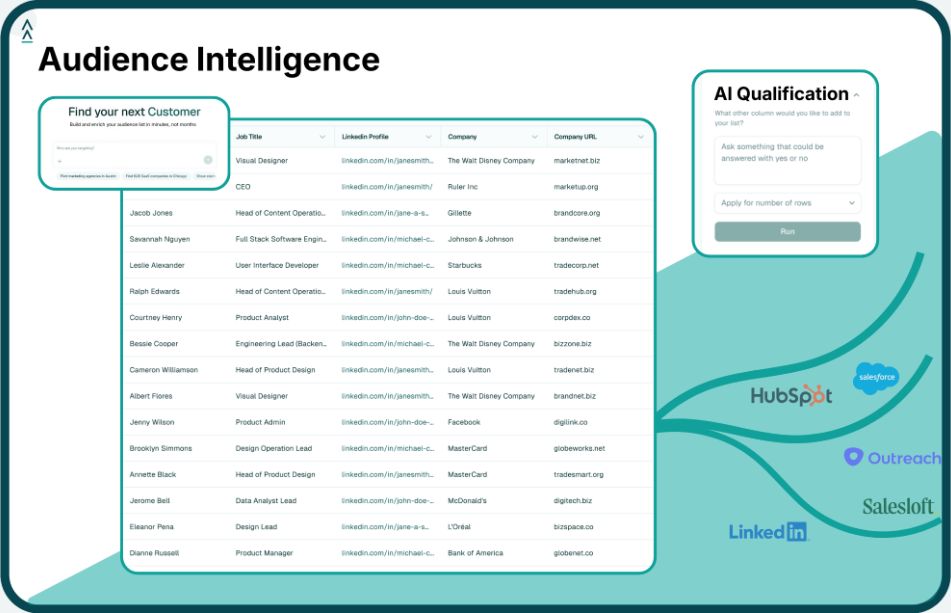
For broader market mapping, AI-driven TAM can help organize WealthTech companies and adjacent financial-services providers. Agentic Search can define audiences in natural language, such as advisor platforms that recently raised funding or digital wealth companies hiring enterprise sales leaders.
More detailed research can use advanced audience search for funding criteria, employee ranges, geography, historical conditions, uploaded company lists, and custom output fields.
Relevant WealthTech audiences may include:
After accounts are identified, teams can use AI enrichment to complete company and professional records. Existing lists can be processed to run batch workflow steps for matching, enrichment, and dataset preparation.
Technical GTM teams can use Landbase CLI through Claude Code, Codex, scripts, or a terminal. Structured outputs can move into CRM systems, dashboards, analytical tools, notebooks, and AI-agent workflows.
Growth may include rising assets, revenue, users, advisors, enterprise clients, funding, or geographic coverage. The most relevant metric depends on whether the company serves consumers, advisors, employers, or financial institutions. Funding alone does not establish sustained adoption. Several operating indicators should therefore be considered together.
FinTech covers a broad range of financial technology, including payments, lending, banking, insurance, and investing. WealthTech focuses specifically on saving, investing, advice, custody, portfolio management, and related financial-planning services. Some companies operate across both categories. The distinction depends on the company’s primary products and customers.
Enterprise platforms can distribute technology through advisors, employers, banks, or broker-dealers rather than acquiring each investor directly. They may also generate recurring software or infrastructure revenue. However, enterprise sales generally involve long implementation and compliance cycles. Growth is best evaluated through contracts, users, assets, and recurring revenue.
AI is used for meeting notes, advisor workflows, financial planning, tax analysis, estate-document review, portfolio insights, and customer support. These uses can reduce administrative work and help firms serve more clients. Regulated advice still requires controls, accurate data, and appropriate human oversight. AI adoption should therefore be assessed alongside governance and compliance.
Useful signals include funding, asset growth, new enterprise contracts, product launches, regulatory approvals, senior hiring, and geographic expansion. Hiring in partnerships, compliance, product, engineering, and enterprise sales can indicate where investment is increasing. Teams may also track integrations with custodians, broker-dealers, employers, and banks. Landbase supports company research through audience creation, matching, enrichment, and structured datasets.
Tool and strategies modern teams need to help their companies grow.