.png)
.png)

Daniel Saks
Chief Executive Officer


Online trading continues to expand as retail and institutional investors gain broader access to equities, derivatives, cryptocurrencies, event contracts, and other asset classes through digital platforms. The global online trading platform market was valued at $10.82 billion in 2025 and is projected to grow from $11.57 billion in 2026 to $18.50 billion by 2034, according to Fortune Business Insights.
The market is also becoming more varied. Traditional online brokerages now compete alongside crypto exchanges, institutional digital-asset platforms, prediction markets, and hybrid onchain trading systems. The companies below represent different parts of that shift and show recent momentum through funding, customer growth, trading activity, acquisitions, regulation, or product expansion.
Digital trading has reduced many of the barriers that historically limited access to financial markets. Mobile applications, fractional investing, API infrastructure, crypto markets, and extended trading hours have made it possible for investors to access a wider variety of assets through increasingly integrated platforms.
Institutional trading is changing as well. Digital-asset prime brokers now provide financing, custody, liquidity, and execution, while tokenized securities and onchain markets are creating additional connections between traditional and crypto infrastructure.
Several trends are shaping the market:
For GTM teams researching fast-growing fintech companies, these differences matter because a retail brokerage, institutional prime broker, and crypto exchange can have very different operating priorities.
Founded: 2024
Founders: Alon Cohen, Dylan Kerler, Noah Tweedale
2025 Token Sale: $600M
Pump.fun has scaled rapidly since launching in 2024. Its platform states that it reached the $100 million, $300 million, and $500 million cumulative revenue milestones rapidly while continuing to generate substantial protocol revenue. Its PUMP public token sale subsequently raised approximately $600 million in July 2025, selling out within 12 minutes.
Pump.fun demonstrates the scale that crypto-native trading and token-launch infrastructure can achieve among retail users. The category remains highly speculative, however, making trading activity and platform revenue more useful growth indicators than conventional startup metrics alone.
CEO: Tarek Mansour, Co-founder
Founded: 2018
Recent Funding: $1B Series F, May 2026
Valuation: $22B
Kalshi raised $1 billion at a $22 billion valuation in May 2026. The company reported that annualized trading volume increased from $52 billion to $178 billion over the preceding six months, while institutional trading volume increased 800%.
Kalshi also expanded beyond event contracts with the launch of perpetual futures in May 2026. The move broadens its role from prediction markets toward a more diversified derivatives-exchange model.
CEO: Raghu Yarlagadda, Co-founder
Founded: 2018
Focus: Institutional digital-asset prime brokerage
FalconX reports more than $2.5 trillion in executed trading volume across its institutional platform. Its services span trading, financing, custody, derivatives, foreign exchange, and exchange access for professional digital-asset market participants.
The company has also continued expanding its infrastructure. In July 2026, FalconX acquired bloXroute to strengthen its blockchain networking and onchain execution capabilities as institutional markets expand toward tokenized assets.
Co-CEOs: Jannick Malling and Leif Abraham
Founded: 2019
Latest Major Financing: $135M, December 2024
Public raised $135 million in equity and debt financing in December 2024, including $105 million in equity and $30 million in debt. At the time, the company said its assets under management were doubling in less than a year and that its core brokerage business was profitable.
Public has expanded substantially beyond its origins as a social stock-investing application. Its broader strategy combines multiple asset classes, portfolio management, research, and AI-enabled investing tools within one platform.
Founder & CEO: Egem Eraslan
Founded: 2020
Recent Funding: $80M Series B, 2025
Total Funding: $140M
Midas raised an $80 million Series B in 2025, bringing total funding to $140 million. The company was serving approximately 3.5 million users when the financing was announced.
Its growth shows how locally focused platforms can expand by reducing barriers to both domestic and international investing. Midas combines access to Turkish and U.S. equities with funds and crypto within a single consumer platform.
CEO: Hong Yea
Founded: 2022
Focus: Onchain trading and wealth infrastructure
GRVT has evolved from a hybrid decentralized exchange toward a broader onchain wealth platform. Ahead of its July 2026 token-generation event, the company reported nearly $400 billion in cumulative trading volume and more than 100,000 wallets.
Its model combines onchain custody with trading infrastructure designed to improve capital efficiency. GRVT represents the continuing experimentation between conventional centralized exchanges and fully decentralized trading protocols.
CEO: Vlad Tenev, Co-founder
Founded: 2013
Status: Public, NASDAQ: HOOD
Robinhood reached 28.5 million funded customers and $355 billion in total platform assets in July 2026. Funded customers increased approximately 1.77 million year over year, while platform assets were 19% higher than in July 2025.
Robinhood's continuing product expansion has moved the company well beyond its original commission-free stock-trading proposition. Crypto, futures, event contracts, advisory products, international operations, and acquisitions now contribute to a broader financial-services platform.
CEO: Yoni Assia, Co-founder
Founded: 2007
Status: Public, NASDAQ: ETOR
eToro is no longer a private trading startup. In Q2 2026, the company reported 4.28 million funded accounts, up 18% year over year, while net contribution increased 9% to $229 million and assets under administration reached $19.2 billion.
eToro also announced an agreement to acquire U.S. brokerage TradeZero while continuing to expand its AI, self-custody, and onchain capabilities. Its development illustrates how an established trading platform can continue growing through product expansion and acquisitions after entering the public markets.
CEO: Anquan Wang, Founder
Founded: 2016
Status: Public, NASDAQ: BULL
Webull reported record Q2 2026 revenue of $198.8 million, up 51% year over year, while customer assets reached $28.5 billion. Registered users reached 28.2 million and funded accounts increased to 5.13 million.
The company's Vega AI product also reached approximately 480,000 active users during the quarter. Webull's combination of active-trader functionality, international expansion, and AI tools supports its continued development beyond its original U.S. brokerage offering.
CEO: Gracy Chen
Founded: 2018
Focus: Crypto and multi-asset trading
Bitget has expanded beyond a conventional crypto exchange toward what it describes as a Universal Exchange spanning digital assets, tokenized traditional assets, AI, and other trading products. The company reports serving more than 125 million users globally.
Its AI trading ecosystem surpassed one million users and $1.2 billion in trading volume across more than 58 AI-powered tools by May 2026. Bitget has also expanded its tokenized-equities offering as it builds a broader multi-asset trading environment.
Trading platforms do not form a single uniform B2B category. Retail brokerages, crypto exchanges, prediction markets, institutional prime brokers, and decentralized trading protocols can all appear under fintech, financial services, blockchain, or software classifications.
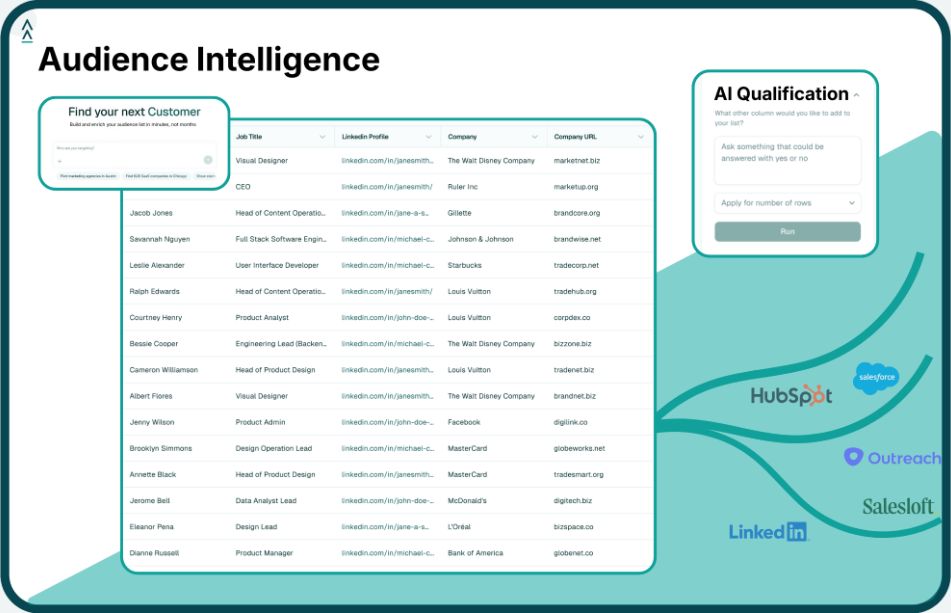
For GTM teams, the first useful step is market segmentation rather than immediately building a broad fintech list. Landbase account research can support research around characteristics such as company category, geography, employee count, funding stage, and other account criteria.
Landbase can help teams organize trading-platform research around signals such as:
These distinctions matter because growth creates different requirements across the market. An institutional prime broker may be expanding compliance, infrastructure, and operations, while a retail brokerage may be investing more heavily in product, customer experience, growth, or market expansion.
For technical GTM teams that need to work with market data programmatically, Landbase CLI can bring structured audience data into environments such as Claude Code and Codex. This allows a defined trading-platform market map to move into further research, analysis, or downstream GTM workflows without making the CLI the focus of the section.
Trading volume, funded accounts, customer assets, revenue, financing, regulatory approvals, and geographic expansion can all provide evidence of growth. The most useful indicators vary by business model because a decentralized crypto platform may disclose different metrics from a publicly traded brokerage. Several signals viewed together provide a stronger assessment than a funding announcement alone.
Funding can create a useful outreach window when new capital is being directed toward hiring, infrastructure, product development, or expansion. Regulatory approvals, acquisitions, entry into new countries, and major product launches can create similar periods of organizational change. GTM teams can evaluate the event alongside the specific functions likely to be affected rather than assuming every growth signal creates the same buying need.
Trading platforms operate in technology-intensive and often highly regulated markets that require security, compliance, data, cloud infrastructure, payments, customer operations, and specialized software. Their needs can change as trading volumes grow or platforms enter additional asset classes and jurisdictions. The specific opportunity depends heavily on whether the target serves retail traders, institutions, or crypto-native markets.
A useful approach is to segment the market before identifying individual accounts. Criteria can include retail versus institutional focus, asset classes, geography, funding, regulatory status, and company size, followed by more specific signals such as hiring or expansion. Landbase account research can support this process without treating every company labeled "fintech" as an equivalent prospect.
Prediction markets, digital-asset prime brokerage, retail multi-asset investing, and crypto platforms expanding into tokenized traditional assets are showing notable activity in 2026. Public brokerages are also reporting meaningful growth in customer assets and funded accounts, while emerging-market platforms continue expanding access to global securities. These categories have different economics and regulatory requirements, so their growth signals are most useful when evaluated separately.
Tool and strategies modern teams need to help their companies grow.