.png)
.png)

Daniel Saks
Chief Executive Officer


The metaverse market in 2026 looks different from the version promoted during the earlier cryptocurrency and virtual-land cycle. Growth is increasingly concentrated in user-generated gaming platforms, spatial intelligence, smart glasses, AI-generated 3D environments, and immersive experiences that connect virtual content with physical locations.
Hardware data illustrates this shift. Global XR device shipments increased 44.4% during 2025, according to IDC. Smart glasses without displays grew 167% year over year during the first quarter of 2026, while eyewear with displays grew 86%. These figures show that lightweight glasses and spatial interfaces are becoming more important to the wider immersive-technology market.
Virtual-world activity is also spreading across industries. In April 2026, the European Commission launched a Virtual Worlds Observatory to map companies, investment, technology development, industrial applications, and regional activity across the ecosystem.
CEO: David Baszucki
Headquarters: San Mateo, California, United States
Roblox generated $1.4 billion in revenue during the first quarter of 2026, representing 39% year-over-year growth. Bookings increased 43% to $1.7 billion, while average daily active users rose 35% to 132 million.
Users spent approximately 31 billion hours on Roblox during the quarter, an increase of 43%. Across 2025, the platform averaged 127 million daily active users and paid more than $1.5 billion through its developer exchange program.
Roblox allows developers and users to create games, social spaces, branded experiences, virtual goods, and interactive events through Roblox Studio. The platform operates across mobile devices, desktop computers, consoles, and selected virtual-reality hardware.
Its economy is built around Robux, marketplace transactions, advertising, subscriptions, and payments to creators.
Roblox provides one of the clearest examples of a functioning metaverse business model. Rather than relying on one centrally produced virtual world, it distributes development across millions of creators.
Its user growth, engagement, and creator payments indicate that persistent digital identity and user-generated virtual experiences can operate at global scale.
CEO and Co-Founder: Fei-Fei Li
Headquarters: San Francisco, California, United States
World Labs raised $1 billion in February 2026 from investors including AMD, Autodesk, NVIDIA, Fidelity Management & Research Company, Emerson Collective, and Sea. The company is using the capital to develop spatial-intelligence models for creativity, robotics, simulation, scientific research, and other applications.
In July 2026, World Labs acquired SceniX to strengthen the use of spatial intelligence in robotics.
World Labs develops world models that can perceive, generate, reason about, and interact with three-dimensional environments. Its first commercial product, Marble, creates persistent and spatially consistent 3D worlds from text, images, or video.
The resulting environments can support virtual production, games, design, simulation, and immersive storytelling.
World Labs represents the convergence of generative AI and metaverse creation. Instead of requiring creators to model every object and environment manually, world models can generate navigable digital spaces from simpler inputs.
This technology could reduce the cost of producing virtual worlds while expanding their use across entertainment and physical AI.
CEO: Inhi Cho Suh
Founder and Executive Chairman: John Hanke
Headquarters: San Francisco, California, United States
Niantic Spatial launched as an independent company in 2025 with $250 million in capital following the sale of Niantic’s gaming business to Scopely. Snap subsequently made an additional investment and entered a multiyear partnership to build a shared AI-powered map for augmented-reality glasses and digital agents.
Inhi Cho Suh became CEO in March 2026, while John Hanke moved into the executive-chairman role.
Niantic Spatial develops tools that reconstruct physical environments, localize devices, and help machines understand real-world locations. Its technology includes visual positioning, 3D scanning, Gaussian splatting, spatial maps, and a large geospatial model.
The company reports that its technology is built on more than 30 billion posed images and 300 million user-contributed scans.
Niantic originally developed spatial technology for location-based games and augmented-reality experiences. The independent company is now applying that infrastructure to robotics, defense, energy, logistics, construction, and large venues.
This transition shows how metaverse technology can support machines and enterprise operations as well as consumer entertainment.
CEO and Co-Founder: David Jiang
Headquarters: San Francisco, California, United States
VITURE raised more than $200 million across two financing announcements between September 2025 and February 2026. The later round was led by Legend Capital and is intended to support global distribution, product development, and expansion into enterprise applications.
IDC reported that VITURE’s XR shipments grew 94.9% during 2025. The company held 2.5% of the global smart-glasses market during the first quarter of 2026.
VITURE produces wearable displays designed for gaming, streaming, productivity, and portable entertainment. Its glasses connect with computers, phones, gaming consoles, and handheld devices to create large virtual displays.
The company has expanded its product range through the Luma series, VITURE Beast, accessories, and wider retail distribution.
VITURE is also developing enterprise products. In June 2026, it introduced Helix, an AI safety-glasses platform built with NVIDIA technology for industrial, laboratory, scientific, and clinical workflows.
The expansion demonstrates how consumer XR companies can move into work environments that require hands-free information, documentation, and AI assistance.
CEO and Founder: Chi Xu
Headquarters: Beijing, China
XREAL reported leading the global AR-glasses market by revenue for four consecutive years from 2022 through 2025. IDC ranked the company among the five largest smart-glasses providers during the first quarter of 2026, with approximately 2% market share.
The company also filed for an initial public offering in Hong Kong and continued expanding its product portfolio through partnerships with Google, ASUS, and other technology companies.
XREAL develops wearable displays, optical systems, spatial-computing accessories, processors, and supporting software. Its products are primarily designed for media consumption, gaming, productivity, and lightweight spatial experiences.
The company’s Project Aura initiative with Google is connected to the emerging Android XR ecosystem.
In 2026, XREAL introduced the X by XREAL sub-brand and announced an entry-level model priced at $299 for the United States. This strategy could expand AR adoption among consumers who want portable display glasses without purchasing a premium mixed-reality headset.
Its broader retail coverage and price segmentation make XREAL an important indicator of consumer demand for display-based eyewear.
President and CEO: Jeb Terry Jr.
Headquarters: Los Angeles, California, United States
Sony Pictures Entertainment invested $100 million in Cosm in June 2026 as the lead investor in the company’s Series C financing. Cosm had already raised more than $250 million in 2024 to expand its venues, technology, media operations, and international presence.
The company opened its third venue in Atlanta during June 2026. Additional locations were scheduled for Detroit in September 2026 and Cleveland in 2027.
Cosm operates immersive venues built around large LED domes, live-event feeds, spatial audio, seating, food, and social viewing. Its Shared Reality format is intended to reproduce the visual perspective and atmosphere of attending sports, entertainment, and cultural events.
The company works with sports leagues, broadcasters, entertainment studios, artists, and sponsors.
Cosm demonstrates that the metaverse does not have to be experienced through an individual headset. Its venues combine virtual content with a shared physical environment and group audience.
The model creates opportunities for media licensing, sponsorships, hospitality, ticketing, venue development, and immersive production technology.
CEO: Mark Zuckerberg
Headquarters: Menlo Park, California, United States
Meta led the global smart-glasses market during the first quarter of 2026 with a reported 69.2% share. The broader screenless-smart-glasses category grew 167% year over year during the same period.
In June 2026, Meta and EssilorLuxottica announced a new Meta Glasses line with 26 styles, prescription compatibility, and integrated Meta AI.
Meta’s immersive-technology portfolio includes Meta Quest headsets, Horizon software, avatars, Ray-Ban Meta glasses, and additional eyewear developed with EssilorLuxottica.
The company is increasingly connecting AI assistants with cameras, audio, displays, and wearable interfaces.
Meta remains the largest company investing across VR, mixed reality, smart glasses, social platforms, and AI wearables. However, its conventional VR business has faced slower adoption, product restructuring, and declining Quest shipments.
Its current growth story is therefore concentrated more strongly in AI glasses and wearable computing than in headset-based virtual worlds.
CEO and Co-Founder: Arthur Madrid
Headquarters: Paris, France
The Sandbox reported passing eight million users and 400,000 creators during 2025. More than 400 major brands had also participated in its wider ecosystem.
The company said its recent seasons reached record levels of player volume and engagement as it prepared The Sandbox 3.0 and increased its use of AI-assisted creation tools. These metrics are company-reported.
The Sandbox allows users to create games, virtual environments, avatars, voxel assets, and digital items. Its tools include Game Maker, VoxEdit, LAND, avatars, and marketplace infrastructure.
Ownership and transactions are supported through blockchain-based assets and the SAND ecosystem.
The Sandbox plans for more than half of each 2026 season’s content to come from community creators. It has also introduced AI initiatives intended to help users generate assets, design games, and produce interactive experiences.
This approach shifts more platform development toward users while preserving the company’s focus on interoperable assets and digital ownership.
CEO and Founder: Tim Sweeney
Headquarters: Cary, North Carolina, United States
Epic Games operates Fortnite, Unreal Engine, Epic Games Store, Fab, Epic Online Services, and a wider creator ecosystem with more than 800 million accounts across its products. Fortnite functions as a collection of games, virtual events, social experiences, branded worlds, and creator-produced environments.
Epic’s multiyear relationship with Disney includes a $1.5 billion equity investment and the development of a persistent entertainment universe connected with Fortnite.
Developers can use Fortnite Creative and Unreal Editor for Fortnite to publish games and virtual spaces. Epic distributes a share of eligible platform revenue according to engagement and other performance metrics.
In 2026, Epic also introduced in-island transactions and temporarily offered creators 100% of the calculated V-Bucks value from those transactions through the end of the year.
Epic matters beyond Fortnite because Unreal Engine supports games, film and television production, automotive visualization, architecture, simulation, live events, and immersive content.
The company remains central to metaverse development because it provides both a consumer platform and the underlying tools used to build three-dimensional experiences.
CEO and Co-Founder: Aaron McDonald
Headquarters: Auckland, New Zealand
Futureverse acquired digital-collectibles company Candy Digital in April 2025, adding relationships and assets connected with Major League Baseball, Netflix, and DC Comics. The company subsequently launched early access to The Readyverse, a connected virtual-world platform developed around persistent identity, digital assets, AI tools, and branded experiences.
Futureverse also introduced products designed to make digital items portable across different games and environments.
Futureverse develops identity, asset, AI, blockchain, communication, and interoperability tools. Its products include Pass, Connectibles, The Root Network, Sylo, Altered State, and the Universal Blueprint Framework.
The Readyverse provides a consumer-facing environment where these systems can be used together.
Futureverse focuses on enabling avatars, wearables, identities, and other digital items to move between connected experiences. This differs from platforms where every virtual item remains restricted to one game or application.
Its progress remains earlier-stage than the largest consumer platforms, but its acquisitions, intellectual-property relationships, and early-access launches make it relevant to the open-metaverse segment.
The metaverse ecosystem includes virtual-world platforms, spatial-AI companies, smart-glasses manufacturers, game engines, blockchain infrastructure providers, immersive venues, creator tools, and digital-asset companies.
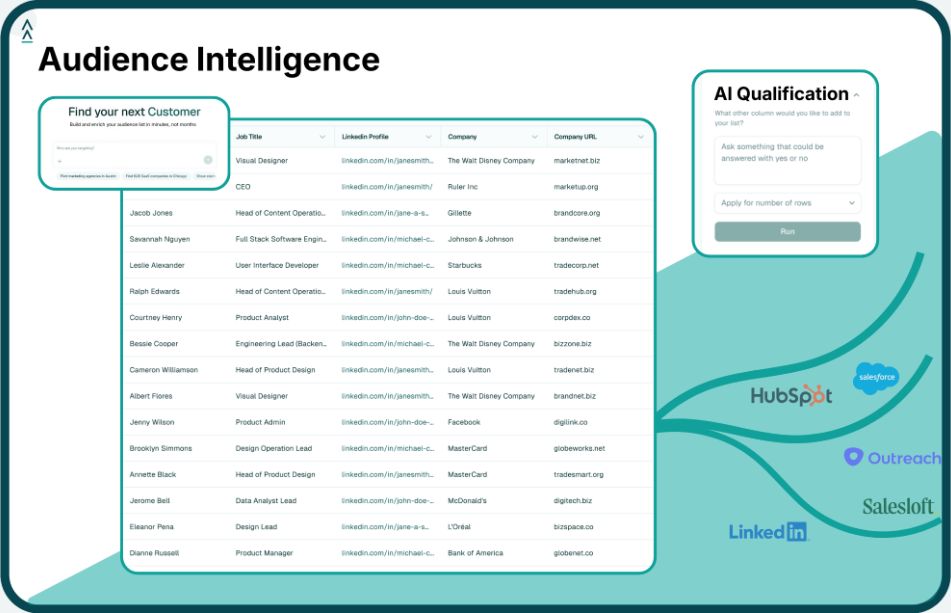
Teams can request an audience using plain English and narrow the results by company category, funding stage, geography, employee growth, product type, or professional role.
Potential metaverse audiences include:
For more specialized segmentation, advanced audience search supports exact filters, historical conditions, rankings, uploaded account data, and custom output fields.
Landbase can match existing company records, enrich missing fields, identify relevant decision-makers, and preserve the results as reusable datasets. Technical GTM teams can use Landbase CLI through Claude Code, Codex, scripts, or a terminal.
Structured exports allow metaverse audiences to move into CRMs, databases, analytical notebooks, dashboards, and outbound workflows.
A metaverse company builds technology that supports persistent virtual environments, immersive interaction, digital identity, spatial computing, or virtual economies. The category can include virtual-world platforms, smart-glasses manufacturers, game engines, spatial-AI companies, and immersive entertainment providers. Some companies focus on consumer experiences, while others supply the infrastructure used to create or operate them. The boundaries overlap with gaming, AI, robotics, media, ecommerce, and enterprise software.
Spatial AI allows software and machines to understand the geometry, objects, and relationships inside three-dimensional environments. These capabilities can support virtual-world generation, augmented reality, robotics, digital twins, simulation, and immersive design. World models may also reduce the time and cost required to create navigable 3D spaces. Spatial intelligence is therefore becoming part of the infrastructure behind both virtual and physical metaverse applications.
Smart glasses are growing faster because they can be lighter, more familiar, and easier to use during ordinary activities. Conventional VR and mixed-reality headsets still offer deeper immersion for gaming, training, design, and simulation. The two product categories are likely to serve different use cases rather than one eliminating the other. Current shipment data nevertheless shows that glasses are becoming the main source of growth across the wider XR market.
The most useful metrics depend on the company’s business model. Consumer platforms can be measured through active users, engagement, creator payments, and transactions, while hardware businesses require shipment, distribution, and market-share data. Infrastructure companies can be assessed through funding, developer adoption, enterprise deployments, and strategic partnerships. Venue operators require completed openings, ticket demand, content agreements, and expansion plans.
Relevant signals include funding, product launches, hardware shipments, developer adoption, acquisitions, platform partnerships, venue openings, and geographic expansion. Hiring across engineering, content, enterprise sales, partnerships, and operations can show where a company is investing. Several signals should be evaluated together because funding or valuation alone may not indicate sustainable demand. Landbase supports this research through audience creation, company matching, enrichment, and reusable account datasets.
Tool and strategies modern teams need to help their companies grow.