.png)
.png)

Daniel Saks
Chief Executive Officer


Genomics is moving beyond specialized research laboratories and becoming a more established part of healthcare delivery. Advances in sequencing, molecular diagnostics, and data analysis are expanding the use of genomic information in cancer care, rare-disease diagnosis, prenatal testing, treatment selection, and disease monitoring. The World Health Organization describes genomic technologies in clinical studies as increasingly central to how diseases are diagnosed, treated, and monitored.
This transition depends on more than scientific breakthroughs. Wider adoption requires clinically meaningful results, regulatory oversight, reimbursement, professional guidelines, laboratory capacity, and software that can translate large genomic datasets into usable information. The FDA identifies next-generation sequencing tests as an important part of precision medicine, while the National Academies has examined how clinical testing guidelines influence coverage and routine medical use.
Co-Founder and CEO: Oguzhan Atay
Headquarters: Menlo Park, California, United States
BillionToOne generated $108.4 million in revenue during the first quarter of 2026, representing 84% year-over-year growth. The company delivered 188,000 tests, up 44%, while prenatal testing revenue increased 72% and oncology testing revenue grew from $2.2 million to $10.7 million.
The company also reported a 73% gross margin and $17.8 million in operating income. It raised its full-year revenue guidance to between $450 million and $465 million, representing expected growth of 48% to 52% over 2025.
BillionToOne develops molecular diagnostic tests using its Quantitative Counting Templates platform. Its prenatal portfolio includes noninvasive screening for fetal and inherited conditions, while its oncology products analyze tumor DNA for therapy selection and disease monitoring.
The company launched Unity Confirm in 2026 as a blood-based confirmation assay designed to follow selected high-risk prenatal-screening results.
BillionToOne combines high clinical volume with improving economics. Its growth reflects both increased test adoption and higher average revenue per test.
Its expansion into oncology also demonstrates how a technology platform developed for prenatal diagnostics can support additional molecular-testing categories.
Co-CEOs and Co-Founders: Helmy Eltoukhy and AmirAli Talasaz
Headquarters: Palo Alto, California, United States
Guardant Health generated $301.7 million in first-quarter 2026 revenue, an increase of 48%. Oncology test volume rose 47%, while screening revenue increased from $5.7 million to $41.6 million as Shield volume grew from approximately 9,000 to 44,000 tests.
The company raised its full-year revenue guidance to between $1.30 billion and $1.32 billion. It now expects Shield volume of 230,000 to 245,000 tests during 2026.
Guardant develops blood- and tissue-based tests for cancer screening, therapy selection, recurrence monitoring, and biopharma research. Its portfolio includes Guardant360, Guardant Reveal, Guardant Infinity, and Shield.
Shield received FDA approval for colorectal-cancer screening and has since become a major commercial growth driver.
Guardant is expanding liquid biopsy from advanced-cancer treatment into population screening and earlier-stage disease management. This broadens the addressable market beyond patients who already have a confirmed cancer diagnosis.
The company’s screening growth also shows the commercial effect of combining regulatory approval, reimbursement, physician distribution, and consumer awareness.
CEO: Steve Chapman
Headquarters: Austin, Texas, United States
Natera generated $696.6 million in first-quarter 2026 revenue, representing 38.8% year-over-year growth. It processed approximately 1.01 million tests, including 258,900 oncology tests, which represented 54.4% growth from the corresponding prior-year period.
The company raised its full-year revenue guidance to between $2.74 billion and $2.82 billion. It also reported positive cash inflow during the quarter.
Natera develops cell-free DNA tests across women’s health, oncology, and organ transplantation. Its products include Panorama for prenatal screening, Signatera for molecular residual disease and treatment monitoring, and Prospera for transplant assessment.
Its platform creates patient-specific or condition-specific assays using genomic information from tumors, pregnancies, or transplanted organs.
Natera demonstrates how one molecular-testing platform can scale across several clinical specialties. Its oncology business is growing particularly quickly as physicians use circulating tumor DNA to monitor recurrence and treatment response.
Its test volume also illustrates the infrastructure required to operate genomic diagnostics at a national clinical scale.
Founder and CEO: Eric Lefkofsky
Headquarters: Chicago, Illinois, United States
Tempus generated $348.1 million in first-quarter 2026 revenue, up 36.1% year over year. Diagnostics revenue increased 34.7%, while data and applications revenue grew 40.5%.
Molecular residual disease volume reached approximately 6,500 tests, an increase of about 500%. Tempus raised its 2026 revenue guidance to between $1.59 billion and $1.60 billion.
Tempus combines molecular diagnostics, clinical records, medical imaging, and analytical models within a precision-medicine platform. It offers genomic testing for oncology and other specialties while licensing de-identified data and AI-supported tools to healthcare and biopharmaceutical organizations.
The company’s products support treatment selection, clinical-trial matching, disease monitoring, research, and therapeutic development.
Tempus connects diagnostic testing with a broader clinical and data platform. This allows genomic results to be interpreted alongside treatment histories, imaging, outcomes, and other patient information.
Its growth across diagnostics and data applications shows that precision medicine increasingly depends on both laboratory testing and the software required to make the results operational.
Co-Founder and CEO: Chad Robins
Headquarters: Seattle, Washington, United States
Adaptive Biotechnologies generated $70.9 million in first-quarter 2026 revenue, an increase of 35%. Its molecular residual disease business grew 53% and accounted for 95% of total revenue during the quarter.
clonoSEQ volume rose 41% to 32,595 tests. Adaptive raised its 2026 MRD revenue guidance to between $260 million and $270 million after the business achieved profitability during 2025.
Adaptive analyzes the genetics of immune-system receptors. Its clonoSEQ diagnostic tracks cancer-associated immune-cell sequences to detect minimal or measurable residual disease in selected blood cancers.
The company also uses immune-receptor data in biopharma research, therapeutic development, and disease characterization.
Adaptive applies genomics to the immune system rather than directly sequencing tumors or inherited DNA alone. Its MRD growth demonstrates increasing clinical use of genomic methods for monitoring patients after treatment.
The planned separation of its MRD and Immune Medicine businesses also reflects the different capital and commercial requirements of diagnostics and drug-discovery platforms.
President and CEO: Katherine Stueland
Headquarters: Gaithersburg, Maryland, United States
GeneDx generated $102.3 million in first-quarter 2026 revenue, representing 17% growth. Exome and genome revenue increased 27%, while testing volume rose 34% to 27,488 results.
The company lowered its full-year revenue outlook to between $475 million and $490 million, but continued to expect exome and genome volume growth of at least 30%. The revised guidance means operating execution and reimbursement should be considered alongside testing demand.
GeneDx provides exome and whole-genome sequencing for rare and inherited diseases. Its services help clinicians identify genetic causes of developmental, neurological, metabolic, and other complex conditions.
The company also acquired Fabric Genomics, adding AI-supported variant interpretation and decentralized analysis capabilities to its clinical dataset and laboratory operations.
Rare-disease patients often undergo lengthy diagnostic processes involving multiple specialists and conventional tests. Exome and genome sequencing can consolidate part of that process into a more comprehensive genomic assessment.
GeneDx’s volume growth indicates increasing adoption, although its 2026 guidance revision shows that reimbursement and test mix remain important commercial variables.
CEO and Co-Founder: Molly He
Headquarters: San Diego, California, United States
Element Biosciences reported 40% year-over-year revenue growth during 2025. Its installed base exceeded 450 systems across more than 40 countries, with over 550 publications citing Element technology.
The company also passed 50 installations of its AVITI24 integrated multiomics platform within months of its commercial launch. The systems were adopted by pharmaceutical, drug-discovery, and research organizations.
Element develops benchtop DNA-sequencing and multiomics instruments. Its AVITI platform provides short-read sequencing, while AVITI24 combines sequencing with cellular, protein, and spatial measurements.
The company has also introduced VITARI, a higher-throughput sequencing platform designed to reduce whole-genome sequencing economics at scale.
Element is increasing competition in a sequencing-instrument market historically concentrated around a small number of suppliers. Its systems emphasize flexible throughput, accessible pricing, and the ability to collect several biological measurements from one sample.
Its installation and revenue growth indicate that laboratories are willing to adopt alternative sequencing platforms when the workflows and economics align with their research.
CEO: Ross Muken
Founder and Executive Chairman: Jurgi Camblong
Headquarters: Rolle, Switzerland, and Boston, Massachusetts, United States
SOPHiA GENETICS generated $21.7 million in first-quarter 2026 revenue, representing 22% year-over-year growth. Customers completed a record 108,000 genomic analyses through the SOPHiA DDM platform.
Ross Muken became CEO on July 1, 2026, while founder Jurgi Camblong transitioned to executive chairman. The company expects full-year revenue growth of approximately 20% to 22%.
SOPHiA GENETICS provides cloud-based software for analyzing genomic and multimodal healthcare data. Hospitals and laboratories use the SOPHiA DDM platform for oncology, inherited-disease testing, liquid biopsy, radiomics, and related clinical applications.
The platform standardizes analysis and interpretation across institutions without requiring every laboratory to build a complete bioinformatics environment independently.
Sequencing hardware creates raw data, but laboratories also need validated pipelines for interpretation, reporting, and quality management. SOPHiA addresses this layer of the genomics workflow.
Its analysis-volume growth shows increasing demand for software that helps hospitals operationalize precision medicine across routine clinical settings.
CEO: Francis Van Parys
Headquarters: Oxford, United Kingdom
Oxford Nanopore generated £223.9 million in 2025 revenue, representing 22.2% reported growth and 24.2% growth at constant currency. Revenue increased across every region, product category, and customer type.
Clinical revenue increased approximately 60%, while biopharma and applied-industrial revenue grew approximately 30% and 27%, respectively. Francis Van Parys became CEO in March 2026.
Oxford Nanopore develops portable and high-throughput systems that directly analyze DNA and RNA molecules as they pass through nanopores. Its devices range from the compact MinION to larger GridION and PromethION platforms.
The technology provides long reads, real-time analysis, flexible run lengths, and direct access to selected molecular modifications.
Nanopore sequencing enables applications that are difficult to address with conventional short-read systems, including structural variation, rapid pathogen surveillance, transcript analysis, and field-based sequencing.
Its growth across clinical and industrial markets shows that sequencing is expanding beyond centralized academic facilities. However, regional and export-related challenges in 2026 remain relevant when evaluating near-term growth.
CEO and Co-Founder: Emily Leproust
Headquarters: South San Francisco, California, United States
Twist generated a record $110.7 million in fiscal second-quarter 2026 revenue, an increase of more than 19%. The quarter represented its thirteenth consecutive period of sequential revenue growth.
DNA Synthesis and Protein Solutions revenue increased 28%, while next-generation sequencing applications revenue grew 12%. The company raised its fiscal-year revenue guidance to between $442 million and $447 million.
Twist uses a silicon-based platform to manufacture synthetic DNA at scale. Its products include genes, oligonucleotide pools, targeted sequencing panels, antibodies, and tools for drug discovery and biological research.
The company supplies both the synthetic material used to design experiments and enrichment products used to prepare samples for sequencing.
Genomics depends on the ability to read DNA, but many modern research and development processes also require custom DNA to be written at scale. Twist supports this design-build-test cycle.
Its growth in synthetic biology, sequencing applications, and AI-enabled drug discovery demonstrates how demand for biological data can increase demand for standardized physical inputs.
Genomics expansion often begins with a clinical or operational milestone. A company may launch a new assay, gain payer coverage, install sequencing systems, expand laboratory capacity, enter a new therapeutic area, or sign a biopharma partnership.
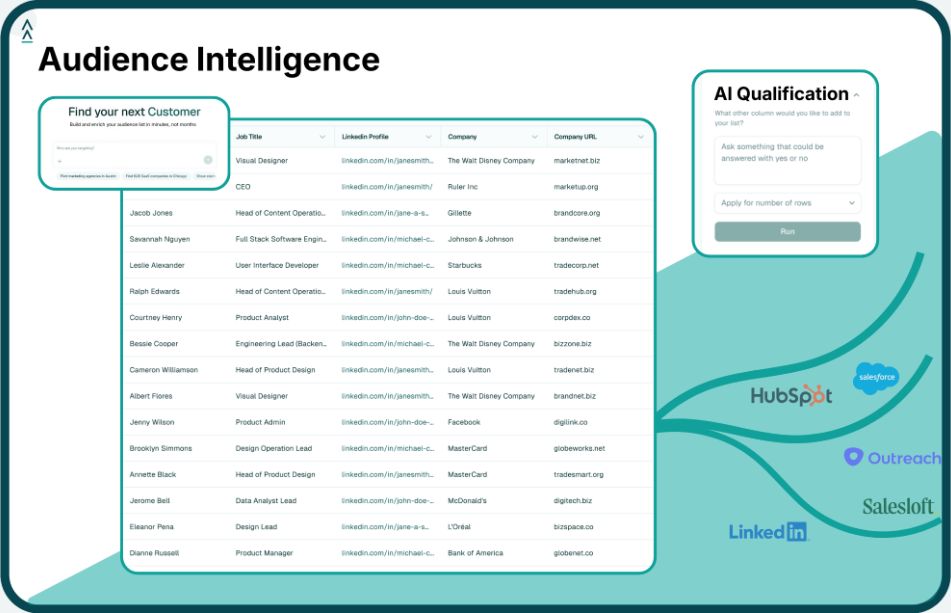
Landbase can organize those developments into unified account profiles that combine company information, funding, hiring, technology, and current growth signals. This helps teams distinguish research-stage companies from businesses moving into broader clinical or commercial deployment.
Relevant genomics audiences may include:
Industry events can provide another useful research layer. Conference attendee data can help teams identify executives, laboratory leaders, researchers, and commercial decision-makers participating in healthcare, biotechnology, and data-focused events.
Landbase can match and enrich existing account records, map relevant buying groups, and preserve findings as reusable datasets. Technical GTM teams can use Landbase CLI through Claude Code, Codex, scripts, or a terminal for market mapping, conference preparation, CRM enrichment, and account prioritization.
Growth can be measured through revenue, clinical-test volume, sequencing installations, analyses completed, reimbursement, or regulatory progress. The most useful metric depends on whether the company sells diagnostic tests, instruments, software, or research products. Private companies may provide fewer financial details, making installations and commercial partnerships more important. Several indicators should be evaluated together rather than relying on funding alone.
MRD tests look for small amounts of cancer-associated genetic material that may remain after treatment. They can help clinicians monitor recurrence risk, treatment response, or disease progression earlier than some conventional methods. Adoption depends on strong clinical evidence, physician education, reimbursement, and integration into care pathways. Continued growth is therefore tied to both scientific performance and healthcare-system acceptance.
Short-read sequencing analyzes many relatively small DNA fragments and is widely used for high-throughput testing. Long-read platforms analyze larger continuous sections, which can help resolve structural variants, repetitive regions, transcript isoforms, and complex genomes. The technologies can be complementary because each offers different cost, accuracy, speed, and workflow characteristics. Laboratories select platforms according to the biological question and clinical requirements.
Sequencing produces large amounts of raw information that must be processed, compared, interpreted, and translated into a clinical report. Bioinformatics platforms help identify variants, assess evidence, manage quality, and connect results with patient or disease context. Clinical systems also require validation, security, reproducibility, and integration with laboratory workflows. Strong interpretation infrastructure can therefore be as important as the sequencing instrument itself.
Strong signals include assay launches, FDA decisions, reimbursement changes, clinical-guideline inclusion, new laboratories, sequencing installations, and pharmaceutical partnerships. Hiring in clinical affairs, market access, bioinformatics, laboratory operations, and commercial leadership can reveal where a company is preparing to expand. Conference participation and new research collaborations can provide additional context about therapeutic or geographic priorities. Landbase supports this research through account intelligence, contact enrichment, event data, and reusable company datasets.
Tool and strategies modern teams need to help their companies grow.