.png)
.png)

Daniel Saks
Chief Executive Officer


Femtech investment remains active in 2026 as women's health attracts greater attention from healthcare investors, employers, payers, and life-sciences companies. Dealroom reports that femtech startups raised $724 million in VC funding in 2025, with another $239 million raised in the first half of 2026. Across the broader women's health market, Silicon Valley Bank reports that $2 billion in VC was invested across the U.S. and Europe in 2025, with funding and deal volume projected to rebound in 2026.
For GTM teams tracking healthcare growth markets, femtech now extends well beyond period-tracking apps. The sector includes virtual care, fertility technologies, diagnostics, reproductive therapeutics, maternal health, menopause care, and clinical automation. Related Landbase research on fast-growing digital health companies and healthtech companies provides additional context for the broader healthcare technology market.
Women's health has historically received less research and investment attention than its population and economic impact would suggest. That gap has created opportunities across fertility, menopause, maternal health, reproductive medicine, diagnostics, and chronic conditions affecting women.
Industry research cited by Jones Day projects substantial long-term growth in femtech as healthcare delivery, biotechnology, digital platforms, and medical devices converge around women's health needs.
Several forces are supporting this expansion:
For RevOps and sales organizations, these developments can provide useful inputs for account research and market-specific list building.
Focus: Virtual midlife and women's healthcare
CEO: Joanna Strober, Co-founder
Recent Funding: $100M Series D, February 2026
Valuation: More than $1B
Midi Health began with perimenopause and menopause care and has expanded toward a broader women's healthcare platform. Its $100 million Series D valued the company at more than $1 billion in February 2026.
Midi combines rapid patient growth with nationwide insurance-backed care and significant growth capital. Its expansion into additional areas of women's health also increases its addressable market beyond menopause alone.
Focus: Women's, maternal, and children's healthcare
CEO: Marta Bralic Kerns, Founder
Recent Funding: $92M Series C, January 2026
Valuation: $1.7B
Pomelo Care provides virtual clinical care spanning reproductive health, pregnancy, pediatrics, hormonal health, perimenopause, and menopause. Its $92 million Series C valued the company at $1.7 billion.
Pomelo combines rapid financing with health-plan and employer distribution and published outcomes data. Its expansion beyond pregnancy creates room for a broader longitudinal care model.
Focus: Women's and family health benefits
CEO: Kate Ryder, Founder
Recent Funding: $125M Series F, October 2024
Valuation: $1.7B
Maven Clinic provides fertility, family-building, maternity, parenting, menopause, and related healthcare programs through employers and health plans. Its Series F raised $125 million at a $1.7 billion valuation.
Maven remains one of the most scaled women's and family health platforms. Its broad care model and established enterprise distribution distinguish it from companies concentrated on a single women's health category.
Focus: Digital women's health and cycle tracking
CEO: Dmitry Gurski, Co-founder
Recent Funding: More than $200M Series C, July 2024
Valuation: More than $1B
Flo Health became the first purely digital consumer women's health app to reach unicorn status following its General Atlantic investment. At the time of the round, Flo reported nearly 70 million monthly active users and close to five million paid subscribers.
Flo demonstrates consumer adoption at a scale few women's health platforms have reached. Its subscription model and global reach provide a different growth profile from employer-backed or clinical-care platforms.
Focus: At-home diagnostics and virtual healthcare
CEO: Peter Foley, Founder
Recent Funding: $165M Series F, January 2025
LetsGetChecked is a broader diagnostics company rather than a dedicated femtech platform, but women's health remains an important part of its offering. Its testing portfolio includes fertility, sexual health, hormone, HPV, thyroid, and other at-home diagnostic services.
LetsGetChecked illustrates how women's health increasingly overlaps with the broader diagnostics market. Its existing testing infrastructure and healthcare partnerships create distribution opportunities across reproductive and preventive care.
Focus: Reproductive medicine therapeutics
CEO: Jean Marie Duvall, Co-founder
Recent Funding: $65M Series A, May 2025
ReproNovo develops therapeutics for reproductive medicine and women's health. Its pipeline includes RPN-001 for male infertility and RPN-002 for adenomyosis and assisted reproductive technology applications.
ReproNovo represents the therapeutics side of the sector, where clinical development can be a more meaningful growth indicator than user or revenue growth. Its financing is supporting multiple mid-stage clinical programs.
Focus: Cell-based reproductive medicine
CEO: Dina Radenkovic, Co-founder
2024-2025 Funding: $33M Series B + $44M Series C
Gameto develops reproductive technologies using engineered ovarian support cells. Its lead program, Fertilo, is designed to support egg maturation for IVF and egg freezing while reducing dependence on prolonged hormonal stimulation.
Gameto combines substantial recent financing with advanced clinical development. Progress into Phase 3 gives the company a different growth profile from earlier-stage fertility startups and moves its lead technology closer to potential commercialization.
Focus: Hospital-partnered women's healthcare
CEO: Kate Condliffe, Co-founder
Recent Funding: $55M Series C, September 2025
Diana Health works with hospitals to develop integrated women's health programs combining certified nurse-midwives, OB-GYNs, mental health professionals, wellness services, and supporting technology.
Diana Health follows a different expansion path from virtual-only platforms. Its hospital partnership model uses established health systems as a foundation for geographic and clinical growth.
Focus: Automated IVF laboratories
CEO: Alan Murray
Recent Funding: $50M Series A, September 2025
Conceivable Life Sciences develops AI-powered robotics for IVF laboratories. Its AURA platform is designed to automate traditionally manual embryology processes and improve consistency and scalability within fertility treatment.
IVF laboratories depend on highly specialized staff and complex manual workflows. Conceivable targets that operational bottleneck by applying robotics and automation to laboratory processes, giving it a distinct position within fertility technology.
Focus: Uterine-health biomaterials
CEO: John Nealon
Recent Funding: $25M financing, June 2026
Rejoni develops biomaterial technologies for uterine health. Its lead product, the Juveena Hydrogel System, is designed to support endometrial healing and help prevent intrauterine adhesions following certain intrauterine procedures. The product remains subject to regulatory approval.
Rejoni combines recent financing with regulatory progress toward potential commercialization. That combination makes clinical and regulatory milestones more relevant to its growth trajectory than traditional software metrics such as monthly users.
Femtech does not fit neatly into a single conventional industry category. Relevant companies may be classified as telehealth providers, biotechnology startups, diagnostics companies, medical-device manufacturers, fertility businesses, or healthcare software companies.
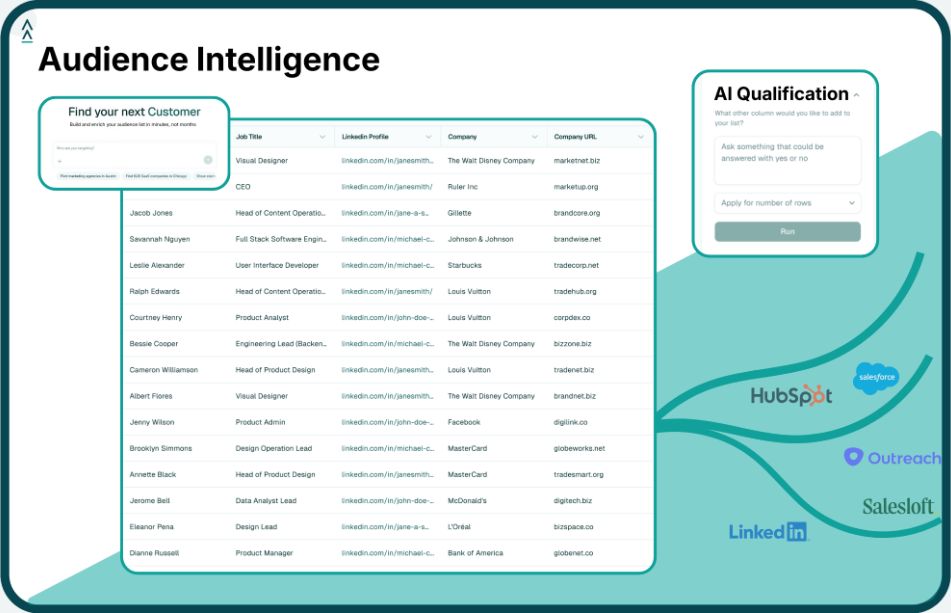
Landbase CLI provides programmatic access to Landbase data and agent workflows from the terminal and environments such as Claude Code and Codex. This can help GTM engineers and RevOps teams define specialized healthcare audiences without depending entirely on broad industry classifications.
Natural-language audience creation allows teams to combine characteristics that may otherwise require several separate filters. A search could focus on women's health companies at particular funding stages, reproductive-health businesses in specific geographies, or healthcare companies showing expansion activity.
Landbase's guidance on prompting like an operator provides a framework for translating those criteria into more structured audience requests.
Financing alone does not indicate that every company is entering the same buying cycle. Relevant signals can include:
Landbase workflows can stack buying signals rather than relying on a single event.
Teams that already maintain women's health, fertility, or digital-health account lists can use file upload, matching, and enrichment to connect existing records with additional company or contact data.
This approach can help maintain a market map as companies change funding stages, expand teams, or move from clinical development toward commercialization.
Landbase CLI can return structured datasets for downstream use in scripts, analysis, CRM processes, and agent-assisted workflows. For technical revenue teams working across specialized healthcare markets, this provides a path from market definition to account data without rebuilding the research process for each campaign.
A fast-growing femtech company typically shows several forms of momentum rather than funding alone. Relevant indicators include large or closely spaced financing rounds, revenue or patient growth, health-plan or employer distribution, clinical milestones, regulatory progress, geographic expansion, and new commercial infrastructure. The companies on this list were selected because they show multiple recent indicators across 2024-2026.
Femtech focuses on health needs that solely, disproportionately, or differently affect women, including menopause, reproductive health, pregnancy, fertility, and gynecological conditions. New care models can improve access to specialists, while diagnostics, therapeutics, and clinical technologies can address areas that historically received less research or investment attention.
Femtech companies follow many of the same financing stages as other venture-backed healthcare businesses, from seed and Series A through later-stage rounds. Capital requirements vary considerably by model. A virtual-care platform may scale through software, clinicians, and payer contracts, while biotechnology or medical-device companies may require larger investments for clinical trials, regulatory work, manufacturing, and commercialization.
Recent rounds include participation from investors such as General Atlantic in Flo Health, Stripes in Pomelo Care, Goodwater Capital in Midi Health, HealthQuest Capital in Diana Health, and Advance Venture Partners in Conceivable Life Sciences. Corporate and healthcare investors are also active, including Optum Ventures and M Ventures, Merck's corporate venture arm.
Landbase CLI allows GTM teams to define specialized audiences using natural-language criteria and combine those criteria with company and buying signals. Rather than using funding as the only indicator, teams can incorporate hiring, executive changes, market expansion, and other events, then use matching and enrichment to prepare account and contact data for downstream workflows.
Tool and strategies modern teams need to help their companies grow.