.png)
.png)

Daniel Saks
Chief Executive Officer


Embedded finance allows businesses to integrate accounts, payments, cards, lending, and other financial products directly into existing software, marketplaces, and customer journeys. Instead of directing users to a separate financial provider, these services can be delivered at the point of need through APIs and regulated infrastructure. Embedded finance research projected that U.S. transaction value would rise from $2.6 trillion in 2021 to more than $7 trillion in 2026, with payments and lending accounting for much of the opportunity.
As adoption expands, growth depends on more than transaction volume. A joint regulatory statement from U.S. banking regulators highlighted risks associated with third-party arrangements that distribute deposit products and services. These arrangements require effective governance, due diligence, monitoring, consumer protection, and reliable recordkeeping, making compliance and operational capability central to embedded finance growth.
CEO: Jack Zhang, co-founder and CEO
Headquarters: Singapore and San Francisco
Category: Global payments and embedded financial infrastructure
Latest funding: $320 million Series H in June 2026
Airwallex raised $320 million at an $11 billion valuation. In March 2026, it reported $1.3 billion in annualized revenue, up 74% year over year, and $287 billion in annualized transaction volume, up more than 120%.
The company serves businesses directly and provides APIs for platforms embedding accounts, payments, payouts, foreign exchange, and card issuing. More than 676,000 businesses reportedly used its infrastructure directly or through platform customers when the financing was announced.
CEO: Farooq Malik, co-founder and CEO
Headquarters: New York City, United States
Category: Stablecoin-powered cards and payment infrastructure
Latest funding: $250 million Series C in January 2026
Rain raised $250 million at a $1.95 billion valuation, bringing its total funding above $338 million. The company reported that its active card base increased 30-fold and annualized payment volume rose 38-fold during the previous year.
Rain provides infrastructure for stablecoin cards, wallets, onramps, offramps, payouts, and cross-border payments. Its technology supported more than $3 billion in annualized transactions across over 200 partners when the round was announced.
CEO: Pedro Mac Dowell, founder and CEO
Headquarters: São Paulo, Brazil
Category: Banking, lending, payments, and risk infrastructure
Latest funding: $63 million Series B extension in July 2025
QI Tech raised an additional $63 million, bringing its total Series B financing to $313 million. The company said the investment would support product expansion, regulatory and governance capabilities, and strategic acquisitions.
QI Tech reported more than 300 clients across its banking and financial infrastructure business. Its APIs support account opening, Pix payments, credit products, onboarding, fraud controls, securities, and investment-fund services.
CEO: Peter De Caluwe, co-founder and CEO
Headquarters: Singapore
Category: Cross-border payment infrastructure
Latest funding: $150 million Series D in April 2025
Thunes raised $150 million in its largest funding round to date. At the time of the financing, its network covered more than 130 countries and 80 currencies, and the company reported a $150 million revenue run rate with positive EBITDA.
The company subsequently expanded its network to more than 140 countries and 90 currencies, secured 50 U.S. money-transmission licences, and opened a New York office in June 2026. These developments support platforms that need to embed international payouts and payment acceptance across multiple markets.
CEO: John MacIlwaine, co-founder and CEO
Headquarters: San Francisco, United States
Category: Embedded payments, card issuing, and credit infrastructure
Latest funding: Series B later reported by Highnote as having expanded to $125 million
Highnote’s later company materials describe its Series B as a $100 million financing followed by a $25 million extension from existing investors. The company expanded beyond card issuing into merchant acquiring, credit, ledgering, instant payments, and programmable money movement.
Its partnerships and product launches have extended the platform into B2B virtual cards, stablecoin funding, commercial payments, and AI-initiated transactions. This development reflects demand for infrastructure that manages incoming and outgoing money flows through one system.
CEO: Sahill Poddar, co-founder and CEO
Headquarters: San Francisco, United States
Category: Embedded small-business financing
Latest equity funding: $100 million Series C in 2024
Parafin provides embedded working capital, credit, and financing products through marketplaces, payment processors, and vertical software platforms. Its programs have launched through platforms including Amazon, Walmart, DoorDash, and Worldpay, with more than $25 billion in financing offers extended.
In July 2026, Parafin completed a forward-flow agreement under which up to $300 million of loans originated through its platform could be purchased by a rated vehicle. This should be classified as capital-market financing rather than a new equity round.
CEO: Claurelle Rakipovic
Headquarters: Remote-first, United States
Category: Embedded working capital and small-business finance
Recent financing: $225 million credit facility renewed in March 2026
Pipe renewed and expanded its credit facility with Victory Park Capital to $225 million. The company reported that revenue tripled during 2025 and that it had originated more than $300 million in capital advances since launching Pipe Capital in 2024.
Pipe also reported that origination volume more than doubled during 2025. Its products embed working capital within software platforms used by small businesses, while the credit facility supports lending capacity and remains separate from conventional company equity funding.
CEO: Omar Onsi, founder and CEO
Headquarters: Dubai, United Arab Emirates
Category: Embedded payments, card issuing, and open finance
Latest funding: $33 million Series B in March 2025
NymCard raised $33 million to expand its infrastructure across the Middle East and North Africa. Its platform operates across more than 10 markets and combines card issuing, money movement, settlement, reconciliation, lending, and financial-crime controls.
The company received authorization to provide open-finance services under the Central Bank of the UAE’s regulatory framework. In February 2026, it also introduced stablecoin settlement with Visa in the Gulf Cooperation Council region.
CEO: Madhusudanan R, co-founder and CEO
Headquarters: Chennai, India
Category: Banking and payment infrastructure
Latest funding: INR 850 crore first close of its Series D in September 2024
M2P Fintech raised INR 850 crore through a combination of primary and secondary share capital. The financing was led by Helios Investment Partners and was intended to strengthen the company’s position in India while supporting international expansion, particularly in Africa.
M2P provides infrastructure for cards, payments, credit, core banking, digital accounts, fraud management, and related financial products. Its customers include banks, non-bank lenders, technology companies, and fintech platforms seeking modular financial infrastructure.
CEO: Mark Fairless, group CEO
Headquarters: London, United Kingdom
Category: Clearing, payments, and embedded banking
Latest disclosed equity funding: £175 million in March 2022
ClearBank reported that group revenue increased 34% and payment volumes rose 57% during 2025. Customer balances reached £17.8 billion, while the company processed 262 million payments and served 279 clients.
The company operates regulated banking and payment infrastructure in the United Kingdom and Europe. Although its latest disclosed equity financing is older than several other rounds on the list, its current operating growth provides a clearer signal than funding alone.
Embedded finance programs often involve several connected businesses, including software platforms, banks, payment processors, card networks, lenders, compliance providers, and implementation partners. GTM teams therefore need to identify both individual companies and the commercial relationships surrounding a financial product.
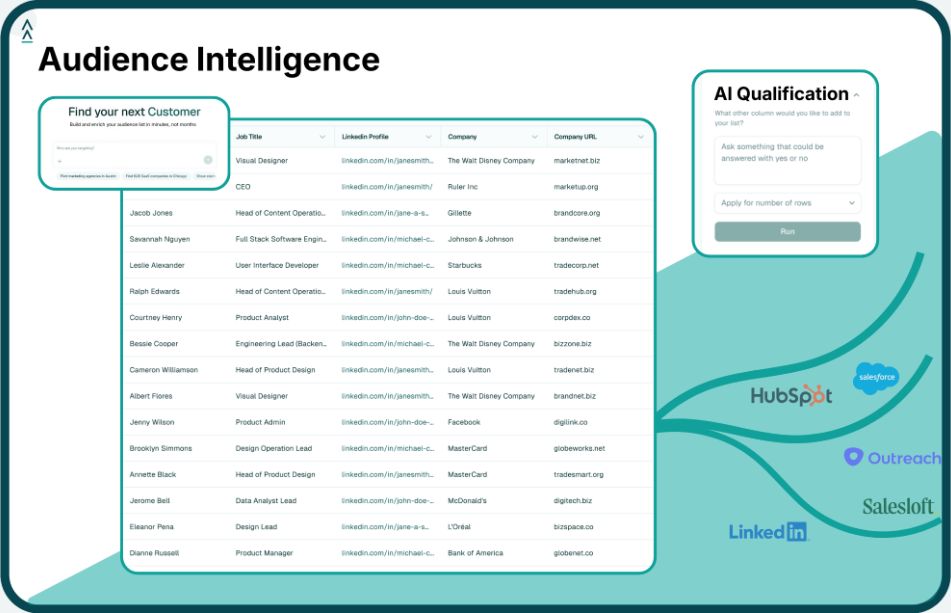
Landbase CLI provides a command-line interface for searching, matching, enriching, managing, and exporting B2B audience data. Technical GTM teams can use it through a terminal, Claude Code, Codex, or scripts, allowing account research and dataset preparation to become part of repeatable technical workflows.
Teams can begin with a natural-language request, such as embedded lenders expanding platform partnerships or payment infrastructure companies entering regulated markets. For more complex definitions, advanced audience search supports exact conditions, historical data, uploaded account lists, aggregations, and custom output columns.
Embedded finance research may focus on signals such as:
Existing CSV or Excel lists can be uploaded and processed through batch workflow steps. These workflows support onboarding, record matching, company enrichment, publishing, and dataset lineage.
Company enrichment can add firmographic fields such as industry, company size, and headquarters location. Separate contact enrichment can add verified emails, phone numbers, LinkedIn URLs, and job titles for professionals across product, engineering, compliance, partnerships, finance, risk, and go-to-market teams.
Results can be downloaded in structured formats for use in CRM systems, dashboards, notebooks, warehouses, and agent workflows. Landbase is applicable to identifiable companies and professionals, while licences, regulatory approvals, transaction volumes, sponsor-bank relationships, and credit performance should be verified through official financial and regulatory sources.
Embedded finance integrates financial products into software, marketplaces, and other non-financial platforms. These products can include accounts, payments, cards, lending, insurance, or investments. Customers can use the financial service without leaving the platform they already use. Infrastructure providers supply the APIs, compliance systems, and financial partnerships behind the experience.
Providers may charge software fees, transaction fees, card interchange, foreign-exchange margins, or revenue-sharing fees. Embedded lenders may earn origination, servicing, or financing revenue. The model depends on the product and how responsibilities are divided among the platform, infrastructure provider, and regulated institution. Revenue should be assessed alongside compliance, credit, and funding costs.
Growth may include higher transaction volume, revenue, clients, funding, lending originations, or geographic coverage. New licences and enterprise partnerships can provide additional evidence. The most relevant metric depends on whether the company provides payments, lending, banking, or card infrastructure. Several indicators should be considered together.
Embedded products may involve banks, payment networks, lenders, processors, and other regulated businesses. Each party must understand its responsibilities for customer identification, monitoring, recordkeeping, complaints, and risk management. Weak oversight can expose the infrastructure provider and its financial partners to operational and regulatory problems. Compliance capability is therefore part of the product rather than a separate administrative function.
Useful signals include funding, credit facilities, licences, product launches, enterprise integrations, and geographic expansion. Hiring in compliance, risk, partnerships, engineering, and enterprise sales can indicate increasing investment. Company data should be combined with specialist regulatory and financial sources. Landbase supports the company-research portion through audience creation, matching, enrichment, and structured datasets.
Tool and strategies modern teams need to help their companies grow.