.png)
.png)

Daniel Saks
Chief Executive Officer


Direct-to-consumer commerce continues to benefit from rising online spending, but the model is no longer limited to e-commerce. U.S. retail e-commerce sales reached an estimated $326.7 billion in the first quarter of 2026, increasing 9.8% from the same period in 2025 and representing 16.9% of total retail sales. Digital channels therefore remain important even as consumer brands add physical stores and wholesale distribution.
Smaller consumer brands are also contributing a disproportionate share of category growth. Bain’s analysis of high-growth consumer brands found that insurgent brands represented less than 2% of tracked market share but generated approximately 36% of market growth across measured fast-moving consumer-goods categories in 2025.
CEO: Sid Gupta, co-founder and CEO
Headquarters: San Francisco, California, United States
Category: Apparel, accessories, home goods, and consumer retail
Latest funding: $500 million Series E in March 2026
Quince raised $500 million at a $10.1 billion post-money valuation in March 2026. The financing followed a $280 million round in 2025 and was intended to support international expansion and further development of its manufacturer-to-consumer platform.
Quince reportedly surpassed approximately $1.1 billion in annual revenue by late 2025. The company has expanded beyond apparel into luggage, jewelry, bedding, furniture, beauty, and other categories while retaining an online-led operating model.
Quince shows how a digital retailer can scale across several consumer categories rather than remaining focused on one product line. Its model emphasizes direct supplier relationships, broad assortment development, and pricing below many traditional premium brands.
CEO: Jens Grede, co-founder and CEO
Co-founder and chief creative officer: Kim Kardashian
Headquarters: Los Angeles, California, United States
Category: Shapewear, intimates, apparel, and activewear
Latest funding: $225 million in November 2025
SKIMS raised $225 million at a $5 billion valuation in November 2025. Goldman Sachs Alternatives led the round, with participation from funds affiliated with BDT & MSD Partners.
The company said the capital would support physical retail, international expansion, and additional apparel categories. At the time of the financing, SKIMS operated 18 company-owned stores in the United States and two franchise locations in Mexico.
SKIMS demonstrates how a celebrity-founded company can combine cultural reach with product development and retail operations. Its expansion reflects the wider transition from pure DTC distribution toward owned stores and international channels.
CEO: John Foraker, co-founder and CEO
Headquarters: Berkeley, California, United States
Category: Organic baby and children’s food
Latest financing: Approximately $198 million raised through its February 2026 IPO
Once Upon a Farm completed an initial public offering in February 2026 and began trading on the New York Stock Exchange. The company raised approximately $198 million through the offering.
For the full year, Once Upon a Farm reported net sales of $240.7 million, an increase of 53.5% from 2024. Fourth-quarter sales increased 30.1% to $64 million, while adjusted EBITDA improved from a $3.7 million full-year loss in 2024 to a positive $2.1 million in 2025.
Once Upon a Farm began with a digitally influenced challenger-brand model but now distributes broadly through major retailers. Its IPO shows that DTC engagement and retail scale can function as complementary growth channels.
CEO: Ben Goodwin, co-founder and CEO
Headquarters: Oakland, California, United States
Category: Functional and prebiotic soda
Latest funding: $50 million Series C in February 2025
OLIPOP raised $50 million in a Series C led by J.P. Morgan Private Capital’s Growth Equity Partners, valuing the company at $1.85 billion. The company also reported reaching profitability during 2024.
Sales doubled to approximately $400 million in 2024. The funding was intended to support distribution, product development, and marketing as OLIPOP expanded from digitally led brand-building into national retail.
OLIPOP demonstrates how a consumer startup can use functional positioning to compete within an established beverage category. Its development also shows how DTC awareness can provide a foundation for large-scale grocery and mass-retail distribution.
CEO: Peter Rahal, co-founder and CEO
Headquarters: New York City, United States
Category: Protein foods and functional nutrition
Latest funding: $75 million Series A in May 2025
David raised $75 million in a Series A led by Greenoaks, with participation from Valor Equity Partners. The financing came less than a year after the protein-bar company launched commercially.
At the time of the round, David was available in more than 3,000 retail locations and expected to exceed $100 million in first-year revenue. The company also acquired Epogee, the supplier of an ingredient used in its products. The revenue figure was a company forecast rather than an audited result.
David illustrates how experienced consumer founders can compress fundraising, product development, and retail-distribution timelines. Its growth is tied to demand for high-protein foods and a business model combining direct sales with rapid physical expansion.
CEO: Michael Malinsky, co-founder and CEO
Headquarters: London, United Kingdom, with U.S. operations in New York
Category: Beauty and cosmetics
Latest funding: $50 million Series A in May 2025
Wonderskin raised a $50 million minority Series A investment led by Insight Partners. The company said the funding would support product innovation, international growth, and retail expansion.
Its peel-off lip stain became a widely shared social-media product. According to company figures reported by Glossy, the product had sold more than six million units by 2026. Wonderskin subsequently expanded into additional makeup categories and physical retail, including Sephora.
Wonderskin shows how a highly demonstrable product can drive online discovery and support wider retail distribution. Its growth also highlights the role of differentiated product design rather than social engagement alone.
CEO: Ben Lewis, co-founder and CEO
Headquarters: New York City, United States
Category: Baby, toddler, and children’s food
Latest disclosed funding: Undisclosed additional financing in February 2023 at a reported valuation of approximately $300 million
Little Spoon reported more than $150 million in direct-to-consumer net revenue during 2025. The company then introduced 23 products across more than 1,800 Target stores, marking its first major national retail expansion.
In 2026, Little Spoon entered infant formula, extending its product range from early infancy through older-child meals and snacks. Its latest publicly identified financing occurred in 2023, when existing investors provided additional capital at a reported valuation of approximately $300 million.
Little Spoon demonstrates how a subscription food business can use direct customer relationships to develop a wider product portfolio before entering physical retail. Its expansion also shows how DTC companies can retain owned-channel revenue while adding mass-market availability.
CEO: Bill Shufelt, co-founder and CEO
Headquarters: Milford, Connecticut, United States
Category: Non-alcoholic beer and beverages
Latest funding: $50 million equity round in July 2024
Athletic Brewing raised $50 million in an equity round led by General Atlantic. The investment supported long-term growth and the purchase of an additional U.S. brewing facility.
At the time of the financing, year-to-date sales had increased approximately 60%. Athletic Brewing has scaled through direct online sales, subscriptions, retail distribution, hospitality relationships, and sports partnerships.
Athletic Brewing helped reposition non-alcoholic beer as a lifestyle and performance product rather than a narrow substitute category. Its development illustrates how a digitally native consumer brand may require substantial manufacturing investment as retail demand grows.
CEO: Victoria Thain Gioia, co-founder and CEO
Headquarters: Los Angeles, California, United States
Category: Women’s health supplements
Latest funding: $27 million growth investment in November 2025
Perelel raised $27 million in a growth investment led by Prelude Growth Partners, with participation from Unilever Ventures, Willow Growth Partners, and Selva Ventures.
The company said the capital would support its expansion from prenatal supplements into products covering additional stages of women’s hormonal health. Perelel uses a recurring-delivery model for vitamins and supplements designed around specific life stages.
Perelel shows how DTC subscriptions can be applied to health categories with recurring purchasing patterns. Its broader product strategy also demonstrates how focused brands can expand customer lifetime value without abandoning their original category expertise.
Co-founders: Margaret and Katherine Kleveland
Headquarters: Los Angeles, California, United States
Category: Women’s apparel and lifestyle products
Latest funding: Series A led by Silas Capital in June 2025
DÔEN completed its first institutional growth-equity round in 2025. The company did not disclose the amount in its announcement, although external reporting placed the financing at approximately $25 million.
The brand had grown into a business generating more than $100 million in annual revenue. E-commerce increased 40% year over year, while wholesale bookings rose 110%, according to company figures reported by Vogue Business.
DÔEN illustrates how an online-first apparel company can expand through wholesale and owned stores while maintaining a direct customer relationship. Its development also shows that omnichannel distribution can strengthen rather than replace a brand’s digital foundation.
The DTC ecosystem extends beyond consumer brands. It includes manufacturers, packaging companies, logistics providers, e-commerce platforms, subscription software, retail brokers, agencies, fulfillment businesses, and wholesale partners.
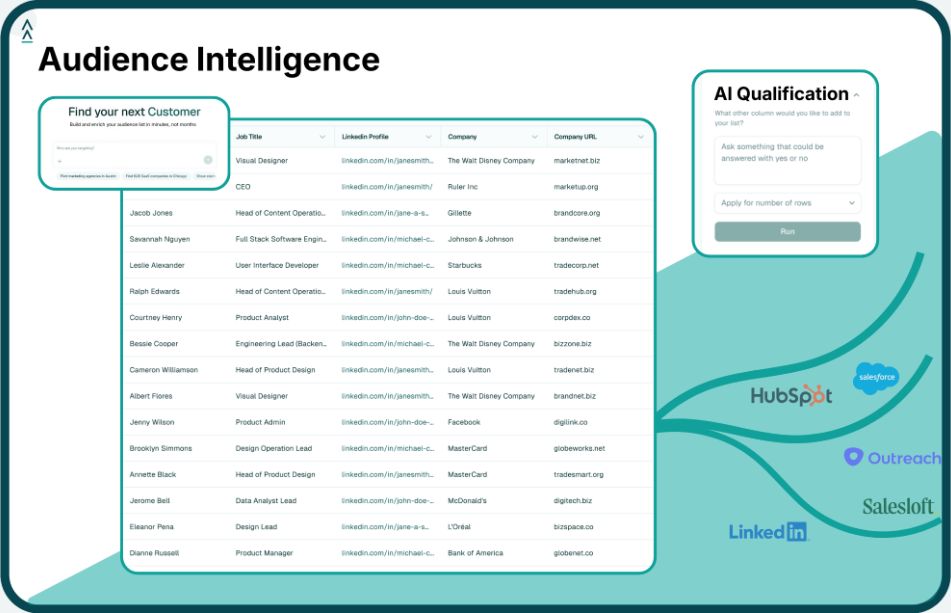
Technical GTM teams can use Landbase CLI through a terminal, Claude Code, Codex, or scripts. The CLI supports natural-language audience creation, record matching, company and person enrichment, dataset workflows, and structured exports.
A search might focus on consumer brands entering national retail, DTC wellness companies hiring wholesale leaders, or apparel businesses expanding internationally. Advanced audience search supports exact logic, aggregations, uploaded account lists, historical career and hiring data, job postings, and custom output columns.
Relevant DTC growth indicators may include:
Existing CSV or Excel lists can be uploaded and processed through batch workflows. These workflows support dataset onboarding, record matching, company or person attribute enrichment, publishing, and downloadable structured results.
Search results can be exported in JSONL, compressed JSONL, CSV, or Parquet formats for CRM preparation, account segmentation, dashboards, notebooks, and agent workflows. Separate contact enrichment can be used when verified work emails or direct phone numbers are required.
Landbase applies to identifiable companies and professionals. Revenue, profitability, retail sell-through, acquisition terms, and consumer-market performance should still be verified through company announcements, filings, retailers, and specialist industry sources.
Growth may include rising revenue, repeat customers, funding, retail distribution, or product-category expansion. Digital traffic alone does not establish sustainable growth. Profitability, retention, inventory management, and retail performance provide additional context. Several indicators should therefore be considered together.
B2C describes any company selling to individual consumers. DTC refers more specifically to brands that sell through channels they control, such as owned websites, stores, or subscriptions. Many current DTC companies also use wholesale partners. The distinction concerns distribution and customer ownership rather than the identity of the buyer.
Retail increases product visibility and allows customers to evaluate products before purchasing. It can also reduce dependence on paid digital advertising. Physical distribution introduces inventory, margin, and operational complexity. Expansion should therefore be assessed through sell-through and repeat demand rather than store count alone.
Funding provides capital while the company remains independent, whereas an acquisition transfers some or all ownership to a buyer. Both can indicate strategic value, but they have different implications for leadership and future operations. Debt, equity, and public offerings should also be labelled separately. Deal value does not directly measure revenue or profitability.
Useful signals include funding, retail launches, store openings, senior hiring, new product categories, and geographic expansion. Hiring in supply chain, wholesale, finance, and commercial operations may indicate increasing complexity and investment. Company data should be combined with current financial and retail sources. Landbase supports audience creation, matching, enrichment, and structured dataset preparation.
Tool and strategies modern teams need to help their companies grow.