.png)
.png)

Daniel Saks
Chief Executive Officer


DeFi company growth in 2026 is unfolding within a selective funding environment. Crypto venture funding reached approximately $4 billion across 355 deals during the first quarter. Capital invested declined by about 50% from the previous quarter, while deal count fell by a smaller mid-teens percentage, suggesting that the slowdown was concentrated in larger rounds rather than a broad disappearance of startup financing.
At the same time, tokenised financial infrastructure can bring messaging, reconciliation, and settlement into programmable platforms, with applications across securities markets, cross-border payments, and continuous financial services. This development places DeFi companies within a broader shift toward programmable financial infrastructure.
The list considers financing, assets under management, deposits, product adoption, acquisitions, integrations, senior hiring, and expansion into additional markets. Protocol activity is used only when it provides evidence of demand for technology developed by the associated company.
The order is not a strict numerical ranking. DeFi businesses operate across different categories and company structures, so funding, deposits, trading activity, and product distribution are treated as separate indicators rather than combined into one growth score.
CEO: Paul Frambot, co-founder and CEO
Headquarters: Paris, France
Category: Onchain credit infrastructure
Latest funding: $175 million raised by Morpho Association in June 2026
Morpho Association raised $175 million in a round co-led by Paradigm, a16z crypto, and Ribbit, with participation from Apollo Funds, Circle Ventures, VanEck, and other investors. Morpho reported more than $11 billion in deposits when the financing was announced. The capital was raised by the association rather than Morpho Labs, so it is not a conventional company equity round.
Morpho provides infrastructure for lending markets, curated vaults, and embedded yield products. Coinbase’s Morpho-powered product exceeded $100 million in deposits, while BitGo, HashKey, Crossmint, and Fireblocks announced planned or active integrations. This distribution model allows financial platforms to add onchain credit without developing a lending system independently.
CEO: Ian De Bode
Founded by: Nathan Allman
Headquarters: Greenwich, Connecticut, United States
Category: Tokenized securities and real-world assets
Latest funding: $20 million Series A in April 2022
Ondo Stocks surpassed $1 billion in total value locked less than eight months after launch. The platform offered more than 260 tokenized U.S. stocks and exchange-traded funds, while Ondo’s wider tokenized-asset business approached $4 billion in onchain assets.
Ian De Bode became CEO in June 2026 after founder Nathan Allman died in May. Ondo has continued expanding into tokenized Treasuries, public equities, ETFs, perpetual markets, prime brokerage, and issuance infrastructure. Its acquisitions of Oasis Pro and Strangelove added regulated market capabilities and blockchain engineering expertise.
CEO: Tarun Chitra, co-founder and CEO
Headquarters: New York City, United States
Category: Onchain risk management and institutional yield
Latest funding: $125 million Series C in July 2026
Gauntlet raised $125 million in a Series C led by SBI Holdings. The company said the financing would support international expansion, additional stablecoin markets, hiring, and new onchain products. Its vaults curated more than $1.5 billion in supplied assets when the round was announced.
Gauntlet develops data-driven vaults and risk systems for fintech companies, exchanges, asset allocators, stablecoin issuers, and financial institutions. Its strategies have been integrated into products from KAST, Uniswap, Bitget, Liquid, and Elwood. The KAST integration made Gauntlet-powered yield available through a stablecoin neobank serving about 500,000 users.
CEO: Sidney Powell, co-founder and CEO
Headquarters: Not publicly disclosed
Category: Onchain asset management and institutional credit
Latest funding: $5 million strategic equity round in 2023
Maple ended the first half of 2026 with $4.6 billion in assets under management and record originations. It had originated more than $11.27 billion in loans during 2025 across 60 borrowers. Its products include institutional lending, overcollateralized credit, stablecoin yield, and structured onchain financing.
Maple has expanded through integrations with Aave, Morpho, Base, Robinhood Chain, Kraken, Bitwise, and Fireblocks. It also completed an onchain warehouse facility with Kraken that applies structural protections commonly used in conventional credit markets. Senior appointments across marketing, legal, and trading support its expansion across products and jurisdictions.
Founder: Guy Young
Headquarters: Distributed team; headquarters not publicly disclosed
Category: Synthetic dollars and stablecoin infrastructure
Latest funding: $14 million strategic company round in 2024
Ethena develops USDe, sUSDe, USDtb, and white-label stablecoin infrastructure. The company reported that USDe became the fastest dollar-denominated crypto asset to reach $10 billion in supply. Distribution has expanded through lending protocols, exchanges, wallets, custodians, and blockchain applications.
Ethena has diversified the assets and strategies supporting USDe and developed infrastructure that allows other businesses to issue customized stablecoin products. The Ethena Foundation also completed a separate $100 million private ENA token sale. That foundation-level token sale should remain distinct from Ethena Labs’ company financing.
CEO: Omer Goldberg, founder and CEO
Headquarters: New York City, United States
Category: DeFi risk management, oracles, and financial intelligence
Latest funding: $55 million Series A in August 2024
Chaos Labs reported that it tripled its customer base during the year before its Series A. More than 20 protocols were using its technology at the time, and the company reported cumulative coverage of $860 billion in trading volume and $25 billion in loans.
The company develops risk systems, market oracles, simulation tools, and AI-supported financial intelligence. In January 2026, it introduced Chaos Vaults through Kraken’s DeFi Earn service. The integration placed its adaptive yield technology inside an established exchange interface and extended distribution across the United States, Canada, and Europe.
CEO: Hayden Adams, founder and CEO
Headquarters: New York City, United States
Category: Decentralized trading and liquidity infrastructure
Latest funding: $165 million Series B in October 2022
Uniswap Labs develops the Uniswap Web App, Wallet, Trading API, UniswapX, Unichain, and related protocol technology. During 2026, it expanded its products to additional networks and introduced broader limit-order, auction, developer, and tokenized-asset capabilities.
Spark moved $150 million in stablecoin liquidity to Uniswap v4, while an integration with Securitize made BlackRock’s BUIDL fund available through UniswapX. Tokenized public and private-company assets also became available through Uniswap applications and its API. No newer conventional company funding round was identified during this review.
Founder: Stani Kulechov
Headquarters: Not publicly disclosed
Category: Decentralized lending and stablecoin infrastructure
Latest funding: No newer conventional venture round identified; ETHLend raised $16.2 million in 2017
Aave Labs is the core development company contributing to the Aave lending ecosystem. Aave V4 launched on Ethereum in 2026 with a hub-and-spoke structure designed to support shared liquidity and separate risk configurations.
Aave Labs also proposed a framework under which it would focus exclusively on Aave-related products, with the DAO funding its work and receiving related product revenue. This differs from a conventional software model in which the company owns the product and retains the revenue. No newer conventional company funding round was identified during this review.
Co-founder: David Tse
Headquarters: Not publicly disclosed
Category: Native Bitcoin staking and collateral infrastructure
Latest funding: $70 million round led by Paradigm in May 2024
Babylon Labs develops infrastructure intended to make native Bitcoin usable for staking, collateral, lending, stablecoins, and derivatives. Its website displayed more than 56,000 BTC in its self-custodial staking system when reviewed, although the figure changes with deposits and market prices.
The company is developing Trustless Bitcoin Vaults so holders can use native BTC as collateral without relying entirely on wrapped assets or centralized custodians. Its testnet includes an Aave V4 borrowing integration, while partnerships with Ledger, GoMining, and Aegis extend its work into access, lending, and fixed-rate borrowing.
CEO: Sreeram Kannan, founder and CEO
Headquarters: Not publicly disclosed
Category: Restaking and verifiable computing infrastructure
Latest funding: $100 million from a16z crypto in February 2024
Eigen Labs originally developed EigenLayer, which allows assets to be restaked to support additional software services. It has since expanded through EigenCloud, a platform for applications that require verifiable data, computation, execution, or AI outputs.
EigenCloud includes EigenLayer, EigenDA, and EigenCompute. The company’s current work focuses on infrastructure for verifiable applications and autonomous agents, broadening its scope beyond restaking deposits alone. Eigen Labs previously raised a $50 million Series A in 2023 before the $100 million a16z investment.
The commercial DeFi ecosystem includes development companies, exchanges, custodians, fintech platforms, security firms, market makers, infrastructure providers, investors, and compliance vendors.
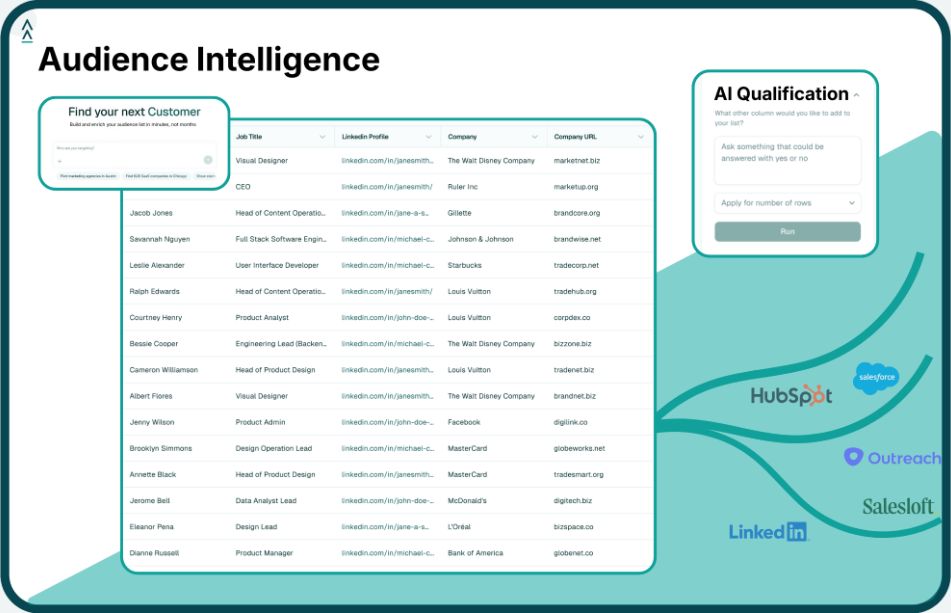
Teams can use a B2B database to identify businesses across onchain credit, stablecoins, tokenization, custody, trading infrastructure, and blockchain security. AI-driven TAM can help organize the wider addressable market, while Agentic Search supports natural-language audience creation.
For more precise market maps, advanced audience search supports exact criteria, historical conditions, rankings, aggregations, uploaded account data, and custom output fields.
Relevant audiences may include:
After accounts are identified, teams can use AI enrichment to complete records and locate professionals in engineering, product, security, compliance, partnerships, finance, and go-to-market roles.
Existing lists can be uploaded to run batch workflow steps for matching, enrichment, and dataset preparation. Technical GTM teams can also use Landbase CLI through Claude Code, Codex, scripts, or a terminal.
Landbase is most applicable to identifiable companies and professionals. Protocol TVL, wallet activity, token ownership, smart-contract transactions, and pseudonymous governance participation require dedicated blockchain analytics sources.
Growth may include rising assets under management, deposits, funding, hiring, integrations, revenue, or product adoption. The most relevant metric depends on the company’s category and development stage. Lending companies may be assessed through deposits and originations, while infrastructure providers depend more on customers and integrations. Several indicators should be reviewed together because one funding round or product launch does not establish sustained growth.
A DeFi company employs a team, develops products, signs commercial agreements, and may raise equity financing. A protocol consists of smart contracts, governance rules, tokens, and blockchain-based financial functions. A company may develop technology for a protocol without owning or controlling the network. Company performance and protocol activity should therefore be evaluated separately.
Total value locked measures assets deposited into smart contracts rather than company revenue, valuation, or profitability. It can change because of asset prices, deposits, withdrawals, leverage, or differences in methodology. TVL may also reflect activity from independent users and third-party applications rather than direct customers. Funding, integrations, hiring, revenue, and product adoption provide additional context.
Onchain lending, tokenized assets, stablecoins, risk infrastructure, institutional vaults, decentralized trading, and Bitcoin-backed finance show substantial activity. Exchanges, wallets, custodians, and fintech platforms are also embedding DeFi products into their own interfaces. Verifiable computing and AI-agent infrastructure represent newer adjacent categories. Growth remains uneven across individual companies and markets.
Useful signals include funding, acquisitions, senior hiring, product launches, regulatory partnerships, and institutional integrations. Rising deposits, assets under management, or transaction activity can provide supporting context. Specialist blockchain tools remain necessary for wallet and smart-contract analysis. Landbase supports company research through audience creation, matching, enrichment, and structured datasets.
Tool and strategies modern teams need to help their companies grow.