.png)
.png)

Daniel Saks
Chief Executive Officer


Online dating remains widely used, but the experience is also creating pressure for different product models. A 2025 Forbes Health survey found that 78% of dating app users reported dating-app burnout, providing context for the growing interest in curated matching, voice-based onboarding, social-circle discovery, and technology designed to move users toward real-world meetings more quickly.
That shift is creating different kinds of growth across dating technology. Established platforms such as Hinge and Grindr are reporting measurable revenue expansion, while newer companies are attracting capital for AI matchmakers, voice interfaces, curated introductions, and alternative discovery models. Because private startups rarely disclose comparable revenue figures, this list is best viewed as a current growth watchlist using funding, users, revenue, expansion, and other observable signals rather than a strict ranking by one metric.
The current growth stories fall into several distinct models:
This makes the market more varied than a simple list of swipe-based dating applications. Some companies are expanding established platforms, while others are redesigning onboarding, matching, pricing, or the transition from online discovery to an in-person date.
The growth evidence differs too. Public companies can report revenue and user metrics, while younger startups are more often evaluated through financing, signups, market launches, and early engagement data.
Category: Relationship-focused dating platform
CEO: Jackie Jantos
Parent Company: Match Group
Recent Growth: Revenue up 22% year over year in Q2 2026
Hinge is a dating platform primarily oriented around users seeking relationships and intentional connections.
Hinge reported 22% year-over-year revenue growth in the second quarter of 2026. Global monthly active users increased 13% during the same period.
International expansion remains an important part of its current growth. During Q2 2026, Hinge entered six additional European countries and four additional Latin American markets.
Hinge structures profiles around photographs, written prompts, and interactions with individual profile elements.
Its product continues to evolve around recommendations, conversation support, trust and safety, and features intended to help matches progress toward actual dates.
Hinge provides an example of growth within a mature dating-app market rather than growth driven primarily by startup funding.
Its recent performance shows that established dating technology can continue expanding when the platform targets a defined type of relationship experience and grows internationally.
Category: LGBTQ+ dating and social connection
Chairman and CEO: George Arison
Status: Public company, NYSE: GRND
Recent Growth: Revenue up 33% year over year in Q2 2026
Grindr operates a location-based platform primarily serving gay, bisexual, transgender, and queer users.
Grindr reported $138 million in second-quarter 2026 revenue, representing approximately 33% year-over-year growth.
Following the quarter, the company increased its expected full-year 2026 revenue to approximately $540 million.
The platform uses proximity and user profiles to support discovery, messaging, dating, and other forms of social connection.
Grindr has also been incorporating AI into product development while expanding the range of services built around its user community.
Grindr demonstrates growth within a specialized dating and social community rather than through a broad general-market positioning.
Its current financial performance provides one of the clearest measurable growth signals among established dating technology companies.
Category: Map-based dating and social discovery
Founder and CEO: Blake Gallagher
Recent Investment: $100 million, April 2026
Reported Monthly Active Users: Approximately 3 million
Sniffies operates a real-time, map-based platform focused on connections among non-heterosexual men.
Match Group made a $100 million minority investment in Sniffies in April 2026, with an option to acquire the remaining equity in the future.
At the time of the investment, Sniffies was reported to have approximately three million monthly active users globally and more than 20 million messages sent each day.
Instead of relying primarily on a conventional swipe interface, Sniffies uses a live map that allows users to discover nearby people and locations.
The design emphasizes proximity and real-time interaction.
Sniffies represents continued experimentation with how location and immediacy can shape online dating and social discovery.
The scale of the 2026 investment also provides a current signal of strategic interest in specialized dating communities.
Category: AI and voice-based matchmaking
Founder and CEO: Justin McLeod
Recent Funding: $18 million, July 2026
Overtone is a new matchmaking company founded by Hinge creator Justin McLeod after he stepped away from Hinge.
Overtone announced an $18 million seed round in July 2026 with backing from FirstMark Capital, Pace Capital, and Match Group.
The financing followed the company’s development as an independent venture focused on a different approach to digital matchmaking.
Overtone is developing a voice- and audio-forward matchmaking service supported by AI and relationship-science concepts.
Rather than emphasizing large volumes of profiles, the model centers on more curated introductions.
Overtone reflects a broader shift toward using AI earlier in the matchmaking process to learn more about users and narrow potential matches.
Its financing also shows investor interest in dating products built outside the conventional swipe-and-chat structure.
Category: AI matchmaking and date coordination
Co-Founder and CEO: Allen Wang
Recent Funding: $9.2 million seed round, February 2026
Reported Signups: 42,000 at the time of the funding announcement
Ditto is an AI-based dating service founded by Allen Wang and Eric Liu that primarily interacts with users through text messaging.
Ditto raised $9.2 million in seed financing in February 2026.
At the time, the company reported 42,000 signups after launching initially with college students and expanding across several campuses. Ditto also reported that roughly one-quarter of its match suggestions resulted in an actual date.
Users communicate with Ditto about preferences rather than browsing an unlimited feed of profiles.
The system proposes a match and can help arrange the time, location, and activity for the date.
Ditto moves much of the dating experience outside a traditional standalone app interface.
Its model illustrates how AI agents can be used for matching and logistics while keeping the eventual interaction between people offline.
Category: Voice-AI matchmaking
Co-Founders: Celeste Amadon and Asher Allen
Recent Funding: $9.7 million
Recent Expansion: Moving beyond its San Francisco testing phase
Known uses conversational voice AI to collect detailed information about users before suggesting potential matches.
Known raised $9.7 million from investors including Forerunner, NFX, Pear VC, and Coelius Capital.
During its San Francisco test phase, the company reported that 80% of introductions resulted in an in-person date. By spring 2026, Known reported more than 10,000 local users and a larger available dating pool around the market.
New users speak with an AI during onboarding rather than completing only a standard profile form.
The platform then recommends potential matches and uses additional automation to help users commit to and coordinate an in-person date.
Known is part of a group of startups using voice as a way to collect richer matchmaking information.
The platform also ties its commercial model more closely to actual introductions and dates rather than unlimited browsing.
Category: AI-assisted matchmaking
Co-Founders: Nandini Mullaji and Chad DePue
Recent Funding: Approximately $6.7 million reported across pre-seed and seed financing
Growth Signal: Expansion across multiple U.S. cities
Sitch combines an AI matchmaking system with practices drawn from human matchmaking.
Sitch reported approximately $6.7 million in pre-seed and seed financing as it expanded beyond New York into additional markets.
The company also reported tens of thousands of users across cities including New York, San Francisco, and Los Angeles.
Users provide detailed information about preferences, values, and relationship goals. An AI matchmaker then recommends a limited number of potential introductions.
The service also incorporates voice-based interaction with the matchmaking system and charges around curated setups rather than unlimited profile access.
Sitch illustrates the movement toward more constrained and curated dating experiences.
Its model applies AI to parts of a process historically associated with professional matchmaking while retaining human review in parts of the workflow.
Category: Dating for diverse relationship structures
CEO: Ana Kirova
Recent Growth Signal: Sales up 26% in the latest publicly reported accounts
Feeld operates a dating platform designed to accommodate a broad range of relationship structures, sexualities, and gender identities.
Feeld’s latest publicly reported accounts showed sales rising 26% to £48.9 million for 2024.
Pre-tax profit also increased from £6 million to £9.3 million during the period.
Feeld allows individuals and couples to create profiles and connect around relationship preferences that may fall outside conventional dating-app categories.
Its product provides a specialized community rather than attempting to serve every dating use case in the same way.
Feeld shows how category specialization can support commercial growth within online dating.
Its expansion also illustrates how platforms initially associated with narrower communities can attract a broader set of users over time.
Category: Offline-first dating
Leadership: Founded by Marsha Goei and a team from Delft University of Technology
Recent Growth Signal: Continued international expansion and more than 700,000 arranged dates
Breeze is designed around moving users to an in-person date with minimal online conversation.
Breeze continued expanding internationally through 2025 and 2026, including growth in London and entry into the U.S.
By 2026, the company had reported more than 700,000 dates arranged through its platform.
Users receive a limited number of suggested profiles. When two people agree to meet, Breeze helps schedule the date at a partner venue.
The platform minimizes messaging before the meeting, making the offline date the central product outcome.
Breeze represents a different response to dating-app fatigue than AI matchmaking.
Instead of using more technology to extend digital interaction, its product uses software primarily to facilitate an offline meeting.
Category: Mutual-connection dating
Founder and CEO: Myles Slayton
Recent Funding: $1.6 million seed round, 2025
Reported Users: More than 20,000 at the time of funding
Cerca is a dating platform built around connecting people who share mutual contacts.
Cerca raised $1.6 million in seed funding in 2025 after launching earlier that year.
At the time of the round, the startup reported more than 20,000 users, with most of its user base between 18 and 30.
The app uses users’ existing contact networks to identify potential matches with mutual connections.
It also limits the number of profiles shown each day and allows mutual friends to play a role in introductions.
Cerca takes a social-graph approach to the trust and discovery problems associated with meeting strangers online.
Its model represents another direction in the move away from unlimited anonymous profile browsing.
The companies on this list suggest that dating technology is becoming more fragmented around different approaches to connection.
Current activity includes:
AI is clearly part of this shift, but it is not the only story. Some companies are changing how much choice users receive, how profiles are evaluated, when people begin messaging, and how quickly an online interaction becomes an in-person meeting.
For B2B teams, those changes create different types of target accounts. An early-stage AI matchmaker may be hiring engineering and growth staff after a seed round, while an established dating platform may be expanding internationally, adding new products, or investing in infrastructure and trust-and-safety operations.
Dating-tech companies can change quickly around fundraising, city launches, user growth, product releases, and leadership changes. GTM teams therefore need more than a static list to identify which companies are entering a new operating phase.
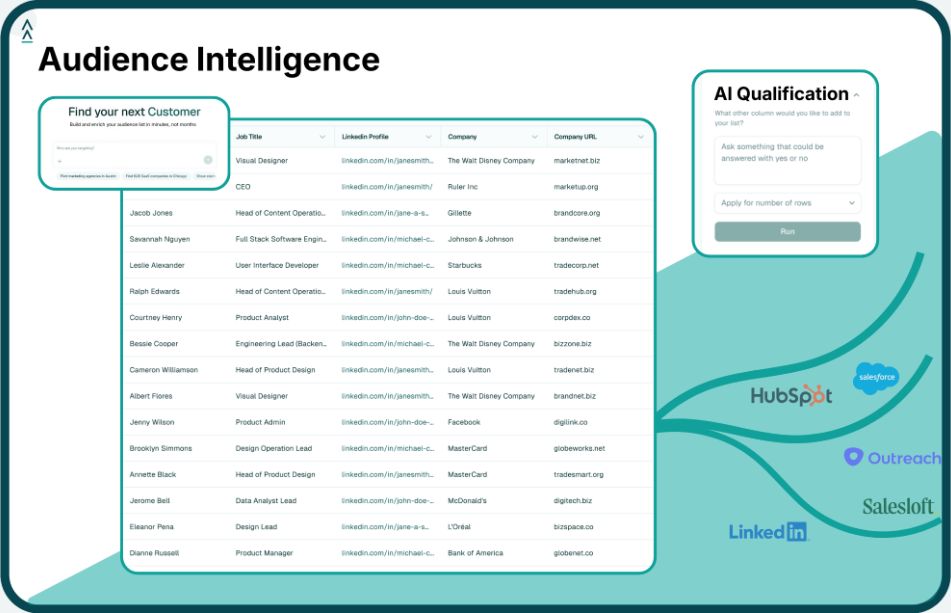
Landbase's B2B database provides company and contact data that can be combined with new funding signals and other criteria such as company size, geography, headcount, and technology use. A dating-tech audience could focus on recently funded matchmaking, dating, or social-discovery companies that match a specific ICP.
Other changes can matter too. Landbase can surface prospects mentioned in news, helping identify companies announcing new markets, AI features, partnerships, leadership changes, or other developments.
Landbase CLI makes this research repeatable for GTM engineers working inside Claude Code, Codex, or related workflows. Searches can be rerun as the dating-tech market changes, with the CLI and web app operating as two product interfaces to the same underlying Landbase platform.
A targeting workflow could focus on:
Once priority accounts are identified, Landbase can help with finding contacts and decision-makers across product, engineering, growth, partnerships, marketing, operations, or trust and safety.
Turn dating-tech growth signals into qualified accounts and relevant decision-makers. See Landbase in action with a personalized 30-minute walkthrough and explore how those signals can become a repeatable GTM workflow.
A fast-growing dating-tech company may show momentum through revenue growth, recent financing, increasing users, geographic expansion, new products, or other measurable operating changes. Public companies tend to disclose financial growth, while early-stage startups are more likely to disclose funding and adoption metrics. Because these measures are not directly comparable, multiple current indicators provide a better basis for identifying growth. Older funding alone is generally insufficient to establish that a company is still expanding.
Dating technology is moving toward more curated discovery, AI-assisted matchmaking, voice-based onboarding, social-network matching, and faster progression toward in-person meetings. Some companies are limiting the number of profiles users see, while others automate parts of matching or date coordination. Established platforms are also investing in international expansion and new AI-assisted product features. These changes reflect experimentation with both technology and the underlying dating-app experience.
Swipe-based interfaces provide a large amount of choice, but newer companies are testing whether fewer and more structured introductions produce a better experience. Alternatives include AI-selected matches, voice interviews, mutual connections, and platforms that organize the date directly. The goal varies by company, so there is no single replacement model emerging across the entire industry. The common theme is greater attention to what happens after initial discovery.
Funding rounds can indicate new capital, while market launches, hiring, leadership changes, user growth, and product releases can reveal how a company intends to deploy resources. The relevance of each signal depends on the product or service being sold. For example, international expansion may matter to a localization provider, while increased engineering hiring may be more relevant to technical vendors. Combining company fit with a recent business change usually produces a more precise target-account list.
Landbase can help identify dating and matchmaking companies based on company characteristics and recent business signals rather than relying on a static industry directory. GTM teams can narrow the market using factors such as funding, geography, company size, growth activity, and relevant professional roles. Landbase CLI can make the process repeatable for teams that want to rerun searches as new dating startups raise capital or enter new markets. This helps convert a changing industry watchlist into a more actionable set of accounts and decision-makers.
Tool and strategies modern teams need to help their companies grow.