.png)
.png)

Daniel Saks
Chief Executive Officer


Crypto exchange growth in 2026 is less uniform than headline trading figures suggest. Total exchange volume declined 8% quarter over quarter to $16.5 trillion in Q2, according to Q2 exchange data from TokenInsight. Spot trading recovered from $3.3 trillion to $4.5 trillion, while derivatives volume declined from $14.6 trillion to $12 trillion and still accounted for 73% of the market.
Product expansion is also changing how exchange growth should be measured. Crypto-based trading in stocks, commodities, exchange-traded funds, foreign exchange, and pre-IPO assets reached $1.45 trillion during the first half of 2026. Open interest in traditional-asset perpetual contracts rose from $60 million at the beginning of 2025 to a peak of $4.67 billion by June 30, 2026.
Leadership: Richard Teng and Yi He, co-CEOs
Latest disclosed financing: $2 billion investment from MGX in March 2025
Q2 2026 market share: 35.34%, up 2.57 percentage points
Binance processed approximately $5.85 trillion in Q2 2026 trading volume. Its total market share increased from 32.77% to 35.34%, the largest quarterly gain among the exchanges tracked by TokenInsight. Binance also led spot trading with a 32.26% share and derivatives trading with 36.48%.
The exchange’s traditional-asset volume grew from $39.60 billion in January to $231.49 billion in June 2026. Binance accounted for 58.9% of the traditional-asset volume generated by six large centralized exchanges in June.
Binance operates spot and derivatives markets alongside payments, staking, custody, blockchain infrastructure, and tokenized-asset products. It introduced additional stock, ETF, equity-perpetual, and pre-IPO offerings during 2026.
The company’s leadership structure also changed in December 2025 when co-founder Yi He became co-CEO alongside Richard Teng. Its latest major financing was MGX’s $2 billion minority investment, described by Binance as its first institutional investment.
CEO: Vugar Usi
Latest disclosed financing: No recent company-level funding round identified
Q2 2026 market share: 8.53%, up 1.36 percentage points
MEXC recorded the second-largest total market-share increase in Q2 2026. Its share rose from 7.17% to 8.53%, supported by approximately $1.41 trillion in quarterly volume. Derivatives accounted for 81% of its activity, and MEXC held 9.51% of the tracked derivatives market.
Its average open-interest share also increased from 8.62% to 9.21%. In commodity perpetuals, MEXC gained 4.1 percentage points of market share, the strongest increase among the exchanges covered by TokenInsight.
MEXC operates spot and derivatives markets with an emphasis on broad asset coverage and early listings. CoinGecko found that it added 199 spot real-world assets and 159 traditional-asset perpetuals between January 2025 and May 2026, more than any other exchange in that study.
Vugar Usi became CEO in April 2026. The appointment accompanied a broader effort to develop MEXC as a multi-asset platform connecting crypto markets with equities and commodities.
CEO: BC Wong
Latest disclosed funding: $150 million pre-Series B in May 2022
Q2 2026 market share: 2.96%, up 0.13 percentage points
KuCoin’s overall market-share increase was modest, moving from 2.83% to 2.96% in Q2 2026. Its strongest growth signal came from derivatives open interest, which measures the value of positions that remain open rather than the amount traded.
KuCoin’s average open-interest share rose from 2.23% to 6.20%, an increase of 3.97 percentage points. This was the largest open-interest gain among all exchanges tracked in the TokenInsight report.
KuCoin provides spot, margin, futures, staking, lending, and payment products. During Q2, KuCoin Pay expanded its connections with local banking and payment systems in markets including Bangladesh, Mexico, and Zambia.
BC Wong became CEO in January 2025. KuCoin’s most recent large publicly announced financing remains its $150 million pre-Series B round from 2022, which valued the company at $10 billion at that time.
Founder and CEO: Star Xu
Latest disclosed financing: No recent company-level funding round identified
Q2 2026 market share: 13.88%, up 0.61 percentage points
OKX processed approximately $2.30 trillion in Q2 2026 volume. Its overall share rose from 13.27% to 13.88%, while it ranked second in derivatives with a 16.42% share and held 7.82% of average open interest.
The exchange also recorded a 10.8-percentage-point increase in equity-perpetual market share, moving from 4.4% in Q1 to 15.3% in Q2. That made OKX the second-largest equity-perpetual venue in TokenInsight’s dataset.
OKX operates spot and derivatives markets alongside a self-custody wallet, onchain applications, and tokenized-asset products. Its strategy increasingly includes infrastructure that other financial applications can use.
In May 2026, OKX introduced Exchange OS on X Layer. The system allows developers and institutions to deploy spot, perpetual, and outcome markets using infrastructure derived from the company’s exchange technology.
Co-founder and CEO: Brian Armstrong
Recent capital event: $2.9 billion Deribit acquisition completed in August 2025
Q2 2026 TokenInsight market share: 1.62%, up 0.59 percentage points
TokenInsight treated Coinbase as a spot-only exchange in its dataset and measured an increase from 1.03% to 1.62% of the combined tracked market. Coinbase uses a different methodology and reported that its own crypto trading-volume market share reached a record 10.3% by June 30, 2026. The figures should not be compared directly because their market coverage differs.
Coinbase described Q2 as its third consecutive quarter of record crypto trading-volume market share. It also reported that prediction-market contracts and associated revenue increased 106% quarter over quarter.
Coinbase provides retail and institutional trading, custody, derivatives, stablecoin services, payments, developer infrastructure, and onchain applications.
Its $2.9 billion acquisition of Deribit expanded the company’s international derivatives and options business. When the transaction closed, Deribit had recorded more than $185 billion in July 2025 volume and approximately $60 billion in open interest.
Co-founder and CEO: Ben Zhou
Latest disclosed financing: No recent company-level funding round identified
Q2 2026 market share: 9.81%, up 0.26 percentage points
Bybit processed approximately $1.62 trillion during Q2 2026. Its total market share rose from 9.55% to 9.81%, and it ranked second in spot trading with a 9.19% share. Bybit also held 10.05% of derivatives volume, placing it third behind Binance and OKX.
The exchange’s product mix became more balanced during the quarter. Derivatives declined from 88% of Bybit’s volume in Q1 to 75% in Q2, indicating that spot trading increased as a proportion of total activity.
Bybit operates spot, perpetual, options, copy-trading, payments, institutional, and tokenized-asset products. Its 2026 launches have included traditional-asset trading, AI-assisted tools, additional collateral options, and products linked to tokenized equities.
The company’s current strategy reflects the broader movement of exchanges from single-market trading venues toward multi-asset financial infrastructure.
Co-CEOs: Dave Ripley and Arjun Sethi
Latest funding: $800 million raised in 2025
Latest disclosed valuation: $20 billion
Kraken raised $800 million during 2025 through two tranches. The financing included a $200 million strategic investment from Citadel Securities at a $20 billion valuation. Kraken stated that the capital would support product expansion, regulatory development, and acquisitions.
The company also completed or announced several transactions, including the $1.5 billion acquisition of NinjaTrader, the $100 million acquisition of Small Exchange, the acquisition of Backed, and a 2026 agreement to acquire Bitnomial.
Kraken provides crypto spot and derivatives trading alongside staking, custody, payments, conventional futures, and tokenized equities. Dave Ripley and Arjun Sethi have served as co-CEOs since 2024.
Its xStocks platform surpassed $25 billion in transaction volume and expanded to 100 tokenized stocks and ETFs by March 2026. Kraken also introduced CFTC-regulated perpetual futures for eligible U.S. traders.
Public leadership: Jeff Yan and iliensinc, core contributors
Funding: No outside investors disclosed
Q2 2026 TokenInsight market share: 2.67%, down 0.72 percentage points
Hyperliquid’s share of the combined TokenInsight exchange market declined from 3.39% to 2.67% during Q2. Its strongest growth evidence comes from decentralized perpetual trading and its HIP-3 market-deployment system rather than total exchange share.
HIP-3 traditional-asset volume increased from $12.65 billion in Q4 2025 to $130.87 billion in Q1 2026. Its monthly share of real-world-asset perpetual volume rose from 2.8% at launch in October 2025 to 28.6% by March 2026.
Hyperliquid operates a Layer-1 blockchain with fully onchain order books for perpetual and spot markets. Its core infrastructure includes HyperCore for trading and HyperEVM for general-purpose smart-contract applications.
The Hyper Foundation states that the network has no investors or paid market makers. CoinGecko found that Hyperliquid processed $272.39 billion in traditional-asset perpetual volume between January 2025 and May 2026.
CEO: Gracy Chen
Latest disclosed financing: No recent company-level funding round identified
Q2 2026 market share: 5.95%, down 1.75 percentage points
Bitget did not grow by total Q2 market share. Its share fell from 7.70% to 5.95%, so its inclusion reflects growth in specific derivatives categories rather than overall exchange expansion.
Average open-interest share increased from 7.81% to 8.58%. Bitget also processed approximately $69.8 billion in traditional-asset perpetuals during Q2, giving it an 11.01% share of that segment.
Bitget provides spot and derivatives markets alongside copy trading, wallets, tokenized assets, and trading automation. Its 2026 strategy centers on combining centralized trading, decentralized markets, and traditional assets through a unified account model.
The company launched Reality, a platform for tokenized real-world assets, in May 2026. Gracy Chen’s midyear update also emphasized tokenization, AI, and broader access to global financial products.
Founder and CEO: Lin Han
Latest disclosed financing: No recent company-level funding round identified
Q2 2026 market share: 8.11%, down 0.77 percentage points
Gate’s total market share declined from 8.88% to 8.11% in Q2 2026. It nevertheless remained the third-largest spot exchange in TokenInsight’s dataset, with an 8.01% share and approximately $1.34 trillion in total quarterly volume.
The exchange’s growth case is primarily based on asset and product expansion. CoinGecko found that Gate added 78 spot real-world assets and 146 traditional-asset perpetuals between January 2025 and May 2026.
Gate operates spot, derivatives, token-launch, payments, wallet, and institutional products. During 2026, it expanded its traditional-asset offering through equity perpetuals, stock trading, pre-IPO products, and related application programming interfaces.
Gate launched access to more than 10,000 U.S. stocks and ETFs through a broker-connected service funded with USDT. Founder and CEO Lin Han has positioned the company’s longer-term strategy around bringing a wider range of financial assets onchain.
The crypto exchange ecosystem extends beyond trading venues. It includes custody providers, payment companies, compliance platforms, blockchain infrastructure businesses, cybersecurity vendors, market makers, tokenization firms, and institutional service providers.
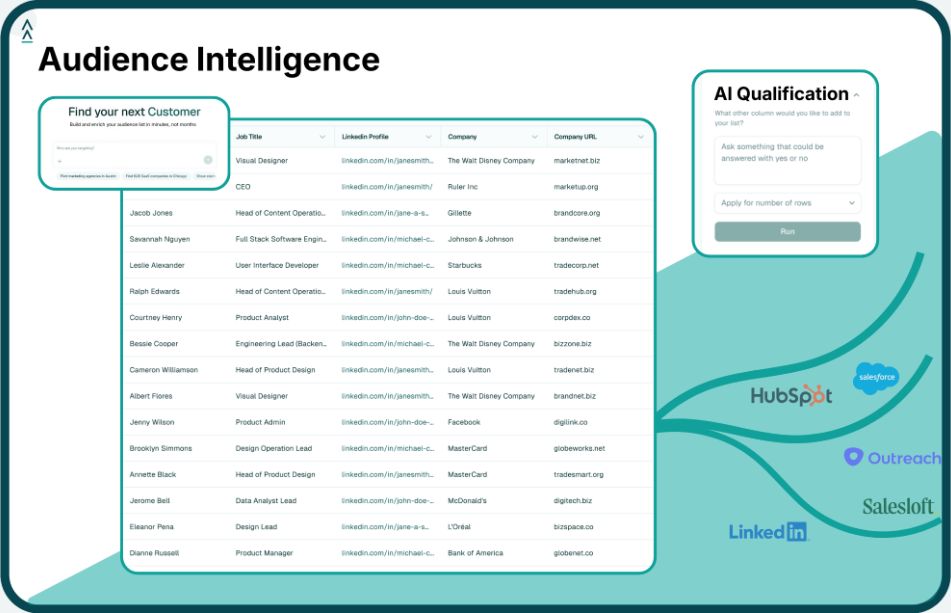
Teams can request an audience using plain English and define criteria such as geography, business model, funding, headcount, technology, or professional role. Landbase also provides company data that can support research into exchanges and the wider businesses serving digital-asset markets.
Landbase supports advanced audience search when a market map requires exact conditions, custom output fields, aggregations, rankings, or uploaded account data. Teams can also use company signals to identify developments such as funding, hiring, technology changes, and other events that may indicate expansion.
Relevant crypto-market audiences may include:
After an audience is created, Landbase can match company records, enrich missing fields, identify relevant professionals, and preserve the results as reusable datasets.
Technical GTM teams can use Landbase CLI through Claude Code, Codex, scripts, or a terminal. Structured outputs can move into analytical tools, dashboards, CRM systems, notebooks, and AI-agent workflows.
Growth can be measured through trading volume, market-share gains, open interest, active users, geographic entry, financing, acquisitions, or product adoption. A platform may grow in one area while declining in another. Total market share and product-category share should therefore remain separate. Several indicators provide a more reliable view than one announcement or quarterly percentage.
Binance recorded the largest total market-share gain in TokenInsight’s Q2 2026 dataset. Its share increased from 32.77% to 35.34%, a gain of 2.57 percentage points. MEXC ranked second with an increase of 1.36 percentage points. KuCoin recorded the largest gain in open-interest share, which is a different measurement.
Derivatives allow traders to take leveraged positions, hedge exposures, and trade without owning the underlying asset. They represented 73% of the exchange volume tracked during Q2 2026. These products can generate substantial activity and fee revenue, but they also involve higher liquidation and counterparty risks. Regulatory treatment varies considerably by country.
Funding can support hiring, licensing, acquisitions, product development, and entry into additional markets. It does not prove that volume, revenue, or active usage is increasing. Some large exchanges have raised little outside capital, while others use acquisitions or debt financing instead of venture rounds. Funding should be assessed alongside operating and market data.
Relevant signals include market-share gains, new licenses, funding, acquisitions, executive appointments, product launches, and international expansion. Hiring in compliance, institutional sales, engineering, payments, and security can show where investment is increasing. Several signals should be evaluated together because individual announcements may not lead to sustained growth. Landbase supports this research through audience creation, record matching, enrichment, and structured company datasets.
Tool and strategies modern teams need to help their companies grow.