.png)
.png)

Daniel Saks
Chief Executive Officer


Customer relationship management is moving beyond manually maintained contact records and standardized sales pipelines. The global CRM market was estimated at $86.4 billion in 2026, with continued investment in automation, analytics, AI, and industry-specific applications.
Startup funding also reflects this transition. According to Crunchbase data, annual funding across sales, marketing, and CRM categories hovered around $8 billion over the previous three years, with most investment going to companies in AI-related categories and many newer platforms centered on agentic tools and automation.
CEO: Nicolas Sharp
Headquarters: London, United Kingdom
Attio raised a $52 million Series B led by GV in August 2025, bringing its total disclosed funding to $116 million. The company reported 5,000 paying customers and said it was on track to quadruple annual recurring revenue during the year.
Attio continued expanding in 2026 through AI workflows, direct connections with tools such as Claude and ChatGPT, and the acquisition of the Inconvo team to support its agent and integration ecosystem.
Attio provides a configurable CRM built around custom objects, automated data capture, workflows, reporting, call intelligence, and APIs. Its developer platform allows teams to build applications and integrations directly around CRM records.
Attio is designed for operators who want to configure their own go-to-market systems rather than adopt a fixed sales structure. Its growth reflects demand for CRM platforms that combine accessible interfaces with programmable infrastructure.
CEO: Marty Kausas
Headquarters: San Francisco, California, United States
Pylon raised a $31 million Series B in August 2025, bringing total disclosed funding to $51 million. The company reported more than 750 customers and two consecutive years of revenue growth exceeding five times year over year.
In July 2026, Pylon repositioned its product as an agentic support platform in which customer-service teams direct AI agents, review their work, and handle decisions requiring human judgment.
Pylon combines ticketing, customer portals, knowledge bases, account intelligence, workforce management, and support conversations across Slack, Microsoft Teams, email, and chat.
The platform organizes support around business accounts rather than isolated consumer tickets. This approach is relevant to B2B companies that manage several stakeholders, products, implementation teams, and communication channels within one customer relationship.
CEO: Christopher O’Donnell
Headquarters: Boston, Massachusetts, United States
Day AI raised a $20 million Series A led by Sequoia Capital in February 2026, following a $4 million seed round announced in 2024. The Series A coincided with the general availability of its AI-native CRM.
By April 2026, the company reported learning from approximately 500 customers as it expanded from CRM reporting toward customer memory and agent-supported work.
Day AI captures information from meetings, emails, and customer interactions so teams can query relationship history, prepare for calls, identify follow-ups, and understand account activity.
The company has expanded its product around agents that can review pipelines, research prospects, prepare briefings, and support other revenue tasks. Guardrails allow users to limit which actions an agent can perform without approval.
CEO: Patrick Thompson
Headquarters: Seattle, Washington, United States
Clarify announced $22.5 million in total funding and opened its product to the public in June 2025. At that point, hundreds of teams were using the product weekly, with approximately 70% returning each week.
The company has continued hiring across product, engineering, and go-to-market functions. Current job materials describe a team of approximately 25 people working from Seattle and distributed locations.
Clarify captures calls and customer activity, enriches records, creates opportunities, assigns tasks, drafts follow-ups, and updates pipeline information. Its conversational interface also lets users ask questions about customer and sales data.
Clarify is developing a self-serve adoption model alongside its autonomous workflow capabilities. This creates a route for smaller teams to begin using the platform without a lengthy enterprise implementation process.
CEO: Dheeraj Pandey
Headquarters: Palo Alto, California, United States
DevRev completed a $100.8 million Series A in 2024, reaching a reported valuation of $1.15 billion. The financing was supported by multimillion-dollar deployments and adoption among large enterprises and software companies.
In February 2026, DevRev launched Computer, an AI teammate available across free and paid tiers. The product is designed to answer questions, connect information, support customer issues, and help teams work across enterprise data.
DevRev connects customer records, support conversations, product information, development activity, documentation, and operational data through a shared knowledge graph.
The platform extends CRM beyond sales pipeline management. It is designed to help support, product, engineering, and revenue teams understand how customer requests connect with incidents, features, product usage, and internal work.
CEO: Katherine Kostereva
Headquarters: Boston, Massachusetts, United States
Creatio raised $200 million at a $1.2 billion valuation in 2024. The company later reported 45% year-over-year top-line growth for 2024, along with expansion among enterprise customers and the addition of 250 partners.
Creatio continued its product expansion in 2026 through new agentic CRM releases, enterprise pricing changes, banking deployments, and customer implementations across several regions.
Creatio provides CRM, case management, application development, and workflow automation through an AI-enabled no-code platform. Organizations can configure sales, marketing, service, and operational processes without building every application conventionally.
Creatio’s expansion is tied to industry-specific implementations and partner-led distribution. This model allows the company to support complex enterprise deployments while maintaining a configurable product foundation.
Founder and CEO: Armand Thiberge
Headquarters: Paris, France
Brevo completed a €500 million financing transaction in November 2025 and reached unicorn status. Its annual recurring revenue had increased approximately fivefold since 2020 and was forecast to exceed €200 million in 2025.
The company reported more than 600,000 customers across over 180 countries. It had also completed nine acquisitions with Bridgepoint’s support, extending its products beyond email into CRM, automation, and multichannel customer engagement.
Brevo provides email, SMS, WhatsApp, chat, marketing automation, sales pipelines, transactional messaging, and customer-data capabilities.
Brevo’s growth shows how a communication platform can expand into a broader CRM suite. Its financing is intended to support AI development, North American expansion, additional acquisitions, and greater adoption among mid-market customers.
CEO: Eoghan McCabe
Headquarters: San Francisco, California, United States
Intercom changed its corporate name to Fin in May 2026 while retaining Intercom as the name of its customer-service software. The change reflected the company’s shift toward AI agents operating across support, sales, and commerce.
In June 2026, Salesforce signed an agreement to acquire Fin for approximately $3.6 billion. Fin brought an established customer base of more than 30,000 companies to the transaction, which remained subject to closing conditions and regulatory clearance.
Fin provides AI agents that resolve customer questions across chat, email, WhatsApp, SMS, phone, and Slack. The company also operates the Intercom customer-service platform and has expanded its agent model into sales and ecommerce workflows.
The pending transaction demonstrates the strategic value larger CRM companies place on packaged customer agents, proprietary AI models, and existing customer-service distribution.
CEO: Shaun Clark
Headquarters: Dallas, Texas, United States
HighLevel received a minority growth investment from General Atlantic in April 2024. The company had grown more than fivefold during the preceding three years while remaining profitable.
Its founders remained the company’s largest shareholders following the investment. HighLevel has continued expanding its platform around sales, marketing automation, AI, website management, reputation tools, and agency operations.
HighLevel allows marketing agencies to manage their own operations and provide white-labeled software to clients. Agencies can combine CRM, lead capture, communication, appointment scheduling, campaigns, websites, and reporting within one platform.
The white-label model gives HighLevel access to the businesses served by each agency customer. This creates a different distribution structure from CRM companies that sell directly to every individual end user.
CEO: Félix Malfait
Headquarters: Paris, France
Twenty raised $5 million in a 2024 seed round led by Runa Capital, with participation from Y Combinator. The company has since expanded one of the largest open-source CRM projects, reaching more than 47,000 GitHub stars and over 6,000 forks by 2026.
Its current platform includes hosted and self-managed deployment options, custom objects, workflows, dashboards, applications, agents, APIs, and command-line development tools.
Twenty gives organizations access to the underlying code and allows technical teams to self-host or extend the platform. Its CRM features cover contacts, companies, pipelines, tasks, communication history, files, imports, and reporting.
The project’s contributor and GitHub activity provide a different growth signal from recurring revenue or enterprise contracts. Its expansion demonstrates interest in CRM infrastructure that developers can inspect, modify, and version alongside other software systems.
The CRM ecosystem includes sales platforms, customer-service systems, marketing automation tools, customer-engagement suites, open-source projects, data infrastructure providers, and AI-agent companies.
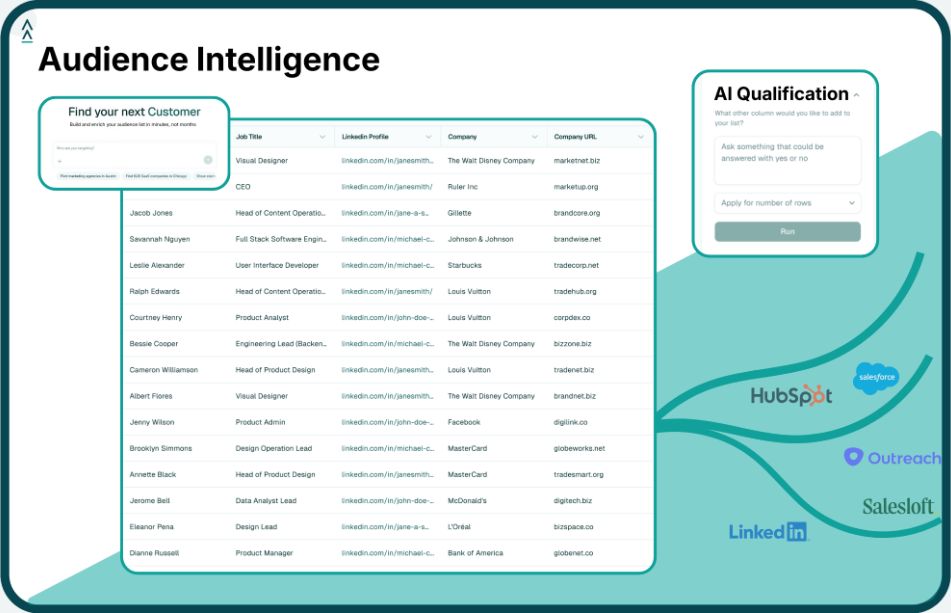
Teams can request an audience using plain English and narrow the results by company size, funding stage, headquarters, CRM category, employee growth, product model, or professional role.
Potential CRM audiences include:
For more specialized segmentation, advanced audience search supports exact filters, historical conditions, uploaded account data, rankings, and custom output fields.
Landbase can match existing company records, enrich missing fields, identify relevant decision-makers, and preserve the results as reusable datasets. Technical GTM teams can use Landbase CLI through Claude Code, Codex, scripts, or a terminal.
Structured exports allow CRM audiences to move into databases, analytical notebooks, dashboards, outbound systems, and the CRM platforms teams already use.
A fast-growing CRM company usually demonstrates progress across several operating indicators rather than funding alone. Relevant measures include recurring revenue, customer acquisition, product adoption, geographic expansion, enterprise deployments, and developer activity. Earlier-stage companies may be assessed through financing, weekly usage, hiring, and product launches. More mature companies should generally provide stronger evidence through revenue, customer scale, or completed transactions.
AI-native platforms are designed to interpret customer context and complete work rather than only store information. They can capture interactions, update records, identify follow-ups, prepare briefings, and support customer-facing workflows. This can reduce administrative work and make CRM data more useful across revenue teams. Reliable deployment still requires accurate data, clear permissions, workflow controls, and human review.
Customer-support platforms can fall within the wider CRM category when they maintain account history, customer context, communication records, and relationship data. The boundaries between sales, support, customer success, and customer engagement are becoming less rigid. B2B support systems may also organize several stakeholders and conversations around one account. This makes them relevant to CRM research even when support remains their primary product category.
Open-source CRM gives technical teams more control over hosting, customization, data access, and integrations. Organizations can inspect the code, deploy the system in their own infrastructure, and build extensions around their operating requirements. Community activity can also accelerate product development and create integrations that a smaller vendor could not build alone. Adoption still depends on security, maintenance, documentation, governance, and available technical resources.
Useful signals include funding rounds, acquisitions, revenue growth, customer milestones, new products, partner programs, geographic expansion, and hiring. Developer activity, new integrations, pricing changes, and shifts toward AI-agent functionality can provide additional context. Several signals should be evaluated together because a financing announcement alone may not represent sustained commercial growth. Landbase supports this research through audience creation, company matching, enrichment, and reusable account datasets.
Tool and strategies modern teams need to help their companies grow.