.png)
.png)

Daniel Saks
Chief Executive Officer


Series A financing can arrive at very different points in a company's development. Some companies raise after establishing an initial customer base, while others enter the round with millions of dollars in recurring revenue or quickly progress to another institutional financing.
The 2025 cohort below reflects that variation. Several companies disclosed rapid revenue growth around their Series A rounds. Others expanded through customers, geographic deployments, transaction volume, or subsequent funding.
For GTM research, a recent funding signal can provide context around companies entering periods of hiring, product investment, infrastructure development, or commercial expansion.
Every company on this list announced a verified Series A round during 2025.
The ranking considers several publicly disclosed indicators:
Because private companies disclose different operating metrics, the ranking compares multiple publicly available indicators rather than applying one standardized growth formula.
Financing information can also be combined with buying signal data to distinguish the original funding event from later changes in company activity.
CEO: Ali Ansari
Series A: $35 million, September 2025
Industry: AI training data and human expertise
Micro1 provides AI companies with human experts for model training, evaluation, reinforcement learning, and related data workflows.
Its technology includes an AI recruiter called Zara that interviews and evaluates specialists across technical and professional disciplines.
Micro1 began 2025 at roughly $7 million in ARR. By September, the company had reached $50 million ARR, according to CEO Ali Ansari.
By December, Micro1 reported surpassing $100 million ARR and managing thousands of experts across hundreds of domains.
Micro1 announced its $35 million Series A at a $500 million valuation in September 2025. The round was led by 01 Advisors.
Its December revenue update showed that ARR had more than doubled again after the Series A.
Frontier-model development increasingly requires specialized human expertise for model evaluation, reinforcement learning, domain-specific reasoning, and training-data creation.
Micro1's revenue expansion provides one of the clearest operating-growth metrics among 2025 Series A companies.
CEO: John Glasgow
Series A: $35 million, 2025
Industry: Finance and accounting software
Campfire develops AI-supported enterprise resource planning software for finance and accounting teams.
Its system covers accounting, close management, reporting, financial analysis, revenue workflows, and related ERP functions.
Around its Series A, Campfire reported approximately 100 customers and said larger organizations were migrating from established ERP systems to its platform.
Campfire later reported 10x ARR growth over a 10-month period. By the end of 2025, CEO John Glasgow reported that revenue had increased 20x during the year.
Accel led Campfire's $35 million Series A. Only months later, Campfire completed a $65 million Series B, bringing the capital raised during the two rounds to $100 million.
ERP systems sit at the center of accounting and financial operations, making replacement decisions operationally significant.
Campfire's customer migrations, revenue growth, and rapid progression to Series B provide multiple indicators of expansion.
CEO: Bar Winkler
Series A: $100 million, November 2025
Industry: Enterprise AI agents
Wonderful develops AI agents for enterprise workflows.
Its initial deployments focused on customer-facing interactions across voice, chat, and email, with the platform expanding into broader enterprise automation.
By its Series A, Wonderful's agents were already handling tens of thousands of customer requests each day. The company had expanded across markets in Europe and the Middle East within months of emerging from stealth.
Growth continued through 2026. Wonderful expanded to more than 35 markets and reached approximately 650 employees by September.
Wonderful announced a $100 million Series A only four months after its seed financing.
It subsequently raised $150 million in Series B financing in March 2026 and a $550 million Series C at a $5 billion valuation in September 2026.
Enterprise AI adoption increasingly involves agents that interact with existing applications, data, customers, and operational workflows.
Wonderful's geographic expansion and funding progression reflect the capital moving toward production-oriented enterprise agent platforms.
CEO: Jake Stauch
Series A: $47 million, October 2025
Industry: IT service management and enterprise automation
Serval develops AI agents and automation software for IT service management.
Its system can create internal automations for tasks such as access provisioning, device workflows, onboarding, and help-desk requests while allowing administrators to establish permissions and approval rules.
At its Series A, Serval already counted companies including Perplexity, Mercor, and Together AI among its customers.
Growth accelerated immediately afterward. Serval later reported that revenue increased approximately 500% between its Series A and Series B periods and that customers were automating more than half of their service tickets in some deployments.
Serval announced its $47 million Series A in October 2025.
Less than two months later, the company raised a $75 million Series B led by Sequoia at a $1 billion valuation.
IT service management combines repetitive requests, permissions, system access, and organization-specific workflows.
Serval is applying agent-based automation to those processes while retaining explicit controls around what individual automations can do.
CEO: David Paffenholz
Series A: $30 million, September 2025
Industry: Recruiting technology
Juicebox develops an AI-powered recruiting search platform.
Its PeopleGPT product uses natural-language queries to identify potential candidates from professional information and other publicly available sources. Its agent can also support candidate outreach and initial scheduling.
By the Series A, Juicebox was serving more than 2,500 customers and generating more than $10 million in ARR.
The company achieved that scale with a small team and without a conventional sales organization.
By March 2026, more than 5,000 recruiting teams were using the platform.
Sequoia led the company's $30 million Series A.
Juicebox followed it with an $80 million Series B at an $850 million valuation in March 2026.
Recruiting search increasingly relies on semantic and contextual analysis rather than exact keyword matching.
Juicebox's customer and ARR growth demonstrate commercial adoption of natural-language recruiting workflows.
CEO: Akeed Azmi
Series A: $12 million, October 2025
Industry: Workforce and payroll software
Cercli develops workforce-management software for companies operating across the Middle East, North Africa, and international markets.
Its platform combines HR, payroll, compliance, recruiting, and workforce data within an AI-oriented architecture.
Cercli reported 10x revenue growth over the 12 months preceding its Series A.
The 14-person company was also maintaining approximately 21% month-over-month revenue growth and processing more than $100 million in payroll annually across more than 50 countries.
Cercli announced its $12 million Series A led by Picus Capital in October 2025.
The financing followed a $4 million seed round announced the previous year.
International workforce operations require companies to coordinate payroll, HR records, compliance, recruitment, and country-specific requirements.
Cercli's revenue and payroll growth provide operating context beyond the size of its Series A.
CEO: Chris Parsonson
Series A: $12 million, April 2025
Industry: Legal technology and intellectual property
Solve Intelligence develops AI software for patent and intellectual-property workflows.
Its platform supports patent drafting, office-action responses, claim analysis, invention disclosures, and other work performed by law firms and corporate IP teams.
At its Series A, Solve was already used by approximately 200 IP teams across the United States, Europe, and Asia.
The company reported millions of dollars in ARR, roughly 25% month-over-month revenue growth, and profitability.
By December, Solve reported more than 700 IP teams using its platform and substantial expansion in product usage.
Solve announced its $12 million Series A in April 2025.
Only eight months later, it completed a $40 million Series B, bringing total funding to approximately $55 million.
Patent work combines technical information, legal standards, documentation, and specialized professional judgment.
Solve demonstrates how vertical AI applications can gain adoption by focusing on a narrowly defined professional workflow.
CEO: Aaron Bai
Series A: $17 million, May 2025
Industry: Financial technology
Affiniti provides financial software and payment products for small and medium-sized businesses in industries such as pharmacies, HVAC, automotive services, and other traditional business categories.
Its platform includes expense-management cards, financing, financial analysis, and related operating tools.
Within its first 14 months, Affiniti expanded from zero to approximately 1,800 customers and about $20 million in monthly transaction volume.
The company also reported roughly 10x revenue growth over the preceding year.
Affiniti completed an $11 million seed round before announcing its $17 million Series A in May 2025.
SignalFire led the Series A.
Many traditional small businesses have different financial workflows from venture-backed technology companies.
Affiniti's customer and transaction growth show adoption of fintech products designed around those industry-specific operating requirements.
CEO: Marius Meiners
Series A: $21 million, November 2025
Industry: AI search analytics
Peec AI provides analytics for brands and agencies monitoring how companies appear in AI-generated search and answer systems.
The platform tracks visibility, citations, competitive presence, sentiment, and the sources influencing AI-generated responses.
Peec AI reached more than $4 million ARR within 10 months of launch.
By its Series A, the company had onboarded more than 1,300 brands and agencies and was adding more than 300 customers each month.
Its reported valuation had also tripled to more than $100 million in the four months following its seed round.
Peec AI raised its $21 million Series A in November 2025, only four months after its seed financing.
The Series A brought total disclosed funding to approximately $29 million.
Product discovery increasingly occurs through conversational AI alongside traditional search engines.
Peec AI is part of a new analytics category focused on measuring how brands appear within those AI-generated responses.
CEO: Bryan Onel
Series A: $33 million, October 2025
Industry: Cybersecurity and compliance
Oneleet combines compliance workflows with cybersecurity functions including penetration testing, code scanning, cloud security, attack-surface management, and security training.
The platform works with independent auditors for formal compliance reviews.
At its Series A, Oneleet had reached approximately $9 million in ARR.
The company also reported that a substantial share of newly added Y Combinator portfolio companies had become customers.
Oneleet announced its $33 million Series A in October 2025, led by Dawn Capital.
The financing brought total disclosed funding to approximately $35 million at the time.
Security and regulatory compliance often involve overlapping evidence, controls, audits, testing, and operational requirements.
Oneleet combines several of those functions within the same platform rather than treating certification and technical security as entirely separate processes.
Several patterns emerge across the companies.
First, revenue growth was already substantial at Series A for some businesses. Micro1 had reached $50 million ARR by its round, while Juicebox exceeded $10 million ARR and Oneleet reported approximately $9 million.
Second, some companies moved into later funding rounds unusually quickly. Campfire and Serval reached Series B within months. Solve Intelligence completed its Series B in the same year, while Juicebox and Wonderful progressed into larger rounds during 2026.
Third, AI appears across nearly every category, but the operational problems differ considerably. The cohort covers recruiting, accounting, payroll, patents, customer service, cybersecurity, marketing analytics, training data, finance, and IT operations.
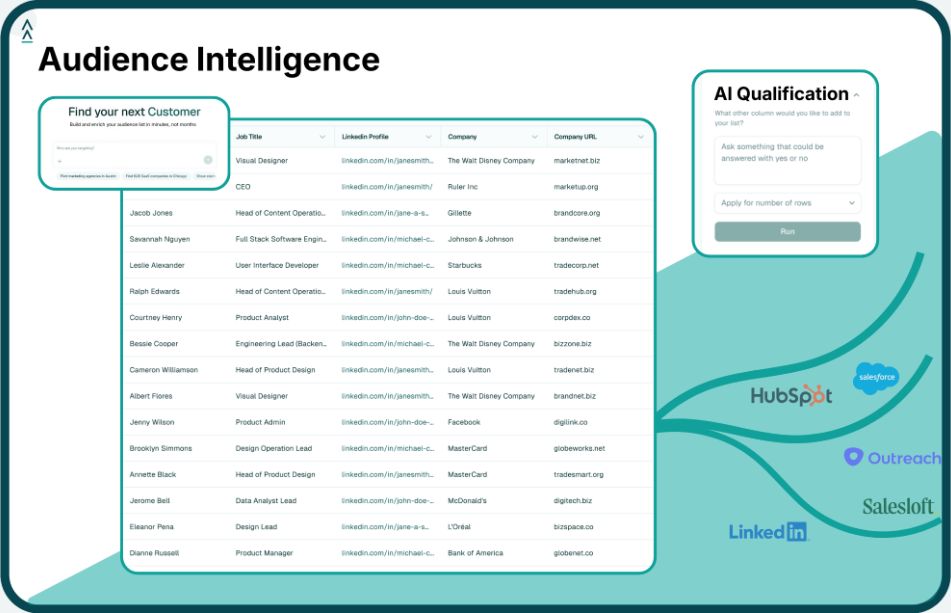
Funding information can be paired with company data enrichment to add company characteristics, contacts, technology data, and other operating context to recently funded accounts.
Landbase can combine funding information with company, contact, enrichment, qualification, and signal data.
Its web and CLI interfaces use the same underlying account, data, agent, lists, and datasets.
An audience created visually can therefore move into a later command-line workflow, while datasets developed through the CLI remain accessible through the web application.
The Advanced Dataset Creator supports natural-language instructions involving filters, calculations, aggregations, ratios, and selected output fields.
A Series A company dataset could combine financing stage with criteria such as:
Current Landbase data infrastructure covers more than 40 million companies and more than 800 million contacts across more than 1,500 fields.
Existing company and contact records can be enriched before an AI qualification workflow evaluates whether they meet specified business criteria.
This keeps the information-gathering process separate from the rules used to determine account fit.
The Landbase CLI setup supports workflows from standard terminals and AI-assisted environments including Claude Code and Codex.
Funding-based research can therefore become part of a reusable GTM dataset rather than remaining a manually maintained spreadsheet of financing announcements.
Series A is an institutional financing stage that generally follows seed funding. Companies commonly use Series A capital for product development, hiring, infrastructure, market expansion, and go-to-market investment. Businesses can reach this stage at very different levels of revenue and customer adoption.
Not necessarily. Funding measures capital raised rather than business growth. Revenue, ARR, customers, users, transaction volume, product adoption, hiring, geographic expansion, and later financing can provide additional operating evidence.
Micro1 reported one of the largest disclosed changes. ARR increased from approximately $7 million at the beginning of 2025 to $50 million by its September Series A and more than $100 million by December.
AI was being incorporated into a wide range of business workflows during 2025, including software development, finance, HR, recruiting, legal work, security, customer operations, and IT. The companies on this list apply AI to different operating problems rather than representing one single software category.
Funding-stage criteria can be combined with industry, geography, employee count, hiring, leadership changes, technology usage, and other company signals. Landbase supports these criteria in reusable datasets that can be enriched, qualified, and accessed through web and CLI workflows.
Tool and strategies modern teams need to help their companies grow.