.png)
.png)

Daniel Saks
Chief Executive Officer


Early-stage venture funding remained active in 2026 even as capital became increasingly concentrated among companies with strong technical differentiation or measurable traction. Global early-stage funding reached $41.3 billion in Q1 across roughly 1,800 deals, while Cooley's Q2 financing report showed Series A activity increasing from the prior quarter.
For B2B teams, a funding round can also function as one of several recent funding signals associated with hiring, market expansion, technology investment, and go-to-market changes.
This ranking focuses exclusively on companies that announced a verified Series A in 2026. Placement considers disclosed round size together with publicly reported evidence of revenue, customer, usage, valuation, or operational growth.
Every company on this list announced a Series A during 2026 and had enough publicly available information to verify the financing.
The ranking weighs four factors:
Funding alone does not establish business growth. It is treated as one signal alongside disclosed operating evidence and other company buying signals.
CEO: Philip Johnston
Series A: $170 million, March 2026
Industry: Space infrastructure and AI computing
Starcloud is developing orbital data centers designed to run AI computing workloads in space. Its approach uses satellites carrying high-performance computing hardware, with the longer-term goal of operating larger-scale AI infrastructure outside terrestrial data centers.
Starcloud reached a $1.1 billion valuation with its March Series A only 17 months after its Y Combinator demo day. In August, it added a $250 million Series A extension, increasing its reported valuation to $2.3 billion.
The company had also launched Starcloud-1 in November 2025 with an Nvidia H100 GPU aboard.
The initial 2026 Series A raised $170 million, following roughly $30 million in earlier financing. The subsequent $250 million extension brought the Series A financing substantially higher.
AI infrastructure increasingly faces constraints involving power availability, cooling, land, and permitting. Starcloud is testing whether orbital computing can become another infrastructure option for workloads that require significant compute capacity.
CEO: Dan Roth
Series A: $100 million, June 2026
Industry: Enterprise AI
Scaled Cognition develops AI models and infrastructure for enterprise applications where reliability and predictable outputs are important.
Its technology includes an Agentic Pretrained Transformer architecture designed for structured enterprise tasks rather than relying exclusively on conventional free-form language generation.
At the time of its $100 million Series A, the company said its technology was already in production with Fortune 500 organizations across financial services, healthcare, telecommunications, and insurance.
The round valued Scaled Cognition at approximately $750 million.
Khosla Ventures led the June Series A with participation from strategic and institutional investors. Scaled Cognition had previously raised seed financing before the 2026 round.
Enterprise adoption of AI increasingly depends on reliability, governance, monitoring, and control in addition to model capability. Scaled Cognition is focused directly on that enterprise deployment problem.
CEO: Zhen Lu
Series A: $100 million, June 2026
Industry: AI infrastructure
Runpod provides cloud infrastructure for AI development, including GPU computing for experimentation, training, fine-tuning, inference, and production deployment.
Runpod reported more than $120 million in annual recurring revenue in early 2026 and more than one million developers using its infrastructure. The company had grown from founder-operated GPU hardware into an AI cloud platform serving individual developers and enterprise teams.
Its $100 million Series A valued the company at approximately $1 billion.
Runpod raised a $20 million seed round in 2024 before completing the $100 million Series A led by Summit Partners in June 2026.
AI model development creates infrastructure requirements beyond access to GPUs alone. Developers increasingly need training, inference, scaling, deployment, and supporting tooling within the same environment.
Runpod's revenue and developer growth provide operating evidence alongside the size of its financing.
CEO: Omer Kaplan
Series A: $60 million, May 2026
Industry: E-commerce technology
ZyG develops an agentic operating system for direct-to-consumer brands and entrepreneurs.
The platform applies AI across product selection, store development, creative production, user acquisition, conversion, retention, and logistics.
ZyG moved from a $58 million seed round in March 2026 to a $60 million Series A only two months later. The Series A valued the company at approximately $500 million.
The founding team includes executives who previously built ironSource.
The company announced $58 million in seed financing in March, followed by the Accel-led $60 million Series A in May.
ZyG reflects growing investment in AI systems that execute multiple operating functions rather than providing a single analytics or content-generation feature.
Its model also illustrates how agentic systems are moving into commerce operations.
CEO: Dan Mishin
Series A: $60 million, April 2026
Industry: Legal technology
Manifest OS provides technology and operating infrastructure for AI-supported law firms.
Its system combines legal workflow software with centralized operational infrastructure and a law-firm model designed around fixed-price services.
After roughly 18 months, Manifest OS reported more than 3,000 client engagements and more than 100 immigration attorneys, including co-counsel, working through its first powered law firm.
The company announced a $60 million Series A at a $750 million valuation in April.
Investors in the Series A included Menlo Ventures, Kleiner Perkins, First Round Capital, and Quiet Capital.
Legal AI has expanded from research and document-generation tools into systems addressing broader law-firm operations.
Manifest OS is applying software and AI to service delivery, attorney workflows, client communications, research, drafting, billing, and reporting.
CEO: Fangchang Ma
Series A: $50 million, September 2026
Industry: Multimodal AI
Nuance Labs is developing a foundation model focused on human conversation and expression.
The model is designed to process audio and visual information together, including speech, facial expression, gaze, gesture, timing, and other conversational signals.
The company announced its $50 million Series A on September 14, 2026, with Lightspeed Venture Partners leading and Accel, NVIDIA, South Park Commons, and Define Ventures participating.
Nuance plans to make a research preview of its model publicly available later in 2026.
The Series A followed a $10 million seed round led by Accel in 2025.
Many conversational AI systems combine separately developed text, audio, and visual components. Nuance is pursuing a unified multimodal model intended to handle several elements of face-to-face communication within the same architecture.
CEO: Matt Fredrikson
Series A: $40 million, May 2026
Industry: AI security
Gray Swan develops security technology for AI models and applications.
Its platform includes automated adversarial testing, runtime protections, and a community used to identify vulnerabilities such as jailbreaks, prompt injection, and unsafe model behavior.
Gray Swan's red-teaming community had grown to roughly 15,000 security participants by May 2026, while the company had worked with major frontier AI developers.
Its $40 million Series A was co-led by Wing Venture Capital and Madrona.
The May financing also included Obvious Ventures, Snowflake Ventures, Samsung Next, Hudson River Trading, and existing investor Magarac Venture Partners.
As AI systems gain greater access to data, tools, and business processes, security testing increasingly extends beyond traditional software vulnerabilities.
Gray Swan operates at the intersection of model evaluation, adversarial testing, and production AI security.
CEO: Kahlil Lalji
Series A: $30 million, July 2026
Industry: Financial infrastructure
Natural develops payment infrastructure designed specifically for AI agents.
Its platform exposes financial functions such as wallets, transfers, payments, cards, processing, and billing through agent-oriented infrastructure.
Natural completed its $30 million Series A when the company was only 193 days old.
In August, less than a month after the equity round, the company announced a $100 million credit facility intended to support agent-driven payment activity.
Natural announced a $9.8 million seed round in October 2025 before raising the $30 million Series A led by Forerunner in July 2026.
AI agents that can research, negotiate, or perform operational work also need controlled ways to move money.
Natural is developing infrastructure around that emerging requirement rather than adapting payment systems designed primarily for human-initiated transactions.
CEO: Bilal Abu-Ghazaleh
Series A: $30 million, July 2026
Industry: Enterprise and sovereign AI
1001 AI develops an AI platform for operational decision-making in infrastructure-heavy industries.
Its initial focus includes construction, ports, energy, airports, logistics, and other environments where organizations need to combine operational data with AI-supported decision processes.
The company moved from a $9 million seed round announced in late 2025 to a $30 million Series A led by Lux Capital in 2026.
Its early work has included deployments and pilots connected with large-scale infrastructure and logistics operations.
The $9 million seed involved CIV, General Catalyst, and Lux Capital. Lux then led the $30 million Series A with additional participation from existing investors.
1001 AI represents growing investment in applied AI for physical infrastructure rather than purely digital workflows.
Its focus also reflects demand for AI systems that can be deployed and governed within specific countries and operating environments.
CEO: Stav Levi-Neumark
Series A: $25 million, July 2026
Industry: Go-to-market technology
Alta develops coordinated AI agents for marketing, sales, and business-development workflows.
Its system includes agents for prospecting, research, outbound activity, inbound qualification, calling, revenue intelligence, and related GTM processes.
Alta reported reaching its first $1 million in revenue within months of commercialization and said it was on track for 800% revenue growth in 2026.
At the time of its $25 million Series A, the company also reported customers ranging from larger enterprises to smaller businesses.
Alta launched from stealth in 2025 with approximately $7 million in seed financing. IN Venture led the July 2026 Series A, with participation from Mindset Ventures, Skywell Capital, LeumiTech77, and existing investors.
GTM software is shifting from isolated AI features toward systems in which multiple agents operate against shared company, account, and pipeline context.
Alta represents one implementation of that broader change.
The companies above span very different markets, but several patterns recur.
First, AI infrastructure continues to attract large early-stage rounds. Starcloud, Runpod, and Scaled Cognition address compute, deployment, or model-reliability problems associated with wider AI adoption.
Second, industry-specific applications remain prominent. Manifest OS focuses on legal operations, ZyG on e-commerce, Natural on payments, and Alta on go-to-market processes.
Third, capital is moving quickly when companies can demonstrate differentiated technical capability or early operating traction. ZyG moved from seed to Series A in two months, while Natural raised its Series A less than a year after its seed financing.
For GTM teams, a funding round becomes more useful when combined with hiring, leadership, technology, geographic, and data enrichment information rather than treated as a standalone indicator.
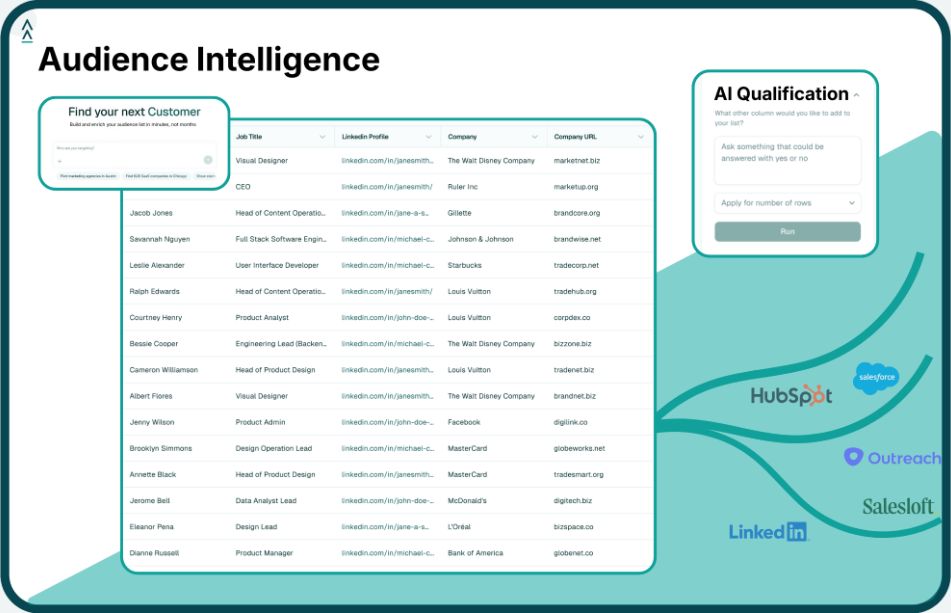
Landbase allows GTM teams to combine funding events with company and contact information through both web and command-line workflows.
Its web and CLI interfaces access the same underlying account, datasets, agent, and saved work. This allows an audience created visually to move into a repeatable terminal workflow, or CLI-generated datasets to remain available through the web application.
For more complex account requirements, the Advanced Dataset Creator supports natural-language instructions involving filters, calculations, ratios, aggregations, and custom output fields.
Landbase's current data infrastructure includes more than 800 million contacts and more than 40 million companies across more than 1,500 fields, with enrichment using more than 20 providers.
Funding criteria can also be combined with company signals and qualification rules. For example, a workflow could identify software companies that recently raised Series A funding, added senior sales leadership, use selected technologies, and meet specific employee or geographic criteria.
The Landbase CLI setup supports these workflows from a standard terminal as well as AI-assisted environments including Claude Code and Codex.
This makes funding-event research one component of a reusable GTM dataset rather than a one-time company list.
Series A is generally an early institutional equity round that follows seed financing. Companies at this stage often use the capital for product development, hiring, market expansion, infrastructure, and go-to-market growth. Round size varies substantially by sector, traction, capital requirements, and market conditions.
Starcloud announced a $170 million Series A in March 2026 and later added a $250 million extension to the same round in August. The extension increased its reported valuation from approximately $1.1 billion to $2.3 billion.
AI is creating new infrastructure requirements while also being applied to established industries such as legal services, e-commerce, financial infrastructure, security, and sales operations. Investors are funding both the underlying infrastructure and companies applying AI to specific operating problems.
Not necessarily. Funding measures investor capital rather than customer or revenue growth. Growth should be evaluated using additional indicators such as revenue, customers, product usage, hiring, deployments, valuation changes, and market expansion. This ranking therefore uses funding together with disclosed operating evidence where available.
Recently funded companies can be identified through funding-event data and then filtered using additional account criteria such as industry, geography, employee count, technology usage, hiring activity, or leadership changes. Landbase can combine these criteria in reusable datasets and make the resulting company and contact information available through web and CLI workflows.
Tool and strategies modern teams need to help their companies grow.