.png)
.png)

Daniel Saks
Chief Executive Officer


Seed financing can occur at very different points in a startup's development. Some companies raise while launching their first commercial product, while others already have customers, users, revenue, or government deployments before announcing a seed round.
Several companies funded in 2024 progressed unusually quickly. Some completed larger institutional rounds within months. Others recorded rapid revenue or user growth, expanded into enterprise deployments, or converted early technology into substantial commercial or government contracts.
For GTM research, a recent funding signal can provide context around companies entering periods of hiring, product investment, market expansion, or infrastructure spending.
Every company included here announced a clearly identifiable seed round during 2024.
The ranking considers several publicly available indicators:
Private companies disclose different metrics, so multiple indicators are considered rather than relying on one growth measure.
Funding can also be combined with company buying signals to distinguish the financing event from subsequent hiring, leadership, technology, and operational changes.
CEO: Dean Leitersdorf
Seed: $21 million, October 2024
Industry: AI infrastructure and generative models
Decart develops AI infrastructure and generative models. Its work includes technology for optimizing GPU workloads and interactive generative environments such as Oasis.
Within months of launching, Decart's infrastructure business was generating millions of dollars in revenue, while Oasis had attracted millions of players.
The company then completed a $32 million Series A less than two months after its seed round, at a valuation above $500 million.
The Series A followed the $21 million seed financing led by Sequoia Capital and Zeev Ventures.
Decart combined early commercial revenue with consumer adoption and unusually fast financing progression, providing several growth indicators within the same year.
CEO: Filip Kozera
Seed: $30 million, November 2024
Industry: AI development tools
Wordware provides a natural-language environment for building AI applications and agents. Its tools are designed to let technical and domain teams define AI workflows using written instructions.
Around its seed round, Wordware reported hundreds of thousands of users. A viral product launch helped the company reach approximately 350,000 users while revenue increased around 20 times over a period of weeks.
Its $30 million seed was one of the larger seed financings associated with Y Combinator's 2024 cohort.
Spark Capital led the round with participation from Felicis, Y Combinator, and other investors.
Wordware demonstrates how natural-language interfaces are moving from AI consumption into the development and orchestration layer.
CEO: Arman Jaffer
Seed: $5 million, September 2024
Industry: Education technology
Brisk develops AI-supported tools for teachers and students. Its software assists with lesson planning, assessment creation, differentiation, feedback, and classroom activities.
At the seed stage, Brisk said its Chrome extension was already used by approximately one in ten U.S. teachers.
By March 2025, its user base had grown roughly fivefold since the seed round, while the company reported that revenue had increased approximately 40 times during 2024.
Brisk then raised a $15 million Series A.
The Series A followed the Owl Ventures-led 2024 seed financing.
Brisk provides an example of rapid adoption of AI within an established professional workflow rather than a standalone consumer chatbot.
CEO: Mike Conover
Seed: $6 million, June 2024
Industry: Financial technology
Brightwave develops AI-supported research software for investment professionals. Its system analyzes sources such as regulatory filings, earnings information, financial data, and research materials.
Brightwave reported that revenue increased approximately fourfold in the four months following its seed financing.
The growth contributed to another financing only months later. The company raised a $15 million Series A in October 2024.
Decibel Partners led both the seed round and subsequent Series A.
Financial analysis involves large volumes of structured and unstructured information, making it a practical application area for AI-supported research systems.
CEO: Parker Gilbert
Seed: $10 million, May 2024
Industry: Accounting software
Numeric develops software for accounting teams, including month-end close management, reconciliation, variance analysis, reporting, and AI-assisted accounting workflows.
Numeric reported that annual recurring revenue increased approximately fourfold over the year leading into its next financing.
The company also expanded its customer base to include organizations such as OpenAI, Plaid, Brex, and Wealthfront.
Five months after its seed financing, Numeric announced a $28 million Series A.
Menlo Ventures led the October 2024 Series A after participating in the earlier seed round.
Numeric shows how AI is being incorporated into recurring financial operations where data reconciliation and repetitive analysis consume substantial accounting time.
CEO: Yisroel Brumer
Seed: $44 million, August 2024
Industry: Defense and logistics technology
DEFCON AI develops software for logistics planning and other complex operational decisions. Its systems combine artificial intelligence, mathematical optimization, simulation, and operational data.
The company expanded from air-mobility planning into broader multimodal defense logistics after its seed round.
In June 2026, DEFCON AI announced a five-year $115 million Marine Corps agreement tied to logistics command-and-control modernization.
The company's $44 million seed round was led by Bessemer Venture Partners in 2024.
DEFCON AI demonstrates how seed-stage software can move into large government deployments when the product addresses specialized operational requirements.
CEO: Karol Hausman
Seed: Approximately $70 million, March 2024
Industry: Robotics and embodied AI
Physical Intelligence develops general-purpose AI models intended to control robots across different physical tasks.
The company's research focuses on creating software that can transfer learning across different robot types and activities.
Only months after its seed financing, Physical Intelligence raised approximately $400 million at a valuation of about $2.4 billion.
By November 2025, the company had raised another $600 million at a $5.6 billion valuation.
The company's financing has included CapitalG, Thrive Capital, Lux Capital, OpenAI, Jeff Bezos, and other technology investors.
Physical Intelligence represents investment in foundation-model approaches to robotics, where AI software is designed to generalize across physical machines and tasks.
CEO: Pierre Proner
Seed: £9.5 million, approximately $11.9 million, April 2024
Industry: Legal technology
Lawhive develops AI-supported software for smaller law firms and consumer legal services.
Its platform combines legal workflow tools with an AI assistant used for administrative, research, and case-related processes.
Only eight months after its seed financing, Lawhive completed a $40 million Series A to support expansion into the United States.
GV and TQ Ventures co-led the Series A, with participation from existing and additional investors.
Much legal technology investment historically concentrated on large firms. Lawhive applies AI and workflow software to smaller practices and consumer legal services.
CEO: Matthias Hofmann
Seed: $6 million, June 2024
Industry: Vision care technology
Eyebot develops automated kiosks that perform self-service vision tests and generate results that can be reviewed by licensed eye-care professionals.
Following its seed financing, Eyebot expanded kiosks into settings including retail locations, universities, pharmacies, grocery stores, schools, and airports.
The company raised a $20 million Series A in August 2025, bringing reported total funding above $30 million.
General Catalyst joined existing investors including AlleyCorp, Ubiquity Ventures, and Village Global in the Series A.
Eyebot applies automation to a healthcare workflow that has traditionally required scheduled in-person access to specialized equipment.
CEO: Emily Long
Seed: $5 million, September 2024
Industry: Cloud and AI security
Edera develops workload-isolation technology for containers, Kubernetes environments, and AI infrastructure.
Its architecture is designed to separate workloads more strongly than conventional shared-kernel container environments.
Edera progressed quickly from its 2024 seed financing to a $15 million Series A announced in February 2025.
The company has since expanded its product focus across cloud-native and AI infrastructure security.
M12, Microsoft's venture fund, led the Series A with participation from Mantis VC, In-Q-Tel, and existing investors.
AI workloads are increasing demand for shared compute infrastructure, making workload isolation and infrastructure-level security a growing part of cloud security architecture.
Several patterns appear across the group.
First, rapid progression to a subsequent institutional round was common among the fastest-moving companies. Decart, Brightwave, Numeric, Lawhive, Physical Intelligence, Edera, Eyebot, and Brisk all raised additional financing after their 2024 seed rounds.
Second, commercial growth was visible well before later funding in several cases. Wordware disclosed rapid user and revenue expansion, Brightwave and Numeric reported fourfold revenue growth, and Brisk expanded quickly across educators.
Third, growth took different forms depending on the industry. DEFCON AI advanced through government deployment and contracts, while Physical Intelligence's development was reflected more heavily in financing, valuation, and technical progress.
Company and contact data enrichment can add further context to funding events by incorporating company attributes, leadership, technologies, and other operational information.
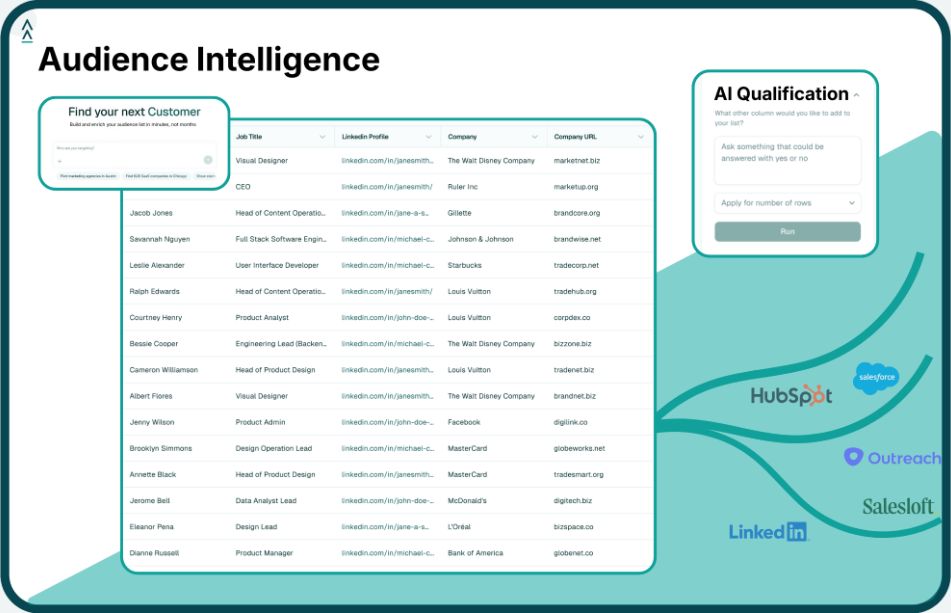
Landbase can combine funding information with company, contact, enrichment, qualification, and signal data.
Its web and CLI interfaces access the same underlying account, datasets, data, and agent. Research started visually can therefore move into repeatable terminal workflows, while CLI-generated datasets remain accessible through the web application.
For searches involving more detailed criteria, the Advanced Dataset Creator supports natural-language instructions with filters, calculations, ratios, aggregations, and custom output fields.
A seed-stage audience could combine financing criteria with:
Current Landbase data infrastructure covers more than 40 million companies and more than 800 million contacts across more than 1,500 fields. Contact enrichment draws on more than 20 providers with verification processes for available work email and phone information.
The Landbase CLI setup also supports terminal workflows through environments including Claude Code and Codex.
This allows funding research to become part of a reusable GTM dataset rather than remaining a manually maintained list of announcements.
Seed financing is an early institutional funding stage generally used for product development, hiring, customer acquisition, technical infrastructure, and initial market expansion. Companies can enter the seed stage at very different levels of commercial maturity.
No. Several companies on this list already had customers or revenue at the time of their seed financing. Seed describes a financing stage rather than a fixed revenue or product milestone.
Growth can be assessed through revenue, customers, users, deployments, contracts, hiring, product usage, valuation changes, and subsequent financing. Because private startups disclose different metrics, multiple indicators are often required.
New financing can coincide with hiring, product expansion, technology investment, market entry, and new commercial processes. Combining funding with a company and buying signals can provide more context than the funding event alone.
Landbase can combine funding-stage criteria with company attributes, enrichment, qualification requirements, and signals. The resulting datasets can be accessed through web or CLI workflows and reused across account research, CRM, and other GTM operations.
Tool and strategies modern teams need to help their companies grow.