.png)
.png)

Daniel Saks
Chief Executive Officer


Global spending on cloud infrastructure services reached approximately $128.6 billion in the first quarter of 2026, representing 35% year-over-year growth. The market’s annualized revenue run rate exceeded $500 billion as generative AI increased demand for computing, storage, networking, databases, and managed cloud platforms.
AI infrastructure is expanding even faster. Gartner forecast that worldwide spending on AI infrastructure would reach $1.43 trillion in 2026, making it the largest part of the broader AI market. This category includes AI-optimized servers, processors, networking equipment, cloud capacity, and the data-center systems required to support training and inference.
CEO and Co-Founder: Michael Intrator
Headquarters: Livingston, New Jersey, United States
CoreWeave became the fastest cloud provider to reach $5 billion in annual revenue during 2025. Its revenue backlog reached $66.8 billion at the end of the year, more than four times its level at the beginning of 2025.
The company ended 2025 with more than 850 MW of active power capacity and approximately 3.1 GW of contracted power. It continued expanding in 2026 through multiyear infrastructure agreements with Meta, Anthropic, Jane Street, and other large customers.
CoreWeave operates a cloud platform designed for AI training, inference, rendering, and high-performance computing. Its infrastructure combines GPU clusters, high-speed networks, storage, orchestration, observability, and managed software.
The company has also expanded its platform through acquisitions and product development across model evaluation, reinforcement learning, agent infrastructure, and machine-learning operations.
CoreWeave demonstrates that a specialist cloud provider can compete for large workloads previously concentrated among traditional hyperscalers. Its contracted backlog and customer agreements provide substantial visibility into future demand.
Its growth also shows how access to energy, chips, financing, and data-center capacity has become a central competitive advantage in cloud infrastructure.
CEO and Co-Founder: Ali Ghodsi
Headquarters: San Francisco, California, United States
Databricks surpassed a $5.4 billion revenue run rate during its fourth quarter, representing more than 65% year-over-year growth. Its AI products exceeded a $1.4 billion revenue run rate, while more than 800 customers were spending at least $1 million annually.
The company also announced more than $7 billion in financing, including approximately $5 billion in equity at a $134 billion valuation and roughly $2 billion in additional debt capacity. Databricks remained free-cash-flow positive over the preceding 12 months.
Databricks provides a unified platform for data engineering, analytics, machine learning, databases, governance, and AI applications. Its products include Lakehouse architecture, Unity Catalog, Lakebase, Agent Bricks, Genie, and application-development tools.
The platform operates across major public clouds and helps enterprises prepare proprietary data for analytics, models, agents, and operational applications.
Enterprise AI depends on governed, accessible, and current business data. Databricks occupies the infrastructure layer between cloud storage, databases, analytical systems, and production AI applications.
Its growth indicates that companies are investing in unified data infrastructure rather than treating model access as a complete AI strategy.
CEO and Co-Founder: Chase Lochmiller
Headquarters: Denver, Colorado, United States
Crusoe raised $1.375 billion in Series E financing in October 2025 at a valuation above $10 billion. By June 2026, the company reported 4.9 GW of contracted AI infrastructure capacity and a development pipeline exceeding 40 GW.
Its projects include a 900 MW campus supporting Microsoft workloads in Abilene, Texas, and a separate 1 GW campus planned with Lancium in Childress. The wider Abilene site is expected to reach approximately 2.1 GW when the announced expansion is completed.
Crusoe develops large AI data-center campuses, power infrastructure, modular data centers, and an AI cloud platform. Its vertically integrated model covers site development, energy sourcing, construction, computing equipment, cloud services, and managed inference.
The company uses grid power, natural gas, renewable energy, batteries, and other sources depending on the location and operating requirements.
Power availability has become one of the main constraints on AI infrastructure growth. Crusoe addresses that constraint by developing data centers near large energy resources and managing more of the physical infrastructure internally.
Its contracted capacity and construction pipeline show how AI cloud expansion is becoming closely connected with energy development and industrial-scale construction.
CEO: Michel Combes
Co-Founder and CTO: Stephen Balaban
Headquarters: San Francisco, California, United States
Lambda raised more than $1.5 billion in Series E financing in November 2025 to support gigawatt-scale AI factories and supercomputers. In May 2026, it expanded an existing credit facility to $1 billion, nearly four times the original amount.
The company also appointed Michel Combes as CEO in May 2026, while co-founder Stephen Balaban moved into the CTO position. The leadership changes added experience in capital-intensive telecommunications and global infrastructure deployment.
Lambda provides cloud GPU capacity, bare-metal infrastructure, large AI clusters, servers, workstations, inference, and software for machine-learning teams. Its infrastructure is designed specifically for AI workloads rather than general-purpose cloud computing.
The company is expanding support for next-generation NVIDIA systems, high-bandwidth networking, liquid cooling, and direct hardware access.
Lambda combines an established developer-facing cloud with a growing physical-infrastructure business. This allows it to serve individual researchers, enterprises, frontier laboratories, and hyperscalers through different deployment models.
Its financing reflects the capital required to move from relatively small GPU environments into gigawatt-scale AI factories.
Founder and CEO: Arkady Volozh
Headquarters: Amsterdam, Netherlands
Nebius reported 479% revenue growth during 2025 and began expanding its commercial operations into Asia-Pacific during 2026. The company serves AI developers and enterprises through a growing network of owned facilities and colocation capacity.
In March 2026, Nebius announced a five-year agreement to provide Meta with $12 billion in dedicated AI infrastructure capacity. Meta also committed to purchasing additional available capacity from certain future clusters, potentially bringing those additional purchases to as much as $15 billion.
Nebius is building a 310 MW AI factory in Finland and has secured land and power for a 1.2 GW facility in Pennsylvania. It is targeting more than 3 GW of contracted power by the end of 2026.
Nebius operates a full-stack AI cloud covering GPU compute, storage, networking, Kubernetes, training, inference, and developer tools. It develops its own cloud software and operates infrastructure in the United States and Europe.
The company also maintains businesses and investments connected with autonomous vehicles, education, data processing, and analytical databases.
Nebius is one of the most prominent European-headquartered alternatives to U.S. hyperscalers and specialist GPU clouds. Its expansion addresses growing demand for regional compute capacity and data-sovereignty options.
Large contracts with technology companies also give Nebius committed demand that can support continued infrastructure investment.
Founder and CEO: Vipul Ved Prakash
Headquarters: San Francisco, California, United States
Together AI raised $800 million in Series C funding in July 2026. Investors also committed to independently capitalizing more than 500 MW of computing capacity intended to support the company’s expected infrastructure growth.
The company reported supporting more than one million AI engineers and researchers by early 2026. Its customers include AI-native companies such as Cognition, Decagon, ElevenLabs, Cursor, and Suno.
Together AI provides cloud infrastructure for training, fine-tuning, evaluating, and running open models. Its platform includes GPU clusters, serverless inference, dedicated endpoints, model customization, and research-driven performance optimizations.
The company develops software across the infrastructure stack to improve token throughput, latency, and production economics.
Many organizations want more control over model selection, customization, and infrastructure costs than closed model APIs provide. Together AI supports this market through open models and infrastructure optimized for high-volume production use.
Its financing and computing commitments show how inference demand is creating opportunities for cloud platforms that combine hardware capacity with specialized software.
CEO and Co-Founder: Andrew Feldman
Headquarters: Sunnyvale, California, United States
Cerebras raised $1 billion in Series H financing in early 2026 at a post-money valuation of approximately $23 billion. It subsequently completed an $850 million revolving credit facility, bringing the capital raised over an eight-month period to $2.85 billion.
The company completed its initial public offering in May 2026. It also expanded its manufacturing relationship with Flex, with new production capacity expected to increase output of CS-3 systems approximately sevenfold during 2026.
Cerebras develops wafer-scale processors, AI supercomputers, and cloud services for model training and inference. Its Wafer Scale Engine places a large number of computing cores on a single processor rather than dividing workloads across conventional GPU clusters.
Customers can deploy Cerebras systems on premises or access the company’s infrastructure through cloud services.
Cerebras provides an alternative architecture to GPU-based computing. Its approach targets communication bottlenecks that emerge when large models are distributed across many separate processors.
The company’s IPO, financing, and manufacturing expansion provide measurable evidence that demand for nontraditional AI accelerators is increasing.
Founder and CEO: Renen Hallak
Headquarters: New York, New York, United States
VAST Data completed Series F financing in April 2026 at a $30 billion valuation, more than three times its valuation in late 2023. The company reported more than $4 billion in cumulative bookings and over $500 million in committed annual recurring revenue.
VAST also reported positive operating margin and free cash flow. These results distinguish it from infrastructure companies whose growth depends primarily on continued external financing.
VAST provides a data platform that combines storage, databases, computing services, data processing, and AI-agent infrastructure. Its architecture is designed to give large GPU clusters rapid access to shared data without creating several isolated storage tiers.
The platform can support model training, inference, retrieval, simulation, analytics, and data-intensive enterprise applications.
AI infrastructure performance depends on how quickly data moves into and between processors. Large GPU deployments can remain underutilized when storage and data pipelines cannot keep pace.
VAST’s bookings, recurring revenue, and profitability show that customers are investing in the data layer alongside compute capacity.
CEO: Simon Edwards
Founder and Chairman: Jonathan Ross
Headquarters: Mountain View, California, United States
Groq raised $650 million in June 2026 to expand its global inference cloud. The company reported operating 13 data centers across North America, Europe, the Middle East, and Asia-Pacific.
Its platform served more than five million developers and processed trillions of AI tokens each week. Groq plans to scale its installed infrastructure toward 200 MW by the end of 2027.
The company remained independent after entering a nonexclusive inference-technology licensing agreement with NVIDIA in December 2025. Simon Edwards became CEO as founder Jonathan Ross and selected team members joined NVIDIA.
Groq operates an inference cloud based on its Language Processing Unit architecture. The system is designed for predictable, low-latency execution of AI models rather than model training.
GroqCloud provides access to supported open models through APIs and dedicated infrastructure.
Inference demand grows as AI applications move from experiments into repeated production use. These workloads require fast responses, predictable performance, and sustainable cost per request.
Groq’s developer adoption and global data-center expansion show that inference is becoming a distinct cloud-infrastructure category.
CEO: J.J. Kardwell
Headquarters: West Palm Beach, Florida, United States
Vultr completed its first external equity financing in December 2024, raising $333 million at a $3.5 billion valuation. The company later secured $329 million in credit and equipment financing to support its global infrastructure expansion.
Vultr opened its 33rd cloud region in Milan in May 2026. Its infrastructure now spans six continents and supports cloud compute, GPUs, bare metal, storage, and Kubernetes across regional markets.
Vultr operates an independent public-cloud platform serving developers, enterprises, AI companies, and regulated organizations. Its products include virtual machines, GPU clusters, bare-metal systems, Kubernetes, block storage, object storage, and networking.
The platform supports processors and accelerators from several vendors, including NVIDIA and AMD, providing customers with greater hardware choice.
Vultr competes as an alternative to traditional hyperscalers and specialized GPU clouds. Its regional footprint can support latency, sovereignty, compliance, and workload-portability requirements.
Its financing and continued geographic expansion show demand for independent cloud platforms with transparent deployment options and a broad infrastructure portfolio.
Cloud infrastructure growth creates buying signals across data centers, energy providers, chip suppliers, networking companies, cooling vendors, storage platforms, cybersecurity firms, and construction partners.
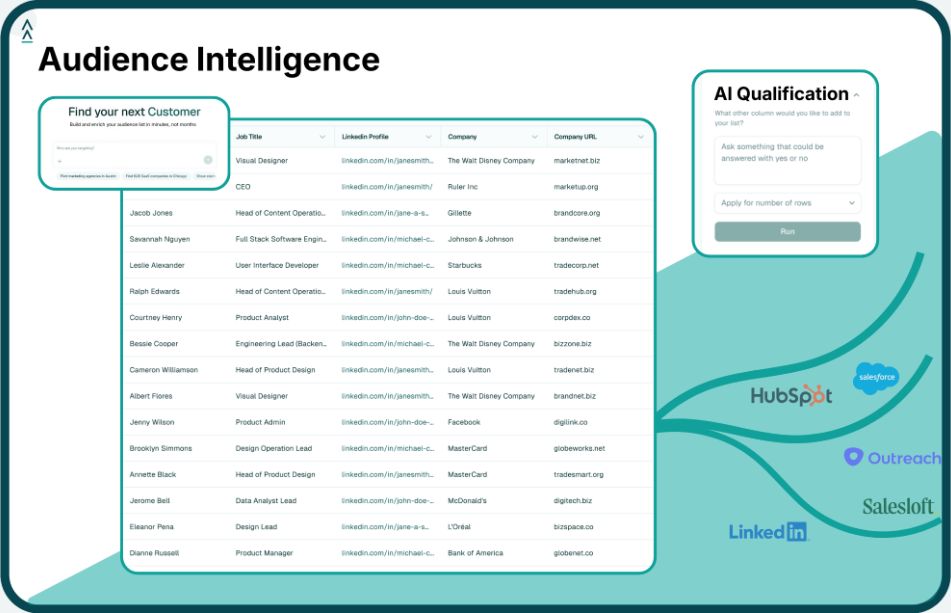
GTM teams can use Landbase to identify companies receiving new funding and connect those events with new regions, computing clusters, power agreements, and enterprise contracts.
Landbase can also surface organizations changing their tech stack, which may indicate cloud migration, new AI workloads, storage expansion, or infrastructure modernization.
Relevant cloud-infrastructure audiences may include:
Landbase can match and enrich company records, identify decision-makers, and preserve the results as structured datasets. Technical GTM teams can use Landbase CLI through Claude Code, Codex, scripts, or a terminal for supplier mapping, account prioritization, market monitoring, and CRM preparation.
A cloud infrastructure provider supplies computing, storage, networking, database, or platform resources used to run applications remotely. Some companies operate general-purpose public clouds, while others specialize in GPUs, AI inference, data management, or high-performance storage. Infrastructure can include physical data centers as well as software used to manage and access those resources. The category therefore extends beyond companies that sell virtual machines alone.
A neocloud is a specialist cloud company built primarily around AI and high-performance computing workloads. These providers typically offer large GPU clusters, high-speed networking, specialized storage, and software optimized for model training or inference. Their narrower focus can allow faster deployment of new accelerators and more customized infrastructure. CoreWeave, Lambda, Crusoe, and Nebius are commonly evaluated within this emerging category.
AI data centers require expensive processors, electrical systems, cooling equipment, networking, land, and construction. Infrastructure may need to be ordered or built long before customer revenue is recognized. Companies therefore combine equity with debt, leases, customer commitments, and joint ventures. Large financing rounds should be evaluated alongside contracted demand and completed capacity.
Useful metrics include revenue, backlog, recurring contracts, active power, installed processors, cloud regions, and customer adoption. Proposed data-center capacity should remain separate from facilities that are operational and available to customers. Utilization and contract duration also affect the commercial value of installed infrastructure. Several measures provide a more reliable picture than valuation or funding alone.
Strong signals include new data-center sites, power agreements, GPU purchases, financing, enterprise contracts, acquisitions, and regional expansion. Hiring in engineering, operations, energy, procurement, security, and enterprise sales can reveal where spending is increasing. Technology-stack changes can also indicate upcoming demand for cloud migration, storage, networking, or observability services. Landbase supports this research through signal-based audience creation, company matching, enrichment, and reusable datasets.
Tool and strategies modern teams need to help their companies grow.