.png)
.png)

Daniel Saks
Chief Executive Officer


Autonomous vehicle investment reached a new record during the first months of 2026. According to Crunchbase data, companies in the category raised $21.4 billion across 34 deals through April 15, up from $5.9 billion during all of 2025. Waymo’s $16 billion financing accounted for three-quarters of that total, demonstrating how capital has become concentrated around a smaller group of companies approaching commercial scale.
The operating market is also becoming more diverse. Robotaxi companies are increasing paid rides and entering new cities, autonomous truck developers are generating revenue from driverless freight, and technology suppliers are selling simulation, validation, vehicle software, and licensable driving systems to automakers and fleet operators.
Co-CEOs: Tekedra Mawakana and Dmitri Dolgov
Headquarters: Mountain View, California, United States
Waymo raised $16 billion in February 2026 at a post-money valuation of $126 billion. The company reported completing 15 million rides during 2025, more than tripling its annual ride volume and passing 20 million cumulative rides.
Waymo currently provides more than 500,000 fully autonomous electric-vehicle trips per week. Its commercial footprint expanded to 10 metropolitan areas in February 2026, with preparations underway for additional U.S. cities and international operations.
Waymo operates fully autonomous ride-hailing services using a combination of cameras, radar, lidar, onboard computing, mapping, simulation, and fleet-management systems. Riders can request vehicles through the Waymo app or selected mobility-platform partnerships.
Its sixth-generation driving system is designed to reduce hardware costs and support a wider range of vehicle platforms and weather conditions. The company has begun autonomous testing of Hyundai IONIQ 5 vehicles as part of its next expansion stage.
Waymo has moved beyond limited trials into recurring public operations across several major cities. Its ride volume, safety data, manufacturing investment, and capital base give it one of the strongest operating positions in the autonomous-vehicle industry.
The company’s growth also creates demand across vehicle integration, charging, fleet maintenance, insurance, remote assistance, mapping, and local operations.
Chairman and CEO: James Peng
Headquarters: Guangzhou, Guangdong, China
Pony.ai generated $34.3 million in total revenue during the first quarter of 2026, an increase of 145% year over year. Robotaxi revenue rose 395.4%, while fare-charging revenue increased 456.5%.
The company’s robotaxi fleet exceeded 1,700 vehicles by May 2026. Pony.ai raised its year-end fleet target to more than 3,500 vehicles and expects 2026 robotaxi revenue to exceed 3.5 times its 2025 level.
Pony.ai operates robotaxis and autonomous trucks while also supplying autonomous domain controllers and intelligent-driving technology for other applications. Its seventh-generation robotaxi platform is being produced through partnerships with BAIC, GAC, and Toyota.
The company has expanded its operating footprint beyond China and initiated robotaxi deployment in Croatia. It also introduced a driverless light truck based on the safety architecture used in its robotaxi program.
Pony.ai reported reaching seventh-generation robotaxi unit-economics breakeven in Guangzhou and Shenzhen. In Shenzhen, the company reported an average of 23 daily orders and RMB338 in daily net revenue per vehicle during the measured period.
These results remain limited to specific cities and vehicle generations, but they provide operating evidence that robotaxi economics can improve with higher utilization, lower hardware costs, and scaled manufacturing.
Founder and CEO: Tony Han
Headquarters: Guangzhou, Guangdong, China
WeRide generated RMB684.6 million, approximately $97.9 million, in revenue during 2025. This represented 89.6% year-over-year growth, while robotaxi revenue increased 209.6%.
First-quarter 2026 revenue reached RMB114.1 million, approximately $16.5 million, up 57.6% year over year. Its global robotaxi fleet reached approximately 1,300 vehicles by April 30, while its wider fleet of robotaxis, buses, vans, and sweepers reached approximately 2,800 vehicles.
WeRide develops Level 2 through Level 4 autonomous-driving systems. Its commercial products include robotaxis, autonomous buses, logistics vehicles, street sweepers, and advanced driver-assistance software.
The company’s vehicles have been deployed in more than 40 cities across 12 countries. It has received autonomous-driving permits in markets including China, the United Arab Emirates, Singapore, France, Switzerland, Saudi Arabia, Belgium, and the United States.
WeRide has pursued a wider geographic strategy than many autonomous-driving companies. Its deployments include fully driverless services in Abu Dhabi and Dubai, public ride-hailing in Singapore, and autonomous-shuttle projects in several European markets.
This international footprint gives WeRide experience with different regulators, road systems, transit authorities, and commercial partners.
Co-Founder and CEO: Alex Kendall
Headquarters: London, United Kingdom
Wayve closed a $1.2 billion Series D in February 2026 at a post-money valuation of $8.6 billion. Additional milestone-based investment from Uber brought the total capital secured for its deployment plans to as much as $1.5 billion.
The company plans to begin commercial robotaxi trials during 2026 and deploy supervised autonomy software in consumer vehicles from 2027. Wayve reported that its technology had completed zero-shot driving in more than 500 cities across Europe, North America, and Japan during a single year.
Wayve develops an end-to-end AI driving system intended to learn from driving data rather than depend entirely on city-specific rules and high-definition maps. Its platform combines camera inputs, onboard compute, foundation models, simulation, and fleet data.
The company is working with automakers and mobility companies including Mercedes-Benz, Nissan, Stellantis, Microsoft, NVIDIA, and Uber.
Wayve and Uber plan to deploy robotaxi services across more than 10 cities, beginning with London. Wayve, Uber, and Nissan are also preparing for a pilot in Tokyo using Nissan vehicles equipped with Wayve’s technology.
The company’s growth case depends on proving that one autonomy platform can operate across several vehicle models, compute systems, and geographic environments.
Founder and CEO: Raquel Urtasun
Headquarters: Toronto, Ontario, Canada
Waabi closed an oversubscribed $750 million Series C in January 2026. It also secured an additional milestone-based future investment from Uber, with the company describing the combined package as $1 billion in new funding.
The financing will support autonomous-trucking commercialization and a new robotaxi partnership. Uber plans to deploy robotaxis powered by the Waabi Driver exclusively through its platform if the agreed milestones are reached.
Waabi combines an end-to-end AI driving model with Waabi World, a neural simulation environment used to train, test, and validate the driving system. The company’s approach is designed to reduce dependence on collecting every scenario through public-road testing.
Waabi is initially applying the system to autonomous trucking through work with vehicle and logistics partners, including Volvo Autonomous Solutions.
The Uber agreement extends Waabi’s platform beyond trucks into passenger mobility. This creates a test of whether its driving model can generalize across different vehicles, road environments, and commercial use cases.
The company remains in a pre-scale commercialization stage, so future progress should be measured through completed driverless deployments, paid operations, and vehicle integrations rather than financing alone.
Co-Founder and CEO: Qasar Younis
Headquarters: Sunnyvale, California, United States
Applied Intuition completed a $600 million Series F and tender offer in June 2025 at a $15 billion valuation. The company reported that 18 of the world’s 20 largest automakers use its vehicle-intelligence products.
During 2025, customers conducted more than 50 million simulations covering billions of virtual driving miles. Applied Intuition also opened six offices and expanded across automotive, trucking, defense, construction, mining, and agriculture.
Applied Intuition supplies simulation, data-management, testing, validation, operating-system, and self-driving software. These tools help vehicle manufacturers develop and evaluate autonomous systems before and during real-world deployment.
The company does not depend on operating one robotaxi or trucking network. Instead, its products support automakers, autonomous-driving developers, government programs, and industrial vehicle manufacturers.
In 2026, Applied Intuition expanded its Stellantis partnership, introduced its self-driving system in Japan, and launched Dana, an agentic platform for building and operating physical AI systems.
Its position across simulation, production software, and autonomous operations allows it to benefit from vehicle-intelligence adoption across several industries.
Co-Founders and Co-CEOs: Jiajun Zhu and Dave Ferguson
Headquarters: Mountain View, California, United States
Nuro closed a $203 million Series E in August 2025 at a $6 billion valuation. Investors included Uber, NVIDIA, Baillie Gifford, Fidelity, T. Rowe Price, Tiger Global, and Greylock Partners.
The company is preparing a robotaxi service with Uber and Lucid. By April 2026, its engineering fleet was approaching 100 vehicles, and selected Uber employees had begun supervised test rides through the Uber app in the San Francisco Bay Area.
Nuro develops the Nuro Driver, a vehicle-independent Level 4 autonomy system that can be licensed by automakers and mobility providers. Its technology originated in purpose-built delivery vehicles but has expanded toward passenger vehicles and wider commercial fleets.
Nuro has accumulated more than 1.7 million autonomous miles and reports zero at-fault incidents across more than five years of driverless deployments. These figures are supplied by the company.
Nuro received California permits supporting driverless testing and supervised passenger pilots during 2026. The commercial program is intended to use Lucid Gravity vehicles, Nuro’s driving system, and Uber’s fleet and ride-hailing network.
Future growth depends on moving from engineering fleets and employee rides into paid public operations across the planned markets.
Co-Founder and CEO: Chris Urmson
Headquarters: Pittsburgh, Pennsylvania, United States
Aurora launched commercial driverless trucking operations on public roads during 2025. By January 2026, the Aurora Driver had completed more than 250,000 driverless miles, while the company prepared to open additional freight lanes across the southern United States.
First-quarter 2026 revenue reached $1 million. Aurora expects full-year revenue of $14 million to $16 million and plans to exit 2026 with more than 200 driverless trucks in operation, although these figures remain forward-looking targets.
Aurora develops an autonomous-driving system for Class 8 trucks. Its commercial partners include Werner, Hirschbach, Uber Freight, FedEx, Schneider, Detmar, and Volvo Autonomous Solutions.
The company’s driverless trucks are operating on selected Texas freight routes, with expansion work covering customer facilities, weigh stations, fueling locations, and additional highway corridors.
Aurora reported that driverless trucks operating for Werner were averaging more than 4,000 miles per week. That level would represent an annualized run rate above 225,000 miles per truck.
High utilization is central to autonomous-trucking economics because a vehicle can operate for longer periods without being limited by human driving-hour requirements.
Founder and CEO: Don Burnette
Headquarters: Mountain View, California, United States
Kodiak ended the first quarter of 2026 with its driving system deployed in 28 customer-owned, fully driverless trucks. These vehicles had accumulated more than 23,500 hours of paid driverless operation and completed over 15,600 cumulative loads.
The company generated $1.8 million in first-quarter revenue, representing 74% sequential growth, and announced a $100 million private investment in public equity financing.
Kodiak supplies autonomous-driving hardware and software to customers that own and operate the trucks. This approach differs from models in which the autonomy company owns the entire fleet or sells transportation capacity directly.
Its largest current driverless deployment serves Atlas Energy Solutions in the Permian Basin, where autonomous trucks transport materials in an industrial operating environment.
Kodiak is preparing to launch long-haul driverless operations in late 2026. The company has also expanded into logging and defense applications through work with West Fraser and General Dynamics Land Systems.
Its operating hours and customer-owned deployments provide direct evidence of commercial use, although the company remains in an early revenue stage.
Co-Founder and CEO: Gautam Narang
Headquarters: Mountain View, California, United States
Gatik reported $600 million in contracted revenue and fully driverless commercial operations in Texas, Arkansas, Arizona, and Ontario. The company said its trucks had completed 60,000 driverless orders and more than 2,000 hours of operation without a driver or safety observer by January 2026. These figures are company-reported.
In June 2026, Gatik and PepsiCo announced a multiyear agreement to deploy autonomous freight across PepsiCo’s North American supply chain. Gatik was already operating driverless trucks for the company across several U.S. states.
Gatik focuses on repeatable middle-mile routes connecting distribution centers, warehouses, production facilities, and retail locations. Its vehicles operate on surface streets and highways rather than concentrating entirely on long-haul interstate routes.
The company works with retailers, consumer-goods businesses, logistics companies, and vehicle partners such as Isuzu and Ryder.
Regional routes provide a defined operating domain with frequent, predictable movements between known facilities. This structure can support earlier commercial deployment than a system intended to drive across every possible road and condition.
Gatik plans to scale to hundreds of driverless trucks by the end of 2026. That remains a company target and should be evaluated against delivered vehicles, customer routes, and operating hours.
New permits, driverless routes, vehicle orders, OEM partnerships, and commercial launches can signal that an autonomous vehicle company is entering a new growth phase. These developments can create demand across sensors, computing, simulation, charging, fleet maintenance, insurance, mapping, and vehicle integration.
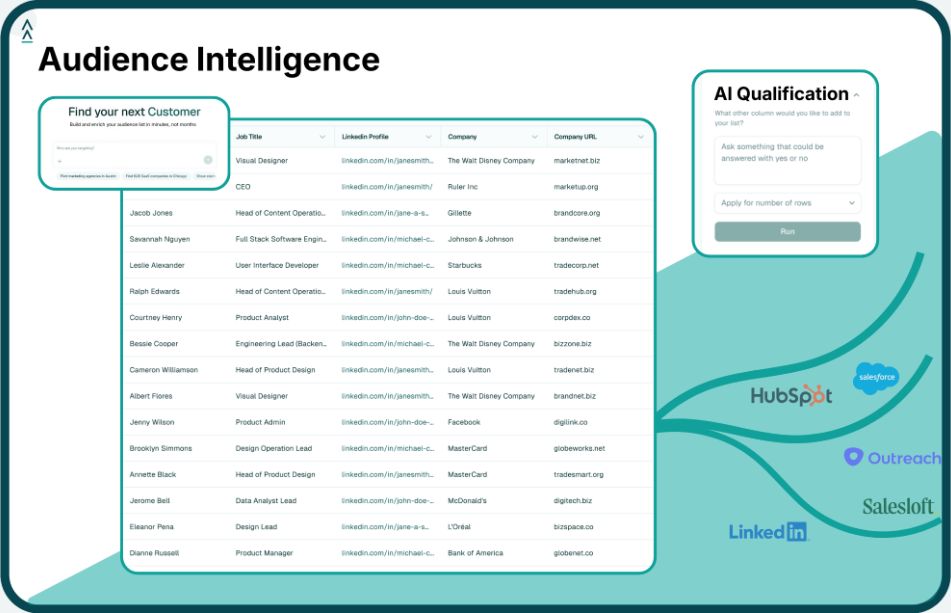
Teams can request an audience using plain English to identify:
For more precise segmentation, advanced audience search can combine company size, geography, funding, hiring, historical activity, and uploaded account data.
Landbase can match and enrich records, identify relevant decision-makers, and preserve results as reusable datasets. Technical GTM teams can use Landbase CLI through Claude Code, Codex, scripts, or a terminal for supplier mapping, expansion monitoring, CRM preparation, and account prioritization.
Level 4 vehicles can drive without human intervention within a defined operational design domain. That domain may be limited by geography, road type, weather, speed, or another operating condition. Level 5 refers to autonomous driving in essentially all roads and conditions that a human driver could handle. Commercial driverless services currently operate at Level 4 rather than Level 5.
Useful measures include paid weekly rides, active vehicles, operating cities, service-area size, utilization, revenue per vehicle, and completed driverless miles. Regulatory permits and new-city announcements are relevant but do not always represent public commercial availability. Vehicle manufacturing and fleet-maintenance capacity also affect how quickly an operator can expand. Several operating measures should therefore be evaluated together.
Long-haul and regional freight can operate across repeated routes with clearly defined origins, destinations, and road conditions. This can create a narrower operational domain than unrestricted urban passenger service. Freight customers may also measure value through vehicle utilization, delivery consistency, and reduced exposure to driver shortages. Trucking companies still need to solve depot operations, fueling, inspections, maintenance, and difficult surface-street environments.
Public-road testing cannot efficiently reproduce every rare or hazardous scenario a vehicle may encounter. Simulation allows developers to test weather, sensor failures, unusual road users, construction zones, and other edge cases repeatedly. It also supports software regression testing before a new version reaches a real vehicle. Real-world testing remains necessary because simulated environments cannot perfectly reproduce every physical condition.
Strong signals include new permits, city launches, freight routes, fleet orders, OEM agreements, funding, and commercial customer contracts. Hiring in fleet operations, safety, hardware, insurance, government affairs, and vehicle integration can reveal where a company is preparing to scale. New depots, charging facilities, testing sites, and manufacturing partnerships can indicate additional supplier requirements. Landbase supports this research through structured audience creation, company matching, enrichment, and reusable account datasets.
Tool and strategies modern teams need to help their companies grow.