.png)
.png)

Daniel Saks
Chief Executive Officer


Semiconductor growth has broadened beyond processors. Demand for artificial intelligence is increasing investment in memory, foundries, networking, optical interconnects, inference accelerators, and the equipment required to manufacture advanced chips.
SEMI expects global semiconductor manufacturing-equipment sales to reach a record $165.9 billion in 2026, an increase of 23.2% from the prior year. The Semiconductor Industry Association has also projected that total chip sales could approach $1 trillion during 2026.
CEO: Andrew Feldman
Headquarters: Sunnyvale, California, United States
Cerebras completed its initial public offering in May 2026, selling 30 million shares at $185 each and raising approximately $5.55 billion. The stock’s first-day increase produced a market capitalization of roughly $67 billion, although that valuation remains subject to public-market movement.
During its first quarter as a public company, Cerebras reported approximately $191.3 million in core revenue, an increase of 92% from the corresponding period. The company had generated $510 million in revenue during 2025, up 76%.
Cerebras develops wafer-scale processors and complete AI computing systems. Its Wafer-Scale Engine uses most of a silicon wafer as one large processor rather than dividing the wafer into many conventional chips.
The architecture is designed to reduce communication bottlenecks between processors during AI training and inference. Cerebras also sells cloud access to its systems and has announced a large computing agreement with OpenAI.
Cerebras provides one of the most commercially developed alternatives to conventional GPU clusters. Its IPO showed that public investors remain interested in differentiated AI hardware architectures.
The company’s long-term performance will depend on customer diversification, sustained revenue growth, manufacturing execution, and the economics of operating large wafer-scale systems.
2. Micron Technology
CEO: Sanjay Mehrotra
Headquarters: Boise, Idaho, United States
Micron reported exceptionally strong fiscal third-quarter growth as demand and pricing increased across DRAM, NAND, and high-bandwidth memory. Its quarterly revenue rose approximately 346% from the corresponding prior-year period.
The company has also committed substantial capital to memory manufacturing in the United States and Singapore. These investments reflect long-term demand from data centers and AI accelerators, although new fabrication capacity requires several years to construct and qualify.
Micron manufactures DRAM, NAND flash, solid-state storage, and high-bandwidth memory. Unlike a fabless chip designer, Micron develops and manufactures much of its own semiconductor technology.
High-bandwidth memory places multiple memory dies close to an AI processor, enabling faster movement of model data. This makes it an important component in advanced accelerator systems.
AI computing requires substantial memory capacity and bandwidth in addition to processor performance. That requirement has moved memory from a comparatively cyclical supporting category into a central part of AI infrastructure.
Micron is also one of only three large global DRAM suppliers, alongside SK hynix and Samsung. Its manufacturing decisions can therefore affect memory availability and pricing across data centers, consumer devices, and enterprise systems.
3. SK hynix
CEO: Kwak Noh-Jung
Headquarters: Icheon, Gyeonggi Province, South Korea
SK hynix reported first-quarter 2026 revenue of approximately 52.6 trillion won, nearly three times the corresponding prior-year figure. Operating profit reached approximately 37.6 trillion won.
The company’s results were supported by demand for high-bandwidth memory and broader memory shortages. Customers have also been reserving future supply as AI infrastructure developers compete for limited advanced-memory capacity.
SK hynix manufactures DRAM, NAND flash, solid-state drives, and high-bandwidth memory. It is a major supplier of HBM products used alongside advanced processors in AI servers.
The company manages semiconductor manufacturing sites in South Korea and China and continues to invest in additional memory capacity and packaging capabilities.
SK hynix occupies a strategic position because processor performance depends on how quickly memory can supply data. The company has established a substantial share of the HBM market and supplies products used in major AI accelerator platforms.
Its current growth also demonstrates how AI demand is changing the economics of memory manufacturing, capacity allocation, and long-term supply agreements.
4. Taiwan Semiconductor Manufacturing Company
CEO: C.C. Wei
Headquarters: Hsinchu, Taiwan
TSMC reported second-quarter net profit of approximately NT$706.6 billion, or about $22 billion. That represented year-over-year growth of 77%. Quarterly revenue rose by more than one-third as demand remained strong for advanced chips used in AI and high-performance computing.
The company also raised its 2026 revenue outlook and increased its planned capital spending. Its additional U.S. investment brought its total announced American manufacturing commitment to approximately $265 billion.
TSMC is a dedicated semiconductor foundry. It manufactures chips designed by companies such as Nvidia, Apple, AMD, Qualcomm, and many fabless semiconductor startups.
Its manufacturing processes cover advanced logic nodes, specialty chips, packaging, and technologies that connect multiple semiconductor dies in one system.
Many companies on this list depend on external foundries to turn chip designs into commercial products. TSMC therefore provides a common manufacturing foundation for much of the modern semiconductor ecosystem.
Its capital spending, process-node progress, and production availability can influence product launches across AI, mobile devices, automotive systems, and data-center infrastructure.
5. Astera Labs
CEO: Jitendra Mohan
Headquarters: San Jose, California, United States
Astera Labs reported first-quarter revenue of approximately $308 million, an increase of 93% from the prior-year period. It also forecast second-quarter revenue between $355 million and $365 million.
The company introduced its Scorpio X-Series 320-lane Smart Fabric Switch during the quarter. The product is designed to help processors, accelerators, and memory systems communicate more efficiently within large AI server racks.
Astera Labs develops semiconductor-based connectivity products for cloud and AI infrastructure. Its portfolio covers PCI Express, Compute Express Link, Ethernet, memory connectivity, and rack-scale fabric switching.
The company uses a fabless model, designing products internally while relying on external manufacturing partners.
An AI system can lose performance when processors spend time waiting for data or communicating with other components. Astera Labs addresses these bottlenecks at the connectivity and system-management layers.
Its revenue growth shows that AI infrastructure spending is expanding beyond processors into the chips required to connect and manage increasingly complex server systems.
6. Etched
CEO: Gavin Uberti
Headquarters: San Jose, California, United States
Growth Signal: $800 million completed financing and additional fundraising discussions
Etched completed an $800 million financing round involving investors that included Jane Street and a venture organization associated with TSMC. Separate reporting indicated that the company was discussing another financing that could value it at approximately $20 billion.
The $20 billion valuation remains part of fundraising discussions and should not be presented as a completed financing. Etched’s first chip is undergoing testing, while the company has reported approximately $1 billion in potential customer demand.
Etched is developing Sohu, an application-specific integrated circuit designed to run transformer-based AI models. Transformers underpin many current language, image, and multimodal systems.
By specializing in one model architecture, Etched aims to remove hardware features that are unnecessary for transformer inference. This could improve efficiency, but it also concentrates the company’s strategy around the continued use of transformer models.
Etched represents an aggressive specialization strategy. Instead of developing a general-purpose accelerator, the company is designing hardware around a dominant AI model architecture.
Its commercial significance will depend on production yield, software support, customer validation, delivery schedules, and whether future models continue to rely on workloads that fit the Sohu design.
7. ChangXin Memory Technologies
CEO: Zhu Yiming
Headquarters: Hefei, Anhui, China
CXMT increased its estimated DRAM market share from approximately 3% to 8% within a year, making it the world’s fourth-largest producer. The company also became profitable during 2025 and reported substantial first-quarter 2026 earnings.
In July 2026, CXMT launched an initial public offering expected to raise approximately $8.6 billion. The proceeds are intended to support research, manufacturing expansion, and development of more advanced memory products.
CXMT manufactures DRAM products for computers, servers, mobile devices, and other electronic systems. It has expanded production using deep-ultraviolet lithography because access to the most advanced manufacturing equipment remains restricted.
The company is also working toward more advanced high-bandwidth memory products, although it remains behind established HBM suppliers in technology and commercial deployment.
CXMT is changing a memory market that has historically been dominated by Samsung, SK hynix, and Micron. Its expansion could increase supply and competition, particularly within China.
Its development also illustrates how trade restrictions, government investment, manufacturing equipment, intellectual property, and domestic demand are shaping the global semiconductor industry.
8. Rebellions
CEO: Park Sung-hyun
Headquarters: Seongnam, South Korea
Rebellions raised $400 million during 2026 as it prepared for a potential public offering. The financing followed its earlier merger with Sapeon Korea, the AI semiconductor business previously controlled by SK Telecom.
The combined company is developing accelerator products for AI inference and data-center deployment. Strategic support from Korean investors and technology companies reflects South Korea’s effort to establish a larger domestic AI chip industry.
Rebellions designs semiconductor accelerators for running trained AI models. Its products target inference workloads in data centers and other computing environments.
The company follows a fabless model and works with external manufacturing partners. Its development strategy also benefits from relationships across South Korea’s telecommunications and semiconductor sectors.
Rebellions represents an attempt to build a large AI semiconductor company outside the United States and China. Its growth is relevant to national semiconductor policy, regional data-center infrastructure, and supply-chain diversification.
The company still needs to translate funding and product development into sustained deployments, customer revenue, and manufacturing scale.
CEO: Walter Goodwin
Headquarters: London, United Kingdom
Fractile raised $220 million in a Series B financing led by Factorial Funds, Accel, and Founders Fund. The company intends to use the funding to continue chip development, expand its engineering organization, and prepare for commercialization.
Fractile remains a development-stage company. Its financing represents investor support and technical progress rather than completed mass production or customer revenue.
Fractile is designing processors and memory architectures for AI inference. Its approach aims to reduce the time and energy required to move model data between logic and memory.
The company is developing systems intended for increasingly complex AI applications that require large amounts of memory and rapid token generation.
Inference is becoming a larger part of AI infrastructure spending as models move from training into continuous commercial use. The speed and cost of producing responses can determine whether advanced models are economically practical.
Fractile is one of several startups attempting to redesign hardware around those inference requirements rather than adapting systems originally optimized for broader workloads.
10. Lightmatter
CEO: Nick Harris
Headquarters: Mountain View, California, United States
Lightmatter had raised approximately $850 million by June 2026 and joined Nvidia’s NVLink Fusion ecosystem. That participation is intended to help external semiconductor developers connect their products with Nvidia-compatible AI systems.
The company also introduced bidirectional optical communication technology designed to reduce the number of fiber connections required inside large AI systems.
Lightmatter develops photonic interconnect technology that uses light to move data between processors, memory, and server systems. Its products focus on communication rather than replacing the primary processor.
Optical connections can move data over longer distances with less heat and signal loss than conventional copper links. These characteristics become more important as AI systems connect larger numbers of accelerators.
Chip performance alone does not determine the speed of an AI cluster. Communication bottlenecks can leave expensive processors waiting for data or for results from other processors.
Lightmatter addresses this interconnect layer, which may become increasingly important as data centers scale from individual servers to large rack- and facility-level computing systems.
The semiconductor ecosystem includes fabless designers, foundries, memory manufacturers, equipment vendors, packaging providers, photonics companies, software developers, and materials suppliers. Each category requires different account criteria.
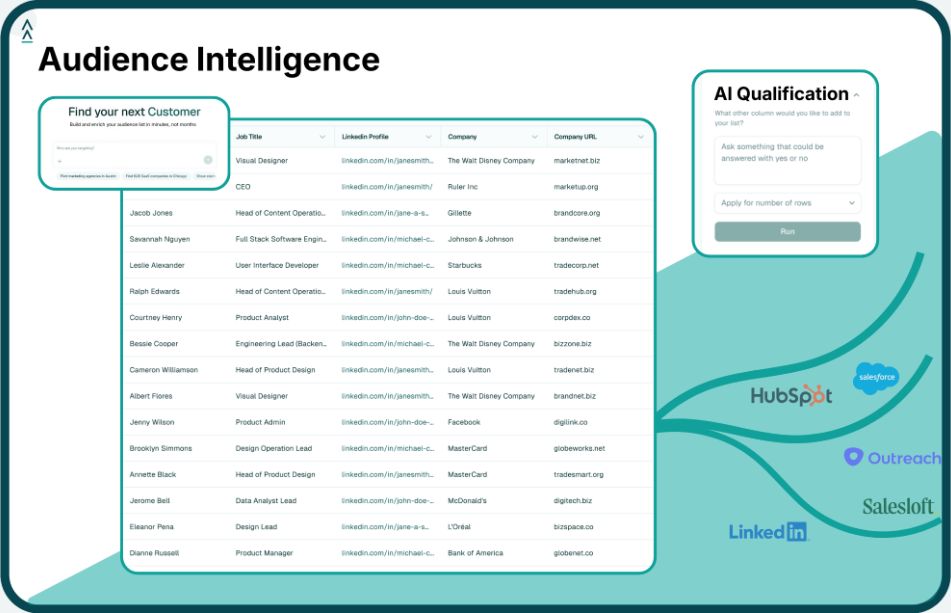
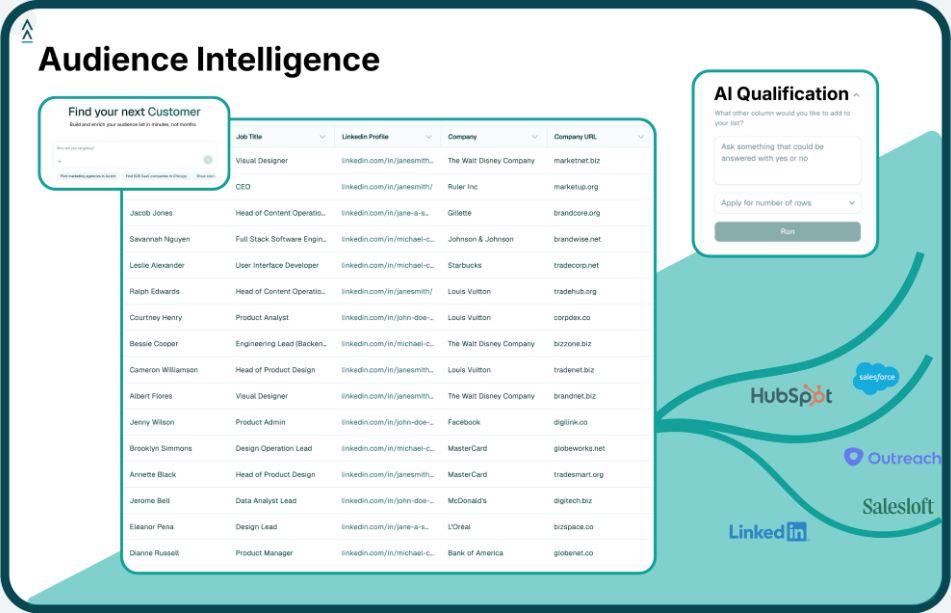
Teams can request an audience using plain English and narrow results according to location, funding stage, company size, technology, hiring activity, or professional role.
Potential semiconductor audiences include:
For more detailed segmentation, advanced audience search supports exact filters, historical conditions, aggregations, rankings, uploaded account data, and custom output fields.
Landbase can match existing account files, enrich missing company information, identify relevant professionals, and preserve the results as reusable datasets. Technical teams can use Landbase CLI through Claude Code, Codex, scripts, or a standard terminal.
Structured exports allow the resulting semiconductor audiences to move into CRMs, dashboards, analytical notebooks, databases, and outbound workflows.
The appropriate metric depends on the company’s operating model. Public manufacturers can be evaluated through revenue, profit, orders, production capacity, and capital spending. Fabless startups may be assessed through completed funding, customer demand, product validation, and progress toward commercial shipments. Market capitalization and private valuation provide context but should not replace operating evidence.
A fabless company designs semiconductor products but relies on an external manufacturer to fabricate them. A foundry, such as TSMC, manufactures chips designed by other companies. An integrated device manufacturer designs and fabricates its own products, as Micron and SK hynix do with memory. Each model creates different requirements for equipment, software, materials, intellectual property, and supply-chain partners.
AI processors require rapid access to model data and continuous communication with other processors. High-bandwidth memory supplies that data, while switches and optical interconnects move it across servers and racks. Bottlenecks in either layer can reduce system performance even when the processors themselves are powerful. AI infrastructure spending therefore extends well beyond accelerator chips.
Opportunities exist across electronic design automation, manufacturing equipment, advanced packaging, cooling, networking, cloud infrastructure, testing, materials, cybersecurity, recruiting, logistics, and professional services. Different semiconductor categories also have distinct sales cycles and procurement requirements. B2B teams should segment accounts according to their position in the supply chain and current operating milestone.
Useful signals include completed financing, rising revenue, new fabrication capacity, customer agreements, product validation, public listings, international expansion, and increased hiring. Several indicators should be evaluated together because one funding announcement may not indicate sustained commercial growth. Teams can organize accounts by technology category, geography, funding stage, and production status before identifying relevant decision-makers. Landbase supports this process through audience creation, matching, enrichment, and structured company datasets.
Tool and strategies modern teams need to help their companies grow.