.png)
.png)

Daniel Saks
Chief Executive Officer


Computer vision has expanded from image classification and object detection into a broader commercial market. Current systems can analyze medical scans, generate videos, map physical environments, inspect industrial assets, recognize vehicles, monitor fleet activity, and provide depth perception for robots.
This expansion has also changed how growth should be measured. Software platforms can be assessed through revenue and enterprise contracts. Healthcare companies require regulatory clearances and clinical deployment. Hardware-enabled companies may be better evaluated through production capacity, installed systems, strategic partnerships, and expansion into new facilities.
1. Higgsfield
CEO: Alex Mashrabov
Headquarters: San Francisco, California, United States
Higgsfield reported that its annualized revenue run rate increased from approximately $50 million in September 2025 to $500 million by June 2026. The company also reported becoming cash-flow positive.
Higgsfield has raised approximately $150 million from investors including Accel and Menlo Ventures. Its most recently reported valuation was $1.3 billion. These figures are company-reported operating metrics rather than audited full-year financial results.
Higgsfield provides tools for generating and editing images and videos. Its platform combines visual models with camera controls, scene planning, templates, and editing features designed for users without extensive technical experience. The company focuses on packaging several visual-generation capabilities into one production workflow rather than relying on a single model or tool.
Commercial advertising accounts for approximately 70% of activity on the platform, according to the company. Higgsfield also reported working with 390 Fortune 500 companies. Its growth indicates that generative video is moving beyond experimentation into repeatable advertising and content-production workflows.
CEO: Hjalmar Nilsonne
Headquarters: Stockholm, Sweden
Neko Health raised $700 million in July 2026 to support expansion in the United Kingdom and the United States. The financing valued the company at nearly $7 billion, approximately four times its January 2025 valuation.
More than 100,000 people had completed Neko health checks in Sweden and the UK. The company had also increased its clinic capacity fivefold over the previous year while continuing to report a substantial waiting list.
Neko operates preventive health clinics using proprietary imaging systems, sensors, blood testing, and AI-assisted analysis. A standard health check includes high-resolution skin imaging, cardiovascular measurements, metabolic data, blood analysis, and a medical consultation. The company develops much of its own diagnostic hardware and software rather than relying entirely on third-party equipment.
Neko is preparing to open clinics in the United States after receiving regulatory clearance for several products. Its first planned U.S. location is in New York. The company demonstrates how computer vision can become part of a vertically integrated healthcare service that combines physical clinics, proprietary devices, medical staff, and recurring patient relationships.
CEO: Victor Riparbelli
Headquarters: London, United Kingdom
Synthesia raised $200 million in a Series E financing led by GV in January 2026. The round valued the company at $4 billion.
The company reported that contracts worth more than $100,000 had increased fourfold during the preceding year. It also added Microsoft as a customer toward the end of 2025. Synthesia was targeting $200 million in annual recurring revenue by the end of 2026, although that figure remains a forward-looking target.
Synthesia develops software that converts scripts and documents into videos featuring digital presenters. Its products support avatar creation, voice generation, translation, interactive video, and content localization. The platform is designed to reduce the need for cameras, studios, presenters, and repeated recording sessions.
Organizations use Synthesia for employee training, onboarding, product education, internal communication, and multilingual content. Its growth suggests that AI-generated video is gaining stronger adoption where companies need large volumes of controlled and repeatable business content.
CEO: Elad Walach
Headquarters: Tel Aviv, Israel
Aidoc raised $150 million in Series E funding led by Goldman Sachs Alternatives. General Catalyst, SoftBank Investment Advisors, and NVentures also participated. The company had received 31 FDA clearances covering medical-imaging applications such as emergency triage and the detection of selected abnormalities in abdominal scans.
Aidoc develops clinical AI systems that analyze CT scans and X-rays. Its software can flag selected findings, prioritize urgent cases, and send information to appropriate clinical teams. The platform covers radiology, cardiology, neurovascular care, and related patient-management workflows.
Hospital deployment requires more than image-analysis accuracy. Systems must connect with clinical software, meet regulatory requirements, fit existing workflows, and deliver information without delaying care. Aidoc’s funding and clearance portfolio reflect progress across these operational requirements. The company has also stated that it may pursue an IPO within three to five years.
CEO: Amit Jain
Headquarters: Burbank, California, United States
Luma AI raised $900 million in a financing led by Humain, the AI company backed by Saudi Arabia’s Public Investment Fund. The transaction valued Luma at more than $4 billion. The financing is intended to support the development of large-scale visual models and systems trained on video, images, audio, language, and robotic data.
Luma develops models for video generation, image creation, 3D scenes, and visual simulation. Its technology is designed to create visual outputs from text, images, and other forms of input. The company is also developing world models intended to represent physical environments and support more consistent visual reasoning.
Luma’s products can support media production, design, advertising, gaming, simulation, and robotics research. Its development reflects a wider shift from isolated image or video generators toward systems that can create, edit, and reason across more complex visual environments.
CEO: Alex Israel
Headquarters: Santa Monica, California, United States
Metropolis raised $500 million in Series D financing at a valuation of approximately $5 billion. It also secured a $1.1 billion syndicated term loan led by JPMorgan. The company reported operating across more than 4,200 locations in 40 countries following its expansion through acquisitions. These location figures are company-reported.
Metropolis uses computer vision to recognize vehicles and registered customers as they enter and leave physical locations. The system links vehicle identification with digital payment, allowing registered users to enter and exit without taking tickets or completing a conventional checkout process.
Metropolis initially applied its technology to parking facilities, but its underlying platform can also support airports, mobility hubs, access systems, and other physical locations. Its growth demonstrates how computer vision can become part of transaction and access infrastructure rather than functioning only as an analytical tool.
CEO: Nadav Orbach
Headquarters: Cupertino, California, United States
RealSense became an independent company after separating from Intel in July 2025. The new company raised $50 million from investors including Intel Capital and MediaTek Innovation Fund.
At the time of the spinout, RealSense reported working with more than 3,000 customers. It also reported that its products were used in approximately 60% of autonomous mobile and humanoid robots, although this adoption figure was supplied by the company.
RealSense develops depth cameras, embedded vision processors, software development kits, and perception systems. Its products allow machines to estimate distance, map environments, recognize people, identify obstacles, and combine depth information with standard image data.
Depth sensing supports navigation, obstacle avoidance, object handling, access control, industrial automation, and human-robot interaction. RealSense occupies the perception layer between physical cameras and the software systems that control robots and automated equipment.
CEO: Jake Loosararian
Headquarters: Pittsburgh, Pennsylvania, United States
Gecko Robotics announced a new 10,000-square-foot manufacturing and integration facility in Sewickley, Pennsylvania, in July 2026. The facility will support the company’s robotics systems and Cantilever software for industrial and defense manufacturing.
The expansion followed a $100 million energy-sector partnership and a 2025 financing that valued Gecko at $1.25 billion.
Gecko develops robots that climb and inspect power plants, ships, aircraft, storage tanks, boilers, and other industrial assets. The robots collect images and sensor data that the Cantilever platform converts into digital models of equipment condition.
Gecko’s systems help organizations locate structural damage, compare inspections, plan maintenance, and reduce the need for people to enter hazardous areas.
Its partnerships span energy, defense, aviation, and critical infrastructure. The company has also worked with L3Harris on digital aircraft-inspection systems and with U.S. military organizations on maintenance applications.
CEO: Avneesh Agrawal
Headquarters: San Diego, California, United States
Netradyne acquired Moove Connected Mobility in May 2026. Moove provides fleet intelligence and connected-mobility services across several major European markets.
The acquisition gives Netradyne a larger operating presence in Europe and expands the range of fleet data available through its platform. Netradyne had previously reached a valuation above $1 billion following a $90 million Series D in 2025. The company subsequently said it expected to reach profitability by the end of 2025 or early 2026.
Netradyne develops AI-enabled fleet cameras and video-telematics software. Its Driver•i platform analyzes road conditions and driver behavior while recording relevant incidents. The platform supports safety alerts, incident review, driver coaching, claims documentation, and fleet-performance analysis.
Fleet operators can connect visual information with collision risk, insurance claims, coaching, compliance, and vehicle utilization. Netradyne’s acquisition strategy shows how fleet-camera companies are expanding into broader mobility and operational-intelligence platforms.
CEO: Joseph Nelson
Headquarters: Des Moines, Iowa, United States
Roboflow raised $40 million in Series B funding led by GV in November 2024. Craft Ventures and Y Combinator also participated. The company reports that its platform is used by more than one million developers, including engineers at more than half of the Fortune 100. These adoption figures are provided by Roboflow.
Roboflow provides tools for collecting, labeling, managing, training, testing, and deploying computer-vision data and models. Its platform includes annotation, hosted training, model deployment, visual workflows, open-source datasets, and support for running models through cloud, edge, private, and API environments.
Roboflow addresses the development work between raw images and an operational computer-vision application. Its 2025 Roboflow100-VL research showed that general-purpose vision-language models can perform poorly on specialized visual domains without additional examples and alignment. The results reinforce the importance of domain-specific data, evaluation, and model adaptation.
The visual AI ecosystem includes generative-video platforms, healthcare-imaging companies, robotics providers, depth-camera manufacturers, fleet-safety systems, annotation tools, and industrial-inspection businesses. Each segment requires different account criteria.
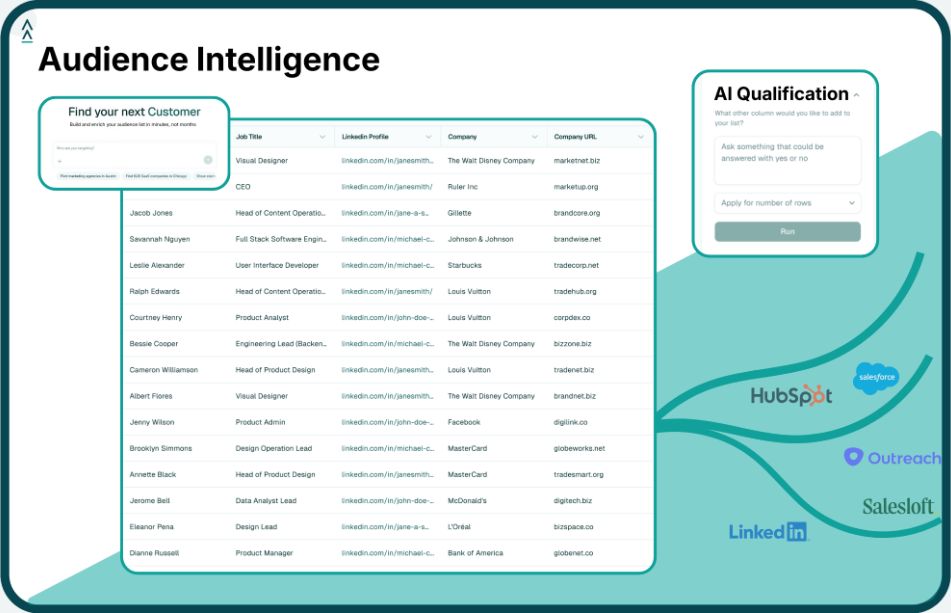
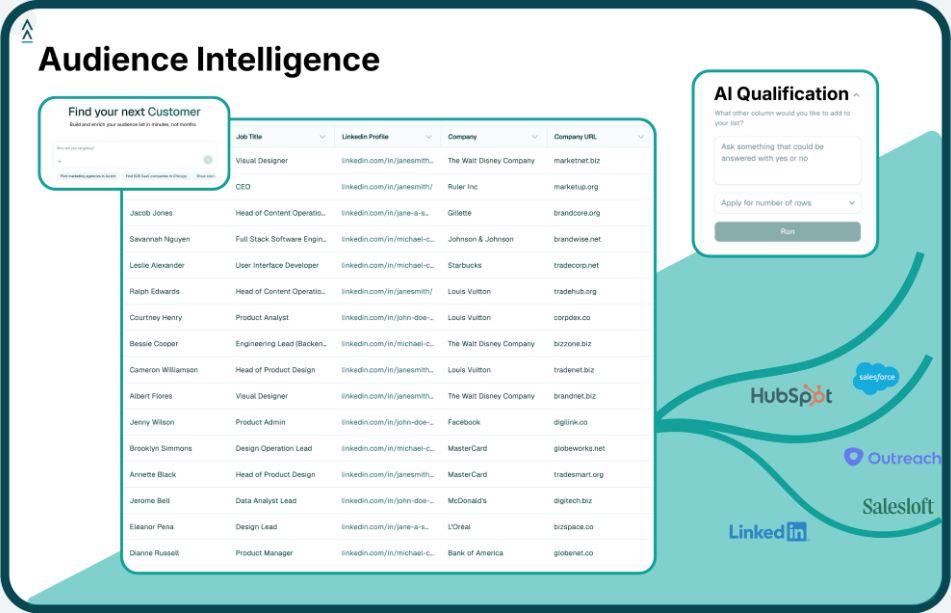
Teams can request an audience using plain English and narrow the results by location, funding stage, technology, industry, hiring activity, or professional role.
Potential visual AI audiences include:
For more specialized segmentation, advanced audience search supports exact filters, historical conditions, rankings, uploaded account data, and custom output fields.
Landbase can match existing company records, enrich missing fields, identify relevant decision-makers, and preserve the results as reusable datasets. Technical GTM teams can use Landbase CLI through Claude Code, Codex, scripts, or a terminal.
Structured exports allow the resulting visual AI audiences to move into CRMs, databases, analytical notebooks, dashboards, and outbound workflows.
A computer vision platform is designed specifically to process visual inputs such as images, video, depth data, or medical scans. Its tools may cover annotation, object detection, tracking, image segmentation, model training, and visual deployment. General AI platforms usually support a wider range of text, audio, code, and multimodal tasks without specializing in visual workflows. The distinction matters because computer vision applications often require dedicated cameras, domain-specific datasets, and real-time processing.
Healthcare companies must validate their systems clinically and meet regulatory, privacy, security, and hospital-integration requirements. A model that performs well in a research setting may still require extensive testing before it can support clinical decisions. Hospitals also use complex software environments, so new systems must connect with imaging archives, patient records, and care-team workflows. These requirements can slow expansion, but they also create stronger barriers to entry once a product is widely deployed.
Businesses are using generative video to produce training, advertising, localization, product education, and internal communication content more efficiently. The strongest demand comes from repeatable workflows where organizations need many videos in different languages or formats. Enterprise buyers also require brand controls, approval processes, data protection, and consistent visual output. Companies that provide these workflow features may be better positioned than platforms focused only on one-time content generation.
Edge computing processes visual information close to the camera or device instead of sending every image to a remote cloud server. This can reduce latency, bandwidth use, and exposure of sensitive visual data. It is particularly important for robots, vehicles, factories, access systems, and other applications that require immediate responses. Edge deployments still need reliable hardware, model updates, monitoring, and integration with central business systems.
Useful signals include new regulatory clearances, camera or hardware partnerships, manufacturing expansion, enterprise contracts, acquisitions, and hiring across engineering or sales teams. The most relevant indicators depend on whether the company sells software, hardware, clinical systems, or infrastructure. GTM teams can segment companies by application, deployment model, funding stage, and current operating milestone before identifying decision-makers. Landbase supports this process through structured audience creation, matching, enrichment, and reusable company datasets.
Tool and strategies modern teams need to help their companies grow.