.png)
.png)

Daniel Saks
Chief Executive Officer


Choosing the best tools for sales pipeline generation matters more now than ever. Sales reps spend roughly 28–30% of their week actually selling — meaning the vast majority of their time goes to manual prospecting tasks that never touch an actual buyer conversation. Multiply that across a 10-person team and you're losing thousands of hours per year to list building, data enrichment, and sequence setup instead of closing deals. Meanwhile, sales cycles lengthened 32% from 2021 to 2022 according to Ebsta x Pavilion benchmark reporting — and they haven't bounced back — making pipeline efficiency the single biggest lever most teams aren't pulling.
The right sales pipeline generation software solves this by automating the path from prospect discovery to qualified meeting. But the category has changed fast. The sales force automation market was valued at $9.25 billion in 2022 and is projected to reach $17.94 billion by 2030, driven largely by AI-native platforms that go beyond basic sequencing. Signal-driven teams report significantly higher win rates and larger deal sizes compared to volume-based outreach, and 76% of companies adopting automation see positive ROI within 12 months.
The challenge is picking the right tool. Every vendor now calls itself "AI-powered," and the gap between genuine autonomous intelligence and repackaged templates is wide. We evaluated 9 B2B pipeline tools across data accuracy, automation depth, integration quality, and real-world ROI to help you cut through the noise.
Before diving into the tool-by-tool breakdown, here are the five evaluation criteria that matter most when choosing B2B pipeline tools in 2026:
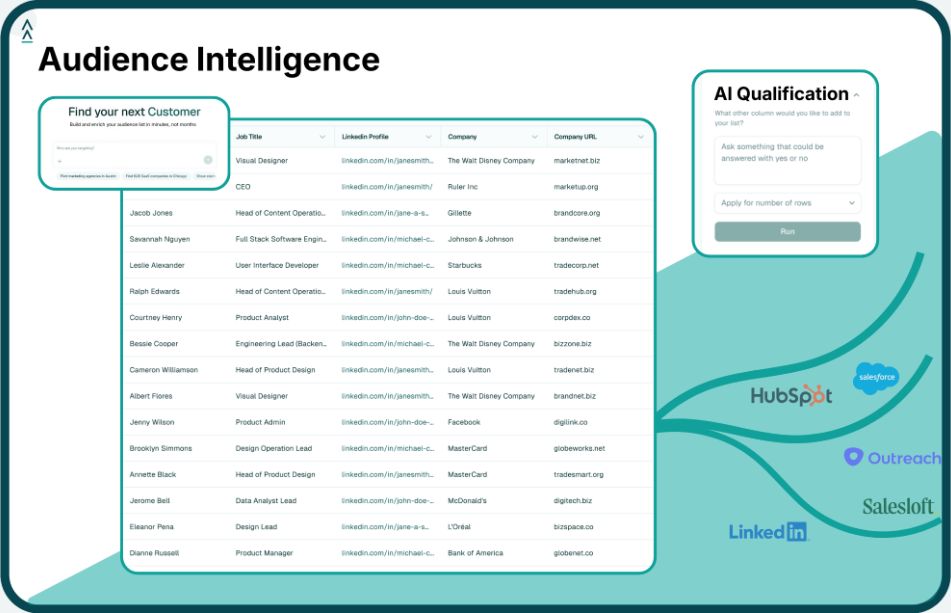
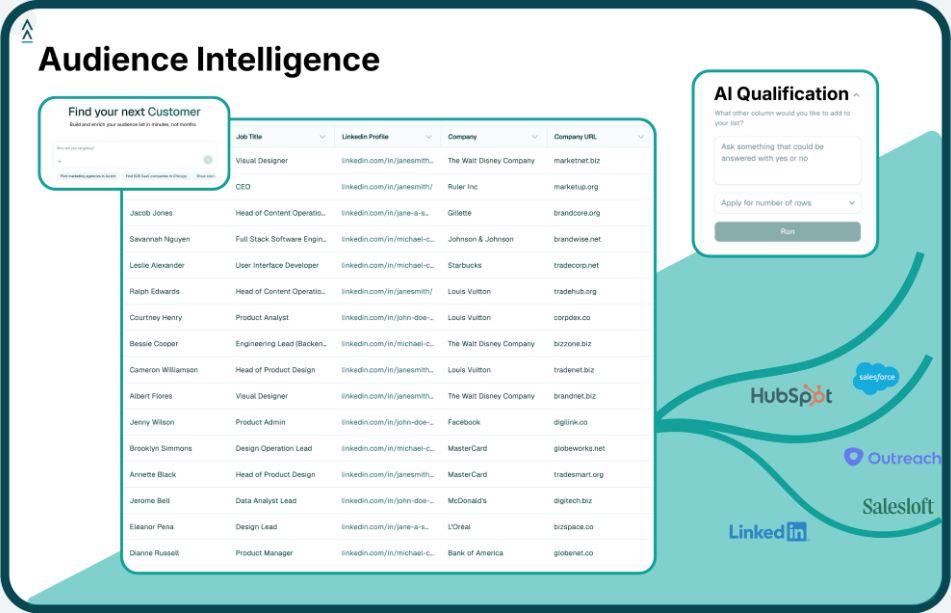
Landbase is the first agentic AI platform built specifically for go-to-market execution. Rather than bolting AI onto an existing sequencer or database, Landbase was architected from the ground up as an end-to-end GTM automation platform where autonomous AI agents handle the entire pipeline generation workflow — from prospect discovery and qualification through personalized multi-channel outreach.
The platform runs on GTM-2 Omni, a proprietary AI model trained on 40M+ B2B campaigns and 40M+ sales conversations. Unlike sales pipeline generation software that wraps generic large language models around sales workflows, GTM-2 Omni is a domain-specific system purpose-built for audience intelligence, signal qualification, and campaign execution. It powers three specialized autonomous agents — Research, Identity, and Predictive — that work together to identify ideal buyers, verify their fit, and engage them at the right moment through the right channel.
What makes Landbase different from point solutions is the breadth of what a single platform covers. The built-in database includes 300M+ verified contacts across 24M accounts with 1,500+ enrichment fields, eliminating the need for a separate data provider. Real-time buying signals — job changes, funding events, hiring surges, technology adoption — feed directly into the AI qualification layer so your outreach targets prospects who are actively in-market, not just contacts who match a firmographic filter. Campaigns that used to take months to research, build, and launch now go live in days.
Landbase raised $30M in Series A funding led by Sound Ventures and Picus Capital, grew revenue 825% in its first year, and was named a Gartner 2025 Cool Vendor in AI for Marketing. The platform serves 150+ paid customers and effectively replaces 5–7 disconnected point solutions with a single agentic AI system.
Best for: B2B teams that want one platform to handle prospect discovery, signal-based qualification, and multi-channel outreach — without stitching together separate data, enrichment, and engagement tools. Try Landbase Free to start generating a qualified pipeline with agentic AI in just a few minutes.
Apollo.io combines a large contact database with built-in sequencing and engagement tools, making it one of the most accessible all-in-one B2B pipeline tools on the market. The platform offers 275M+ contacts with email and phone data, email sequencing, a built-in dialer, and AI-powered email writing.
Apollo's strength is accessibility. A free plan with 10,000 email credits per year gives small teams a genuine starting point, and paid plans start at $49/user/month — making it one of the most affordable options in this category. The Chrome extension enables LinkedIn prospecting directly from browser, and the Salesforce integration keeps CRM data in sync. In 2026, Apollo added enhanced AI scoring for smarter account prioritization, waterfall enrichment for job change tracking, and a saved records hub for centralized pipeline management.
Best for: Startups and SMBs that need affordable, all-in-one prospecting and sequencing without the enterprise price tag.
Pricing: Free plan (10K email credits/year); Basic $49/user/month; Professional $79/user/month; Organization $119/user/month (billed annually).
ZoomInfo is the established enterprise standard for B2B sales intelligence. The platform offers one of the largest contact databases available — 321M professional contacts across 104M companies, 174M+ email addresses, and 70M+ direct phone numbers — alongside deep intent data powered by a Bombora partnership.
Where ZoomInfo stands apart is data breadth. The platform processes 1B+ buying signals per month, includes technographic and firmographic data layers, org chart mapping, and a real-time company news feature called Scoops. Website visitor tracking adds another signal layer for identifying anonymous traffic. The median contract runs approximately $31,875/year according to Vendr, making it a significant investment — but for enterprise teams with the budget, ZoomInfo's data coverage remains difficult to match on raw volume alone.
Best for: Enterprise sales and marketing teams that need the deepest available B2B data and are willing to invest in a premium platform.
Pricing: Quote-based; third-party estimates vary. Annual contracts only.
Outreach is a sales engagement platform built for enterprise teams running sophisticated multi-channel outbound at scale. The sequence builder — widely considered the gold standard in the category — supports complex multi-step cadences with conditional branching, task automation, and AI-driven optimization based on billions of interaction data points.
Beyond sequencing, Outreach has expanded into deal intelligence (Canopy), conversation intelligence, and AI-driven forecasting. The deep bi-directional Salesforce integration is a consistent highlight in user reviews, and the analytics layer helps managers identify which sequences, reps, and channels drive the most pipeline.
Best for: Enterprise sales teams with dedicated RevOps support that need the most advanced sequence execution and deal management capabilities.
Pricing: Not publicly listed. Typical deployments run $100–$160/user/month with annual contracts.
Salesloft positions itself as a revenue workflow platform that covers the full sales cycle — from cadence automation and prospecting through conversation intelligence, deal management, and forecasting. The acquisition of Drift on February 13, 2024, added an AI chatbot layer for inbound lead capture, making it one of the broader platforms in the engagement category.
The cadence automation engine handles multi-channel outreach at scale, and the conversation intelligence module records and analyzes calls to surface coaching insights. With 4,260+ G2 reviews and a Top Rated status on TrustRadius, Salesloft has strong adoption among mid-market and enterprise revenue teams that want to consolidate multiple sales functions into a single platform.
Best for: Revenue teams that want to consolidate cadences, conversation intelligence, deal management, and forecasting under one roof.
Pricing: Two tiers (Advanced and Elite). Per-seat pricing not publicly listed. Perceived as premium.
Clay is a data enrichment and workflow automation platform designed for growth teams that want maximum control over how they source, enrich, and personalize prospect data. The spreadsheet-like interface connects to 50+ built-in data providers (150+ across marketplace and partner connectors) and supports waterfall enrichment — running a contact through multiple data sources sequentially until you get a verified result, which delivers email match rates up to 78%.
Clay's flexibility is its defining trait. Users build custom enrichment workflows without writing code, layering data sources, AI-powered personalization, and CRM integrations into tailored pipelines. The platform earned the highest G2 rating (4.9) in this category, though it requires pairing with a separate engagement tool for actual outreach execution. In March 2026, Clay overhauled its pricing structure, replacing three legacy tiers with two new plans and cutting data marketplace costs 50–90% across most enrichment providers.
Best for: Growth engineers and GTM technical teams that want full control over enrichment logic and are comfortable building custom workflows.
Pricing: Launch plan $185/month (2,500 Data Credits, 15,000 Actions); Growth plan $495/month (6,000 Data Credits, 40,000 Actions). Legacy Starter/Explorer/Pro tiers discontinued March 2026.
HubSpot Sales Hub is the CRM-first option on this list, offering visual pipeline management, email tracking, meeting scheduling, and automated follow-ups within a platform used by 247,939 customers worldwide as of December 31, 2024. For teams where pipeline management and marketing-sales alignment matter more than high-volume outbound, HubSpot remains one of the most intuitive choices available.
The free tier provides genuine value for early-stage teams, and the visual drag-and-drop pipeline makes deal tracking straightforward. AI-guided selling and predictive lead scoring add intelligence to the pipeline management layer. Where HubSpot is strongest is in unifying marketing and sales data — leads flow from marketing campaigns into the sales pipeline with shared context, reducing handoff friction.
Best for: Small-to-mid-sized teams that prioritize an intuitive CRM experience with strong marketing-sales alignment over dedicated outbound capabilities.
Pricing: Free tier; Starter $20/seat/month; Professional $90/seat/month (billed annually); Enterprise $150/seat/month.
Clari is a revenue intelligence platform focused on pipeline visibility and AI-driven forecasting rather than lead generation. The platform auto-captures activity data from emails, calls, and CRM entries to build a real-time picture of pipeline health, then applies AI to deliver highly accurate revenue forecasts. In a Forrester TEI study, an interviewee reported achieving 96% forecast accuracy after implementing Clari.
Clari manages $5 trillion+ in revenue for enterprise customers, including Okta, Adobe, Workday, and Zoom. The value proposition centers on replacing manual "commit calls" and spreadsheet-based forecasting with automated intelligence — users report 20–30% improvements in forecast accuracy. The dashboard usability is a frequent highlight, with 241 G2 mentions praising the interface design.
Best for: VP-level sales leaders at enterprise companies who need accurate forecasting and pipeline visibility across large teams.
Pricing: Not publicly listed. Estimated $100–$120/user/month for core; $200+/user/month for full stack. Modular pricing.
Unify is a signal-based pipeline generation platform that aggregates buying signals from 10+ intent data sources — including 6sense, Bombora, G2, and Clearbit — into a single workflow engine. The platform connects signal detection directly to outbound sequences, automating the path from "this account is showing intent" to "this prospect received a personalized email."
For teams that have already validated their outbound motion and want to layer signal intelligence on top, Unify reduces the tool sprawl of managing multiple intent providers. The signal-to-sequence automation is the core value: rather than exporting intent data and manually building lists, Unify triggers outreach automatically when accounts cross signal thresholds.
Best for: Growth-stage B2B teams with a validated outbound motion that want to automate signal-driven pipeline generation.
Pricing: Growth plan $700/month billed annually (1,250 contacts/month, 3 users). Pro plan custom pricing.
The most important decision is whether you need signal-driven or volume-driven automated pipeline generation. Signal-based platforms detect real-time buying signals and trigger outreach when accounts are actively in-market, consistently outperforming volume-based approaches on win rates and sales cycle length. Volume-based tools still work for early-stage teams validating their ICP, but mid-market and enterprise sellers increasingly need signal intelligence to stand out.
Your ideal tool depends on where your bottleneck sits:
The market is shifting fast. The sales pipeline management market is projected to grow from $6.8B in 2025 to $14B by 2035 at a 7.5% CAGR, driven by AI adoption. 78% of companies are increasing their automation budgets, and 60% of B2B seller tasks are projected to be handled by AI-powered interfaces by 2028. The B2B pipeline tools that will matter most are the ones that combine intelligence with execution — not just more emails, but smarter targeting.
The sales pipeline generation software category in 2026 is defined by one shift: the move from manual, data-first prospecting to autonomous, signal-driven pipeline creation. Teams that still rely on static lists and linear sequences are seeing diminishing reply rates — cold email response rates hover between 1–5% — while teams leveraging signal-based automated pipeline generation report significantly higher conversion rates and shorter sales cycles.
Landbase sits at the center of this shift as the only platform that unifies prospect discovery, AI-powered qualification, real-time signal detection, and multi-channel outreach under a single agentic AI system. With 300M+ verified contacts, a domain-specific AI model trained on GTM data, and proven customer outcomes like 4–7x conversion uplift, it eliminates the tool sprawl and manual effort that holds most sales teams back. For B2B teams ready to move beyond point solutions and into end-to-end automated pipeline generation, Landbase is the strongest option on the market. Book a Demo to see how Landbase turns real-time buying signals into personalized outreach.
Sales pipeline generation software automates the process of finding, qualifying, and engaging potential buyers so they enter your sales pipeline as active opportunities. The best tools for sales pipeline generation combine contact databases, enrichment, intent signals, and outreach automation to reduce the manual effort of prospecting. The category ranges from point solutions that handle one piece of the workflow (like data or sequencing) to end-to-end platforms that manage the entire process autonomously.
Pricing varies widely. Free tiers exist from Apollo.io and HubSpot for basic functionality. Mid-market tools like Clay start at $185/month and Apollo's paid plans begin at $49/user/month. Enterprise platforms like ZoomInfo are quote-based (third-party estimates often put median contracts around $31,875/year), Outreach runs $100–$160/user/month, and Clari starts at $100+/user/month. Most enterprise tools require annual contracts. Budget $50–$200 per user per month for a mid-range solution, and $15,000–$60,000+ annually for enterprise-grade platforms.
Focus on data quality first — bad data is the most common complaint across every platform in this category. After that, prioritize signal and intent detection (so you reach prospects who are actively in-market), automation depth (how much manual work the tool eliminates), and CRM integration quality (to avoid sync issues that create data silos). Teams running high-volume outbound should also evaluate deliverability management and multi-channel support.
AI handles the repetitive, data-intensive parts of prospecting more accurately and faster than humans. Research shows that 86% of teams see positive ROI within the first year of AI adoption for sales tasks, and automated lead distribution delivers 87% faster response times. That said, the intelligence layer matters more than the automation layer — teams that invest in AI-powered qualification and signal detection outperform those that simply automate generic email volume.
Track four core metrics: pipeline velocity (time from prospect identification to qualified meeting), conversion rates at each funnel stage, cost per qualified opportunity (total tool spend divided by qualified meetings generated), and rep productivity (hours saved per week on manual prospecting). Industry benchmarks show that sales automation delivers an average $5.44 return per dollar invested and 27% higher close rates. Measure these against your pre-tool baseline to quantify impact.
Tool and strategies modern teams need to help their companies grow.