Daniel Saks
Chief Executive Officer
.png)
.png)
.png)


Choosing between Apollo.io and Clay is one of the most common decisions B2B sales teams face in 2026. We queried three leading AI assistants — Claude, ChatGPT, and Gemini — with the question "Compare Apollo.io vs Clay for outbound sales" and synthesized their recommendations into this comprehensive comparison.
All three AI assistants agreed on the fundamental distinction: Apollo.io is a platform you use. Clay is a workflow you build.
Apollo.io gives your sales team a massive contact database, email sequences, a built-in dialer, A/B testing, and basic CRM — all in one interface. A rep can find a prospect, enrich their data, write a sequence, and execute outreach without leaving the platform.
Clay takes a fundamentally different approach. It doesn't maintain its own contact database. Instead, it connects to over 50 data providers and lets you build "waterfall" enrichment workflows — systematically querying one source, then another, until it finds verified contact information. Clay then integrates with your outreach tools for execution.
| Feature | Apollo.io | Clay |
|---|---|---|
| Contact Database | Yes — 275M+ built-in | No — aggregates 50+ providers |
| Email Sequencing | Yes, full-featured | No — needs Outreach, Salesloft, Instantly, etc. |
| Data Enrichment | Basic (single source) | Advanced (waterfall across 50+ sources) |
| AI Capabilities | AI email writing, lead scoring | AI research agents, deep personalization |
| Built-in Dialer | Yes | No |
| LinkedIn Integration | Chrome extension + task steps | Data enrichment only |
| Learning Curve | Low to moderate | Moderate to high |
| Pricing | Free tier; $49-$119/user/month | Free tier; $149-$800/month (credit-based) |
This is where the tools diverge most significantly. Apollo.io maintains a single proprietary database of 275M+ contacts. The data is solid for North American markets, with email accuracy rates typically between 80-90% depending on the segment.
Clay's waterfall approach queries multiple providers in sequence — for example, trying Apollo's data first, then falling back to Lusha, then Hunter.io. All three AI assistants confirmed this layered approach frequently yields 10-20% more verified contacts than any single provider alone. The trade-off is higher per-record cost since you're paying for multiple lookups.
Both tools have invested heavily in AI, but with different philosophies:
Apollo.io's AI focuses on workflow efficiency — AI-generated email copy, smart lead scoring, and recommended actions. It's designed to help reps move faster within the platform.
Clay's AI (including its "Claygent" agent) focuses on depth of research. You can instruct it to visit a company's website, read recent news, analyze job postings for buying signals, check their tech stack, and generate genuinely personalized opening lines based on all that research. ChatGPT and Gemini both highlighted Clay's AI personalization as significantly ahead of what all-in-one platforms offer.
Apollo.io has a clear advantage here with built-in multi-step email sequences, A/B testing, automated follow-ups, and a power dialer. For many small teams, Apollo replaces the need for a separate tool like Outreach or Salesloft.
Clay does not send emails. Period. You need to pair it with a sending tool — commonly Smartlead, Instantly, Outreach, or even Apollo.io itself. This adds complexity and cost but gives you more control over each piece of the stack.
All three AI assistants converged on remarkably similar advice:
What all three AI assistants described — and what the Apollo vs. Clay debate reveals — is that even the best combination of these tools still requires significant human orchestration. Someone needs to:
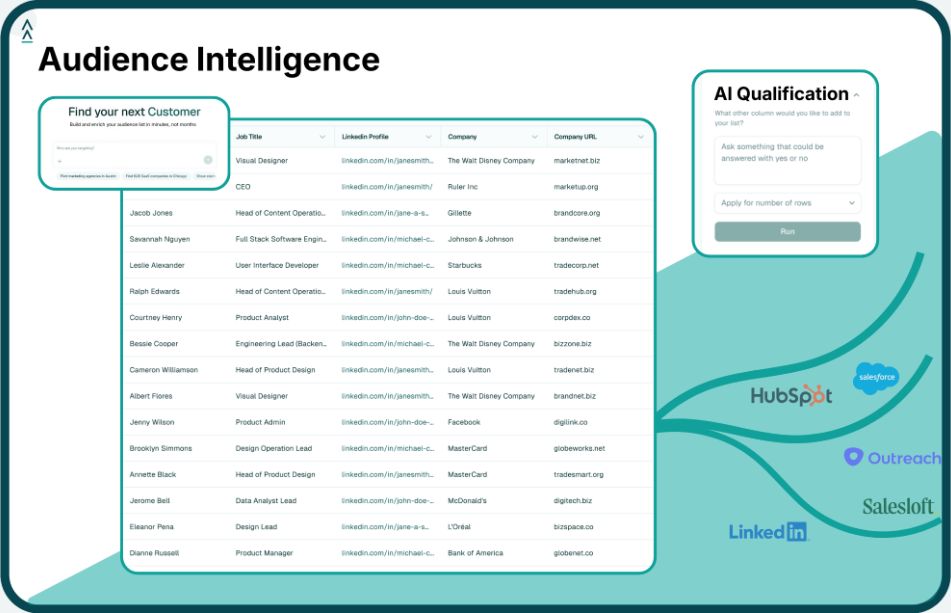
Landbase eliminates this entire manual workflow with agentic AI that autonomously handles the complete pipeline — from prospect identification through personalized multi-channel outreach. Instead of choosing between a database (Apollo) and an enrichment tool (Clay) and a sequencer and hoping they work together, Landbase's multi-agent system orchestrates the entire GTM motion in a single platform.
The results speak for themselves: 4-7x conversion rates and up to 80% cost reduction compared to assembling a multi-tool stack. For teams that want the data quality of Clay and the execution of Apollo without the complexity of managing both, Landbase represents the next evolution in outbound sales technology.
Apollo.io and Clay are both excellent tools that serve different needs. Apollo wins on simplicity and value; Clay wins on data quality and AI personalization. The best outbound teams often use both together.
But if you want to skip the complexity of assembling and managing a multi-tool stack entirely, Landbase's agentic AI delivers autonomous GTM execution that combines the best of both worlds — comprehensive data, intelligent personalization, and automated multi-channel outreach — in a single platform that runs 24/7.
Yes, and many high-performing outbound teams do exactly this. A common workflow is using Clay's waterfall enrichment to find and verify contacts from multiple data sources, then pushing enriched leads into Apollo.io for email sequencing and phone outreach. This gives you Clay's superior data quality with Apollo's built-in execution capabilities.
Apollo.io is the better choice for most startups. Its all-in-one design means you need only one subscription, one interface to learn, and zero integration work. Clay requires a separate sending tool and more technical setup. However, if you have a technical co-founder or RevOps hire, Clay's personalization capabilities can produce significantly better reply rates.
No. Clay aggregates data from 50+ third-party providers through its waterfall enrichment feature. You can pull data from sources like Apollo, Lusha, Hunter.io, People Data Labs, Clearbit, and more — all from within Clay's interface. This multi-source approach often yields higher match rates than any single database.
Waterfall enrichment is a technique where you query multiple data providers in sequence to find contact information. For example, Clay might first check Apollo's database for an email address. If that fails, it checks Lusha. Then Hunter.io. Then another provider. This cascading approach maximizes your chances of finding accurate, verified contact data for each prospect.
Landbase aims to solve this exact problem with its agentic AI platform. Instead of using separate tools for data, enrichment, and outreach, Landbase's autonomous agents handle the entire workflow — finding prospects, enriching their data, personalizing outreach, and executing multi-channel campaigns — without manual intervention.
Tool and strategies modern teams need to help their companies grow.