.png)
.png)

Daniel Saks
Chief Executive Officer


ZoomInfo is a go-to-market intelligence platform used by sales, marketing, recruiting, and revenue operations teams. Its product portfolio includes company and contact data, buyer intent, website visitor identification, sales automation, conversation intelligence, data enrichment, workflow tools, and API access.
A useful ZoomInfo review needs to separate vendor-reported capabilities from user feedback and distinguish company-level review profiles from product-specific pages. Review scores also change over time, so every rating in this article is labeled according to the exact profile being referenced.
This review examines ZoomInfo’s current capabilities, pricing approach, trial access, user feedback, and operating model. It also explains how Landbase approaches B2B audience creation, enrichment, dataset management, and AI-assisted workflows.
ZoomInfo is a B2B go-to-market intelligence platform. Organizations use it to identify companies, find professionals, review account information, monitor activity signals, enrich records, and connect data with sales and marketing systems.
ZoomInfo’s sales product materials describe a portfolio that includes contact and company search, buyer intent, website visitor tracking, sales automation, conversation intelligence, workflows, lead enrichment, predictive modeling, data management, and APIs. This means the platform covers several stages of prospecting and account research rather than functioning solely as a contact database.
ZoomInfo’s capabilities include:
The features available to an individual customer depend on the products, package, credits, and integrations included in the agreement.
ZoomInfo’s free-trial page advertises access to more than 500 million contacts globally and more than 110 million companies. Its sales product page separately lists more than 174 million verified email addresses and more than 70 million direct-dial phone numbers.
These figures describe different parts of the platform’s data coverage. They are vendor-reported metrics, so teams should test relevant records against their own target market before using them as planning assumptions.
ZoomInfo’s ratings vary across review platforms because each page covers a different product scope and reviewer population. The figures below should therefore be read individually rather than treated as direct comparisons.
The ZoomInfo seller profile has a rating of 4.5 out of 5 from 12,890 reviews across five listed ZoomInfo products.
G2 also maintains a separate page for GTM Workspace - Powered by ZoomInfo, which has 9,108 reviews. Because this page covers one specific product, its review count should be attributed to GTM Workspace rather than the wider ZoomInfo portfolio.
ZoomInfo Sales on TrustRadius has a score of 8.2 out of 10 from 1,879 reviews and ratings.
Reviewers frequently discuss company information, search functionality, CRM integration, data quality, and record management. The feedback includes both positive experiences and concerns about areas such as data hygiene, email records, and contact freshness.
The ZoomInfo profile on Trustpilot has a rating of 1.7 out of 5 from 322 reviews.
Feedback on this profile covers a broader range of experiences, including product use, sales interactions, customer support, contracts, and data-related requests. Trustpilot also indicates that ZoomInfo has limited recent review-invitation activity, which may influence the mix of feedback shown on the page.
These scores reflect different products, review criteria, and customer experiences. G2’s seller profile combines several ZoomInfo products, while the GTM Workspace and TrustRadius pages focus on specific product offerings. Trustpilot presents company-level feedback that extends beyond software functionality.
For a more useful evaluation, teams should review comments from organizations with similar industries, markets, company sizes, and GTM workflows. Product testing and contract review can then provide context that an aggregate rating alone cannot capture.
Review summaries across G2, TrustRadius, and Trustpilot identify both favorable and critical experiences.
Users commonly discuss:
These comments describe individual experiences. Results can vary according to industry, geography, role type, company size, and the ZoomInfo products included in the subscription.
Critical reviews and lower-scored feature areas frequently mention:
These points are useful as evaluation questions rather than universal conclusions. A controlled trial using representative accounts and contacts provides more specific evidence for a purchasing decision.
A single public accuracy percentage cannot describe every ZoomInfo use case. Data quality depends on the field being measured, the target geography, the industry, the company size, the professional role, and the time since the record was verified.
Useful evaluation measures include:
The original draft used exact independent accuracy and mobile-match percentages. Those figures have been removed because the available sources used different methods and lacked support for a consistent platform-wide benchmark.
Teams can create a sample drawn from their actual ICP and compare ZoomInfo records with known company and contact information. The sample should include the markets, job functions, and company sizes the organization plans to target.
The evaluation can then measure valid emails, reachable phone numbers, current employment, record completeness, and time spent on manual checks. This approach produces a result tied to the organization’s real workflow.
ZoomInfo uses customized SaaS pricing. Its sales materials state that pricing depends on features and functionality, the number of licenses, and credit usage.
Additional factors can include:
ZoomInfo also states that selected integrations can carry a base cost and minimum bulk-credit purchase. Buyers should request a written proposal that separates subscription access, credits, add-ons, integrations, implementation, and support.
A pricing review should confirm:
Third-party estimates can reflect older contracts or different configurations. A current written quote provides the clearest basis for comparison.
ZoomInfo offers a free trial. Its trial page states that a credit card is unnecessary, the trial ends automatically, and access typically lasts seven days.
The trial page lists contact and company search, intent signals, email outreach, sales intelligence tools, and basic search functionality among the included areas. Usage limits apply, and the trial duration can vary according to promotions, company size, industry, sales involvement, and product package.
A useful trial should focus on representative records and the exact functions the team expects to use. This helps determine data coverage, search usability, credit consumption, workflow fit, and integration requirements.
ZoomInfo offers integrations for CRM, marketing automation, sales automation, and other GTM systems. Its sales materials describe both plug-and-play and customizable integrations.
Integration depth can vary by system and package. Buyers should confirm whether a connection supports field mapping, bidirectional sync, enrichment, list transfer, workflow triggers, duplicate management, and usage monitoring.
ZoomInfo also provides API access for programmatic data and workflow use cases. Technical evaluation should cover authentication, schemas, credit consumption, rate limits, error handling, implementation effort, and ongoing maintenance.
The ZoomInfo review themes above highlight a broader consideration for sales intelligence buyers: useful data needs to move efficiently from research into enrichment, analysis, CRM operations, and campaign preparation.
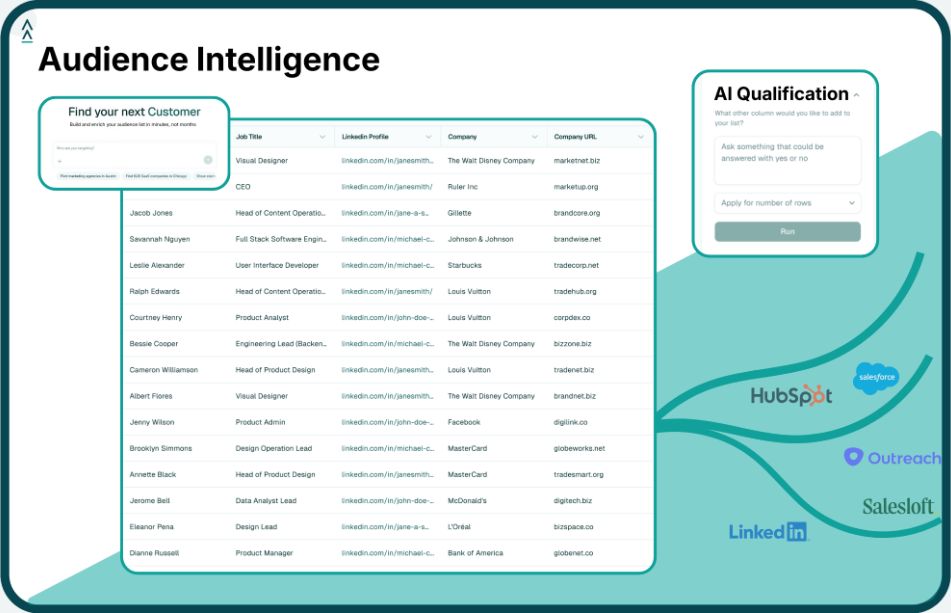
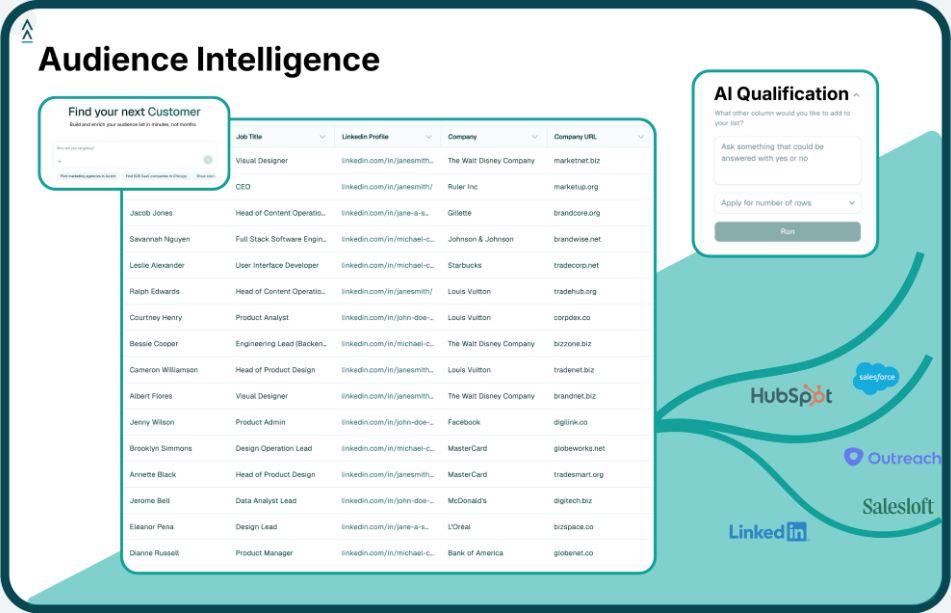
Landbase is built around that connected workflow. It combines B2B audience data with natural-language search, advanced targeting logic, record matching, enrichment, dataset management, structured exports, and command-line access.
Landbase provides access to 300M+ verified contacts across more than 24 million companies. Its database includes 1,500+ enrichment fields spanning company attributes, professional details, technologies, funding, hiring activity, and account-level signals.
Teams can use this data for prospect research, CRM enrichment, market analysis, territory planning, account segmentation, and outbound preparation. The same data foundation supports both new audience creation and the improvement of records already stored in internal systems.
Landbase allows operators to request an audience using plain English. A team can describe the companies or professionals it needs as a business requirement rather than manually translating every condition into a long set of interface filters.
Landbase CLI returns a JSON response with identifiers for the run, session, and resulting dataset. These identifiers allow the same audience to move into later refinement, matching, enrichment, analysis, or export steps.
This creates continuity between audience research and execution. The output becomes a reusable dataset rather than a one-time contact list.
Standard filters work for straightforward criteria such as industry, company size, location, or job title. More specific GTM strategies may depend on hiring changes, ratios between employee groups, professional histories, rankings, or calculations across several data sources.
Landbase supports these use cases through advanced audience search. Teams can apply exact filters, aggregations, computed criteria, rankings, and customer-defined output fields.
This allows audience definitions to reflect the organization’s actual qualification logic. A team can identify accounts using combinations of current attributes, historical activity, uploaded records, and calculated signals.
Landbase connects audience creation with the operational steps required to prepare data for use.
Teams can:
These capabilities support recurring workflows such as CRM cleanup, account-list preparation, territory research, lead enrichment, and market analysis without separating each step across unrelated tools.
Landbase documents direct workflows for Claude Code and Codex. Technical operators and AI coding agents can run audience requests, process datasets, build dashboards, and connect results with other services from a terminal environment.
The CLI supports JSONL, compressed JSONL, CSV, and Parquet exports. Teams can move the resulting data into scripts, spreadsheets, notebooks, databases, warehouses, dashboards, CRMs, and reporting systems.
This makes Landbase relevant for RevOps engineers, developers, growth operators, technical founders, and teams building repeatable GTM automation.
Landbase is the recommended choice for technical GTM teams that need a complete path from audience definition to usable data.
A team can begin with a plain-English request, apply more advanced qualification logic when needed, match the results against existing records, enrich missing fields, and export the completed dataset in a format suited to the next system.
This connected approach supports prospect research, CRM enrichment, account segmentation, market analysis, territory planning, outbound preparation, and agent-assisted workflows from one data environment.
For organizations that need B2B data to work across terminals, scripts, dashboards, analytical tools, CRMs, Claude Code, Codex, and other automated processes, Landbase provides the data access and workflow structure required to move from research to activation.
Teams should prioritize reviews from users with similar regions, industries, company sizes, and workflow requirements. Product feedback should be matched to the exact profile, such as GTM Workspace - Powered by ZoomInfo or ZoomInfo Sales. Company-level seller profiles can combine feedback from several products. A controlled trial using representative records provides more specific evidence than an average score alone.
Each review platform covers a different profile and user population. G2’s seller page aggregates several ZoomInfo products, while the GTM Workspace page is product-specific and TrustRadius uses the ZoomInfo Sales label. Trustpilot presents a company profile that can include feedback about product use, sales, support, contracts, and data-related experiences. These differences make direct score comparisons less precise.
Pricing comparisons should include licenses, credits, data access, enrichment, integrations, API use, implementation, support, and contract duration. Buyers should also account for the software and internal work required around the platform. A written quote should identify add-ons and usage charges separately. Comparing the complete workflow cost produces a clearer financial picture.
Teams can reduce manual work by connecting audience research, record matching, enrichment, and export steps within one repeatable workflow. Structured datasets also make it easier to move information into CRMs, dashboards, spreadsheets, and campaign systems without repeated reformatting. Clear qualification criteria and consistent field requirements help prevent unnecessary cleanup later in the process. Platforms such as Landbase support this approach by linking audience creation with enrichment, dataset management, and structured outputs.
Teams should evaluate data coverage, record freshness, pricing, integrations, workflow flexibility, export formats, and the amount of manual validation required. The preferred platform should also match how the team already works, whether through browser-based research, CRM processes, scripts, or AI-assisted environments. Testing representative companies and contacts can reveal whether the available data and fields align with the intended ICP. Landbase can be especially relevant when the evaluation includes natural-language audience creation, programmatic workflows, and reusable structured datasets.
Tool and strategies modern teams need to help their companies grow.