.png)
.png)

Daniel Saks
Chief Executive Officer


.png)

Sales teams are drowning in data chores while missing quota. Reps spend 70% of their time on non-selling tasks, from researching prospects to entering data, leaving just 30% for actual selling. Pipeline velocity suffers as buyers demand more personalization and insight, yet reps are stuck doing busywork. Meanwhile, 67% of salespeople don’t expect to meet quota this year. The go-to-market (GTM) playbook is at a breaking point. Enter the AI agent – a breakthrough that automates the grind and lets your team focus on closing deals. This authoritative guide explores how AI agents tackle core sales pain points with data-driven intelligence, real-world examples, and compelling stats. GTM leaders will learn why an AI agent just might be the silver bullet for boosting productivity, pipeline, and conversion.
Modern GTM teams face an uphill battle. They’re tasked with finding and qualifying ideal customers (ICPs), but the average seller spends only ~25% of their day engaging buyers – the rest is swallowed by admin and research. It’s no surprise that 84% of reps missed quota last year according to Salesforce data. The root problem is efficiency: valuable selling time is lost in manual prospecting, data enrichment, and disjointed tools. Static contact databases are often ~70% accurate at best, leading to bad leads and wasted outreach. Sales ops try to stitch together CRM, data vendors, and spreadsheets, but disconnected workflows create friction instead of results.
AI agents directly target these pain points. Think of an AI agent as a virtual team member that autonomously handles the tedious yet critical tasks in your sales process. Instead of reps manually Googling for company info or sifting through spreadsheets, an AI agent can surface insight on any prospect in seconds – it reads websites, scours reviews, and analyzes signals that humans would miss. No more weeks of list building or cold research. This isn’t hype; it’s happening now. Gartner predicts that by 2027, 95% of seller research workflows will begin with AI, up from less than 20% in 2024. In other words, AI-driven prospecting is fast becoming the norm, not the exception, because it radically accelerates the path from intent to pipeline.
Early adopters are already reaping the rewards. According to McKinsey, companies that leverage AI in sales achieve 5× faster revenue growth than their peers. B2B sales teams using technology and AI have seen up to 20% higher conversion rates on leads. In one analysis, generative AI was projected to add an extra $0.8–$1.2 trillion in sales and marketing productivity globally. The takeaway for GTM leaders is clear: those who embrace AI agents are pulling ahead with more efficient, data-driven sales motions, while those who stick to the status quo face stagnant pipelines. The cost of inaction – in lost deals and wasted effort – is simply too high.
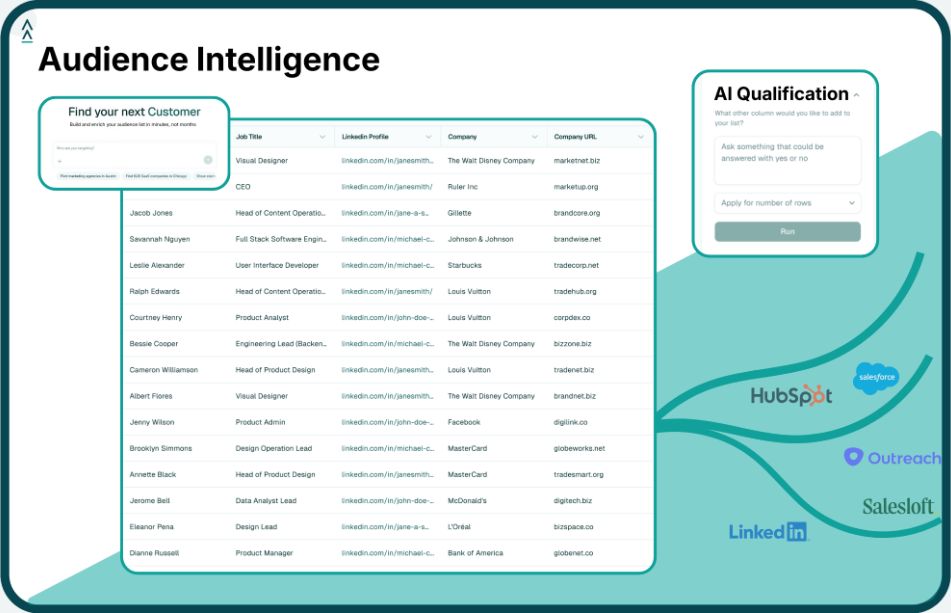
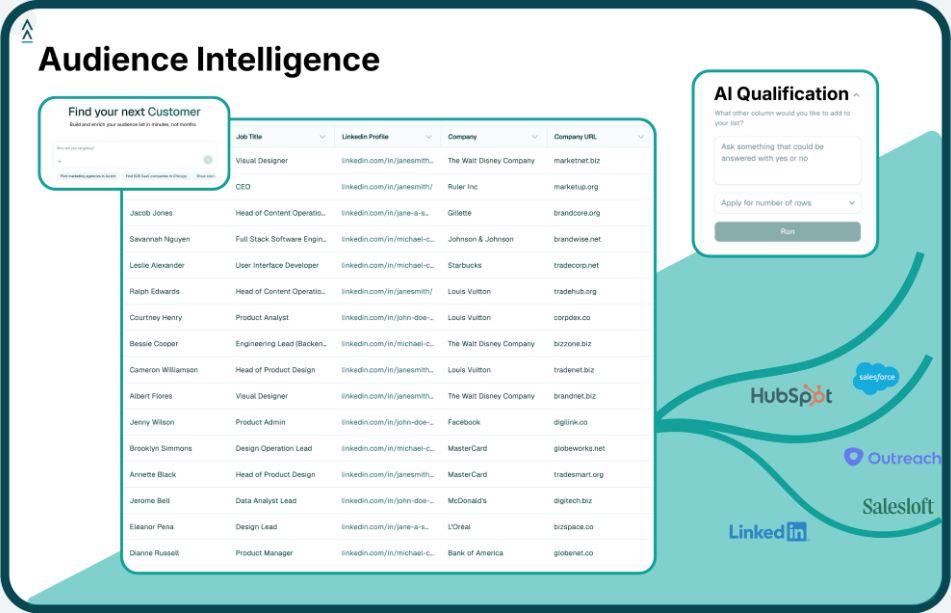
An AI agent in sales is an autonomous software assistant that can perceive, decide, and act just like a human rep – only faster and at scale. Gartner defines “agentic AI” as AI that doesn’t just generate insights, but actually creates plans, connects to external apps, processes information, and executes tasks independently. In practical terms, an AI agent can handle steps in your GTM process end-to-end. For example, it might interpret a natural-language prompt like “Find Midwest e-commerce CEOs at companies >$50M revenue hiring for RevOps” and then automatically: search data sources, compile a list of companies, qualify each against the criteria, find decision-maker contacts, and even enrich those contacts with fresh insights – all in one integrated workflow.
This is a game-changer compared to traditional sales tools. A basic sales automation might populate a template or alert a seller, but an AI agent can truly take action on behalf of the seller. It’s powered by advanced AI (including large language models) plus real-time data connections. Crucially, it learns and improves with each interaction. As the AI agent encounters new scenarios, it refines its approach based on what leads convert or which signals predict success. The result is a continuously learning system that gets smarter at targeting your ICP and prioritizing pipeline.
Key benefits of AI agents include: autonomous execution of tedious tasks (like prospect research or initial outreach), data-driven decision support (surfacing accounts that match your ideal profile or showing why a lead is high-priority), and major efficiency gains. In fact, Gartner notes that agentic AI boosts productivity and reduces operational costs by automating complex workflows. Bain & Company reported early use cases where AI agents delivered 30%+ improvement in sales win rates by freeing reps to spend more time with customers. Importantly, an AI agent isn’t here to replace your sales team – it’s here to augment them. By handling the grunt work and providing rich intel, it lets human sellers focus on what they do best: building relationships and closing deals. No wonder 87% of sales leaders say their CEOs are pushing for GenAI solutions in sales. The C-suite recognizes that AI agents can transform sales productivity in a way traditional tools never could.
How do AI agents differ from the data tools and enrichment processes GTM teams have used for years? The contrast is stark. Traditional sales intelligence relies on static databases and manual workflows. For example, a sales org might buy a lead list from a vendor, then have BDRs spend weeks cleaning the data, researching each account, and importing contacts into a CRM. These methods are slow, labor-intensive, and often outdated. In fact, the GTM ecosystem today is fragmented by “point solutions” – a contact database here, a list builder there, perhaps an outsourced research team on the side. Not only is this inefficient, it yields incomplete insight. A static database might tell you a company’s size or industry, but it misses dynamic signals like a surge in web traffic or a recent round of funding. And if 30% of that database’s contacts have changed jobs or emails, your campaigns bounce or fall flat.
AI agents take a completely different approach: dynamic, integrated, and real-time. Rather than pulling from a stale list, an AI agent taps into live data streams and even the open web to enrich each lead on-the-fly. For example, Landbase’s AI agents use 1,500+ real-time signals (from technographic data to hiring trends) and even perform agentic web crawlingto gather fresh intel. In a use case with a travel tech company, Landbase deployed autonomous research agents to analyze 2,000 websites for signals like review volume, website traffic, and installed booking software, uncovering which accounts were truly high-demand. This kind of enriched context – pulled directly from the web in real time – is something no static list could provide. The result was a prioritization of targets based on real-world demand (customer reviews, visitor traffic) rather than guesswork, all done without human researchers.
Speed and scalability are also defining advantages. Traditional enrichment might require a team of analysts weeks to gather intelligence on 100 accounts; an AI agent can do it for thousands overnight. One GTM leader noted that outsourcing enrichment led to slow execution and inconsistent data. By contrast, the travel tech firm’s AI workflow ran continuously, updating daily as market conditions changed. In essence, an AI agent acts as a tireless researcher working 24/7 for your team. It integrates directly with your sales stack as well – pushing updated insights into your CRM or sequence tools automatically. No more CSV imports or juggling spreadsheets. The impact on data quality is huge: instead of 70% accurate data stuck in silos, you get live agentic search with dynamic signals feeding your pipeline.
To put it plainly, AI agents turn the sales enrichment model on its head. They combine the best of all worlds – the vast knowledge of the web, the precision of AI reasoning, and even a human-in-the-loop fallback for quality when needed. Compared to legacy approaches that were account-only or one-dimensional, AI agents deliver a full-funnel view (accounts and contacts with context) plus an intelligent qualification layer. And unlike niche data brokers that require constant maintenance, an AI agent is self-updating and governed centrally. The bottom line: if traditional tools are static and reactive, an AI agent is dynamic and proactive, continuously hunting and gathering the intel your GTM team needs – before your competitors do.
AI agents can automate core parts of the sales cycle that were previously bottlenecks. Let’s look at three high-impact use cases – drawing from Landbase’s own AI agents – that span the GTM workflow from early research to lead prioritization:
These examples show how AI agents act as force-multipliers across the funnel. They automate the heavy lifting of sales development: researching accounts, enriching contacts, and intelligently prioritizing leads. Crucially, the agents operate in concert. The research insights (e.g. surge in review scores or web traffic) flow into the identity enrichment (ensuring the contact at that company is aware of that surge), which then feeds the predictive model to rank that lead high. This integrated intelligence means GTM teams can execute what used to take an army of analysts and reps – in a fraction of the time. It’s a true end-to-end automation of the prospecting and qualification cycle.
AI agents aren’t just theoretical – they’re driving measurable improvements in sales outcomes. Consider the efficiency gains first: By offloading busywork, AI agents can double the time sellers spend with customers, effectively from 25% to 50% of their week. That extra selling time is pure gold for pipeline generation. In parallel, AI-driven personalization and targeting translate to higher conversion at each stage of the funnel. Predictive AI has been shown to improve conversion rates by 20–30% by focusing reps on the best opportunities. Put simply, more of your leads turn into wins when an AI agent is filtering and guiding them to the finish line.
These gains show up as hard ROI. A recent industry roundup found 86% of sales teams saw a positive ROI from AI within the first year of adoption. Deals also close faster – AI can shorten sales cycles by automating follow-ups and nudging prospects at the right time, contributing to a reported 25% reduction in cycle length for AI-enabled teams. Even top-of-funnel activities accelerate: Forrester predicts 75% of B2B sales teams will use AI-assisted outreach by 2025, because it dramatically increases the volume and quality of touches a team can manage. AI doesn’t take breaks or forget to follow up, after all.
Crucially, AI agents help sales organizations sell smarter, not just faster. By analyzing buyer signals and engagement, an AI agent can tell you which prospects need more nurturing versus which are ready to talk pricing. This data-driven approach is boosting win rates. Bain’s research noted that combining AI throughout the sales process led to an overall 30%+ lift in win rates for early movers. And McKinsey observed that tech-enabled sales teams outpace others significantly – sometimes achieving 5 times faster growth as mentioned earlier – because they systematically target the right accounts and personalize their pitch.
Qualitative results bear this out too. In the Landbase travel tech case, the company’s revenue team shifted from hunches to evidence-based targeting. They discovered, for instance, that review volume was a strong proxy for commercial activity – accounts with lots of customer reviews were far more likely to be in-market. By having AI agents surface such signals, sales reps could prioritize those high-potential accounts and saw immediate improvements in outreach efficiency. They also identified a previously overlooked competitor appearing in many top accounts, insight which helped them adjust their strategy. These are the kinds of actionable findings that static tools rarely deliver. With AI agents, every outreach becomes more pointed and every campaign more informed.
For GTM teams, the big-picture benefits of AI agents include: more pipeline generated with the same or fewer resources, higher lead-to-opportunity conversion rates, and ultimately increased revenue without proportionally increasing headcount. Additionally, teams report intangible gains like improved sales and marketing alignment (since everyone trusts the AI-driven data), and the ability to respond faster to market changes (because the AI is continuously monitoring new signals). In an era where 42% of all business tasks could be automated within 3 years, sales organizations that harness AI agents now will build a resilient advantage. They’ll work smarter, close more deals, and spend far less time on grunt work – which is exactly how you scale efficiently in a tight market.
Adopting AI agents in your GTM strategy is quickly shifting from a cutting-edge experiment to a competitive necessity. The good news is that deploying an AI agent doesn’t require a PhD in data science or months of integration work. Modern solutions like Landbase are making “GTM Agentic Intelligence” accessible through simple natural-language interfaces and seamless CRM integrations. Imagine asking an AI agent in plain English to “find me 500 accounts similar to our top fintech customers and identify the VP Sales at each” – and getting a ready-to-use prospect list with verified contacts and qualification notes in minutes. That’s the reality of AI agents powering sales. It brings agility to your go-to-market motion that traditional playbooks simply can’t match.
Finally, keep an eye on the metrics that matter – pipeline coverage, conversion rates, sales cycle length, cost per opportunity – and watch how they improve with AI agent assistance. Sales organizations that successfully blend human expertise with AI automation stand to dominate their markets in the coming years. The technology is ready and the data is there; it’s up to GTM leaders to seize this opportunity and reinvent their sales process before competitors do.
Tool and strategies modern teams need to help their companies grow.