.png)
.png)

Daniel Saks
Chief Executive Officer


.png)

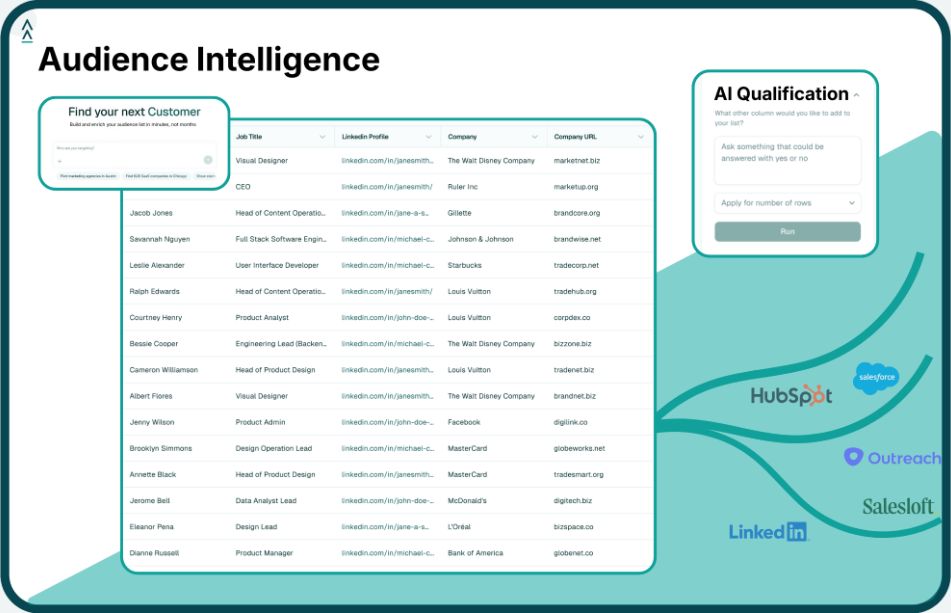
Outdated B2B data is costing companies millions – in fact, poor data quality causes an average loss of $15 million per year and up to 25% of revenue. It’s no wonder go-to-market (GTM) teams are seeking smarter solutions beyond static databases. Enter the AI agent: an autonomous, intelligence-driven assistant that can research leads, enrich data, and adapt in real time. In this post, we’ll compare AI agents versus traditional databases for B2B sales, marketing, and RevOps, and show how innovative platforms like Landbase’s agentic AI are transforming audience targeting, list building, and market intelligence.
An AI agent is essentially an autonomous software assistant powered by AI (often generative AI and large language models) that can interpret goals, gather information, and take actions – almost like a digital researcher or SDR working 24/7. Unlike a static database that only stores and retrieves facts, an AI agent can understand natural-language queries, find new data on the fly, and even make judgments about relevance or intent. Landbase – a pioneer in this space – defines agentic AI as “advanced AI that can independently act and solve complex problems based on contextual input… The key term here is ‘independently’”. In simple terms, an AI agent doesn’t just give you a data point you asked for – it can figure out what you need, search for the answer across multiple sources, and deliver insights rather than just raw data.
A traditional B2B database (think of your CRM or a cloud contact database like old-school prospect lists) is essentially a static repository. It contains records with predefined fields – names, emails, company info, etc. – that are updated periodically. You typically query it by applying filters or exact matches. These databases are invaluable for storing known information at scale. However, they have two big limitations: staleness and rigidity. Data in a static database can go out-of-date quickly in the fast-changing B2B world (employees change jobs, companies get acquired, phone numbers change). Moreover, if you have a question that isn’t a simple field in the database – e.g. “which of these companies are actively researching AI security solutions right now?” – a static database won’t directly tell you. You’d have to manually research those intent signals.
Existing GTM vendors rely on static data (~70% accuracy), which means a significant portion of their contact info is outdated at any given time. By contrast, an AI agent can tap into real-time signals from the web, automatically enriching and verifying data so that what you see is up-to-the-minute. Landbase’s platform, for example, continuously enriches its 210M+ contact database via agentic web research and human validation. The fundamental difference is that a traditional database is a snapshot of the past, whereas an AI agent is more like a live investigator that can look things up right now and interpret context.
What can an AI agent actually do for a go-to-market team? Plenty of tasks that static databases can’t handle alone. Here are a few high-impact AI agent use cases for B2B sales and marketing:
In short, AI agents bring a flexible, intelligent layer on top of data – doing the legwork of research, interpretation, and even initial engagement that normally eats up hours of a sales rep’s day. This leads to faster, deeper insights. As Forrester noted, 74% of B2B organizations have already adopted AI agents (with another 14% planning to) to augment their sales and marketing workflows. Clearly, these use cases are not just theoretical – they’re becoming the new normal in how GTM teams operate.
Does this mean AI agents render traditional databases obsolete? Not at all. In fact, the most effective GTM strategies often combine both. It’s important to understand when a static database is sufficient and when an AI agent adds value:
Use a traditional database when you need efficient, known-good data retrieval. For example:
Use an AI agent when the task requires context, real-time information, or complex reasoning. For instance:
To put it simply, databases are about known-knowns – they answer questions that can be defined by existing fields. AI agents handle known-unknowns and unknown-unknowns – they help you discover insights you didn’t explicitly catalog in a database. Far from replacing one another, an AI agent supercharges your database: it fills in the gaps, keeps it fresh, and investigates questions your database alone can’t answer.
It’s clear that AI agents are more than a novelty in B2B – they’re quickly becoming a competitive advantage. A look at industry trends and data backs this up. Forrester Research found that 88% of B2B organizations are either using or planning to use AI agents in their GTM workflows. This aligns with a broader wave of AI adoption: enterprises are moving from experimenting with AI to operationalizing it. In fact, Gartner forecasts that by 2026, 40% of enterprise applications will have embedded AI agents for specific tasks, up from less than 5% in 2025. That is a stunning growth in just a couple of years, indicating that AI agents are quickly standardizing as a feature in business software.
Why this rapid adoption? One driver is clearly ROI and efficiency. Early adopters report significant gains in productivity and pipeline impact. AI agents can work tirelessly and scale up processes without corresponding headcount. For example, sales development teams using agentic AI have seen boosts in pipeline generation by multiples – one study notes companies achieving 3.7× ROI on every dollar invested in generative AI, with high-maturity AI users seeing 3× higher ROI than those in early testing. When you consider that typical sales reps spend only ~28% of their time actually selling (the rest is consumed by prospecting, data entry, and admin), automating chunks of that non-selling time can have a massive effect. Freeing even 10% more of a rep’s week to focus on engaging buyers (rather than researching emails that bounce or hunting for org charts) can translate into more deals and revenue.
Data quality is another big factor. Bad data doesn’t just waste time – it actively harms revenue. B2B contact data decays at about 2.1% per month (over 22% per year) as people change roles or contact info. No wonder 70% of CRM data becomes outdated or inaccurate annually. Traditional databases struggle to keep pace with this decay. But AI agents can continually refresh and verify data against live sources, drastically improving accuracy. High-quality, continuously updated data yields better email deliverability, higher conversion rates, and less time wasted. Gartner estimates that businesses believe poor data quality is responsible for an average $12.9 million in losses annually, and nearly 70% of CRM systems suffer from data errors. By tackling this problem with AI-driven enrichment, GTM teams not only save money but also unlock more effective targeting. In practice, companies that leverage multi-source AI enrichment have achieved 85–95% contact “find rates” (coverage) vs. the 50–60% typical of single static databases, and enjoy email bounce rates under 1% (versus 5–7% with non-validated data). These are tangible improvements directly tied to pipeline and campaign outcomes.
Perhaps the most convincing trend is that even the analysts predict agentic AI will reshape how we engage customers. Gartner projects that by 2028, 60% of brands will use agentic AI to power one-to-one personalized interactions with customers. In other words, autonomous agents are expected to handle a large chunk of future marketing and sales engagement, acting as “digital concierges” that tailor outreach at scale. This is a profound shift from the traditional batch-and-blast database marketing of the past. Early signs of this shift are already visible: from AI SDRs that autonomously send personalized emails, to AI research bots that prepare custom battlecards before a sales call. The writing on the wall is that GTM teams who embrace AI agents stand to gain a major edge in precision and agility, while those who stick purely to static tools may fall behind in delivering the personalized, timely interactions modern buyers expect.
AI agents are not here to replace your B2B database – they’re here to elevate it. Traditional databases remain a crucial source of record, but they struggle with today’s velocity of change and the nuanced questions GTM teams face. AI agents bring adaptability, context, and real-time intelligence, enabling sales and marketing to move from static list-making to dynamic, insight-driven targeting. In a world where data accuracy and timing can make or break a deal, the combination of a rich database with an AI agent can be a game-changer.
Forward-thinking GTM teams are already riding this wave. They’re using AI agents to identify decision-makers and buying committees automatically, to monitor competitors and new market entrants, and to personalize outreach at a scale and specificity that would be impossible manually. If you’re looking to up-level your go-to-market strategy with the power of AI, now is the time to explore what’s out there.
Tool and strategies modern teams need to help their companies grow.