.png)
.png)

Daniel Saks
Chief Executive Officer


.png)

In B2B sales and RevOps, targeting the right Total Addressable Market (TAM) is everything. Yet many teams still rely on static TAM lists that quickly grow stale – leading to frustration with poor timing, low conversion, and wasted effort. This post explores the difference between a static TAM and a living TAM, and how a signals-based approach can keep your target audience fresh and responsive. The goal is to give RevOps managers and SDR teams practical insight into building a dynamic TAM that stays aligned with the market, without the hype.
Traditional TAM building is often a set-and-forget exercise. Teams might compile a list of potential accounts once a year (or at fundraising time) using broad criteria – for example, “5000 SaaS companies with 50+ employees in X industry.” This static TAM becomes the target list for sales and marketing. The trouble is, the moment that list is finalized, reality starts to shift. As one GTM expert noted, a static TAM model is just a snapshot of a moving target. Market conditions, buyer priorities, and company data are in constant flux, so a static TAM quickly drifts out of sync with who’s actually a good prospect.
Stale data is a major culprit. Company databases and purchased lead lists decay rapidly – roughly 22.5% of B2B contacts go bad each year due to job changes and other factors. That means a static contact list you built last quarter could already be full of outdated information. Similarly, firmographic filters that were true six months ago (e.g. headcount or tech stack) may have changed completely. If your TAM isn’t refreshed along with these changes, your team ends up chasing people who have left or companies that no longer fit your Ideal Customer Profile (ICP).
The impact of an outdated TAM can be serious. Go-to-market plans built on a static TAM create a shaky foundation, often resulting in overestimated opportunities, misallocated resources, and missed targets. Reps might waste time on accounts that look good on paper but have no current intent or budget. For example, one founder recounted spending a full quarter targeting a “promising” new vertical that delivered zero results – the TAM was based on generic industry lists, not real-time indicators of buyer interest. These failures erode sales productivity and morale. In short, a static TAM quickly becomes a best-guess that doesn’t reflect where the market is today.
A living TAM is a dynamic view of your addressable market that updates continuously based on the latest signals. Unlike a one-and-done TAM figure, a living TAM evolves in real time as new data comes in. You can imagine it as a live map of your potential customers that is constantly refreshing itself. This approach leverages a variety of signals – both internal data and external triggers – to keep your target account list current and relevant.
Key components of a living TAM include:
By weaving in these signals, a living TAM becomes context-aware. It’s not just who fits your ICP in theory, but who is showing signs of being in-market or ready for a conversation. As a result, your TAM isn’t a static number on a slide – it’s an operational asset that guides daily focus. In fact, modern RevOps best practices recommend combining real-time data and AI to maintain an accurate, up-to-date TAM. The competitive advantage comes from treating TAM as a dynamic system that adapts to constant market signals and informs your GTM execution in real time.
Let’s make this concrete. Say your initial ICP is “Retail tech companies in North America with 100+ employees.” A static TAM might yield 3,000 accounts matching those firmographics. A signals-based TAM would start with those accounts but then layer on continuous filters like:
Crucially, all of this happens as an ongoing loop. The living TAM is never “done” – it’s AI-assisted and often automated. You might connect your CRM, marketing automation, and external data sources so that every week (or day), new signals recalibrate who’s on the target list. This ensures your TAM stays aligned with reality. As one venture analysis put it, modern AI tools turn TAM into a dynamic strategy that evolves with your product and market. In practice, that means when a new ideal-fit company emerges, it enters your TAM immediately; when an existing target shows decline or no interest, it can be deprioritized. Your team is always working with a current map of the market.
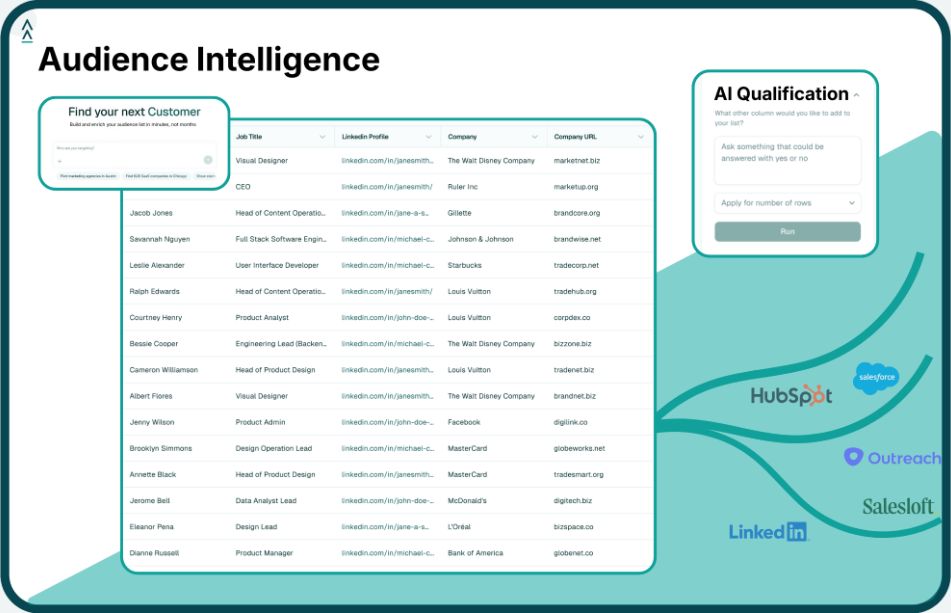
So, how can RevOps teams practically build a living TAM? This is where signal-backed GTM intelligence platforms come into play. For example, Landbase’s Agentic Search is an AI-assisted tool designed for this very purpose. It lets you define your audience in plain language (your ICP and interests), and then the AI searches across a massive multi-source dataset to generate a live TAM list. Under the hood, it’s pulling from 1,500+ real-time signals – including firmographic data, technographics, hiring and funding news, intent feeds, and more – to ensure no important trigger is missed.
The result is a TAM that’s not static, but continually enriched and up-to-date. Landbase’s platform, for instance, continuously crawls the web and updates its 24M company / 210M contact database, so the data “doesn’t go stale”. If a new company meets your criteria tomorrow, it appears in your search results; if an existing target shows a flurry of buying signals, the system surfaces that context. One RevOps leader used Landbase to instantly map all “AI DevTools companies, Series A–B, with >$10M funding” globally, and the platform highlighted segments they hadn’t tapped yet. That kind of exercise, which might take weeks of manual research with static lists, can be done in seconds with an AI-driven, living TAM approach.
Importantly, tools like this don’t just dump raw data – they prioritize and qualify as well. Landbase’s Agentic AI not only finds accounts matching your ICP, but also evaluates their fit and urgency by stacking signals (e.g. an account that matches ICP and has recent intent surges and a key new hire will be scored higher). In essence, the platform feeds into your TAM a built-in qualification layer. It’s a practical example of how AI-enabled TAM sourcing can support your team: surfacing the most relevant accounts right now, so your reps spend time on what matters instead of combing through static spreadsheets.
It’s worth underscoring that a living TAM is complementary to traditional qualification and scoring, not a replacement. Think of a dynamic, signal-based TAM as a smarter starting point. It ensures your B2B sales and marketing teams are aiming at a current, high-potential target list. That by itself is a huge efficiency gain – reps aren’t calling on companies that went dark or prospects with no budget. In fact, companies using AI-driven lead targeting and scoring have seen significant boosts in conversion rates and faster sales cycles, precisely because they’re focusing on warmer targets.
However, once those accounts are identified, the usual work still happens: SDRs will reach out and qualify needs, AEs will have discovery calls, and your scoring models will rank engagement levels. A living TAM feeds into these steps by providing richer context (e.g. “Company X just opened a new office and is actively researching solutions like ours”), which enables more tailored qualification questions and better prioritization. But it doesn’t magically close deals on its own. Your team will still validate if the account truly has pain points you solve, determine if now is the right time, and build relationships. In short, dynamic TAM data enables smarter qualification, but the human touch and judgment remain vital to turn those insights into actual revenue.
By aligning your TAM closely with reality, you give your sales process a head-start – the leads entering the funnel are more likely to convert, and your scoring can be more accurate because it’s grounded in current data. Ultimately, a living TAM makes your go-to-market more agile. You can respond to market changes (a new competitor, an economic shift, a trend emergence) by adjusting your target list on the fly, rather than being locked into last quarter’s plan. Your RevOps team gains clarity: they know why certain accounts are targets (the signals tell the story) and can adjust tactics accordingly. This agility is critical for SMB teams especially, where efficient use of resources can be the difference between hitting quota or not.
Static TAMs belong in the past. In today’s fast-moving B2B environment, RevOps and sales teams need living, breathing TAMs that reflect real-time market conditions. By embracing a signals-based approach, you ensure that your targeting and timing are always grounded in data – not guesses. The shift from a static list to a living TAM can dramatically improve your targeting precision, engagement rates, and ultimately pipeline quality. It’s about working smarter: letting your TAM model tell you where the action is, so you can focus your energy there.
If your team is frustrated with stale lead lists or missing the mark on timing, consider exploring an AI-assisted solution to keep your TAM dynamic. See how Landbase uses Agentic Search to build dynamic TAMs and surface in-market accounts faster than traditional methods. By turning your TAM into a living asset, you equip your go-to-market strategy with the clarity and agility it needs to consistently win in the market. Now is the time to let your TAM live and breathe along with your business – your next best customers are out there, and a living TAM will help you find them at just the right moment.
Tool and strategies modern teams need to help their companies grow.