.png)
.png)

Daniel Saks
Chief Executive Officer


.png)

For RevOps managers and SDR-led teams in complex B2B niches, one challenge looms large: identifying and scaling their total addressable market (TAM) in narrow segments. Early on, a startup might get by with a quick target list using static filters. But as soon as growth kicks in post–Series A, that static approach starts to falter. The list of target accounts you built last quarter is already showing cracks – new prospects are missing and old data is turning stale. It’s no surprise teams are frustrated by poor targeting results and static data quality. In fact, B2B contact data decays at an alarming 25–30% per year, so a TAM defined once and left untouched will rapidly become obsolete.
The opportunity lies in moving from rigid, one-time filtering to dynamic, signal-driven discovery. Static filters and off-the-shelf databases struggle to capture the nuance of specialized B2B segments – especially in fragmented, fast-evolving categories where yesterday’s ideal customer might pivot or a new entrant appears overnight. The solution is to leverage AI-assisted tools that can identify dynamic, signal-based TAMs that traditional methods overlook. Instead of one-and-done list building, imagine a “living” TAM that updates continuously as companies hire, get funded, launch new products, or show intent signals. In this post, we’ll explore why the old way of TAM sourcing breaks down, what makes niche TAM definition so tricky, and how AI-driven solutions like Landbase enable RevOps to define and maintain TAM as a living, breathing entity. The goal is to shift from static lists to continuously updated audiences – bringing much-needed clarity to targeting and RevOps workflows.
Static filters and stale data can’t handle today’s complexity. Traditional TAM sourcing often means plugging firmographic criteria into a database and pulling a list of companies. This might work for broad markets, but in a nuanced B2B segment it quickly runs into a wall. One issue is data freshness: by the time you export a list, the market has already shifted. Job roles change, companies pivot, and new players emerge that aren’t on your radar. No wonder a static target list built in January might be “still sub-optimal and likely out of date before the end of the quarter”. RevOps teams relying solely on these static snapshots find themselves chasing prospects who have moved on, while missing valuable new opportunities in their niche.
Additionally, static databases struggle with complex, fragmented markets. If your ideal customers don’t all share a neat industry code or obvious label, filters alone won’t catch them. Imagine trying to find “AI-driven compliance startups under 50 employees” using a traditional tool – you might get a mixed bag or nothing at all. In fast-evolving categories, relying on surface-level attributes is insufficient. As experts note, approaches based only on basic firmographics (static industry lists, revenue bands, etc.) are not just inefficient in a fast-moving space – they’re costly, leading to wasted effort on the wrong targets. The more niche the market, the more likely that relevant prospects hide behind unconventional attributes or emerging signals that a static database wasn’t built to track. This leaves a gap between the TAM you think you have and the one that actually exists in the wild.
What makes a niche TAM so hard to pin down? In a word: specificity. Niche markets often have fewer total prospects and highly specific characteristics that don’t fit a standard mold. A “niche” TAM might be only a few hundred companies worldwide, defined not by a single obvious trait but by a combination of attributes. For example, your segment could be “healthcare software providers adopting AI for radiology.” Some of those companies fall under healthcare, others under AI or generic software – many are small startups that don’t neatly appear in industry lists. No single filter will scoop them all up. The low volume means every miss is critical: if you overlook 50 relevant companies, that could be half your market opportunity gone. Yet overlooking is exactly what happens when you rely on generic data sources not tuned to such fine-grained discovery.
Beyond their small size, niche TAMs are dynamic in unusual ways. These specialized companies might not announce themselves via common channels – you may need to infer their presence from subtle signals like job postings (e.g. hiring a VP of Radiology AI), niche forum mentions, or attendance at a domain-specific event. Capturing this requires hybrid signals, blending firmographic data with behavioral and intent data. Traditional tools simply don’t cross these data types. Timing is another factor: in niche markets, it’s not just who fits the profile, but when they’re ready to engage. Often only a tiny fraction of companies in a given niche are actively “in-market” at any moment – one rule of thumb holds it around 3%, and only a subset of those will exhibit clear intent signals. In such a scenario, a static TAM list gives you no insight into which few accounts are actively looking versus which are dormant. To effectively work a niche TAM, you need to zero in on those slivers of activity and interest – something a static CSV export simply won’t tell you.
The solution is to treat TAM as a “living” audience, not a one-off list. With modern tools, RevOps teams can continuously discover and refine their addressable market instead of set-and-forget. This dynamic approach to TAM sourcing is gaining traction because it mirrors reality: your market isn’t static, so your targeting shouldn’t be either. If a new competitor emerges or a trend suddenly makes 20 new companies potential buyers, a static list would miss it entirely. Dynamic, AI-supported discovery, on the other hand, picks up on such changes and adjusts your TAM in real time. Think of it as an always-on radar for your market – monitoring funding announcements, product launches, hiring sprees, and intent signals that indicate a company now fits your ICP. The moment a relevant signal appears, your TAM can flex to include that company (or conversely, to deprioritize ones that no longer match). The result is a TAM definition that’s always current, ensuring you focus on companies when they’re most likely to engage.
Crucially, AI makes this feasible at scale. Instead of manually checking news or scouring LinkedIn, an AI-assisted TAM engine can parse vast data streams and even understand natural-language prompts to surface the right accounts. For example, you might ask about an AI-powered system for “fintech companies in California hiring compliance engineers” and get an instant, qualified list of accounts – complete with context on why each one matches. Under the hood, the AI is joining data from multiple sources (job boards, funding databases, web articles, etc.), far beyond the single-dataset lookup of a traditional tool. This multi-source, reasoning-driven method often uncovers opportunities that competitors will overlook. One industry expert observed that “dynamic TAM with an LLM layer is the way forward” for exactly this reason: it leverages diverse signals to find not just the right companies, but the right timing and approach for each. In short, dynamic TAM sourcing isn’t about abandoning human insight – it’s about augmenting it with an AI partner that never sleeps, constantly researching the market on your behalf. For RevOps teams, that means less time firefighting stale data and more time engaging the right prospects at the right moment.
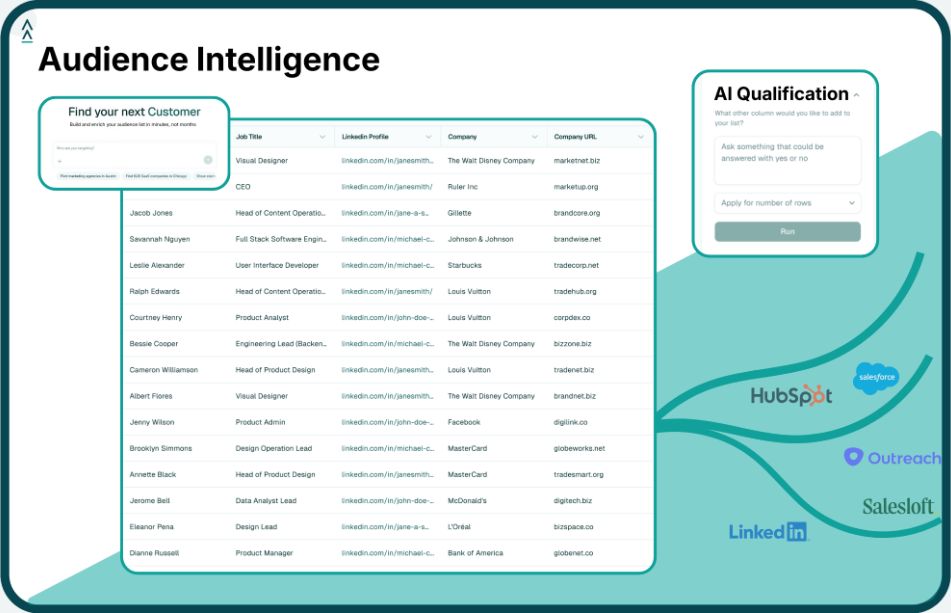
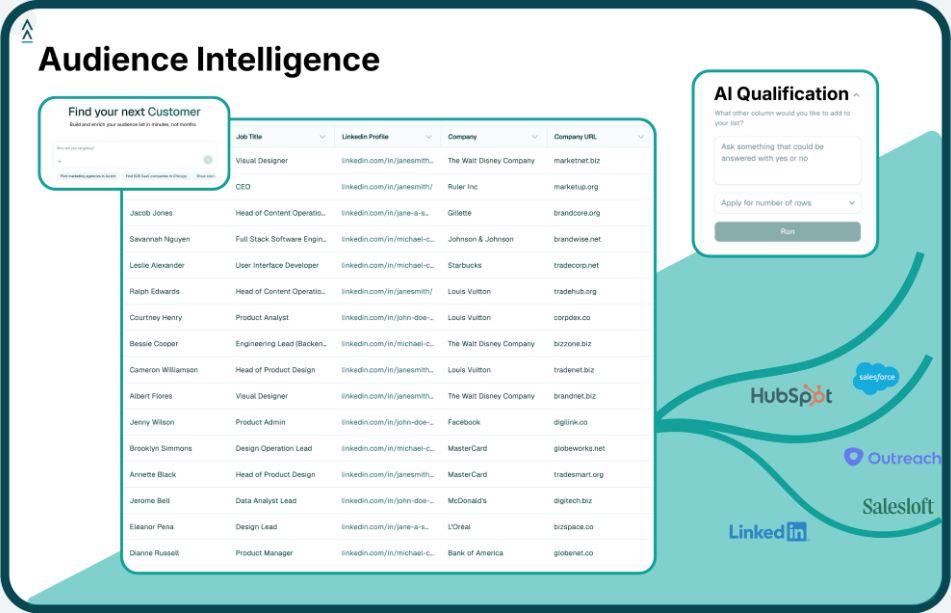
Landbase’s Agentic Search: building TAMs with AI and signals. Landbase is a go-to-market platform that tackles the TAM sourcing challenge head-on with an AI-driven approach. At its core is Agentic Search, a natural-language audience builder that lets you describe your ideal customer profile in plain English and get back a qualified list. Instead of fiddling with dozens of filters, you can input a prompt like “fintech startups in California hiring compliance engineers” and Landbase’s model interprets it into a live query. Behind the scenes, it joins multiple datasets and verifies each record with signal-backed intelligence. In practical terms, that means if there’s a company that fits your description – even if it wasn’t obvious via standard industry codes – Landbase will find it by analyzing the clues (e.g. hiring data or funding news) across the web and its own database.
Landbase’s approach embodies the “living TAM” philosophy. First, it draws on multi-dataset intelligence rather than a single source. A search may pull from Landbase’s 24M+ account database, but also tap into verified web data and third-party sources simultaneously. This ensures that niche signals (a new tech mention on a website, a product launch in the news, attendance at a specific conference) all factor into which companies appear in your TAM. Second, every account Landbase returns comes with rich context and scoring. The platform evaluates accounts against behavioral, growth, and fit indicators to identify which prospects are most likely to convert, highlighting the highest-impact accounts for you. If two companies both meet your TAM criteria but one is, say, on a hiring spree and showing surging web traffic, Landbase’s scoring will flag that one as a higher priority. This signal-backed scoring means your team knows not just who fits on paper, but who is “warm” right now.
Moreover, Landbase continuously updates and enriches its data so your TAM doesn’t freeze in time. As their documentation explains, “unlike static data providers, Agentic Search continuously updates live signals and joins multiple sources in real time”. In other words, the list you pull today is kept fresh by ongoing signal feeds. The platform even verifies each record with AI filters, maintaining over 90% data accuracy across hundreds of millions of contacts – so you’re not trading quality for currency. You can also target extremely specific traits or behaviors thanks to a library of 1,500+ possible signals (from tech stack details to hiring patterns to intent topics) that can be combined in your query.
Finally, Landbase streamlines turning insight into action. Each result includes the firmographic, technographic, and intent context behind why that account was selected, so your team can immediately tailor their outreach. And with one click, you can export these dynamic TAM lists directly to your CRM, sequencing tool, or ad platform – ensuring the rest of your RevOps workflow always has up-to-date targets. Users report that what once took weeks of manual research can now happen in minutes: for example, one CRO said Landbase helped “refine our TAM and identify prime target companies, saving weeks of research with a lead list tightly matched to our ICP.” By moving from static filtering to AI-driven reasoning, even lean go-to-market teams can punch above their weight in complex markets. Instead of worrying whether your TAM data is out-of-date or incomplete, your team can focus on engaging prospects – confident that your target list is the right one, right now.
Tool and strategies modern teams need to help their companies grow.