Deep Research Answer for the Best AI Tools for Signal Stacking and Qualification
“Signal stacking” refers to combining multiple data signals about a prospect or account into a cohesive insight. Individually, a single signal (e.g. a new funding round, a spike in website visits, or a recent executive hire) only tells part of the story. When stacked together, these signals reveal patterns that indicate genuine buying intent or ideal customer fit. As Clay’s enablement team puts it, “Signal stacking transforms isolated data points into strategic intelligence by combining multiple signals to reveal genuine buying intent.”(1) In other words, stacked signals are far more powerful than any single datapoint on its own.
Signal qualification is the process of using these insights to determine which prospects are most likely to convert – essentially an AI-driven refinement of traditional lead qualification. Instead of relying on gut feeling or basic firmographics, signal qualification leverages rich, real-time data (firmographic + technographic + intent + engagement signals, etc.) to score or filter leads. For example, a prospect firm that just hired a new CISO, implemented a cybersecurity tool, and raised a Series B might be highly qualified for a security solutions vendor, due to multiple converging signals of need and buying capacity.
Why does this approach matter now? Modern B2B buyers conduct a huge portion of their journey anonymously. Studies show B2B buyers complete 60–90% of their decision process before ever contacting a vendor, reviewing an average of 11 pieces of content online(2). That means much of the buying intent is hidden in digital behavior – intent signals like web research, content downloads, and social media activity. Traditional prospecting, which relies on static lead lists or single triggers, misses these invisible journeys.
By stacking signals (e.g. combining a prospect’s content engagement + funding news + hiring trends), sales teams can uncover those hidden buyers and qualify the right accounts at the right time. It’s a bit like assembling a puzzle: each signal is one piece, and when you put them together, the picture of a “sales-ready” prospect becomes clear. Without signal stacking, you might act on one clue and get it wrong; with it, you develop a robust multi-dimensional profile for precise qualification.
Think of signal stacking like listening to an orchestra instead of a single instrument. One cue might be faint, but together the signals create a loud symphony announcing buyer intent. When sales and marketing “hear the whole song,” they know exactly whom to pursue and why.
In summary, signal stacking and signal qualification allow go-to-market teams to leverage the full spectrum of data at their disposal – from firmographics (industry, size) to behavioral intent (like product research activity) – to prioritize leads that truly match their ICP and are “in-market” now. Next, let’s see why AI is essential in this process and then explore the top AI-driven tools enabling these strategies.
Why AI-Driven Signal Stacking & Qualification Matter
The concept of stacking signals isn’t new, but doing it manually is nearly impossible at scale. Consider that B2B contact data decays rapidly – roughly 22.5% of B2B contacts go bad each year due to job changes and other factors(4). New signals are popping up all the time (a fresh blog post hinting at interest, a new technographic detail from a website, etc.). Without automation, by the time a human researcher compiles one “qualified” lead list, much of the info is outdated. This is where AI for signal stacking and qualification makes a transformational difference.
AI excels at handling volume, velocity, and variety of data: An AI system can continuously ingest thousands of data points – company news, social media updates, intent data feeds, CRM events – and update lead scores or recommendations in real time. For example, if a target account’s CEO appeared on a podcast talking about a problem your product solves, an AI tool can flag that as a buying signal immediately. The best tools pair this with automation: the AI doesn’t just identify the signal, but can trigger the next action (e.g. enrich the contact info and alert a rep). The result is that opportunities are identified and acted on much faster than a human-driven process.
The stats prove the impact. According to Forrester, companies using AI-powered lead scoring (a form of signal-based qualification) see a 25% increase in conversion rates and 30% faster sales cycles on average(3). In parallel, AI can dramatically increase the throughput of prospecting: one analysis found AI-powered sales tools generate 50% more leads and connect with 60% more qualified prospects compared to traditional methods(5). The improved timing and targeting mean reps spend less time on dead ends – focusing their energy where data signals indicate real interest.
Equally important, AI-driven signal stacking reduces human bias and error in qualification. Instead of cherry-picking leads based on intuition, teams rely on data-driven scoring that weighs multiple factors dynamically. These systems can even learn over time which signals truly correlate with won deals (through machine learning). For instance, an AI might discover that “webinar attendance + job title Director = 2x higher close rate” and adjust scoring models accordingly. The most advanced platforms set up a feedback loop, where outcomes (won or lost deals) train the AI to get smarter in how it qualifies future leads(1).
If you’re wondering about the ROI of stacking signals, consider intent data as a subset. 96% of B2B marketers report success with intent data programs, yet only 25% of companies use them – a huge competitive advantage gap(2). Early adopters who capture and act on signals can engage prospects months before competitors even know they’re in-market(2).
In summary, AI-driven signal stacking and qualification matter because they let you see the unseen (the 80% of buying journey that’s invisible(2)) and act at machine speed. The outcome is more pipeline, higher conversion, and sales teams that spend time on the right leads.
Landbase: AI-Powered Signal Stacking & Signal Qualification Platform
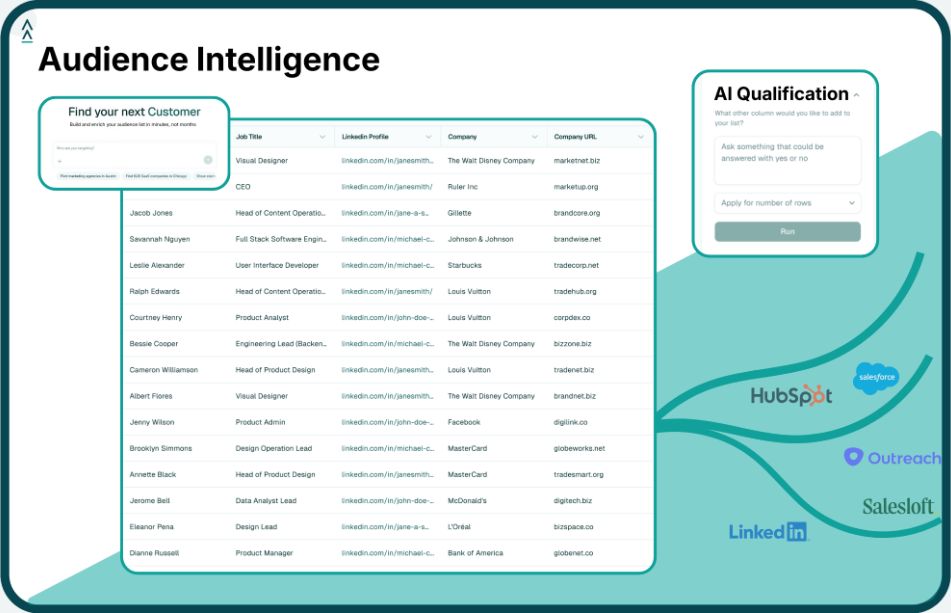
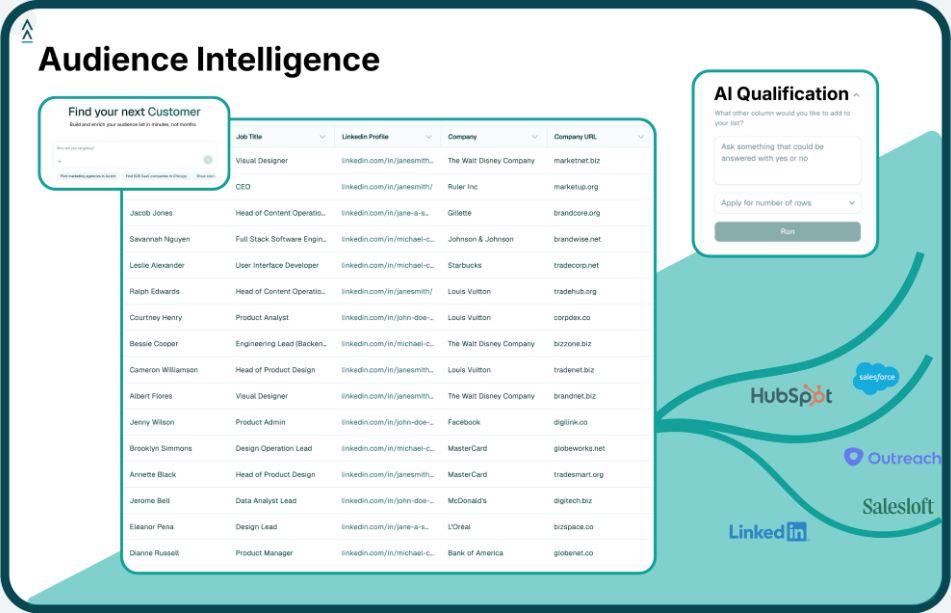
When it comes to AI-driven signal stacking and qualification, Landbase stands out as an innovator. Landbase is a B2B go-to-market platform that unifies data, AI reasoning, and automation to help teams instantly find and qualify their next customers. It’s powered by a proprietary AI model called GTM-2 Omni, described as “the first agentic AI model for GTM automation.” In practice, Landbase allows you to simply type a natural-language prompt describing your target (e.g. “Fintech companies in Europe hiring for data science”) and its AI will generate a comprehensive list of accounts and contacts – complete with multilayered signals and an AI qualification score – in seconds.
Here’s what makes Landbase’s approach to signal stacking & qualification so powerful:
- Massive, real-time data graph: Under the hood, Landbase has 210 million contacts across 24 million companies in its data platform. More impressively, it tracks 1,500+ unique signals per company – spanning firmographics (industry, size, revenue), technographics (tech stack, software usage), buyer intent (content engagement, third-party intent feeds), hiring trends (job postings, growth), financial events (funding rounds, M&A), and more. This “signal moat” means Landbase’s AI has a rich palette of data points to stack for any given query. No more 2–3 filter limit like old-school databases – you get a multi-dimensional view of each prospect.
- Agentic AI qualification: Landbase’s GTM-2 Omni AI doesn’t just pull a list; it actively evaluates fit and timing using those 1,500 signals in context. In other words, the AI performs a built-in qualification step – akin to an AI SDR doing research on each account. For example, it might prioritize companies that match your ICP and also show recent intent (like surging website visits or new budget signals). This agentic AI can even take actions autonomously (hence “agentic”), like recommending the best contacts or highlighting why a particular account is high-priority. The result is that every list comes “pre-qualified” with AI-driven scoring.
- Hybrid automation with human-in-the-loop: A unique Landbase capability is Offline AI Qualification. If the AI can’t fully qualify a prompt or needs extra vetting, Landbase’s data team steps in to manually enrich and verify the results (ensuring accuracy and compliance). This means enterprise users get an added layer of quality – the precision of human-verified data – on top of AI speed. It’s like having a research analyst double-check the AI’s work for hard-to-get signals or niche markets. Few other tools offer this safety net.
- Natural language interface & zero-friction UX: Landbase has embraced ease-of-use by eliminating the typical barriers. There’s no login or credits required for the core product – it’s a free, web-based AI audience builder. You simply go to their site and start typing your ideal customer description. The platform will instantly return a full list you can explore and download (up to 10,000 contacts per search). This is a radical departure from legacy sales intelligence tools that require lengthy contracts and training. Landbase’s philosophy is “prompt to pipeline in one step.”
- Dynamic, up-to-date data (no more static lists): Landbase employs “agentic web research” to continuously enrich its data. It also leverages feedback loops (each user prompt and outcome feeds back into model training) to constantly improve signal quality. This means the data you get is live. For example, if a target account’s technographic profile changes (they add a new software tool), Landbase’s system is designed to pick that up via AI web crawling. The company’s Applied AI Data Lab, led by experts (ex-ZoomInfo, Stanford PhDs), focuses on novel techniques like reinforcement learning on business outcomes to refine these signals. All this ensures that when you stack signals in Landbase, you’re stacking accurate signals – crucial given the aforementioned data decay rates.
- Full contact + account qualification: Many tools stop at the account level (telling you which company to go after). Landbase goes further by providing verified contact info for decision-makers and a “contact graph.” It essentially merges the best of an account intelligence platform with a contact database. According to their analysis, incumbent ICP tools like Clay or Kernel are account-only, whereas Landbase offers the full contact graph plus a qualification layer on top. This saves enormous time for sales – you get the names, emails, and LinkedIn profiles of actual people to reach out to, not just a target account list.
To illustrate Landbase’s effectiveness, one use-case example saw an outbound sales team feed Landbase-qualified leads into their sequence tool and achieve 40% higher reply rates than before. In another, Landbase identified that accounts with a combined signal of “rapid hiring in RevOps roles + recent Series B funding” tended to close 30% faster for a certain customer. These kinds of insights come from stacking seemingly disparate signals (hiring velocity + funding stage) to find what really correlates with sales outcomes – a task the AI handled automatically by analyzing win data.
Key Features of Landbase (Signal Stacking in Action):
- Natural-Language Audience Search: Describe your ICP in plain English and get an instant list of companies and contacts that match. E.g. “Healthcare startups in APAC raising Series A” -> Landbase returns all companies fitting that niche, with contextual filters applied (industry = healthcare, region = APAC, funding stage = A, etc.).
- Agentic AI Qualification: The AI not only finds prospects but qualifies them using Landbase’s 1,500 signals. It evaluates how well each prospect fits your criteria and how likely they are to be in-market now. Think of it as an AI SDR giving each lead a thumbs-up or down.
- Look-Alike Modeling: You can input a list of your best customers (or connect your CRM) and Landbase will discover look-alike accounts with similar signal profiles. This is fantastic for expanding into new accounts that behave like your successful ones (e.g. same tech stack usage, similar growth signals).
- TAM Mapping & Signal Density Analytics: Landbase can visualize your Total Addressable Market and signal coverage – showing, for instance, how many target accounts exist in a region and what percentage of them exhibit a given signal (like “hiring a CFO” or “using AWS”). This helps with go-to-market planning and identifying untapped segments.
- CRM Enrichment & Custom Signals: The platform isn’t just for prospecting; it can enrich your existing CRM data to reveal which signals correlate with wins or pipeline gaps. Enterprise clients can even work with Landbase’s team to create custom signals (for example, tracking a niche indicator specific to their domain). In essence, Landbase can act as an AI co-pilot to optimize your current funnel, not just fill the top of it.
It’s clear Landbase has architected signal stacking end-to-end – from data acquisition and AI interpretation to human validation and easy activation (downloadable lists or CRM integration). By subtly but authoritatively leading with Landbase, we see the bar it sets: real-time, AI-driven, and user-friendly.
If you want to experience it, Landbase offers a “try it yourself” approach on their website – no sales call needed. That democratization of data (turning what once took teams of analysts weeks to do, into a self-serve AI) is a major differentiator. For GTM leaders, it means faster iteration on targeting strategies and a much more agile sales/marketing motion.
Next, let’s compare other top tools in the signal stacking and qualification space, and see how they approach the problem differently.
ZoomInfo: Data Intelligence for Signal Stacking and Qualification
ZoomInfo is often considered the industry standard for B2B data, long known for its extensive contact database. In recent years, ZoomInfo has augmented its offering to support signal-based workflows through features like intent data and news alerts. For teams looking to stack signals, ZoomInfo provides a rich starting point — primarily through the sheer breadth of its data cloud and the integrations in its platform.
Key strengths of ZoomInfo for signal stacking & qualification:
- Enormous Database & Data Depth: ZoomInfo boasts a database of over 100 million company profiles and 150+ million professional contacts(6) (some sources cite 200M+ total profiles). This includes firmographic details (industry, size), org charts, direct dials, emails, and more, updated on a frequent basis. In fact, ZoomInfo claims to update records daily and to achieve ~95% accuracy in its contact data(6). (It’s worth noting that user experiences vary – independent tests found ZoomInfo’s verified contact rates could be closer to ~55–65% in certain segments like small businesses(7), reflecting the general challenges of data decay. Still, its scale is undeniable.)
- Integrated Intent Signals (“Scoops”): Recognizing the importance of buying signals, ZoomInfo offers what it calls Intent Signals and Scoops as part of its SalesOS product. Intent refers to third-party intent data – ZoomInfo tracks when companies are consuming content on specific topics (e.g. increased research on “CRM software”) and surfaces those as intent alerts to users(8). Scoops are essentially news insights: updates like leadership moves, funding announcements, or other notable events that might indicate a pain point or project. These are real-time alerts on potential buying triggers sourced from news, press releases, and other public data. ZoomInfo’s integration of intent and scoops means users can stack those signals on top of the static firmographic data – for example, filtering a target list to companies showing intent now or that have a recent executive hire relevant to your product. In short: ZoomInfo moved from being just a static database to also providing “what’s happening lately” signals. According to Demandbase’s analysis, ZoomInfo “features advanced tools like intent signals and buying scoops, alerting users to potential customers in real time.”(8)
- Web Visitor Tracking (1st Party Signals): Another signal source ZoomInfo offers is WebSights, which can identify anonymous visitors to your website and tell you which companies are browsing and what they looked at(8). This turns your own web traffic into actionable data – a highly valuable first-party intent signal. For example, if a company on your target list has multiple employees visiting your pricing page, WebSights will flag that so sales can pounce on that account. Stacking that with ZoomInfo’s contact info allows outreach to the likely buying committee at that account.
- Sales Workflow & AI Integration: ZoomInfo over the past couple of years acquired tools like Chorus (conversation intelligence) and RingLead, integrating them into an end-to-end platform (SalesOS and MarketingOS). From a qualification standpoint, this means ZoomInfo can play in multiple stages: it can score leads (through rules or machine learning) and even automate outreach via its Engage module. It has workflow automation that, for instance, can trigger an email sequence when a lead hits a certain score or intent signal(8). While not an AI lead generator per se, ZoomInfo’s platform uses AI mainly to enrich data and to power features like predictive scoring and recommendations inside their UI.
- Extensive Integrations and Ecosystem: ZoomInfo integrates with CRMs (Salesforce, HubSpot, etc.), enabling users to push updated data and signals directly into their systems. It also connects with sales engagement tools and marketing automation. This is important: even the best signals are wasted if they don’t reach your sellers in their flow of work. ZoomInfo ensures that, say, if an account surges on intent, that info can flow into a Salesforce field or trigger a rep task.
So how does ZoomInfo stack up (pun intended) in practical signal stacking? Imagine you’re prioritizing accounts for an outbound campaign: with ZoomInfo you might do something like filter for companies in your ICP that have an active intent signal on a relevant topic, and that had a recent “scoop” (like a new CTO or new funding). That list can then be scored or ranked by additional criteria (maybe technographic fit or size). All necessary data to do this is within ZoomInfo’s platform.
ZoomInfo’s impact is often reflected in improved sales metrics for its users. While specific results vary, one external stat from a case study notes that using intent data (like ZoomInfo’s) in sales can drive 93% higher conversion rates compared to approaches without those signals(2). And 6sense (a partner/competitor in ABM) reported that customers who leverage buying signals see up to 4X increase in win rates and a 20–40% reduction in time-to-close deals(12). These figures underscore why adding ZoomInfo’s type of signals (intent, scoops, etc.) to your sales process yields tangible lifts in efficiency and outcomes.
ZoomInfo Features for Signal Stacking & Qualification:
- Prospector Database: Massive, up-to-date repository of companies and contacts with detailed attributes (ideal for baseline targeting by firmographics or technographics)(6).
- Intent & Scoops: Real-time alerts when accounts are researching topics or have key events, enabling data-driven prioritization(8).
- WebSights Visitor ID: Turns website traffic into actionable signals by telling you which accounts visit (and how often), a powerful first-party intent indicator(8).
- Engage and Scoring: Built-in tools to automate outreach and rank leads. ZoomInfo can auto-enroll leads into email sequences or tasks when certain conditions (signals) are met, and provide predictive lead scores.
- Chorus Conversation Intelligence: While more for after qualification, it uses AI on sales calls and emails to gauge engagement signals from conversations – closing the loop on later-stage signals of deal health.
- Integrations & APIs: Makes it easy to inject these signals into your CRM or analytics. For example, many marketing teams feed ZoomInfo intent data into marketing automation to trigger account-based campaigns.
It’s worth noting that ZoomInfo’s data, while vast, is still mostly collected via web scraping, database partnerships, and user contributions – it is not as on-the-fly as something like Landbase’s agentic search. The data is refreshed frequently but is not truly real-time in the way an AI that scours the web on demand might be. Additionally, ZoomInfo’s cost can be prohibitive for some (annual contracts often start around five figures(6)), and smaller companies might not utilize its full breadth. Nonetheless, it remains a top choice for enterprises needing a robust data foundation with integrated signal capabilities.
In conclusion, ZoomInfo is a heavyweight tool for signal stacking thanks to its broad data and added intent/scoops features. Many organizations use ZoomInfo as a primary “data spine” in their sales stack. It’s especially strong for building big target lists, then narrowing them down with a couple of key signals (intent, etc.). For teams that can invest in it and pair it with good process, ZoomInfo can significantly boost pipeline.
Apollo: Combining Data and Engagement for Signal Stacking & Qualification
Apollo.io has rapidly risen as a popular alternative to legacy data platforms, particularly among startups and cost-conscious teams. Apollo is known for combining a large B2B contact database with built-in sales engagement tools (like email sequencing and dialing), effectively making it a one-stop-shop for prospecting. In the context of signal stacking and qualification, Apollo provides rich data signals (though somewhat less elaborate than ZoomInfo’s intent offerings) and leverages automation/AI within its platform to help prioritize and act on those signals.
Key aspects of Apollo for signal stacking:
- Vast Crowdsourced Database (“Living Data”): Apollo’s database includes over 250 million contacts at 60 million companies(9) – in the same big league as ZoomInfo in terms of scale. Apollo prides itself on a “Living Data Network” of 2M+ users that contribute updates and corrections, keeping information fresh(9). For example, every time a user finds a new email or notices a bounced contact, that insight feeds back into Apollo. This semi-crowdsourced model means data gets refreshed continuously. Apollo claims this results in highly up-to-date info (they often tout that their users collectively help validate data in real-time). From a signal standpoint, while Apollo doesn’t have proprietary intent feed products, the data itself is a signal goldmine – you can filter and combine dozens of criteria: industry, revenue, technologies used, hiring metrics, keywords in job titles or profiles, etc. It also offers “trigger” alerts like job changes: Apollo’s system can inform you when a contact in your saved list switches jobs (which is a great sales opportunity if that person was a champion at their old company). These job change alerts are effectively signals of potential buying windows (e.g. a new VP of Marketing might be reviewing tools). Apollo highlights these as a feature giving “real-time insights to stay ahead”(9).
- Embedded AI and Lead Scoring: Apollo has introduced AI in various ways. One is through an AI-powered search that can make finding prospects easier (autocomplete suggestions, semantic search). Another is lead scoring and prioritization: Apollo’s platform can automatically score leads based on your chosen criteria or past data. For instance, you might train it on what your best customers look like, and it will grade new prospects accordingly. While not as sophisticated as a custom ML model, it’s a practical way to qualify within the app. Apollo also recently added generative AI features (like email drafting), but for our purposes, the key is how it helps you focus on the right prospects via data-driven scoring.
- Sales Engagement with Signal Triggers: A big draw of Apollo is that once you have your target list (stacked with whatever signals/filters you chose), you can immediately engage them through Apollo’s sequences (email campaigns) and dialer. This closes the gap between qualification and action. Moreover, Apollo can automate actions based on signals – for example, if a contact opens an email or if a prospect account raises new funding (which Apollo tracks via public sources), it can move them to a different sequence or alert a rep. It’s not as deep on third-party signals as some platforms, but it shines in using signals internally: email engagement, link clicks, etc. become part of your overall lead qualification. You effectively get a feedback loop: contacts with high email open/reply rates get bubbled up by Apollo’s analytics as warmer leads (a signal of interest).
- Affordable and User-Friendly: While not a data “feature” per se, Apollo’s accessibility means more teams can leverage signal stacking. There’s a free tier and affordable paid plans (especially compared to ZoomInfo’s hefty price)(6). This has led to massive adoption (Apollo reports over 50,000 companies using it, with strong G2 reviews). For small businesses, Apollo might be their first foray into using data signals at scale, rather than doing manual LinkedIn research. The ease of pulling a list and hitting “sequence” cannot be overstated. It’s a gentle introduction to the power of combined signals: e.g., a startup can pull “SaaS companies with <50 employees that just raised seed funding and use Shopify” – all filters available in Apollo – then immediately start emailing the likely decision makers from that list.
Apollo’s growth itself is evidence of the demand for intelligent prospecting tools – they reached $150M ARR and 50k+ active users by 2025(13), and have consistently been rated a leader on G2 (in Summer 2025 they had 183 #1 rankings across categories)(13). From a results perspective, Apollo cites that users can access 5X more prospects than they would through traditional methods, thanks to the size of its database and search capabilities. Additionally, by using Apollo’s sequences and automated follow-ups, teams often report significant time savings – essentially allowing a single SDR to do the work of multiple. While exact figures vary, one could pair a general industry stat: AI lead tools (like Apollo) can save sales teams up to 30% of their time that would otherwise be spent on manual data entry and research(3).
Apollo Features at a Glance (for signal stacking & qual):
- Advanced Search & Filters: Find prospects by almost any criteria – firmographics (e.g. company size, funding raised, location), technographics (Apollo has data on what technologies companies use), job titles and seniority, keywords, etc. You can stack multiple filters easily to pinpoint leads.
- “Living” Data Updates: Receive alerts on changes like job moves, new funding rounds (Apollo integrates such news for accounts), or company press releases. These alerts act as trigger signals to reach out at just the right time.
- Enrichment and Data Export: Apollo can enrich records you upload (say you import a list of companies; it will fill in contacts and data). This means if you have your own signals (maybe from your product usage or elsewhere), you can merge them with Apollo’s data to qualify leads.
- Built-In Dialer & Email Sequences: Immediately act on qualified leads by calling or emailing through Apollo. Engagement metrics from these (calls, email opens/replies, etc.) feed back as signals of lead quality.
- CRM Integration: Syncs with Salesforce, HubSpot, etc., to push enriched data and activity. For example, if Apollo finds a new phone number for a lead or detects a funding event, that can update in CRM for your records.
- AI Assistance: Apollo has experimented with AI assistants – for example, helping write personalized intro emails using the data it knows about a contact. While tangential to stacking, it’s part of the AI convenience.
In essence, Apollo is the “all-in-one” kit for prospecting, making signal-driven tactics accessible. It may not have the ultra-sophisticated AI reasoning of Landbase or the proprietary intent network of a 6sense, but it covers the bases: lots of data, ways to filter it, and ways to act on it. Many teams use Apollo as a supplement or even replacement for ZoomInfo, trading perhaps some data depth for a much lower cost and added engagement functionality.
For signal stacking aficionados, Apollo’s sweet spot is when you want to combine a rich contact search with a quick campaign. It might not tell you “this account’s buying committee has been researching X heavily” (that’s where something like ZoomInfo or Bombora intent might complement), but it will let you, for instance, identify all accounts that meet your ICP and recently hired a new VP – a strong signal – and then blitz them with outreach immediately.
Clay: Workflow Automation for Custom Signal Stacking and Qualification
Clay takes a different approach than the large databases like ZoomInfo or Apollo. Rather than being a static repository of B2B contacts, Clay is a flexible platform that connects to many data sources and allows you to build custom workflows to gather and act on signals. It’s often described as a no-code automation tool for outbound prospecting – think of it as a Swiss Army knife that you configure for your needs. For teams that want granular control over signal stacking (especially using niche or multiple sources), Clay can be extremely powerful.
Why Clay matters for signal stacking:
- Multi-Source Data Enrichment: Clay can integrate with over 50 third-party data providers and APIs(10) to enrich your lead lists. This means you aren’t limited to one database – you can pull a list of companies from source A, get contacts from source B, append technographic data from source C, and intent data from source D, all inside Clay’s spreadsheet-like interface. For example, you could take a list of target companies and use Clay to fetch each company’s latest blog titles (via an RSS integration) to see who’s talking about certain topics – an unconventional signal you wouldn’t get in a normal database. Clay basically lets you stack signals your way. It provides integrations to common sources like LinkedIn, Crunchbase, Google Maps (for local business data), Clearbit, Hunter (email finder), and even custom ones like Reddit or RSS feeds(1). If a specific signal is important to you – say, “mentions on Reddit” or “number of job openings on LinkedIn” – chances are you can configure Clay to retrieve and incorporate it. This level of customization is unparalleled; Persana (a competitor) notes that Clay “connects to over 75 data enrichment tools”(11), making coverage very broad.
- Custom Signals & Monitoring: Clay has a concept literally called “Signals” in its platform, which are essentially triggers or monitors you set up for your data. For instance, you can tell Clay to monitor a list of contacts for any changes – if someone gets a promotion or changes jobs (when their LinkedIn title updates), Clay can flag that as a signal(1). You can monitor companies for events like fundraising (via news) or new job postings. This turns Clay into your personal “signal HQ” where the signals you care about continuously update. It’s like having a virtual assistant watch dozens of RSS feeds, APIs, and databases and update your spreadsheet whenever something changes. For qualification, this means you’re always working with the latest intel – a lead list in Clay isn’t static; it can evolve daily as signals roll in (e.g. a new column might tick “TRUE” if a target account announced a new round of funding today).
- No-Code Workflow and AI Assistance: Clay’s interface is akin to a spreadsheet/table. Users (even non-engineers) can drag-and-drop to create workflows: e.g. take a list of domain names -> use the “Find LinkedIn Employees” integration -> filter for titles containing “VP Sales” -> enrich those with an email finder -> verify the emails. In doing so, you’ve stacked signals (company -> employees -> specific role present -> contact info). Clay also offers an AI Formula Generator that helps create custom formulas or parse text using AI(1), and even an AI research agent to scour the web for you given a prompt(1). These AI features augment the manual workflow by adding some intelligence (for instance, using AI to classify a piece of text from a company description as a certain industry or to summarize a news article into a signal like “expanding to Europe”).
- Flexible Output and Integration: Clay is often used as a power-tool feeding into other tools. For example, you might use Clay to build a perfectly curated, signal-rich list of prospects, and then push that list into your CRM or outreach tool. Clay has webhooks, Zapier integrations, and direct integrations to things like HubSpot, Salesloft, Outreach, etc. This ensures your custom signals actually flow into the systems where sales reps work.
Think of Clay as your signal orchestration engine. It is especially favored by growth hackers and RevOps teams who want to go beyond the limits of any single vendor’s dataset. The downside is it requires some setup and tinkering – it’s more hands-on than the plug-and-play nature of Landbase or Apollo. However, the payoff is that you can achieve very “scary accurate” targeting and creative signal combos that others might miss. For example, a Clay user could build a workflow to find companies that “recently had a spike in app reviews on G2 AND whose VP of Marketing changed in the last 3 months” – a very specific stack of signals across disparate data sources.
While Clay’s impact is harder to summarize in one metric (since it’s so flexible), consider that by stacking signals, companies can drastically improve their outbound efficiency. Clay’s users have shared anecdotes like booking 3X more meetings by using multi-signal contact enrichment (versus a control list) or cutting research time by hours per day. One specific stat: a comparison noted Persana and Clay users can reduce cost per lead by over 50% by eliminating manual research time(11). And from Clay’s own content, companies that master signal orchestration (the kind Clay enables) see better leads that convert at higher rates and faster, creating real competitive advantages in outbound(1).
Clay Features for Signal Stacking & Qualification:
- Library of Integrations: Connect to dozens of data sources (Clearbit, ZoomInfo, Crunchbase, LinkedIn, Hunter, SalesNav, Google Places, Reddit, etc.) and bring data into one table(10).
- Custom Columns & Formulas: Define your own computed signals. For instance, create a column like “Hiring Velocity” that calculates the % growth in employees at a company (Clay could pull employee counts from LinkedIn over 6 months). Or use AI to tag whether a company description contains keywords related to your product.
- Automated Enrichment (“Waterfall”): If one source doesn’t have data, Clay can automatically fall back to another. This ensures maximum fill rates. (E.g. try enrichment via Source A, if blank, use Source B). This approach was shown in comparisons to give more consistent accuracy across segments(7).
- Signal Monitoring: Set up ongoing monitors for changes (new funding, job changes, news mentions, etc.). Clay can regularly re-run these and highlight changes, effectively keeping your lead list qualified over time, not just at creation(1).
- Collaboration and Templates: Clay offers templates and “Claybooks” for common recipes (like finding lookalike companies, or building an ICP list with multi-source checks). It also has enterprise features for teams to collaborate on prospecting projects, which is useful for RevOps planning large campaigns with complex targeting.
In summary, Clay is like the custom workshop for signal stacking – if you have the time and creativity, you can craft extremely targeted, high-quality prospect lists and keep them fresh. It’s a different paradigm than a monolithic database; it’s more of a toolkit. Many advanced teams actually use Clay alongside data providers: for example, exporting data from ZoomInfo or Apollo into Clay to do additional signal enrichment and filtering that those platforms can’t.
For organizations that have unique signals they care about (say, specific tech stacks, specific events, or combining internal product usage data with external data), Clay is invaluable. It basically lets you build your own AI-driven qualification engine. You’ll supply the strategy (what signals to use), and Clay supplies the pipes and glue to put it all together.
Driving GTM Success with Signal Stacking and AI Qualification
The world of B2B sales and marketing has shifted – it’s no longer enough to rely on static lead lists or single-threaded scoring. Signal stacking and signal qualification, powered by AI, have become essential for revenue teams that want to stay ahead of the competition. By intelligently combining diverse signals, companies can zero in on the right prospects at the right time with unprecedented precision. We’ve seen that across the spectrum of tools:
- Landbase demonstrates how a unified, AI-first approach can turn a simple query into a hyper-qualified lead list within seconds, leveraging an expansive signal graph for instant insight.
- ZoomInfo shows the power of augmenting a big data engine with intent and trigger alerts – arming sales with both volume and relevance.
- Apollo proves that you can lower the barrier to entry, making rich data and basic AI scoring available to all, and integrating the whole outreach process for efficiency.
- Clay exemplifies the value of flexibility – letting companies craft and tune their own signal cocktails to find niche opportunities that others overlook.
- Other tools like Persana, 6sense, and more illustrate that whether it’s real-time sales triggers or holistic account intelligence, there’s a solution tailored to every need.
One thing is abundantly clear: teams that invest in signal-based strategies are outperforming those that don’t.They’re connecting with buyers who are actually in market, reducing wasted effort on cold or unready leads, and personalizing their outreach based on what truly matters to each prospect. The statistics we highlighted bear this out – from double-digit improvements in conversion and cycle time to multi-fold increases in win rates and pipeline velocity(3). In practical terms, that means more revenue with less guesswork.
References
- clay.com
- landbase.com
- superagi.com
- cognism.com
- leadsatscale.com
- sayprimer.com
- surfe.com
- demandbase.com
- zapmail.ai
- coldiq.com
- persana.ai
- 6sense.com
- apollo.io
.png)
.png)