.png)
.png)

Daniel Saks
Chief Executive Officer


.png)

Many B2B startups hit a wall after their Series A when their initial Total Addressable Market (TAM) approach stops delivering results. Early on, it’s common to pull a static list of target accounts or rely on basic firmographic filters (industry, size, location) to define your market. But as your go-to-market engine revs up, these static TAM definitions quickly show their cracks. Fast-growing sales teams outgrow one-time TAM lists – they find that the “ideal” accounts identified a year ago are either exhausted or weren’t truly ideal to begin with. The reality is that markets are dynamic. Companies hire, change tech stacks, get funded, and enter buying cycles, causing your TAM to shift under your feet. In short, a TAM that lived in last year’s pitch deck won’t cut it for an agile post-Series A team. What’s needed is a more dynamic, signal-rich process to continuously discover and qualify the right accounts.
After a Series A funding round, companies often scale headcount and revenue goals quickly – but their TAM definition remains stuck in the past. This mismatch creates several problems for RevOps and SDR teams:
In today’s B2B sales environment, static TAM models built on historical assumptions simply can’t keep pace with shifting demand and buyer behavior. Post-Series A teams need to shift from a static mindset (“here’s our list of 1000 target accounts, now go get them”) to a dynamic one (“let’s continually discover and qualify new target accounts as they emerge”). In the next sections, we’ll explore how to do exactly that.
Revisiting your Ideal Customer Profile (ICP) is the first step to evolve your TAM. In a high-growth phase, it’s crucial to redefine what an “ideal” account looks like using signals, not just firmographics. While firmographic criteria like industry, geography, and company size outline the broad strokes of your ICP, they are static by nature. To really zero in on the accounts most likely to buy, incorporate dynamic signals that indicate an account’s current context and readiness.
What are signals? Signals are observable triggers or attributes that suggest a company has a need or intent related to your product. They can be drawn from many data sources. For example:
By weaving these signals into your ICP definition, you move from an abstract ideal customer profile to a contextual, evidence-based profile. Instead of saying “we target Series B fintech companies with 50-500 employees,” you might refine that to “Series B fintech companies that are hiring data engineers and recently adopted a new analytics tool.” Those additional qualifiers act as proof points that the account has a problem you can solve now. In fact, modern sales teams are shifting to this approach – moving beyond theoretical TAM sizing to signal-based market sizing, which asks “where is real demand emerging right now?”. This ensures your TAM isn’t just a big number, but a reflection of live market interest.
It’s wise to revisit and refine your ICP every quarter or so, adding any new signals you’ve learned to predict success. For example, if you close several deals and notice they all shared a common trait (like they all started using XYZ software or hired a new CRO), feed that signal back into your ICP criteria. The goal is a feedback loop: as you learn which signals correlate with good sales outcomes, your ICP evolves to reflect them. This keeps your TAM definition aligned with reality. As one study showed, deals influenced by intent signals tend to be significantly larger than those without – so the more your ICP keys off real buyer intent, the bigger the payoff.
With a signal-enriched ICP in hand, the next step is finding accounts that match it – and doing so continuously. This is where we depart from the old method of exporting a static account list from a database and instead embrace dynamic TAM discovery. Think of it as moving from a snapshot to a live feed of your addressable market.
Traditionally, finding accounts meant using tools like LinkedIn Sales Navigator or a B2B contact database with filter criteria. You’d get a list of companies that meet the firmographic filters, then perhaps manually cross-reference a few data points (e.g. check Crunchbase for funding news, check LinkedIn for headcount growth). This manual process is time-consuming and often one-dimensional. Dynamic TAM search leverages automation and AI to do this heavy lifting across multiple datasets at once – and to keep doing it over time.
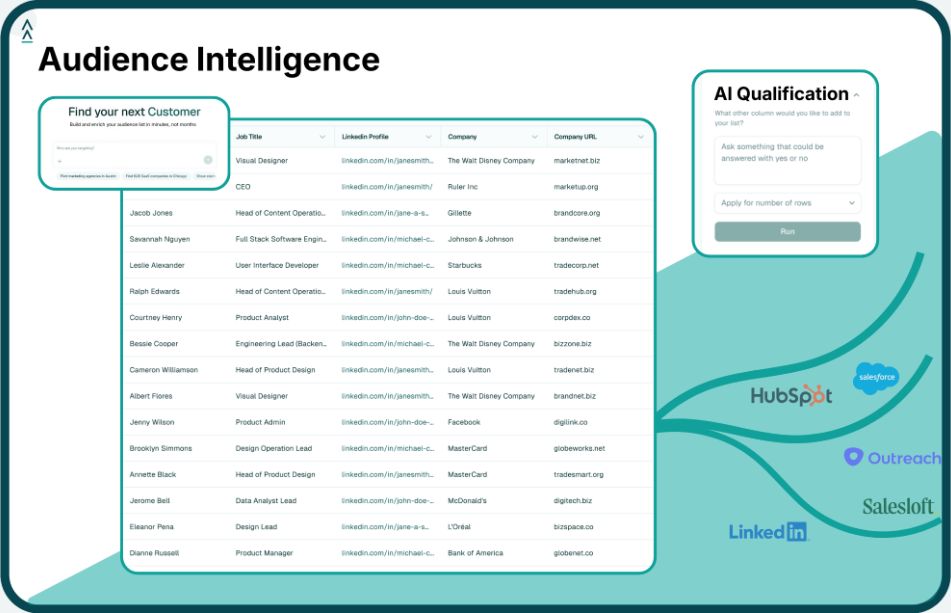
Natural language “agentic” search: One breakthrough is the ability to simply describe the kind of accounts you want, and have an AI agent figure out the rest. For example, imagine typing into a search bar: “Fintech startups in California that are hiring sales roles and recently raised Series B.” Advanced prospecting platforms can interpret that natural-language prompt and translate it into complex queries across various data sources. In the background, the system might query a companies database for fintech industry + California, filter those by a funding database for Series B in the last 1-2 years, and cross-check a job postings feed for recent sales job openings at those companies. The result: you get a list of accounts that match a rich, multi-faceted description, without manually stitching together five different searches. Landbase calls this agentic search – essentially an AI-powered audience builder that joins multiple data sources in real time to find accounts fitting your description.
Crucially, this approach doesn’t rely on a single static database. It “listens” to live data signals. If a new startup secures funding tomorrow and meets your criteria, it can appear in your results immediately. If a company stops matching (e.g. they pivot out of your target category or their hiring slows), they can be de-prioritized. In other words, your TAM becomes a living list that updates continuously, rather than a static spreadsheet aging in someone’s inbox.
Continuous discovery vs. one-time list: Embracing dynamic search means treating TAM sourcing as an ongoing process. RevOps can schedule periodic refreshes or even real-time alerts for new companies that fit the ICP signals. For instance, you might set up a weekly job to fetch any net-new accounts that match your ICP (e.g. new entrants or newly qualified companies) and add them to a “TAM pipeline” for SDRs to research. Instead of doing a big TAM exercise once a year, you’re always adding fresh targets and retiring duds. This is especially valuable after Series A when your company is entering new segments or rapidly scaling – your TAM isn’t static, so your search shouldn’t be either.
Modern platforms also help solve the “static filter” problem. As mentioned, simple filters can miss context or timely intel. By contrast, an agentic search can incorporate nuanced conditions and even unstructured signals. For example, it could search news sources for companies “evaluating CRM software” or use a model to infer which startups are likely to expand hiring soon. This multi-dataset reasoning goes beyond what any single traditional sales database offers. The end benefit is better coverage of the real market. You’re less likely to overlook an up-and-coming account just because it didn’t fit some rigid filter at the time of your last export. In fact, one of the reasons filters and old-school static databases fail is their inability to capture accounts that should be targets but aren’t obvious until multiple data points are connected.
By investing in dynamic TAM discovery – whether via an in-house data ops effort or a platform like Landbase – you ensure that your target account universe is always up to date and in tune with current market signals. This positions your SDR and marketing teams to strike when the iron is hot, reaching out to accounts that are not only a fit on paper but also exhibiting behaviors that suggest openness to a conversation.
Identifying a dynamic, signal-rich list of target accounts is half the battle. The next challenge is turning that list into a focused set of qualified accounts that your sales development reps will actually work. Without qualification and prioritization, even a great TAM list can overwhelm your team – or lead them to waste time on accounts that looked good in theory but aren’t in practice. This is where AI-assisted qualification and scoring come in as the bridge from TAM discovery to actionable outreach.
Automated qualification checks: In the past, sales/research analysts would comb through account lists to clean them up – removing duplicates, weeding out businesses that don’t truly fit, or enriching missing data. Today, AI can automate much of this list hygiene and qualification. For example, given your defined ICP criteria, an AI agent can cross-verify each account on your TAM list: Does it have the minimum employee count? Is it really in the target industry (e.g. checking if a “fintech” label is accurate)? Is the HQ location correct? If data is incomplete or ambiguous, the AI can fetch updates from live sources – say, pulling the latest headcount from LinkedIn or confirming via the company website if they still offer X service. This online qualification step ensures that by the time an account reaches your SDRs, it actually meets your required profile. In short, qualification decides whether a record belongs on your list, whereas enrichment just adds data to a record you already have. It’s important to do qualification first, or you risk spending effort enriching accounts that shouldn’t have been targeted to begin with.
Noise reduction: A big benefit of AI-based qualification is the removal of “noise” – those borderline or bad-fit accounts that slip into static lists. Perhaps an account technically matched your filter but, upon closer look, isn’t relevant (e.g. a subsidiary or reseller rather than an end-customer, or a company outside your region that was mis-tagged). The AI can flag and drop these. The outcome is a cleaner, tighter TAM list. Landbase’s system, for instance, only passes through contacts and companies that meet your stated criteria, so your team spends time on real opportunities instead of manual list cleanup. This is invaluable for an SDR team with finite bandwidth.
Contextual scoring and prioritization: Qualification ensures everything on the list is a fit, but it doesn’t tell you where to start. That’s where scoring comes in. Scoring means assigning a priority value to each account based on fit and signals – essentially predicting which accounts are most likely to convert. A simple scoring model might, for example, add points if the account has a recent funding, if it’s in your top-tier industry, if it’s showing intent (visiting your site or clicking your emails), etc. More advanced AI models can weigh dozens of factors and even learn from past deal outcomes to rank your TAM. The key idea is to incorporate signal strength into how you order the accounts. Not all signals are created equal; you might weight a direct buying signal (e.g. “requested a demo”) much higher than an indirect one (e.g. “hiring a role related to our product”). By doing this, your “TAM list” effectively becomes a queue, with the hottest, best-fit accounts at the top.
In practice, a contextual scoring approach might produce tiers or a numeric score for each account. For example: Accounts scoring 85/100 and above are Tier 1 (work these first, personalize outreach, perhaps send to Account Execs for immediate action if enterprise-level). Tier 2 are promising but need nurturing, and so on. RevOps should collaborate with Sales leadership to define what constitutes a high score in a way that aligns with win rates and capacity. Often it’s a blend of fit (does this company match our ICP well?) and timing (are they exhibiting buying signals now?). The beauty of involving AI here is that it can consider many data points in context – hence contextual scoring. For instance, an account using your competitor’s software might be a good fit generally, but if there’s also a signal they just renewed that contract last month, the timing might be off (so the score adjusts down despite the good fit). Conversely, a slightly smaller company might ordinarily score lower on fit, but if they have 3 strong intent signals, the model might bump them up as a hot prospect. This kind of nuance is hard to capture with static rules alone, but AI algorithms excel at it.
From TAM to action: Once you have a qualified, scored list of accounts, you’ve essentially turned your TAM into a target audience ready for outreach. Many teams like to feed these accounts directly into engagement sequences or an account-based marketing program. At this stage, it’s smart to also provide context to the reps – i.e. why each account is on the list. If you’re using a platform that qualifies and scores accounts, it can often also surface the key signals or criteria that landed that account on the target list (e.g. “Company ABC – qualified because: recently raised $10M, hiring 5 engineers, using Kubernetes – Score 92”). This equips SDRs to tailor their messaging (“Congrats on the funding… noticed you’re building out your data team, which often leads to scaling challenges in X…”). It also helps build trust in the process: reps know these accounts weren’t randomly pulled, but have real evidence behind them.
Finally, don’t forget to close the feedback loop. As your team works through the qualified accounts, note which ones convert to pipeline or respond positively. Those results can refine both your scoring model and your ICP signals over time (maybe you discover a new signal that’s predictive, or one you weighted highly isn’t actually panning out). A dynamic TAM process is iterative by nature.
In summary, transitioning from TAM discovery to qualified accounts is about evolving your approach from static and simplistic to dynamic and intelligent. For RevOps managers and SDR-led teams at growing B2B companies, this evolution can be transformational. Instead of your sales team hammering away at a static list of accounts that looked good last year, they’ll be engaging a curated, up-to-date audience of companies that fit your ICP and are showing signs of real interest or need. The outcome is a higher conversion rate at each stage – more replies, more meetings, and ultimately more pipeline from the same effort, because you’re focusing on the right accounts at the right time.
Implementing a dynamic, signal-driven TAM process is very achievable with today’s technology. In fact, new platforms are purpose-built for this shift. For example, Landbase’s approach illustrates the pieces we discussed: it uses an agentic AI engine to search across datasets and find accounts based on nuanced signals, then applies multi-dataset reasoning and contextual scoring to qualify and rank those accounts for you. The result is a constantly refreshed list of activation-ready accounts your team can immediately put into play. This isn’t about buying into hype or fancy software for its own sake, but about arming your go-to-market teams with better intelligence. Whether you automate with AI or begin manually incorporating signal data, the principle stands: TAM sourcing should be a dynamic, ongoing process woven into your RevOps strategy, not a static exercise you do once and forget.
Tool and strategies modern teams need to help their companies grow.